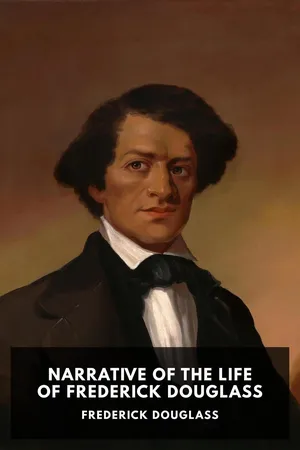
The Narrative of the Life of Frederick Douglass was written in 1845, seven years after Douglass escaped slavery, and is the first of three autobiographies. It covers his life as a slave, enduring the whips of the overseers and the hopelessness of his circumstances, until his escape to the north and arrival at New Bedford, Massachusetts. The brutalities he witnessed and his slowly growing desire for freedom are presented in the vivid language he was already known for in his antislavery oration.
The eloquence of Douglass's speeches caused some skeptics to doubt his credibility, believing that a former slave with no education could never speak so well. Thus, part of his motivation for writing the book was to dispel this suspicion and to provide a fuller history than was possible in his lectures. The abolitionists William Lloyd Garrison and Wendell Phillips provided introductions vouching for the truth of Douglass's words.
The book was an immediate best seller. The fame brought danger to Douglass, who sailed for England shortly after the book's publication to ensure he would not be apprehended as a fugitive slave. He spent two years touring and lecturing in Great Britain and Ireland before returning to America to continue his abolitionist work. English supporters raised funds to purchase his freedom from his former master.
The slave narrative is an autobiographical genre written by escaped slaves concerning their lives in bondage. Slave narratives not only promoted abolitionism by giving first hand evidence of the cruelty and hypocrisy of slaveholders, but also allowed African Americans to express themselves as intelligent, articulate individuals, deserving of respect and freedom. Douglass's Narrative is perhaps the most important example of the genre, on the basis of its literary merits and its impact on the abolitionist movement.
A cornerstone of American literature and a searing firsthand account of slavery's horrors, this brief but powerful memoir remains as urgent and moving today as when it first stunned readers in 1845. In his own eloquent words, Frederick Douglass transforms personal suffering into a profound testament to human dignity and the unbreakable will to be free.
The source for this public-domain ebook is Standard Ebooks (standardebooks.org). Ebooks from other sources often have typos, inconsistent spelling, missing accent marks, and missing punctuation. Ebooks from Standard Ebooks are proofread line by line against a scan of the original printed pages, then proofread again from cover to cover. They are also formatted and typeset following a professional-grade style manual, resulting in new editions supporting state-of-the-art ereader technology: automatic hyphenation, popup footnotes, complete and consistent metadata, high-resolution and scalable vector graphics, and ereader-compatible tables of contents. All of this makes the finished ebooks accurate, functional, and