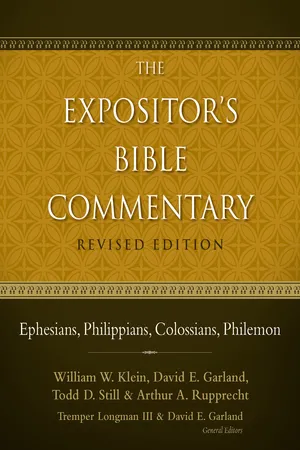
Continuing a Gold Medallion Award-winning legacy, this completely revised edition of The Expositor’s Bible Commentary series puts world-class biblical scholarship in your hands. Based on the original twelve-volume set that has become a staple in college and seminary libraries and pastors’ studies worldwide, this new thirteen-volume edition marshals the most current evangelical scholarship and resources. The thoroughly revised features consist of: • Comprehensive introductions • Short and precise bibliographies • Detailed outlines • Insightful expositions of passages and verses • Overviews of sections of Scripture to illuminate the big picture • Occasional reflections to give more detail on important issues • Notes on textual questions and special problems, placed close to the texts in question • Transliterations and translations of Hebrew and Greek words, enabling readers to understand even the more technical notes • A balanced and respectful approach toward marked differences of opinion
1Paul, an apostle of Christ Jesus by the will of God,
To the saints in Ephesus, the faithful in Christ Jesus:
2Grace and peace to you from God our Father and the Lord Jesus Christ.
COMMENTARY
1a The letter begins in the conventional manner for Hellenistic letters. Paul identifies himself as the author and then appends a further marker of his role—apostle. Though Jesus initially appointed twelve as apostles in the technical sense (Lk 6:13; Mk 3:14), the NT writers use the term more broadly to speak of others whom Christ has “sent out.” This conforms to the etymological sense of the Greek word apostolos (GK 693), “sent one” (e.g., Ac 14:4, 14, where Barnabas is called an apostle; Ro 16:7; 1Th 2:6; cf. Jesus himself as apostle in Heb 3:1), or merely a representative or messenger (2Co 8:23; Php 2:25). Though debated, the meaning of the term apostolos as used in the NT probably derives from the Semitic word šālîaḥ, a proxy or an agent of the one who commissioned him or her. Paul consistently claimed that Jesus commissioned him as an apostle to spread his gospel, especially to the Gentiles (Ro 1:5; 11:13; cf. Ac 9:15; 22:15; 26:17–18). From Paul’s special wording (Ro 1:1, 5; 1Co 15:7–9), and especially his repeated grounding of his appointment in the will of God (1Co 1:1; 2Co 1:1; Col 1:1; 2Ti 1:1), it seems that he considered himself one of the “technical” apostles whom Jesus personally appointed to his role. Whereas in the LXX an “apostle” merely performed a function, in the NT we find the development of what we can call an “office.” Therefore, there are apostles, prophets, and those called to other offices (Eph 2:20; 4:11). Paul owes his position to a divine commission, not his own merit or decision. He is Christ’s representative or ambassador.
1b Paul writes his letter to the saints, or holy ones. The term hagioi (GK 41) has a rich OT background: items, people, practices, and the nation were called “holy” or unholy. Yahweh himself was the “Holy One of Israel.” Holy items are separated to God for his uses and separated from mundane or profane uses. Here Paul clearly specifies Christian believers, namely, his readers. “Saints,” or “holy ones,” parallels other titles that describe who Christians are—the called, the faithful, and the elect. “Holy” does not have an ethical component here; it simply tells who they are, namely, God’s people.
Paul describes the readers in two additional ways: “the faithful” and “in Christ Jesus.” The first could be translated as “those who believe”—which surely defines their status—or as “the faithful ones.” Most likely Paul intends the former. These “holy ones who believe” find their identity “in Christ Jesus.” As one of Paul’s favorite expressions and especially prominent in this letter, “in Christ” expresses the believers’ corporate solidarity in and with Christ. It can have either local (place) or instrumental (means) senses. “Christ,” of course, is the Greek translation of the Hebrew “Messiah” (māšîaḥ, GK 5431), meaning “the anointed one.” In the Hellenistic world, this meaning of “Messiah” would be unclear, and the Hebrew title eventually became equivalent to a name. It seems doubtful that Paul makes a point here of stressing Jesus’ messiahship to his largely Gentile audience.
What about the location specified in the phrase “in Ephesus”? The vast majority of manuscripts read “to the saints who are in Ephesus and faithful.” However, several very early (including 𝔓46, the earliest copy of Ephesians we possess) and very important manuscripts lack the words “in Ephesus,” making it highly improbable that this location was present in the original copy of Paul’s letter. This omission is congruent with the impersonal nature of the letter, given our conclusion that Paul wrote it. However, the omission of the words “in Ephesus” results in an awkward translation (“to the saints who are also believers”) and suggests to some scholars that there was originally a blank space where Tychicus would insert the names of the various cities when he read the letter aloud to them. This suggestion, though ingenious, has found no precedent, no ancient evidence to support it, and little defense by scholars today. So this has led a very few scholars to defend the position that “in Ephesus” was present in the original manuscript of the letter. I decline this option in view of the strong external witnesses that omit them. We must simply live with the somewhat awkward wording in the Greek and consider it the solution with the fewest difficulties.
2 As is his custom (e.g., Ro 1:7; 1Co 1:3; 2Co 1:2; Php 1:2; 2Th 1:2; Phm 3), Paul substitutes in his salutation the rich terms “grace and peace” for the standard Greek “Greetings” (cf. Ac 15:23; 23:26; Jas 1:1). Using full titles, Paul identifies the dual source of these benefits: “God our Father and the Lord Jesus Christ” (or the Lord Jesus the Messiah). In addition to identifying Jesus as the Christ, Paul specifies that Jesus is “Lord.” The LXX replaced the name Yahweh with the title “Lord” (kyrios, GK 3261). Paul has applied that divine title to Jesus, showing that he is the exalted and transcendent one, the one to whom Christians now owe their devotion and worship. On thirteen occasions in his writings, Paul juxtaposes grace and peace as coming from God the Father. Grace (charis, GK 5921) denotes undeserved divine favor that results in salvation, above all (2:5, 8). Peace, from the Hebrew šālôm (GK 8934), denotes completeness, soundness, well-being, and security. Christians uniquely enjoy God’s grace and the peace that being in relationship with Christ brings.
NOTES
1 In addition to 𝔓46, other manuscripts that omit this phrase include
* (original of Aleph), B*, 424c, 1739, plus early writers Basil, Origen, probably Marcion, and Tertullian. One vigorous defense of including “in Ephesus” occurs in Hoehner, 144–48.
II. THEOLOGICAL EXPOSITION: THE BENEFITS OF BELONGING TO THE BODY OF CHRIST (1:3–3:21)
A. Doxology: Praise to the Triune God for the Spiritual Blessings That Accompany Salvation and That Those “in Christ” Enjoy (1:3–14)
OVERVIEW
This section forms one complete sentence in Greek, although current versions break it up into smaller units in keeping with modern standards of writing and the aims of the translators: NRSV, seven sentences; NASB, six; NIV, eight; and NLT, fifteen. Paul begins his letter not with his usual thanksgiving section, where he typically thanks God for what he has done in the lives of the readers, but with an exalted praise to God giving the reasons why God deserves such worship. These blessings accrue to those “in Christ,” a phrase repeated in various forms throughout the section as the arena and means of God’s praiseworthy acts. Stylistically, the section is liturgical, almost hymnic, with its many dependent clauses and prepositional phrases. Paul repeats the phrase “to the praise of his glory” as though it were a refrain and employs various synonyms to emphasize key concepts—knowledge, power, and God’s will.
1. The Father’s Election and Predestination (1:3–6)
3Praise be to the God and Father of our Lord Jesus Christ, who has blessed us in the heavenly realms with every spiritual blessing in Christ. 4For he chose us in him before the creation of the world to be holy and blameless in his sight. In love 5he predestined us to be adopted as his sons through Jesus Christ, in accordance with his pleasure and will—6to the praise of his glorious grace, which he has freely given us in the One he loves.
COMMENTARY
3 The doxology begins with eulogētos (GK 2329), a word best translated as “blessed be” or “praise be,” which corresponds to a Jewish berakah—an extended blessing frequent in the OT and in Jewish prayers. Paul also employs this tactic in 2 Corinthians 1:3–4 (cf. Ro 1:25; 9:5; 2Co 11:31 for his other uses of the Greek term). The one to be praised is both God and the Father of our Lord Jesus Christ. The designation “Father” became a Christian way of understanding God after Jesus called God “Abba.” Neither “God” nor “Father” identifies his name: “God” expresses deity, and “Father” specifies his role in relation to Jesus. Again, this Jesus Christ is “Lord.” Paul adds the reason why God is to be blessed: he has “blessed” (from eulogeō) Christians with “blessings” (from eulogia), a Semitic pleonasm (redundancy). The verb “blessed” and the noun “blessing” are cognate to the first verb, translated “praise be.” “Blessings” are the benefits God has bestowed on his people. Paul adds both the location of those blessings and their extent.
The location of those blessings is truly unexpected: he has blessed believers “in the heavenly realms.” Paul uses this spatial expression here and at 1:20; 2:6; 3:10; 6:12. In the first three texts, believers enjoy a position in the heavenly realms with God or Christ; in the other two, rulers, authorities, and evil spiritual forces reside in the heavenly realms. Is this a literal location or a metaphor for some reality? While evil forces may well be said to inhabit some literal heavenly realms, and though Christ is literally in heaven somewhere, this can hardly be true for believers now in the same literal sense. So rather than presenting some arcane cosmology or topography of the heavenly spheres, Paul’s reference is more likely soteriological and eschatological. Though believers are not yet literally resurrected and seated with Christ (1:20; 2:6), the spiritual transaction that will eventuate in these realities has occurred. Through what Christ accomplished in his resurrection and exaltation, the “age to come” has overlapped the present so that those “in Christ” in this age experience the spiritual benefits that will be consummated in the next age. And because believers are still in “this age,” they continue to contend with their and God’s enemies until the end. I referred to this earlier as “realized” eschatology.
God’s blessings are boundless. Paul says God has spared nothing when it comes to blessing his people spiritually. The key lies in the addition of “in Christ.” They lack nothing in the spiritual realm because they are in him. The preposition “in” may also have an instrumental sense—the blessings come through Christ, and this certainly is true. The rest of the letter will show, however, that the locative sense of inclusion in Christ is the dominant sense. Lincoln, 22, puts it succinctly: “Believers experience the blessings of the heavenly realms not only through Christ’s agency but also because they are incorporated into the exalted Christ as their representative, who is himself in the heavenly realms.” Paul will unpack the implications of this corporate solidarity in more detail as he proceeds.
4 Paul starts with the conjunction kathōs, which means “even as” (NIV, “for”), probably expressing some causal sense. We know that God has blessed us in Christ because he chose us in him and accomplished all the following actions. Paul uses the common word eklegomai (GK 1721), which means to pick out, select, or choose something or someone (cf. BDAG, 305). Of course, it has deep theological meaning in both Testaments, growing out of God’s selection of Israel as his covenantal people: “But you, O Israel, my servant, Jacob, whom I have chosen, you descendants of Abraham my friend, I took you from the ends of the earth, from its farthest corners I called you. I said, ‘You are my servant’; I have chosen you and have not rejected you” (Isa 41:8–9, emphasis added). As with God’s choice of the nation Israel, Paul expresses believers’ election in corporate terms: God chose us in Christ. Or to put it another way, Christ is the elect one in whom the church is included. Paul does not teach that our “souls” preexisted in the heavens with Christ (a Platonic idea), nor that we as individuals were present physically in some mythological sense prior to creation (as in later Gnostic teaching). Rather, as Schnackenburg, 53, puts it, “If God made his plan of salvation in (the preexistent) Christ, he also included us ‘in Christ’ in his plan.”
In keeping with the dominant theme of unity of Jews and Gentiles in the church, Paul sees the entire bod...
Table of contents
Cover
Title Page
Copyright Page
Contents
Contributors
Preface
Abbreviations
Ephesians
Introduction
I. INTRODUCTION AND GREETINGS (1:1–2)
II. THEOLOGICAL EXPOSITION: THE BENEFITS OF BELONGING TO THE BODY OF CHRIST (1:3–3:21)
III. ETHICAL EXHORTATIONS: THE SPIRITUAL RESPONSIBILITIES OF LIFE IN THE BODY OF CHRIST (4:1–6:20)
IV. CONCLUSION (6:21–24)
Philippians
Introduction
I. LETTER OPENING (1:1–11)
II. THE MEANING OF PAUL’S IMPRISONMENT (1:12–26)
III. LETTER THESIS: APPEAL TO UNITY AND COURAGE IN THE FACE OF EXTERNAL FOES (1:27–30)
IV. APPEAL TO HUMILITY AND OBEDIENCE AND THE EXAMPLE OF CHRIST (2:1–18)
V. THE EXEMPLARY SERVICE OF TIMOTHY AND EPAPHRODITUS (2:19–30)
VI. POSITIVE AND NEGATIVE EXAMPLES OF HUMILITY AND BOASTING (3:1–4:3)
VII. LETTER CLOSING (4:4–23)
Colossians
Introduction
I. ADDRESS AND GREETING (1:1–2)
II. THANKSGIVING (1:3–8)
III. PRAYER REPORT (1:9–14)
IV. A POETIC REFLECTION ON THE ALL-ENCOMPASSING CHRIST AND ITS APPLICATION TO THE COLOSSIANS (1:15–23)
V. PAUL’S MINISTRY FOR THE (GENTILE AND COLOSSIAN) CHURCH (1:24–2:5)
VI. ON LIVING IN CHRIST AND AVOIDING CAPTIVITY THROUGH “PHILOSOPHY” (2:6–3:4)
VII. INSTRUCTIONS FOR CHRISTIAN LIVING (3:5–4:6)
VIII. LETTER CLOSING (4:7–18)
Philemon
Introduction
I. SALUTATION (1–3)
II. THANKSGIVING AND PRAYER (4–7)
III. PLEA FOR ONESIMUS (8–22)
IV. GREETINGS AND BENEDICTION (23–25)
Trusted by 375,005 students
Access to over 1.5 million titles for a fair monthly price.
Study more efficiently using our study tools.
Frequently asked questions
Yes, you can cancel anytime from the Subscription tab in your account settings on the Perlego website. Your subscription will stay active until the end of your current billing period. Learn how to cancel your subscription
No, books cannot be downloaded as external files, such as PDFs, for use outside of Perlego. However, you can download books within the Perlego app for offline reading on mobile or tablet. Learn how to download books offline
Perlego offers two plans: Essential and Complete
Essential is ideal for learners and professionals who enjoy exploring a wide range of subjects. Access the Essential Library with 800,000+ trusted titles and best-sellers across business, personal growth, and the humanities. Includes unlimited reading time and Standard Read Aloud voice.
Complete: Perfect for advanced learners and researchers needing full, unrestricted access. Unlock 1.5M+ books across hundreds of subjects, including academic and specialized titles. The Complete Plan also includes advanced features like Premium Read Aloud and Research Assistant.
Both plans are available with monthly, semester, or annual billing cycles.
We are an online textbook subscription service, where you can get access to an entire online library for less than the price of a single book per month. With over 1.5 million books across 990+ topics, we’ve got you covered! Learn about our mission
Look out for the read-aloud symbol on your next book to see if you can listen to it. The read-aloud tool reads text aloud for you, highlighting the text as it is being read. You can pause it, speed it up and slow it down. Learn more about Read Aloud
Yes! You can use the Perlego app on both iOS and Android devices to read anytime, anywhere — even offline. Perfect for commutes or when you’re on the go. Please note we cannot support devices running on iOS 13 and Android 7 or earlier. Learn more about using the app
Yes, you can access Ephesians, Philippians, Colossians, Philemon by William W. Klein,David E. Garland,Todd D. Still,Arthur A. Rupprecht, Tremper Longman III,David E. Garland in PDF and/or ePUB format. We have over 1.5 million books available in our catalogue for you to explore.