eBook - ePub
The Multi-Site Church Revolution
Being One Church in Many Locations
- 224 pages
- English
- ePUB (mobile friendly)
- Available on iOS & Android
eBook - ePub
The Multi-Site Church Revolution
Being One Church in Many Locations
About this book
Fueled by a desire to reach people for Christ, a revolution is underway. Churches are growing beyond the limitations of a single service in one building. Expanding the traditional model, they are embracing the concept of one church with more than one site: multiple congregations sharing a common vision, budget, leadership, and board. Drawing from the examples of churches nationwide, The Multi-Site Church Revolution shows what healthy multi-site churches look like and what motivates congregations to make the change. Discover how your church can: • cast a vision for change • ensure a successful DNA transfer (vision and core values) to its new site • develop new leaders • fund new sites • adapt to structure and staffing change • use technology to support your worship services you'll identify the reasons churches succeed and how they overcome common snags. The Multi-Site Church Revolution offers guidance, insights, and specific action steps as well as appendixes with practical leadership resources and self-diagnostic tools. "I wholeheartedly recommend this book for any pastor or church leader who needs to know the pertinent issues, tested solutions, and real examples of multi-site strategies that are currently being deployed around the world." —Ed Young, senior pastor, Fellowship Church "The authors have done their homework. They have firsthand knowledge of the successes and failures of this movement, having been networking with and facilitating dialogue among churches across the country for years." —Max Lucado, senior minister, Oak Hills Church "Look no further than this book to propel your ministry to Ephesians 3:20 proportions: exceeding abundantly above all that you could ever ask or think!" —Randy and Paula White, senior pastors, Without Walls International Church This book is part of the Leadership Network Innovation Series.
Information
Topic
Theology & ReligionSubtopic
Christian ChurchChapter One
You Say You Want a Revolution?
Meet several highly successful multi-site churches
These men who have turned the world upside down have come here also. —ACTS 17:6 ESV
It is coming…a movement of God. Some even call it a revolution.
On Sunday morning at Seacoast Church, where I (Geoff) serve on staff in Charleston, South Carolina, a band launches into a hard-driving worship chorus as lyrics and background images are projected on screens and television monitors throughout the auditorium. Everyone begins to sing along with the worship team.
This describes the experience at many contemporary churches, except that this scene happens eighteen times each weekend in nine locations around the state, all of which are known as Seacoast Church. Using many different bands and worship leaders, Seacoast’s eighteen nearly identical weekend services represent the look of a church that chose not to fight city hall in order to construct a bigger building. We instead continued to reach new people by developing additional campuses.
At another church across the country, a congregation just north of San Diego sings “How Great Thou Art” in Traditions, one of six venues on the same church campus. North Coast Church in Vista, California, developed six different worship atmospheres, all within a few feet of each other. Traditions is more intimate and nostalgic, while other venues range from country gospel to a coffeehouse feel to vibrating, big subwoofer attitude.
The elements unifying these six on-site venues are the message (one venue features in-person preaching, and the others use videocasts) and the weekly adult small groups, whose discussion questions center on the sermon that everyone heard, no matter which venue they attended. North Coast has now developed multiple venues on additional campuses, so that on a typical weekend in early 2006, worshipers chose between more than twenty different services spread across five campuses.
Over in Texas, Ed Young Jr., senior pastor of Fellowship Church in Grapevine, preaches every Sunday morning on four campuses—Grapevine, Uptown Dallas, Plano, and Alliance—all at the same time. Ed delivers his Saturday night message in person in the main sanctuary on the Grapevine campus. It is videotaped and viewed the following morning by congregations at the other venues via LCD projectors and giant projection screens, framed by live music and a campus pastor. “We decided we could reach more people and save a huge amount of money by going to where the people are and doing smaller venues instead of building a larger worship center in Grape-vine,” Ed says.
In downtown Chicago at New Life Bridgeport, a small church meets in a century-old former United Church of Christ facility. The pastor, Luke Dudenhoffer, preaches a sermon that he’s worked on with up to ten other pastors across the city. Each pastor leads a satellite congregation of New Life Community Church, which is known as one church in many locations.
At Community Christian Church in Chicagoland, eight different drama teams perform the same sketch at eight different locations. Then up to three different teachers deliver a message they’ve developed collaboratively. Most services have an in-person preacher, though some sermons are videocasts.
These churches, and more than 1,500 churches like them across the country, are discovering a new model for doing church. Going beyond additional service times and larger buildings, churches are expanding into multiple venues and locations, and many of them are seeing increased evangelism and even exponential growth as a result. The approach of taking one church to multiple sites seems to be the beginning of a revolution in how church is done in North America and around the world.
When four university computers were linked together for the first time on something called ARPANET in the fall of 1969, there was very little press coverage of the event. Aside from the scientists working on the project, no one considered this event revolutionary; it was just an adaptation of concepts that had existed for many years. In spite of such simple beginnings, ARPANET, known today as the Internet, has revolutionized almost every aspect of our lives in the twenty-first century—from how people get sports scores to how they buy airline tickets to how they size up a church before visiting it.
Revolutions often begin with little fanfare. They are usually built on concepts that have existed for many years and are seldom recognized in the beginning as revolutionary. The measure of a revolution is its impact, not its origins.
That is why we believe the multi-site church movement is revolutionary. The concept of having church in more than one location isn’t new or revolutionary; the roots of multi-site go back to the church of Acts, which had to scatter due to persecution. Elmer Towns points out that the original Jerusalem church “was one large group (celebration), and many smaller groups (cells).…The norm for the New Testament church included both small cell groups and larger celebration groups.”1 Likewise, Aubrey Malphurs observes that Corinth and other first-century churches were multi-site, as a number of multi-site house churches were considered to be part of one citywide church.2
Multi-Site OverviewWhat is a multi-site church? A multi-site church is one church meeting in multiple locations—different rooms on the same campus, different locations in the same region, or in some instances, different cities, states, or nations. A multi-site church shares a common vision, budget, leadership, and board.What does a multi-site church look like? A multi-site church can resemble any of a wide variety of models. For some churches, having multiple sites involves only a worship service at each location; for others, each location has a full range of support ministries. Some churches use videocast sermons (recorded or live); others have in-person teaching on-site. Some churches maintain a similar worship atmosphere and style at all their campuses, and others allow or invite variation.What kind of church uses the multi-site approach? The multi-site approach works best for already growing churches but is used by all types of churches. The majority of multi-site churches are suburban, but many can be found in urban contexts and some in rural contexts. Multi-sites are found among old churches and new, mainline and nondenominational, and in all regions of the country. Smaller churches (30–200 people) tend to do multi-site as a niche outreach or as a regional-campus approach. Medium-size churches (200–800 people) that go multi-site tend to have only two or three campuses. Larger churches (800–2,000 people) and megachurches (2,000 people and up) are the most likely to be multi-site and to do it in a way that develops a large network of campuses.Why become multi-site? The purpose of becoming a multi-site church is to make more and better disciples by bringing the church closer to where people are. The motivation is to do a better job of loving people, including different types of people, with an outcome of making significant advances in obeying Jesus’ Great Commandment (Matt. 22:37–40) and Great Commission (Matt. 28:19–20).How long do multi-site churches last? Several churches have been multi-site for up to twenty years, and a handful for even longer. Some churches use a multi-site approach as a transitional strategy during a building program or a seasonal outreach. Other churches intentionally choose to be multi-site only temporarily as a church-planting strategy to help new congregations start out strong.
Until recent years, few churches in this century have purposely pursued a multi-site strategy. In fact, many churches in the movement have stumbled into multi-site almost by accident. The potential impact of the multi-site movement, however, is extraordinary. Even though the movement is still in the very early stages, multi-site churches are beginning to have a significant influence on how people are being reached with the good news of Jesus Christ.
For Most Churches, Multi-Site Is a “God Thing”
True to historic movements, this new paradigm is finding expression around the world, across all denominations, church sizes, and structures. Churches with 20, 200, 2,000, and 20,000 attendees are experimenting with the “one church in many locations” idea, while denominations are testing multi-site as both a church revitalization model and an alternative to customary church-planting models.
The multi-site movement, however, isn’t confined to the suburbs or to the opening of new locations for growing churches. Urban churches facing the prospect of closure due to dwindling membership are being revitalized as they become satellite campuses of a growing congregation elsewhere in their city. Rural churches are expanding into other communities in their region as they continue to grow in their own town or village. The impact of multi-site churches of every size, shape, and denominational background is just beginning.
It seems to be happening everywhere, with each church having a different trigger point.
After preaching the two Saturday evening services, Craig Groeschel went home with his pregnant wife, Amy, and in the middle of the night, they headed to the hospital for Amy to give birth to their fourth child. Craig was not going to make it for the next morning’s services in their fast-growing congregation, Life Church in Oklahoma City (which stylizes its name as LifeChurch.tv).
Now what? they wondered back at the church. Someone had a crazy idea: “Hey, let’s roll the video from Saturday night.” That decision proved to be divinely inspired.
‘“Life Church even extended itself to Phoenix in July 2005. How can a church in one location “jump the fire trail” almost one thousand miles like that? It starts with the church’s leadership being convinced that it is something God wants them to do as part of their mission.
A multi-site approach is well suited to fast-growing congregations like Life Church, and high-visibility congregations tend to be the ones highlighted in the recent wave of media attention to the multi-site movement. But far more churches are flying under the media radar. They come in all sizes and settings, but their results are equally as impressive.
Take, for example, twenty-five-year-old Chartwell Baptist Church in Oakwood, Ontario, a suburb of Toronto, where Peter Roebbelen is pastor.
“We backed into multi-site,” says Peter. “It’s not something we intentionally tried to do. It was more like a disruptive moment when we faced a problem and saw an opportunity.” In essence, their problem became an opportunity.
For Chartwell, the initial motivation for becoming multi-site was to accommodate growth. “We needed to go to a third service, but we wanted to do it during the optimal Sunday morning time,” Peter explains. So Chartwell began experimenting with the use of additional campuses. That was in 1993. Ten years later, Chartwell was offering six Saturday night or Sunday morning services on four campuses. By 2005, more than 1,200 people regularly attended one of the Chart-well congregations, yet the original church’s seating capacity was 260—and still is—which is consistent with their particular strategy of creating a sense of relational intimacy within each local worship setting.
Life Church and Chartwell are typical of how a congregation becomes multi-site. Most churches that use a multi-site approach evolve into it, rather than starting out with it. According to our research at Leadership Network, the 1,500-plus multi-site churches across North America become multi-site by extending themselves to more than one location: some to locations across town, some across the state, and some around the world.
Church analysts have been observing this trend for a number of years, which was initially seen only in the more innovative churches. In the 1990 book Ten of Today’s Most Innovative Churches by Elmer Towns, three of the ten featured churches have modeled, during some part of their recent history, the practice that the book calls “one church meeting in many locations … a multi-staffed church, meeting in multi-locations, offering multi-ministries, with a single identity, single organization, single purpose, [and] single force of leadership.”3
Peter Roebbelen is one of the few people who has researched the development in recent years. Using a study grant from the Louisville Institute4 (funded by the Lilly Endowment), he visited a number of different locations. His analysis? “I think this is a true movement, a true new work because it’s popping up in independent situations all over the place at about the same time, literally around the world.”
The people he interviewed don’t seem to be fad driven. “It’s a God thing,” Peter concludes. “Most didn’t sit down to strategize and plan and then conclude, ‘We’re going to try multi-site,’ because none of us had heard of multi-site. We simply began doing it. The stories have been remarkably similar from coast to coast and from north to south.”
Especially Helpful for Fast-Growing Churches
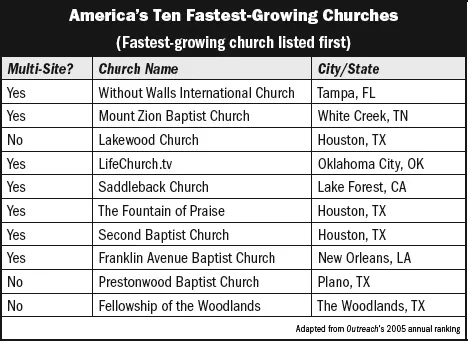
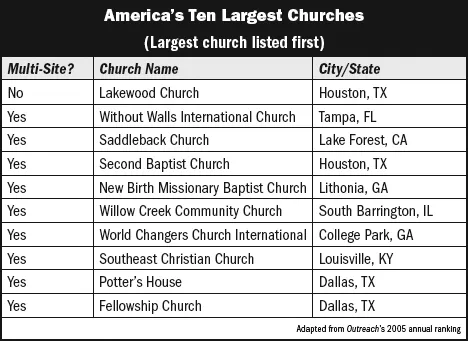
Among the ten fastest-growing churches in the United States, 70 percent use multiple venues or multiple campuses. Likewise, among the ten largest churches in the United States, 90 percent use multiple venues or multiple campuses (see the tables on pp. 22–23). Among megachurches in general, 27 percent hold services at off-site locations, according to a 2005 research project on megachurches.5
Some megachurches continue to build and fill huge sanctuaries. Willow Creek, Chicago, moved into a new 7,100-seat auditorium in 2004; Salem Baptist, Chicago, built a 10,000-seat mega-facility in 2005; Lakewood Church, Houston, bought and refurbished the 16,000-seat Compaq Center sports arena in 2005; First Baptist Church, Woodstock, Georgia, finished a 7,000-seat sanctuary in 2005; Without Walls, Tampa, bought a 9,000-seat Lakeland campus and a 3,000-seat Auburndale satellite campus in 2005; and Glory Church of Jesus Christ, a Korean-American congregation in Los Angeles, bought and moved into a 7,000-seat former boxing arena, known as the Grand Olympic Auditorium, in 2006. (Two of these congregations—Willow Creek and Without Walls—have at least one other campus as well.)
The bigger trend, however, is toward smaller auditoriums. As sociologist Scott Thumma told National Public Radio’s All Things Considered, “Many of the very large megachurches are beginning to spin off satellite or branch campuses around the city or area as a way to reach their diverse populations but also so they don’t have to continue to invest in larger and larger buildings.”6
Not a Growth Strategy by Itself
Bill Easum and Dave Travis have observed that the genius of multi-site is not that it grows your church but that it keeps your church growing. In their book Beyond the Box: Innovative Churches That Work, they comment, “The key to understanding the multi-site movement is to remember that fulfilling the Great Commission drives these congregations, not a growth strategy.”7
In short, multi-site is a means toward an end, not an end goal in itself. Most churches do generate growth through multi-site, but just as importantly, multi-site keeps them from capping the growth they’re experiencing.
Multi-Site Churches Are Bridging Today’s Gap
In recent decades, American churches have morphed from seeker-driven to purpose-driven to postmodern models, all as a response to the skyrocketing number of unchurched Americans and the constant need to apply a biblical worldview to current contexts. Church attendance did increase slightly (from 42 percent to 43 percent), but the actual number of unchurched adults has nearly doubled in the last fifteen years, currently numbered at 75 million.8 The net result is that despite the sincere prayers and efforts of thousands of pastors and leaders across the country, current models of church growth are not working well enough. We must continually find new ways to bridge that gap.
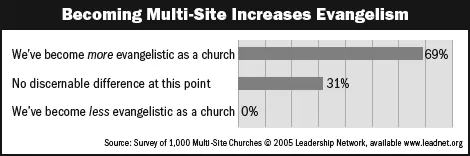
The new multi-site approach, from all early indications, is beginning to do just that. “Early indicators show that multi-site churches are more evangelistic than those with one site,” reports Thom Rainer, a prominent consultant and church researcher.9 A survey we helped conduct in 2005 (see the table above) found that churches have a greater evangelistic impact when they become multi-site.
The many reports of conversion growth at multi-site locations affirm that something is working well. Many people who are wary of “established religion” are willing to come back to these same churches in one of their multi-site expressions, as seen in this emai...
Table of contents
- Cover Page
- Title Page
- Copyright Page
- Table of Contents
- Foreword by Erwin Raphael McManus
- Preface: A Prediction for the Future
- Part One: The Birth of the Multi-Site Movement
- Part Two: How to Become One Church in Many Locations
- Part Three: What Makes Multi-Site Work Best
- Part Four: Why Extend Further and Reach More People?
- Appendix A: Internet Link for Multi-Site Toolbox
- Appendix B: International Multi-Site Overview
- Appendix C: Directory of Multi-Site Churches Cited
- Acknowledgments
- Notes
- About the Authors
- About the Publisher
- Share Your Thoughts
Trusted by 375,005 students
Access to over 1.5 million titles for a fair monthly price.
Study more efficiently using our study tools.
Frequently asked questions
Yes, you can cancel anytime from the Subscription tab in your account settings on the Perlego website. Your subscription will stay active until the end of your current billing period. Learn how to cancel your subscription
No, books cannot be downloaded as external files, such as PDFs, for use outside of Perlego. However, you can download books within the Perlego app for offline reading on mobile or tablet. Learn how to download books offline
Perlego offers two plans: Essential and Complete
- Essential is ideal for learners and professionals who enjoy exploring a wide range of subjects. Access the Essential Library with 800,000+ trusted titles and best-sellers across business, personal growth, and the humanities. Includes unlimited reading time and Standard Read Aloud voice.
- Complete: Perfect for advanced learners and researchers needing full, unrestricted access. Unlock 1.5M+ books across hundreds of subjects, including academic and specialized titles. The Complete Plan also includes advanced features like Premium Read Aloud and Research Assistant.
We are an online textbook subscription service, where you can get access to an entire online library for less than the price of a single book per month. With over 1.5 million books across 990+ topics, we’ve got you covered! Learn about our mission
Look out for the read-aloud symbol on your next book to see if you can listen to it. The read-aloud tool reads text aloud for you, highlighting the text as it is being read. You can pause it, speed it up and slow it down. Learn more about Read Aloud
Yes! You can use the Perlego app on both iOS and Android devices to read anytime, anywhere — even offline. Perfect for commutes or when you’re on the go.
Please note we cannot support devices running on iOS 13 and Android 7 or earlier. Learn more about using the app
Please note we cannot support devices running on iOS 13 and Android 7 or earlier. Learn more about using the app
Yes, you can access The Multi-Site Church Revolution by Geoff Surratt,Greg Ligon,Warren Bird in PDF and/or ePUB format, as well as other popular books in Theology & Religion & Christian Church. We have over 1.5 million books available in our catalogue for you to explore.