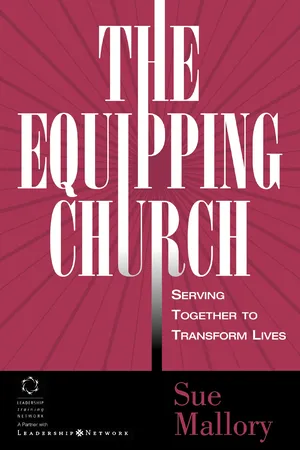
Picture your church as a place where the priesthood of believers finds its expression in creative and powerful ways. Picture leaders and staff equipping and unleashing people to minister in ways consistent with how God designed them. Think of the effectiveness, vitality, and contentment that come when the body of Christ nurtures itself through the healthy give-and-take of each member. In The Equipping Church, Sue Mallory describes the benefits, the structure, and the culture of an equipping church and shows how your congregation can become one. This book is about limitless possibilities. Think "vision." What might your church look like if its members became vital, fully empowered partners in ministry? How can you help them discover and release their full potential? How would their roles change--and yours? AN EQUIPPING CHURCH IS A CHURCH WHERE: * pastors and leaders enable church members to share in ministry * people's gifts, talents, and life callings are matched with areas of service * ministry opportunities are recognized and developed * the culture encourages the growth of a broad array of ministries *a well-designed system addresses needs of every kind, both individual and corporate *the pastor doesn't have to be all things to all people Unpacking insights and principles uncovered by Leadership Training Network over the last several years, Mallory helps you customize an equipping system and culture in your church. You'll proceed from preparation (what you need to know), to foundations (what you need to change), to construction (what you need to do). In the process, Mallory takes you inside the story of her own church, Brentwood Presbyterian, to observe the different stages of their trial-and-error journey and how it has transformed their approach to "doing church." See how they dealt with various concerns that arose along the way, and meet men and women whose lives have been changed because Brentwood took the ministry road less traveled. Each chapter includes a section of "Equipping Principles," questions for discussion and reflection, and a summary of different equipping churches from around the country. With the accompanying Equipping Church Guidebook, this book will be a mile marker in your church--and the gateway to a more effective and biblical approach to ministry.
- 208 pages
- English
- ePUB (mobile friendly)
- Available on iOS & Android
eBook - ePub
About this book
Information
Topic
Theology & ReligionSubtopic
Christian Church1
Starting the Journey
in Helplessness
in Helplessness
SOME OF MY REGULAR holy moments these days occur in my car, far from my church building. My husband and I are among the privileged who drive our pastor to radiation treatments. The gradual advance of cancer has recently forced him to give up the formal title of pastor in our church .Charles no longer preaches. He doesn’t have to—his entire life has become a sermon.
We talk a lot during these trips to the hospital. Actually, I do most of the talking; he does most of the listening. But when he does speak, I know he has been listening. I reflect on all that God is doing in the church today; Charles thinks about all that God will do to get him through today. I’m excited about the ministry to which God has called me; Charles is overwhelmed by all the ways in which God’s people are ministering to him. I’m driven by the vision of the body of Christ being all that it can be; Charles is a humble participant in and beneficiary of that vision coming to reality in his corner of the world.
My pastor, Charles, and I share a lot of history in our parallel walks with God. We’ve come a long way in the last two decades. In a startling way, God has almost exactly reversed our roles. Many of us who have learned so much from Charles over the years now have the honor of ministering to him. He taught us a lot about ministry; now we get to practice on him.
BEFORE THE VISION
I BEGAN THIS JOURNEY into ministry in what I have come to see as the perfect starting place: helplessness. My own faith development occurred in a three-generation home. We lived with my grandparents after my parents’ marriage broke up. I was deeply affected by the unshakable faith of my grandparents, as well as by the ambivalence of my mother, whose divorce had been handled by her church in a demeaning way.
Her pain was deep. I wasn’t always able to sort out my yearnings to trust the Lord of the church from my fears and other feelings connected to the people of the church. I gradually became the kind of person who belonged to the church but wasn’t exactly sure how the church belonged to me.
My first awareness of helplessness came to me when as a young mother I felt the weight of responsibility for my children’s faith. It grew as I wondered about bringing my kids up in the neighborhood church we had attended for several years. There seemed so little there that I could enthusiastically pass on to my children. It never occurred to me that the church might change or that I might have a role in that change. All I knew was that some kind of change needed to happen. I wanted my children exposed to a faith that would challenge and sustain them.
God graciously answered a prayer for which I had no words. A friend invited us to visit her church, which was some distance from our home, because she knew I was concerned about the needs of our family. She was excited about the signs of life that were appearing in her congregation. My family and I arrived at the church we now call home looking for some kind of visible spiritual vitality. We almost immediately sensed an intangible difference. We saw people taking God seriously—and having fun at the same time. A glimmer of hope was beginning to intrude on my first stage of helplessness.
I didn’t realize it at the time, but Brentwood Presbyterian Church was just hitting stride again after two years without a pastor. The new minister was in place, and the impact of his ministry style was beginning to be felt. Our first impressions probably revealed more about our needs than about the church. We were captivated by the new, the different—the life we observed and the welcome we received.
We found a young pastor preaching passionately about what he called “the priesthood of believers.” I thought he had invented a new and exciting concept. Soon he showed me in 1 Peter 2:4–5 that he was actually preaching an ancient biblical principle.
Charles wasn’t preaching a plan or a program but holding a truth before us like a diamond. He was leading us around the gem called “the priesthood of believers” and inviting us to view it from every angle. I sensed somehow that this truth about God’s plan for believers might hold the answer for what I was longing to experience in the Christian journey. I thought I was ready for the next step. It turned out to be a huge step backward. God used a painful and unexpected detour to take me where he wanted me to go.
Before I could mentally deal with the significance of what I was hearing in church, I was ambushed by an overwhelming health challenge. A seemingly minor accident led to long-term, life-changing complications. Over a two-year period of debilitating pain I experienced deterioration of my jaws and severe accompanying headaches. Helplessness returned with a vengeance. A bewildering maze of diagnoses led to the first of several reconstructive surgeries for ruptured and fused disks in my jaws, which left me temporarily disabled. You could literally say that I was laid off from my multifaceted job as the mother of young children. Necessities like cooking, cleaning, and mothering became impossibilities. For a time life was divided into three phases: times when I couldn’t speak because I needed surgery, times when I couldn’t speak because I had just had surgery, and brief times when I could speak and tried to get everything said as quickly as possible before the cycle repeated itself. My self-understanding as a competent person took a severe blow. Pain-free living faded into a memory. I was faced with a shattering inability to meet my family’s needs.
Almost before I could wonder where to turn, people from church showed up, took over, and did what I couldn’t do. They served cheerfully and practically. They changed our lives. Just like that; no fanfare or warning. They met our needs faster than I can tell the story and more completely than words can describe. On some of my lowest days, when helplessness and frustration presented unanswerable questions, God showed me that he could settle a complex argument with a casserole, that he could defeat doubt by means of a quiet friend who sits in silence, offering merely the gift of presence.
I had never experienced the church in action like this. We had never been loved in such ways by people who barely knew us. I still marvel to think that my children have grown up knowing that people in the body of Christ really care for each other. They know the community of Christ as so much more than a theological idea. For them, it’s life! For me, helplessness became the hard teacher I learned to appreciate because it taught me that Christian service is not one among many options, but it is central to God’s call in our lives. The possibility that I too might experience the joy of serving became a driving force to get me healthy again.
I look back on those days of pain and inactivity with a sense of awe. God imparted an emphatic lesson to me through the messages of my pastors, the misery of my condition, and the ministry of fellow believers: The body of Christ lives by mutual giving and receiving. And I had a lot to learn about receiving as well as about giving.
I came out of that unanticipated detour and rehab time with a commitment to make sure others experienced the joy of being served as I had been served. I, who had been given so much, longed to find a place where I in turn could give. I didn’t know what this “giving” would look like, but I knew it could happen because it had happened to me.
My lessons were far from over, as helplessness became a familiar companion during re curring deterioration of my jaw, ineffective solutions, and further surgeries that punctuated the next twenty years. I came to understand the simple paradox that one of the preliminary requirements for equipping ministry is a deep awareness of helplessness. Those who do not recognize their helplessness tend to resist asking for help.
Those who try to do life entirely on their own find it hard to accept the very real help they need. Those who are very capable of doing a lot sometimes miss the joy of seeing how much more they can accomplish working with others. What’s more, those who deny their helplessness may not even seek what they need from God.
One of the preliminary requirements for equipping
ministry is a deep awareness of helplessness.
ministry is a deep awareness of helplessness.
THE VISION COMES TO LIFE
DURING THAT TIME FRAME ( a round the year 1985), Charles had already been pastoring our church for several years. He was discerning that the people needed help to take the next step in order to apply the biblical principles about the priesthood of believers. He believed that believers would serve if given the right opportunities. He wasn’t sure what the process would look like, but he knew it was how God was calling him to lead. He began looking for someone in our congregation who might be interested in discovering what a lay-driven church would look like and how it would act. The quest each of us was on led to the wonderful collision of our lives.
The history and memories Charles and I shared during our drives to the hospital began with those early days and tentative decisions. But it goes far beyond what God has done within Brentwood Presbyterian Church. The vision of equipping churches has taken shape in different places in such unique ways that we now only point to basic biblical principles and smile at all the ways God brings the living body into reality in unusual places with amazing people.
What follows begins with our initial vision and traces our journey to the present. Along the way we’ve discovered that God has been doing
The vision of equipping churches has taken shape in different places in such unique ways that we now only point to basic biblical principles and smile at all the ways God brings the living body into reality in unusual places with amazing people.
similar things in many other churches. We share lessons in common, but specific local applications vary considerably. If you have been longing to participate or pastor in an equipping church, I want to help and encourage you in this book. But the corporate ministry God desires to bring about through you and the believers around you will be a tribute to him. It will bear God’s unique stamp in your unique place. It will take your breath away!
EQUIPPING PRINCIPLES
Equipping Is Not a Program
I will tell you this more than once: Equipping ministry is not new, nor is it a program. It is a way of doing and being the church. Much of what you will read in this book was discovered by trial and error. Perhaps “rediscovered” says it better. The principles that I and countless others are still learning have been woven into the fabric of faith by the Lord of the church.
Equipping ministry is not a format that you can “plug and play.”If you think that “team ministry” is the next add-on for your church, please think again. The principles you read at the end of each chapter will warn, prepare, and direct you, but they won’t give you a simple program.
God has already done work where you are. The pieces that will make up dynamic equipping ministry are in your church right now. The equippers, the equipped, and the yet-to-be equipped are all a round you. Some are hidden, some are misused, some are tire d , and some are abused—which leads me to remind you that as a pastor, director of equipping ministries, leader of such an assortment, or church member wanting to share your gifts, your healthiest initial attitude should be one of humble helplessness. Ask God to work through you to produce a healthy example of his body. Every part of the body belongs to God; every part is there for a reason. Your joyful challenge is to help each member discover that reason!
Equipping Is Not Denominational
While I am a Presbyterian layperson, the equipping church is not particularly Presbyterian. As you will no doubt note, my story will have a Presbyterian flavor and language to it, but the last few years’ experiences and study have taught me that the equipping church can take root anywhere. It can honor and transform across all denominational lines.
The equipping church re p resents one of those core biblical mandates that demand attention. More often than not, as I have discovered in the Presbyterian Book of Order, the documents of many traditions acknowledge the biblical sanction for a robust participation in ministry by the laity. The loss of lay ministry can be explained or blamed on many factors, and I will do my best to suggest some remedies along the way in this book. But the energy of the laity can best be employed today in reclaiming what was temporarily lost. The affirmation must be renewed almost daily: Lay ministry is not a denominational distinctive, but a biblical pattern and command.
Equipping Is Team Oriented
This principle functions everywhere and will get a lot of attention in the chapters that follow. You will not have a local church based on the biblical model without some kind of team mind-set. The word equipping immediately assumes a team model—those who do the equipping and those who are being equipped. One group needs the other. They form a team.
Once you begin to look in Scripture for the guidelines and images of what Christ had in mind for his body, you will be struck by how often the pictures are corporate, not individual. Individuals have certain significant roles in the body, but no individual is the body. When we are “in Christ,” as the Bible so often expresses it, we are in with a whole lot of other folk! We are meant to be a team.
Equipping Is Not Quick or Easy
If you are looking for a quick fix for a struggling church, you will not find it in the equipping church model. If you are looking for the truth and for church as God designed it to be, you will find the equipping church model a biblically sound, historically tested, and workable vision for the body of Christ in action. But getting there won’t be easy. That’s why a shared vision for what can be must be part of the original plan.
EQUIPPING HEROES
Pleasant Hills Community Presbyterian Church
Pittsburgh, Pennsylvania
Vital Churches Institute: www.vitalchurches.com
Senior Pastor: E. Stanley Ott
Pittsburgh, Pennsylvania
Vital Churches Institute: www.vitalchurches.com
Senior Pastor: E. Stanley Ott
Possessing a passion for a vital church, Stan Ott in...
Table of contents
- Cover Page
- Title Page
- Copyright
- Dedication
- Contents
- Foreword
- Acknowledgments
- Introduction
- 1: Starting the Journey in Helplessness
- 2: When the Church Is Healthy, She Dances
- 3: Making Systemic Changes Can Be Shocking
- 4: Examining, Poking, and Prodding the Church Culture
- 5: Checking the Conveyor Belts at the Exits
- 6: Launching the Vision
- 7: Discovering Gifts, Talents, and Experience
- 8: Matching People with Strong Connections
- 9: Pushing Back a Little
- 10: Viewing the Vision of Three Equipping Churches
- 11: Perpetuating the Transformed Vision
- Postscript
- Appendix: The Equipping Church
- Core Values of an Equipping Church
- How to Change the Culture
- How to Build the System
- About the Publisher
- Share Your Thoughts
Trusted by 375,005 students
Access to over 1.5 million titles for a fair monthly price.
Study more efficiently using our study tools.
Frequently asked questions
Yes, you can cancel anytime from the Subscription tab in your account settings on the Perlego website. Your subscription will stay active until the end of your current billing period. Learn how to cancel your subscription
No, books cannot be downloaded as external files, such as PDFs, for use outside of Perlego. However, you can download books within the Perlego app for offline reading on mobile or tablet. Learn how to download books offline
Perlego offers two plans: Essential and Complete
- Essential is ideal for learners and professionals who enjoy exploring a wide range of subjects. Access the Essential Library with 800,000+ trusted titles and best-sellers across business, personal growth, and the humanities. Includes unlimited reading time and Standard Read Aloud voice.
- Complete: Perfect for advanced learners and researchers needing full, unrestricted access. Unlock 1.5M+ books across hundreds of subjects, including academic and specialized titles. The Complete Plan also includes advanced features like Premium Read Aloud and Research Assistant.
We are an online textbook subscription service, where you can get access to an entire online library for less than the price of a single book per month. With over 1.5 million books across 990+ topics, we’ve got you covered! Learn about our mission
Look out for the read-aloud symbol on your next book to see if you can listen to it. The read-aloud tool reads text aloud for you, highlighting the text as it is being read. You can pause it, speed it up and slow it down. Learn more about Read Aloud
Yes! You can use the Perlego app on both iOS and Android devices to read anytime, anywhere — even offline. Perfect for commutes or when you’re on the go.
Please note we cannot support devices running on iOS 13 and Android 7 or earlier. Learn more about using the app
Please note we cannot support devices running on iOS 13 and Android 7 or earlier. Learn more about using the app
Yes, you can access The Equipping Church by Sue Mallory in PDF and/or ePUB format, as well as other popular books in Theology & Religion & Christian Church. We have over 1.5 million books available in our catalogue for you to explore.