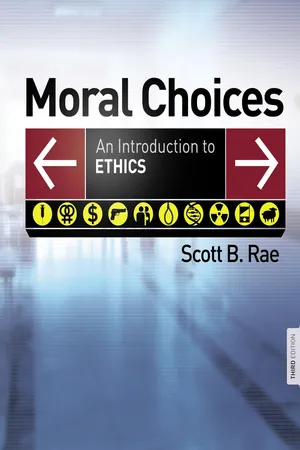
With its unique union of theory and application and its well-organized, easy-to-use design, Moral Choices has earned its place as the standard text for college ethics courses. This third edition offers extensive updates, revisions, and brand new material, all designed to help students develop a sound and current basis for making ethical decisions in today's complex postmodern culture. Moral Choices outlines the distinctive elements of Christian ethics while avoiding undue dogmatism. The book also introduces other ethical systems and their key proponents, including Plato, Aristotle, Augustine, Aquinas, and Kant. After describing a seven-step procedure for tackling ethical dilemmas, author Scott Rae uses case studies to help students think critically and biblically about ? Abortion ? Reproductive Technologies ? Euthanasia ? Capital Punishment ? Sexual Ethics ? The Morality of War ? Genetic Technologies and Human Cloning ? NEW: Ethics and Economics New features include online resources for instructors; a chapter covering global capitalism, environmental ethics, and business ethics; new material on bioethics and on stem cell and embryo research; discussion questions at the end of each chapter; and sidebars with case studies.
eBook - ePub
Moral Choices
About this book
Information
Topic
Theology & ReligionSubtopic
Christian TheologyChapter 1
Introduction: Why Study Ethics?
In Plato’s classic work The Republic, the myth of Gyges sets out the question, Why be moral? Gyges was given the opportunity to live life as an invisible entity, able to do anything he wanted to do with no one ever discovering what he had done. That is, he could do whatever he wanted and would be assured of getting away with it. Given the chance to live life like this, the question Plato raises is, Would a person want to be moral?1 After a good deal of dialogue, Plato concluded that being moral was inherently valuable, apart from any additional benefits it produced or harm that it enabled a person to avoid.
How would you respond to the question, Why be moral? Since the moral life and moral decision making are the focal points of this book, this question is foundational. If you decide that being moral is not very important, then you probably will not spend much time reading this or any other book on ethics. But if being moral is important to you, the content of this book will be helpful in shaping how you view morality.
Most people, when they are genuinely honest with themselves, associate doing well in life with being a good person. Having moral character is still essential to most people’s conceptions of what makes a person flourish in his or her life. For example, it is difficult to imagine a person being considered a success in life if he has gained his wealth dishonestly. It is equally difficult to call a person a success who is at the top of his profession but cheats on his wife, abuses his children, and drinks too much. On the other hand, we rightly hold up a person like Mother Teresa as a model of living a good life, even though she lacked most material goods that society values. One of the principal reasons for being moral is that it is central to most concepts of human fulfillment. For the Christian, being moral is critical to a life that seeks to honor God. We could say that being moral is inherently good because it is foundational to a person’s flourishing in life, since doing well in life and being a good person still go together for most people.
The same holds true for society as a whole. Most people would not want to live in a society in which morality was unimportant, in which conceptions of right and wrong carried little weight. In fact, it is unlikely that any sort of civilized society could continue unless it had concern for key moral values, such as fairness, justice, truthfulness, and compassion. Ethics are important because they give direction to people and societies who have some sense that they cannot flourish without being moral.
Many thoughtful observers of today’s culture are growing increasingly concerned about a breakdown in morality, particularly among students and young adults. They cite phenomena such as drug use, alcoholism, teenage pregnancies, violence, juvenile delinquency, crime, and sexually transmitted diseases as evidence of the moral fabric of society coming unraveled. The alarming number of school shootings, in which students are killing their peers—such as the tragedies at Virginia Tech University in 2007, Northern Illinois University in 2008, and the continuing incidences of these shootings at high schools—only adds to the concern.
Ethics are crucial because moral questions are at the heart of life’s vital issues. Morality is primarily concerned with questions of right and wrong, the ability to distinguish between the two, and the justification of the distinction. Closely related are such questions as, What is a good person? What things are morally praiseworthy? What constitutes a good life? and What would a good society look like? These are fundamental to your view of the world. You cannot formulate an adequate worldview without providing answers to these moral questions.2 Practitioners in a wide variety of professions, whether or not they realize it, deal with moral questions. For example, morality is fundamental to politics, since politics and the law concern the way in which people ought to order their lives together in society. In addition, medicine and the sciences, such as genetics and molecular biology, have numerous moral overtones because they deal with the morally charged areas of life and death. Further, business provides a variety of ethical minefields that can challenge the integrity of the men and women who are striving to succeed in an ever more competitive global economy.
Ethics are also important because you face moral choices every day. Every so often you will face emotionally wrenching moral dilemmas that have no easy answers. Many decisions you will make on a day-to-day basis also involve questions of right and wrong, some of which may have easy answers but are difficult to carry out. Ethics provide the basis on which you make those decisions. Most people have an idea of what sorts of things are right and wrong. Explaining why you think something is right or wrong is altogether another question. The basis on which you make moral choices is often as important as the choices themselves. Yet few people have thought through the way in which they justify their conceptions of right and wrong.
Finally, ethics are important in facing a number of issues, including abortion, euthanasia, same-sex marriage, war, and capital punishment. Debates on issues such as these seem endless and irreconcilable, and they promise to continue far into the future. What many of these issues share is a fundamental disagreement over the ultimate source of moral authority. Some individuals hold that moral authority is ultimately a human construction, while others insist that moral authority comes from some transcendent source that is beyond human beings, such as a revelation from God or nature.3 As you read the newspaper and various news magazines and listen to television news, you will be increasingly aware of the importance of these issues. You will also notice that, apart from legal intervention, most of these issues are no closer to being resolved today than they were ten years ago.
Not only does intractable debate characterize these issues, but society has a general sense of bewilderment over a number of other issues. Many of these involve matters of science and technology that have run far ahead of ethical reflection. For example, genetic testing, gender selection, various reproductive technologies, and the use of human embryonic stem cells in the treatment of certain diseases all involve moral dilemmas that are far from resolved. Most observers in these areas acknowledge that technology has outpaced society’s ability to determine the moral parameters for its use. There is a general sense that ethics are necessary for dealing with our increasingly technological society.
More people have an interest in ethics today than at any other time in the recent past. Some of that interest is due to the complex issues spawned by technology, while others have an alarming sense of a general moral decline in society. In addition, the numerous scandals that have rocked the business community and other professions have left some to ask if “business ethics” and “professional ethics” are indeed oxymorons. Some people are aware of the need to stress values in various educational arenas, including public schools. Many are also realizing that the value-neutral approach to education at all levels is not working, and some even suggest that such value neutrality is impossible. Although there is a greater emphasis on character in view of well-publicized business ethics failures, ethics helps determine which character traits are admirable and worth cultivating.
These reasons for the importance of studying ethics all presume that there is such a thing as genuine moral knowledge. But that notion is being increasingly called into question in philosophy today as a result of the cultural dominance of the worldview of naturalism. Among other things, the naturalist holds that all reality is reducible to that which can be perceived with one’s senses—that is, there is nothing that is real or that counts for knowledge that is not verifiable by the senses. As a result, moral knowledge has been reduced to the realm of belief and is considered parallel to religious beliefs, which the culture widely holds are not verifiable. The theist maintains that moral knowledge is genuine knowledge in the same way that scientific knowledge is real—that the notion that “murder is wrong” can be known as true and cannot be reduced to subjective opinion or belief without the risk of all morality being subjective. The theist argues that no one lives consistently, as though morality is entirely subjective, and that moral truths do exist and can be known as such.4
Overview of the Book
As you read this book, you will be exposed both to foundations in ethics and to the application of those foundations to the most pressing moral issues of the day. Believing that morality ultimately issues from the character of God, I find the most critical and foundational element of ethics to be the direction that God provides, both in his Word (i.e., special revelation) and outside his Word (i.e., general revelation). Chapter 2 will outline the distinctive elements of Christian ethics. This entire book could be about Christian ethics. Some works are entirely devoted to this subject. Here you will simply get a synthesis of the main parameters of biblical ethics.
Throughout the ages, many philosophers, even some whose inquiries predate the written Scriptures, have wrestled with the questions of right and wrong and arrived at somewhat different answers. Recognizing, then, that the Bible is not the only source of ethical inquiry, chapter 3 provides an honest look at alternative ethical systems, such as relativism, utilitarianism, and ethical egoism. We will also examine the major figures who systematized them, including Plato, Aristotle, Augustine, Aquinas, and Kant. These must be brief, but I have included resources, especially original sources, should you wish to study any of these individuals or systems further. For each alternative approach to ethics, I will offer a description of the system and its major advocate, a presentation of the strong points of the system, a comparison of it with Scripture, and a critique of the system, both from within the system itself and from the perspective of Christian ethics. In order to be able to converse with an increasingly secular world about ethics and morality, you need exposure to the ways in which other people have done ethics. Some of these approaches contain truth that ultimately comes from God, even if the people formulating the alternative are unaware of it. Also, for the sake of clarity, I have tried to use terms in a manner consistent with their use in secular works on ethics.
Chapter 4 contains a model for making moral decisions and illustrates its use on some particularly knotty moral dilemmas. This model can be used in virtually any setting and does not require any particular worldview commitment for its profitable use. I offer this model not as a type of computer program for generating correct moral decisions, but as a guideline to ensure that all the key bases are covered when you make moral decisions. This chapter begins to build the bridge from theory to application that will be more clearly defined in subsequent chapters.
Chapters 5 through 12 deal with some of the current issues that are hotly debated both among individuals and in society. Discussion in these chapters will recognize the way these issues affect people individually (personal ethics) as well as how they affect public policy (social ethics). Since medical ethics involves some of the most frequently debated and complex issues, chapters 5 through 8 discuss such issues as abortion, reproductive/genetic technologies, and assisted suicide. Staying within the arena of ethics pertaining to life and death, chapter 9 addresses the issue of capital punishment. Chapter 10 addresses the subject of sexual ethics, which includes sexual orientation, same-sex marriage, and birth control. Chapter 11 takes up the issue that has been debated longer than any other, the morality of war, which has some new questions raised, particularly in the aftermath of 9/11 and the ongoing war on terrorism. Chapter 12 will address the intersection of ethics and economics, with an introduction to business ethics and a brief look at the moral assessment of the economic system of global capitalism.
Introducing Key Terms and Distinctions in Ethics
One of the difficult aspects of studying a subject like ethics is that you are introduced to many terms with which you are unfamiliar. For example, new members of the hospital ethics committee with whom I consult are often unfamiliar with terminology customarily used by ethicists. So, to keep you from the initial shock of jumping headfirst into a new subject, this section will introduce you to some of the key terms that you will often see as you read this book.
Most people use the terms morality and ethics interchangeably. Technically, morality refers to the actual content of right and wrong, and ethics refers to the process of determining right and wrong. In other words, morality deals with moral knowledge and ethics with moral reasoning. Thus, ethics is both an art and a science. It does involve some precision like the sciences, but like art, it is an inexact and sometimes intuitive discipline. Morality is the end result of ethical deliberation, the substance of right and wrong.
Major Categories
Four broad categories have traditionally fallen under the heading of ethics. They include (1) descriptive ethics, (2) normative ethics, (3) metaethics, and (4) aretaic ethics. Normative ethics will be the primary concern in this book.
First, descriptive ethics is a sociological discipline that attempts to describe the morals of a particular society, often by studying other cultures. Anthropologists often use it in their fieldwork to describe the moral distinctives of other cultures.
Second, normative ethics refers to the discipline that produces moral norms or rules as its end product. Most systems of ethics are designed to tell you what is normative for individual and social behavior, or what is right and wrong, both generally and in specific circumstances. Normative ethics prescribes moral behavior, whereas descriptive ethics describes moral behavior. When we examine important moral issues in later chapters, we will be trying to establish a set of norms to apply to that particular issue. When most people debate about ethics, they are debating normative ethics, or what the moral norms should be and how those norms apply to the issues at hand.
Of course, ethics is not the only normative discipline.5 For example, the law produces legal norms but not necessarily moral ones, although law and morality probably overlap significantly. In addition, there are norms of good taste and social acceptability, which we call etiquette. Further, religion produces behavioral norms, often defined by a religious authority such as a pastor or other church official, that govern one’s relationship to God. In chapter 2 we will see that Christian ethics includes a substantial overlap between duties with respect to a person’s relationship to God and duties with respect to the people around him or her.
Third, metaethics is an area of ethics that investigates the meaning of moral language, or the epistemology of ethics, and also considers the justification of ethical theories and judgments. For example, it focuses on the meaning of the major terms used in ethics, such as right, good, and just. The primary focus of technical philosophers, metaethics has been receiving more attention from a popular audience today since more people are insisting that the language of right and wrong is nothing more than an expression of personal preferences. Accordingly, some will argue that the judgment that homosexuality is wrong is not a statement about right and wrong but simply a personal distaste for homosexuality. Morality is thus reduced to matters of taste and preference and has little to do with right and wrong. We will look at this later in chapter 3 when we discuss emotivism.
Fourth, aretaic ethics is a category of ethics that focuses on the virtues produced in individuals, not the morality of specific acts. Also known as virtue theory, it is gr...
Table of contents
- Cover Page
- Title Page
- Copyright Page
- Table of Contents
- Acknowledgments
- Publisher’s Preface
- 1. Introduction: Why Study Ethics?
- 2. Christian Ethics
- 3. Ethical Systems and Ways of Moral Reasoning
- 4. Making Ethical Decisions
- 5. Abortion and Embryonic Stem Cell Research
- 6. Reproductive Technologies
- 7. Biotechnology, Genetics, and Human Cloning
- 8. Physician-Assisted Suicide and Euthanasia
- 9. Capital Punishment
- 10. Sexual Ethics
- 11. The Morality of War
- 12. Ethics and Economics
- About the Publisher
- Share Your Thoughts
Trusted by 375,005 students
Access to over 1.5 million titles for a fair monthly price.
Study more efficiently using our study tools.
Frequently asked questions
Yes, you can cancel anytime from the Subscription tab in your account settings on the Perlego website. Your subscription will stay active until the end of your current billing period. Learn how to cancel your subscription
No, books cannot be downloaded as external files, such as PDFs, for use outside of Perlego. However, you can download books within the Perlego app for offline reading on mobile or tablet. Learn how to download books offline
Perlego offers two plans: Essential and Complete
- Essential is ideal for learners and professionals who enjoy exploring a wide range of subjects. Access the Essential Library with 800,000+ trusted titles and best-sellers across business, personal growth, and the humanities. Includes unlimited reading time and Standard Read Aloud voice.
- Complete: Perfect for advanced learners and researchers needing full, unrestricted access. Unlock 1.5M+ books across hundreds of subjects, including academic and specialized titles. The Complete Plan also includes advanced features like Premium Read Aloud and Research Assistant.
We are an online textbook subscription service, where you can get access to an entire online library for less than the price of a single book per month. With over 1.5 million books across 990+ topics, we’ve got you covered! Learn about our mission
Look out for the read-aloud symbol on your next book to see if you can listen to it. The read-aloud tool reads text aloud for you, highlighting the text as it is being read. You can pause it, speed it up and slow it down. Learn more about Read Aloud
Yes! You can use the Perlego app on both iOS and Android devices to read anytime, anywhere — even offline. Perfect for commutes or when you’re on the go.
Please note we cannot support devices running on iOS 13 and Android 7 or earlier. Learn more about using the app
Please note we cannot support devices running on iOS 13 and Android 7 or earlier. Learn more about using the app
Yes, you can access Moral Choices by Scott Rae in PDF and/or ePUB format, as well as other popular books in Theology & Religion & Christian Theology. We have over 1.5 million books available in our catalogue for you to explore.