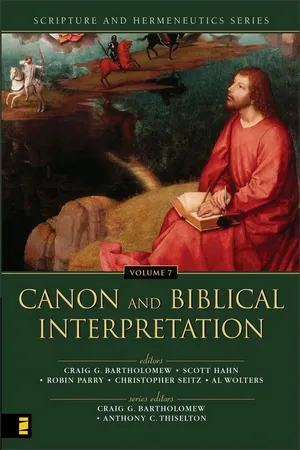
Drawing on a broad array of contributors, volume seven of the Scripture and Hermeneutics Series assesses the current state of canonical interpretation and uses that as a starting point for exploring ingredients in theological interpretation of the Bible today. Canon and Biblical Interpretation begins with a masterful examination of the canonical approach and the various criticisms that have been leveled against it. Additional chapters look at canonical interpretation in relation to different parts of the Bible, such as the Pentateuch, the Wisdom books, the Psalms, and the Gospels. Articles address such issues as canonical authority and the controversial relationship between canonical interpretation and general hermeneutics. A unique chapter explores the relationship between academic exegesis and lectio divina. Editors: • Craig Bartholomew • Robin Parry • Scott Hahn • Christopher Seitz • Al Wolters
eBook - ePub
Canon and Biblical Interpretation
- 464 pages
- English
- ePUB (mobile friendly)
- Available on iOS & Android
eBook - ePub
Canon and Biblical Interpretation
About this book
Information
Topic
Theology & ReligionSubtopic
Christian TheologyCanon, Community and Theological
Construction
Construction
Introduction
Anthony C. Thiselton
The Controversial Status of a ‘Canonical’ Approach
Arguably the disintegration of an emphasis upon the unity of the biblical writings, initially witnessed by widespread disenchantment with the so-called biblical theology movement, gathered momentum first by the concurrent rise of redaction criticism and then more recently from the impact of a postmodern cast of mind and an emphasis upon diversity among communities of faith and within academia.1 Fragmentation and suspicion of ‘grand narrative’ are hallmarks of postmodern thought.2
At one level theological interpretation and theological construction become impossible without some notion of biblical canon as serving ‘to mark out the circumference of acceptable diversity’.3 In the early centuries of the Christian church Irenaeus argued that if the church were to accept Marcion’s expulsion of the Old Testament from the Christian Scriptures, the church would lose the frame of reference within which the New Testament was to be interpreted, and the coherence of the biblical witness to Christ would be disrupted.4 Paul the Apostle likewise sees the Scriptures of the Old Testament as the frame of reference within which the death and resurrection of Jesus Christ are to be understood in accordance with the pre-Pauline tradition that he cites (1 Cor. 15:1–3). According to Luke, Jesus also affirms a two-way hermeneutical interaction in which the Old Testament interprets his work, and his work provides an understanding of the Old Testament (Lk. 24:27 and 43). Ulrich Luz rightly observes, ‘For Paul, the Old Testament is not in the first place something to understand, but itself creates understanding.’5
All the same, those who bring to the issue more pluralist, phenomenological, or postmodernist perspectives, as well as some more traditional biblical specialists may well respond to our quotation above from James Dunn with the question: to whom is the boundary of diversity that marked out the canon ‘acceptable’? Is not this supposed boundary an artificial construct imposed by the Christian church (or its dominant theologians) of the third or fourth century? Does not the insistence of Irenaeus, for example, on working with the four Gospels as a canonical unity reduce and flatten down the distinctive witness and tradition of each evangelist as representative of a particular tradition into a monochrome ‘harmony’ of the Gospels?
Suspicions concerning the validity of a ‘canonical’ approach to the biblical writings have been expressed on both phenomenological and theological (or anti-theological) grounds. Thus, in terms of the first point, James Barr declares, ‘In biblical times the books [of the Bible] were separate individual scrolls. A ‘Bible’ was not a volume one could hold in the hand, but a cupboard … with a lot of individual scrolls. The boundary [of ] … what was Scripture … was thus more difficult to indicate.’6
In relation to the second area of contention, some will remain unmoved by the implicit arguments of Irenaeus and Tertullian that theological construction necessitates reference to the whole potential ‘canon’ of Scripture rather than only to selected biblical texts. Robert Gundry’s essay of 2005 is among the most recent to argue that theological construction does necessitate recourse to the variety and diversity of the canon. He argues, for example, that a Christology based on Mark alone would be of a different shape from one based only on the Fourth Gospel or only on Paul.7 By contrast Heikki Räisänen insists that ‘recognition by biblical scholarship of the wide diversity of beliefs within the New Testament itself ’ renders ways of using the Bible for theological construction or synthesis ‘unviable’.8 ‘The New Testament has turned out to be filled with theological contradictions.’ 9 Räisänen goes further and writes in a dismissive tone: ‘Conservative theologians have stressed the alleged theological unity of the two Testaments and striven towards a canonical, pan-biblical, theology (Childs 1992: Stuhlmacher 1992).’10 Pressing professional courtesy to the limits he states that this ‘runs counter to the rules of sound scholarship’.11This amounts to a declaration of war upon the canonical approach, and invites critical scrutiny of this allusion to ‘rules’ of sound scholarship.
In the history of modern discussions of canon, Brevard Childs notes in his chapter below that in his essay of 1950 to the World Council of Churches Ernst Käsemann asserted that the canon served not as a source of unity, but as a source of disunity.12 Childs also alludes to an increasing tendency to follow Harnack, Sundberg, and Gamble on seeing the formation of the New Testament canon as the product of contingent historical factors deriving from outside the church in the second and third centuries, as against the view of Westcott, Metzger, and others that the canon constituted a recognition of the impact and nature of Scripture through internal processes and judgements within the Christian church.13
While most biblical and hermeneutical specialists will endorse the importance of the subject-areas of the first six volumes of this Scripture and Hermeneutics series, this seventh volume carries a title that provokes controversy, even hostility, in some circles. Renewing biblical interpretation (volume 1), exploring hermeneutics and language (volume 2), engaging with ethical aspects of the biblical writings (volume 3), hermeneutics and history (volume 4), and the formative impact of Lukan texts (volume 6) are universally accepted parts of the agenda of biblical hermeneutics. The subject-matter of volume 5, hermeneutics and biblical theology, may raise a suspicious eyebrow in some circles, but none of these areas remains more open prima facie to controversy than the subject area of the present volume.
However, if some claim that theological construction cannot be undertaken without reference to larger stretches of the biblical writings than individual traditions or textual units, and some even try to insist that a canonical approach allegedly violates ‘the rules of sound scholarship’, we must either grasp the nettle of canonical approaches or give up the enterprise of seeking to build Christian theology upon biblical foundations.
Nevertheless, on further investigation Räisänen’s language appears not only inflated beyond that expected of a fair-minded scholar, but also reflects some widespread mythologies and illusions about precisely what a canonical approach necessarily involves.
Towards a Clarification of what Canonical Approaches Involve
There is no more a single, uniform, canonical approach than there is a single, uniform, ‘historical-critical method’. In my judgment the term ‘the historical-critical method’ should be banned from all textbooks and from students’ essays. There may well be overlap or resemblances between the kind of biblical criticism practised by Westcott, Lightfoot, F.F. Bruce, George Caird and N.T. Wright on one side and by Räisänen or Philip Davies on the other. But it achieves nothing for Räisänen to imperialize and restrict ‘the rules of sound scholarship’ to a virtually non-theistic or supposedly value-free approach. As Francis Watson has argued elsewhere, the isolation of ‘biblical exegesis’ and ‘biblical interpretation’ from theology is itself arbitrary, reductive, and overshadowed by illusory notions of value-free enquiry. Non-theism or positivism is no more value-free than theism.14 Similarly within ‘canonical approaches’ there are strong family resemblances between the canonical perspectives of Brevard S. Childs, James A. Sanders, Rolf Rendtorff, Gerald T. Sheppard, and Christopher Seitz. But differences of emphasis between them suggest the impropriety of offering careless generalizations about ‘canonical criticism’.
Canon criticism in James A. Sanders
The terms canon criticism or canonical criticism were coined by James A. Sanders (b. 1927) in his first major work on the subject, Torah and Canon.15 Twelve years later he gave the sub-title A Guide to Canonical Criticism in his book Canon and Community.16 Another volume of essays, From Sacred Story to Sacred Text carried the sub-title Canon as Paradigm.17 Contrary to what might be inferred from Räisänen’s polemic, Sanders urges that canon criticism does not reject the methods of modern biblical criticism. Tradition history, form criticism, source criticism, and the clear identification of theological diversity within Scripture, remain part of the agenda. However, what is probably more objectionable to Räisänen (although it can be done at the reductive level of phenomenology of religion) is that Sanders wishes to place the Bible ‘where it belongs in the believing communities of today’.18 Mythology about restricting attention solely to ‘the final form of the text’ cannot be attributed to Sanders. He sees canon as a dynamic process that operates within and behind the text, shaping traditions and books en route to canonization.
Sanders emphasizes the dynamic and dialectical relationships between texts, traditions, and communities of faith. The Exodus theme, for example, finds fresh shape and a fresh hermeneutic in Isaiah 40–55. Deuteronomy becomes reduced or re-shaped if it is separated from the rest of the Deuteronomic history from Joshua through to 2 Kings. Continuities within the biblical writings do not exclude diversity, but they witness to monotheism rather than polytheism. To focus piecemeal only on atomistic textual units and books without considering their role in the process of contributing to a broader whole is to miss the transcendent dimension of the whole. Intertextual resonances form part of the hermeneutic of the biblical traditions themselves. Sanders completed his Ph.D. dissertation under S. Sandmel on ‘Suffering as Divine Discipline in the Old Testament and Judaism’, and it is difficult to imagine how any thinker could embark upon this without considering the tension and dialectic between the deuteronomic traditions and Wisdom traditions of Job.
The canonical approach of Brevard S. Childs
Brevard S. Childs (b. 1923), who is more widely regarded as the founder and pioneer of a canonical approach, is widely said to have shared initially the use of Sanders’ term canon criticism in the early 1970s, although he soon discarded this term in favour of the term canonical approach. In a recent interview with John Knox/Westminster Press, however, Childs is on record as insisting, ‘I have always objected to the term “canon(ical) criticism” as a suitable description of my approach’.19 This objection stems partly from the fact that Childs is not proposing ‘a new critical methodology analogous to literary, form, or redactional criticism’, but an exploration and evaluation of ‘the nature of the biblical text being studied’. This includes an understanding of the Bible not simply as ‘a literary deposit’, but as ‘the sacred Scriptures of the church’, and as a ‘living and active text addressing each new generation’.20 In an era when Old Testament scholarship often or typically explored relatively small units of texts or tradition, Childs turned to the larger shape of more extensive textual expanses. In contrast to the mistaken mythologies about a canonical approach in his early work, Childs strongly criticized the tendency of the biblical theology movement to betray ‘lack of rigor’, or to use material as ‘homiletical topping’, and to pay insufficient attention to distinctive ‘context’.21
In the case of his critique of ‘biblical theology’, however, a new emphasis upon canon began to emerge. First, it is a mistake to suggest that any ecclesiastical body ‘can ever “make a book canonical”. Rather, the concept of canon was an attempt to acknowledge the divine authority of its writings and collections.’22‘Canonicity as the “rule of faith” was a confession of the divine origin of the gospel that had called the church into being … Scripture served not as “interesting sources” of historical information … but as testimony that the salvation and faith of the old covenant was one with that revealed in Jesus Christ.’23 The concluding chapter of Biblical Theology in Crisis affirms the unity of the two Testaments in relation to ‘the God of Israel and the Church’, stressing ‘the identity of the Christian God with the God of the Old Testament’.24
It would be a mistake, however, to see this as merely an assertion of dogmatic theology. Childs tests the scope of the method and ‘the claim of continuity’ in terms of the biblical writings themselves.25 Moreover, it becomes clear that (in common with Sanders) Childs recognizes the correlation between canon and community. In spite of Räisänen’s dismissive comment about ‘the rules of sound scholarship’ it is axiomatic for serious hermeneutical endeavour that author-centred and text-centred hermeneutics do not offer all dimensions of hermeneutics or communicative action unless at least some attention has been given to the stance of communities of readers. Of necessity the ‘reception’ of earlier texts and traditions will, in turn, serve to re-shape the development of texts and traditions in an ongoing dialectic.26 Value-free scholarship (if such were to exist) would not be served by insulating text from ‘reception’. The biblical writings become ‘Scripture’ for those communities of faith for whom they are divine revelation and formative.27
In 1972 Childs urged an understanding of closer interconnections between the books of the Pentateuch.28 Two years later he published his magisterial commentary on Exodus. This volume serves to dispel any false mythology about a lack of ‘the rules of sound scholarship’ with convincing effect. Each unit of the text of Exodus first receives careful scrutiny at the textual level with a new translation of the Hebrew text. This includes ‘restoring the best text’ but also ‘seeking to understand how the text was heard and interpreted by later communities’.29 One can scarcely imagine serious textual criticism in action without a correlative study of the theological traditions of later copyists. Next, pace many of his uninformed critics, Childs examines ‘the historical development which lay behind the final form of the biblical text … in considerable detail with regard to both oral and literary levels’.30 This section includes formcritical and traditio-historical analyses, and careful source analysis. Only after this does the ‘final form of the text’ become the focus of critical reflection.
Childs moves on, in the third place, to what he calls the heart of the commentary. This explores the text in its final form, ‘which is its canonical shape, while at the same time recognizing and profiting by the variety of historical forces which were at work in producing it’.31 Without this, the text becomes fragmented and leaves the reader ‘with bits and pieces’.32 But still more important, Childs adds, is the theological dimension. This is the shape which engages the synagogue and the church. A study of the pre-history of the text is useful only if it serves this larger goal.
Three more sections remain. Childs includes the New Testament’s reading of the Old Testament material; a section on the history of exegesis (its posthistory or reception-history); and finally ‘a theological re...
Table of contents
- Cover Page
- Title Page
- Copyright Page
- Table of Contents
- Preface
- Contributors
- Abbreviations
- Introduction: Canon, Community and Theological Construction
- The Controversial Status of a ‘Canonical’ Approach
- Part 1 The Concept of Canon, its Formation and the Hermeneutical Implication
- Part 2 Reading the Old Testament Canonically
- University of Gloucestershire
- The British and Foreign Bible Society
- Baylor University
- Redeemer University College
- About the Publisher
- Share Your Thoughts
Trusted by 375,005 students
Access to over 1.5 million titles for a fair monthly price.
Study more efficiently using our study tools.
Frequently asked questions
Yes, you can cancel anytime from the Subscription tab in your account settings on the Perlego website. Your subscription will stay active until the end of your current billing period. Learn how to cancel your subscription
No, books cannot be downloaded as external files, such as PDFs, for use outside of Perlego. However, you can download books within the Perlego app for offline reading on mobile or tablet. Learn how to download books offline
Perlego offers two plans: Essential and Complete
- Essential is ideal for learners and professionals who enjoy exploring a wide range of subjects. Access the Essential Library with 800,000+ trusted titles and best-sellers across business, personal growth, and the humanities. Includes unlimited reading time and Standard Read Aloud voice.
- Complete: Perfect for advanced learners and researchers needing full, unrestricted access. Unlock 1.5M+ books across hundreds of subjects, including academic and specialized titles. The Complete Plan also includes advanced features like Premium Read Aloud and Research Assistant.
We are an online textbook subscription service, where you can get access to an entire online library for less than the price of a single book per month. With over 1.5 million books across 990+ topics, we’ve got you covered! Learn about our mission
Look out for the read-aloud symbol on your next book to see if you can listen to it. The read-aloud tool reads text aloud for you, highlighting the text as it is being read. You can pause it, speed it up and slow it down. Learn more about Read Aloud
Yes! You can use the Perlego app on both iOS and Android devices to read anytime, anywhere — even offline. Perfect for commutes or when you’re on the go.
Please note we cannot support devices running on iOS 13 and Android 7 or earlier. Learn more about using the app
Please note we cannot support devices running on iOS 13 and Android 7 or earlier. Learn more about using the app
Yes, you can access Canon and Biblical Interpretation by Zondervan, Craig Bartholomew,Scott Hahn,Robin Parry,Christopher Seitz,Al Wolters in PDF and/or ePUB format, as well as other popular books in Theology & Religion & Christian Theology. We have over 1.5 million books available in our catalogue for you to explore.