Many today find the Old Testament a closed book. The cultural issues seem insurmountable and we are easily baffled by that which seems obscure. Furthermore, without knowledge of the ancient culture we can easily impose our own culture on the text, potentially distorting it. This series invites you to enter the Old Testament with a company of guides, experts that will give new insights into these cherished writings. Features include • Over 2000 photographs, drawings, maps, diagrams and charts provide a visual feast that breathes fresh life into the text. • Passage-by-passage commentary presents archaeological findings, historical explanations, geographic insights, notes on manners and customs, and more. • Analysis into the literature of the ancient Near East will open your eyes to new depths of understanding both familiar and unfamiliar passages. • Written by an international team of 30 specialists, all top scholars in background studies.
- 131 pages
- English
- ePUB (mobile friendly)
- Available on iOS & Android
eBook - ePub
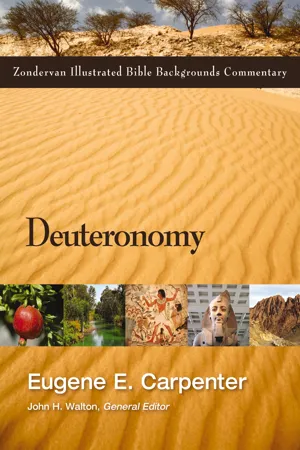
Deuteronomy
About this book
Information
Topic
Theology & ReligionSubtopic
Biblical CommentaryDeuteronomy
by Eugene E. Carpenter

Plowing with donkey and ox.
Jim Monson, Bible Backgrounds
Introduction
Historical Setting
In three powerful speeches, Moses expounds the law (tôrâ, 1:5) forty years after the Lord has delivered Israel from Egypt. The people have “wandered” forty years in the wilderness of the Sinai Peninsula, including spending a year at Mount Sinai, where God made a covenant with his people (Ex. 19–24). At this time Egypt is weakening, but still ruled the ancient Near East. The pharaohs have stopped major expeditions into the land of Canaan, which now allows Israel a providential opportunity to gain a foothold in the land.
The larger historical-cultural milieu for Israel’s experiences with Egypt was the New Kingdom Empire (ca. 1550–1069 B.C., Dynasties 18–20). After a decline in the New Kingdom after Ramesses II (1279–13 B.C.), a brief revival occurred under Ramesses III (1185–1154); but thereafter the Egyptian influence declined into the late periods of the nation (Dynasties 21–30).1
The date of the Exodus fixes the date of these three speeches of Moses. Two approximate dates vie for recognition currently: an early date (ca. 1446 B.C.) and a late date (ca. 1269 B.C.). Allowing forty years for the wilderness wanderings places Moses in the Plains of Moab at about 1406 or 1229. Thutmose III (1479–25 B.C.) and Amenophis II (1427–1396) would have been in power during an Eighteenth Dynasty exodus, while Seti I (Sethos, 1294–79 B.C.) and Ramesses II (1279–13) would likely have been in power during a Nineteenth Dynasty exodus event.2 The next pharaoh, Merneptah (1213–1203 B.C.), erected a stele in western Thebes that records many of his victories. In a small section, he mentions Israel, as a people, already in Canaan in 1209 B.C. While he claims to have wiped out the seed of Israel, ironically his stele is the earliest extrabiblical witness to their presence in the land of Palestine.3
Moses’ exposition of the Sinai covenant occurs in the plains of Moab, which is just north-northeast of the northern tip of the Dead Sea and on the eastern side of the Jordan River. Moses views the future extent of Israel’s promised inheritance from Mount Nebo.4
| New Kingdom Kings (1550–1069) | |
|---|---|
| Early Exodus: Eighteenth Dynasty (1550–1295) | |
| Thutmose III | 1479–1425 |
| Amenhotep II | 1427–1400 |
| Thutmose IV | 1400–1390 |
| Late Exodus: Nineteenth Dynasty (1295–1186) | |
| Seti I (Sethos) | 1294–1279 |
| Ramesses II | 1279–1213 |
| Merneptah | 1213–1203 |
| Wilderness Wanderings | c. 1446–1406 or 1269–1229 |
| Merneptah Stele | 1209 |
| Moses’ Exposition of Law | 1406 or 1229 |
Literary Setting
Deuteronomy shares many affinities with literature from the ancient Near East. The most evident is its relationship to the various law collections or “codes” that have been recovered.5 These collections have come from as early as 2000 B.C. and before—e.g., Sumerian Laws of Ur Nammu (2064–46), Lipit-Ishtar (1875–64), Old Babylonian Laws from Eshnunna (ca. 1850), and Hammurabi king of Babylon (1792–50). The Old Testament contains both comparison and contrast with these collections in subcategories of types of laws, such as case law, apodictic law, laws involving curses, motive clauses, and so on.6
Deuteronomy displays a form and structure that reflects a close relationship with suzerain-vassal treaties.7 The parallels extend to the variety and flexibility of these ancient documents and the covenants and treaties in the Old Testament. The set structures of these treaties are reflected in Deuteronomy and the basic elements are clearly evident (see commentary). Kitchen and McCarthy both make the important point that these treaties were hybrids as well, adapting their form and structure as needed to accommodate differing situations. The basic structure of a suzerain-vassal treaty is best placed within the years 1400–1200 B.C.8
There are many other types of parallels in Deuteronomy, which set it squarely within it ancient Near Eastern cultural context. Oaths were a feature of ancient Near Eastern covenantal documents. The poetry of chapters 32–33 reflects poetic features, style, and theological content found in the literature of Ugarit (Ras Shamra) near the Mediterranean coast. The curses and blessings of Deuteronomy reflect relationships with ancient Near Eastern traditions of such literature reaching to the third millennium B.C. The centrality of love for the suzerain and among the great kings of the Near East, expressed in religious ritual and covenantal and literary documents, reflects the supreme commandment of love in Deuteronomy for the Lord and for one’s fellow human being.9
Religious Setting
Deuteronomy celebrates covenant renewal, specifically the renewal of the covenant at Sinai (see Exodus and Leviticus). If Israel are to claim and retain the land promised to them, they must maintain this covenant. The covenant is renewed again in Joshua 24. In each case, the call to worship and to commitment is paramount; in each case the form and content of the covenantal renewals reflect ancient Near Eastern suzerain-vassal treaty/covenant patterns with necessary changes made to fit special circumstances.
Preamble (1:1–5)
These are the words Moses spoke (1:1). The traditions of the Israelites contained in the Hebrew Bible witness to Moses, the extraordinary leader of ancient Israel. Many ancient leader...
Table of contents
- Cover
- Title Page
- Copyright Page
- Table of Contents
- How to Use This eBook
- Acknowledgments
- Methodology: An Introductory Essay
- General Bibliography
- Abbreviations
- Deuteronomy
- Picture Index
- The New International Version Appendix
Trusted by 375,005 students
Access to over 1.5 million titles for a fair monthly price.
Study more efficiently using our study tools.
Frequently asked questions
Yes, you can cancel anytime from the Subscription tab in your account settings on the Perlego website. Your subscription will stay active until the end of your current billing period. Learn how to cancel your subscription
No, books cannot be downloaded as external files, such as PDFs, for use outside of Perlego. However, you can download books within the Perlego app for offline reading on mobile or tablet. Learn how to download books offline
Perlego offers two plans: Essential and Complete
- Essential is ideal for learners and professionals who enjoy exploring a wide range of subjects. Access the Essential Library with 800,000+ trusted titles and best-sellers across business, personal growth, and the humanities. Includes unlimited reading time and Standard Read Aloud voice.
- Complete: Perfect for advanced learners and researchers needing full, unrestricted access. Unlock 1.5M+ books across hundreds of subjects, including academic and specialized titles. The Complete Plan also includes advanced features like Premium Read Aloud and Research Assistant.
We are an online textbook subscription service, where you can get access to an entire online library for less than the price of a single book per month. With over 1.5 million books across 990+ topics, we’ve got you covered! Learn about our mission
Look out for the read-aloud symbol on your next book to see if you can listen to it. The read-aloud tool reads text aloud for you, highlighting the text as it is being read. You can pause it, speed it up and slow it down. Learn more about Read Aloud
Yes! You can use the Perlego app on both iOS and Android devices to read anytime, anywhere — even offline. Perfect for commutes or when you’re on the go.
Please note we cannot support devices running on iOS 13 and Android 7 or earlier. Learn more about using the app
Please note we cannot support devices running on iOS 13 and Android 7 or earlier. Learn more about using the app
Yes, you can access Deuteronomy by Eugene Carpenter, John H. Walton in PDF and/or ePUB format, as well as other popular books in Theology & Religion & Biblical Commentary. We have over 1.5 million books available in our catalogue for you to explore.