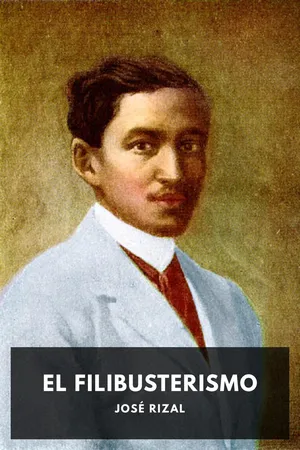
El Filibusterismo by José Rizal
El Filibusterismo is the sequel to Noli Me Tangere, and picks up thirteen years after Crisóstomo Ibarra disappeared, assumed dead after fleeing from the Civil Guard. Returning to the Philippines in disguise, he involves himself in the lives of those he once knew. Ibarra works with the ruling class to make life miserable for the native population, hoping to frustrate them enough to awaken them and cause them to rise up against their oppressors. This proves difficult, as even the slightest talk of liberalism or reform is considered "filibusterism," and filibusters risk jail, deportation, or worse.
The story follows the lives of several characters at all levels of society. Some of the most vulnerable are robbed by corrupt officials and cannot afford legal fees, or find a patron to help to get back what is theirs. Students push back against the stultifying school environment that bars them from any practical learning. When their plans for a new school are hampered, they publish protests, and this lands many of them in jail. Meanwhile, Ibarra hopes to unite with his lost love, and develops plans to foment a revolt against the government.
This novel takes a dark turn from the hopeful Noli Me Tangere, where Rizal showed optimism that modest reform could bring about change. Now the character of Ibarra seems to personify Rizal himself as he comes to the conclusion that real change will only come by violent means. While Rizal himself didn't lead any revolutionary activity, his writings had such an effect that he was exiled and finally executed by the government. Many consider his writings, including El Filibusterismo, to have indirectly inspired the Philippine Revolution.
More than a century after its publication, El Filibusterismo remains a landmark of Philippine literature and a searing portrait of colonial injustice. Rizal's sharp wit and unflinching critique of corruption, hypocrisy, and abuse of power give the novel a lasting power that transcends its historical setting, while its central question, whether real change comes through reform or revolution, still resonates with readers grappling with questions of justice and resistance today.
The source for this public-domain ebook is Standard Ebooks (standardebooks.org). Ebooks from other sources often have typos, inconsistent spelling, missing accent marks, and missing punctuation. Ebooks from Standard Ebooks are proofread line by line against a scan of the original printed pages, then proofread again from cover to cover. They are also formatted and typeset following a professional-grade style manual, resulting in new editions supporting state-of-the-art ereader technology: automatic hyphenation, popup footnotes, complete and consistent metadata, high-resolution and scalable vector graphics, and ereader-compatible tables of contents. All of this makes the finished ebooks accurate, functional, and beautiful, a pleasure to read. (Waking Lion