Many today find the Old Testament a closed book. The cultural issues seem insurmountable and we are easily baffled by that which seems obscure. Furthermore, without knowledge of the ancient culture we can easily impose our own culture on the text, potentially distorting it. This series invites you to enter the Old Testament with a company of guides, experts that will give new insights into these cherished writings. Features include • Over 2000 photographs, drawings, maps, diagrams and charts provide a visual feast that breathes fresh life into the text. • Passage-by-passage commentary presents archaeological findings, historical explanations, geographic insights, notes on manners and customs, and more. • Analysis into the literature of the ancient Near East will open your eyes to new depths of understanding both familiar and unfamiliar passages. • Written by an international team of 30 specialists, all top scholars in background studies.
- 264 pages
- English
- ePUB (mobile friendly)
- Available on iOS & Android
eBook - ePub
Joshua, Judges, and Ruth
About this book
Information
Topic
Theology & ReligionSubtopic
Biblical CommentaryJudges
by Daniel I. Block
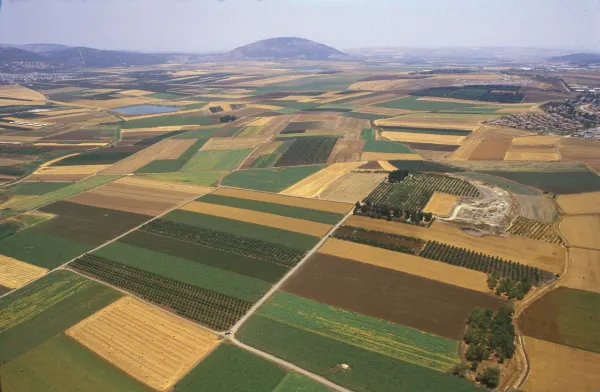
Jezreel Valley with Mt. Tabor on horizon
Z. Radovan/www.BibleLandPictures.com
Introduction
The book of Ruth opens with “in the days when the judges judged,” suggesting that ancient Israelites regarded the events described in the book of Judges as occurring in an identifiable historical period. In one sense, the purpose of Judges is to explain how the Israelites made the transition from being a nomadic people wandering in the desert to the settled agriculturalists that provided the basis for the monarchies of Saul and David. One might have expected their conquest of Canaan, as described in Joshua, to have been followed quickly by the development of sophisticated monarchic political institutions, but this process took from three to four hundred years (depending on the date of the Exodus).1
Much of what is described in Judges and the literary forms incorporated in the book find counterparts in extrabiblical writings from the second and first millennia B.C. The book contains annalistic summaries of conquests, a victory hymn, prayers, prophecies, political speeches, a fable, geographic equations (Bethel = Luz), and so on, all of which are attested outside the Bible. However, while the literary style represented by Judges resembles other biblical compositions (Joshua, Samuel–Kings), it is unlike anything found outside the Bible in the ancient Near East. Whereas the archaeologists’ spades have unearthed inscriptions with literary links to virtually every type of writing found in Judges, nowhere do we find a coherent portrayal of history incorporating the forms and contents of these documents as we find in Judges.
The nearest analogues are the historigraphic writings of Herodotus and Thucydides, but these are far removed from the composition of Judges—in time (fifth century B.C.), space (Greece), and language (Greek). Whereas other ancient Near Eastern societies managed to preserve literary artifacts that contain snippets of historical and cultural information, these remain isolated and unintegrated; they provide the raw materials necessary for historical composition, but none represents the kind of intentional historiography as found in Judges. The biblical author has taken the raw materials and crafted a document that is not only compelling, but also represents a remarkable literary achievement. By deliberately selecting, arranging, and shaping these materials, he presents a picture of the Canaanization of Israelite culture between the Conquest and the establishment of the monarchy.
Historical Background
For the most part, the events described in Judges take place in Canaan, the small strip of land on the eastern Mediterranean sandwiched between Egypt to the south and the territories occupied by Phoenicians and Arameans in the north. Most of its narratives involved Israelites living west of the Jordan, though occasionally the effects spilled over into the Transjordan (e.g., Gideon’s pursuit of the Midianites, ch. 8). The account of Jephthah (10:6–12:7), located in the region of Gilead east of the Jordan, represents a significant exception.
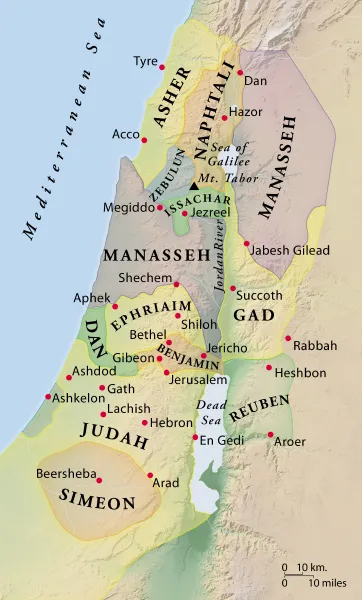
Tribes of Israel
According to chronologies established by archaeologists, the events described in this book transpired in the Late Bronze Age and Early Iron (Iron A and B) Ages. These labels are based on cultural features, specifically the technological transition from bronze to iron as the primary metal of choice. The significance of this shift, and the cultural lag experienced by the Israelites vis-à-vis the Canaanites, is reflected in 1:19 and 4:3, 13, where the narrator acknowledges the latter’s military superiority because they possessed iron chariots.
Establishing the chronological sequence of the events described in Judges poses special problems. While many of the places named in the book can be firmly identified geographically, not a single character is named in any contemporary ancient Near Eastern literature. Consequently, attempts to establish chronological relationships depend on internal biblical evidence of the book on the one hand, and extrabiblical evidence for contemporary developments on the other. We will deal with these separately.
Internal evidence for the chronology of the period of the Judges. Temporal notices appear regularly in this book, declaring the duration of the oppressions and the lengths of the respective rulers’ terms in office. The internal data may be summarized in tabular form.
Table of contents
- Cover
- Title Page
- Copyright Page
- Table of Contents
- How to Use This eBook
- Acknowledgments
- Methodology: An Introductory Essay
- General Bibliography
- Abbreviations
- Joshua
- Judges
- Ruth
- Picture Index
- The New International Version Appendix
Trusted by 375,005 students
Access to over 1.5 million titles for a fair monthly price.
Study more efficiently using our study tools.
Frequently asked questions
Yes, you can cancel anytime from the Subscription tab in your account settings on the Perlego website. Your subscription will stay active until the end of your current billing period. Learn how to cancel your subscription
No, books cannot be downloaded as external files, such as PDFs, for use outside of Perlego. However, you can download books within the Perlego app for offline reading on mobile or tablet. Learn how to download books offline
Perlego offers two plans: Essential and Complete
- Essential is ideal for learners and professionals who enjoy exploring a wide range of subjects. Access the Essential Library with 800,000+ trusted titles and best-sellers across business, personal growth, and the humanities. Includes unlimited reading time and Standard Read Aloud voice.
- Complete: Perfect for advanced learners and researchers needing full, unrestricted access. Unlock 1.5M+ books across hundreds of subjects, including academic and specialized titles. The Complete Plan also includes advanced features like Premium Read Aloud and Research Assistant.
We are an online textbook subscription service, where you can get access to an entire online library for less than the price of a single book per month. With over 1.5 million books across 990+ topics, we’ve got you covered! Learn about our mission
Look out for the read-aloud symbol on your next book to see if you can listen to it. The read-aloud tool reads text aloud for you, highlighting the text as it is being read. You can pause it, speed it up and slow it down. Learn more about Read Aloud
Yes! You can use the Perlego app on both iOS and Android devices to read anytime, anywhere — even offline. Perfect for commutes or when you’re on the go.
Please note we cannot support devices running on iOS 13 and Android 7 or earlier. Learn more about using the app
Please note we cannot support devices running on iOS 13 and Android 7 or earlier. Learn more about using the app
Yes, you can access Joshua, Judges, and Ruth by Richard Hess,Daniel I. Block,Dale W. Manor, John H. Walton in PDF and/or ePUB format, as well as other popular books in Theology & Religion & Biblical Commentary. We have over 1.5 million books available in our catalogue for you to explore.