![]()
1 Corinthians
by David W. J. Gill
1 Corinthians
Important Facts:
■ AUTHOR: The apostle Paul and Sosthenes.
■ DATE: c. A.D. 55 (Paul writing from Ephesus).
■ OCCASION:
• To respond to information that there had been quarrels in the church.
• To prepare for a visit from Timothy and Paul himself.
■ KEY THEMES:
1. The impact of the Christian gospel on the life of the Christian.
2. The ordering of the local church.
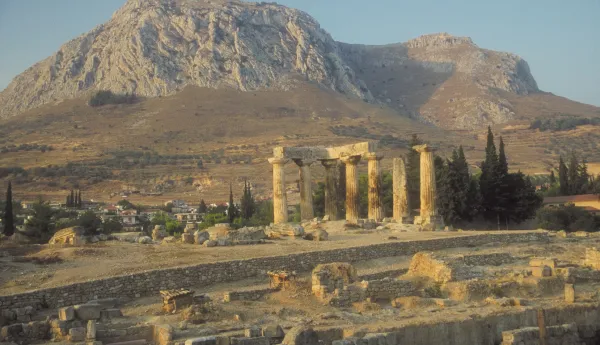
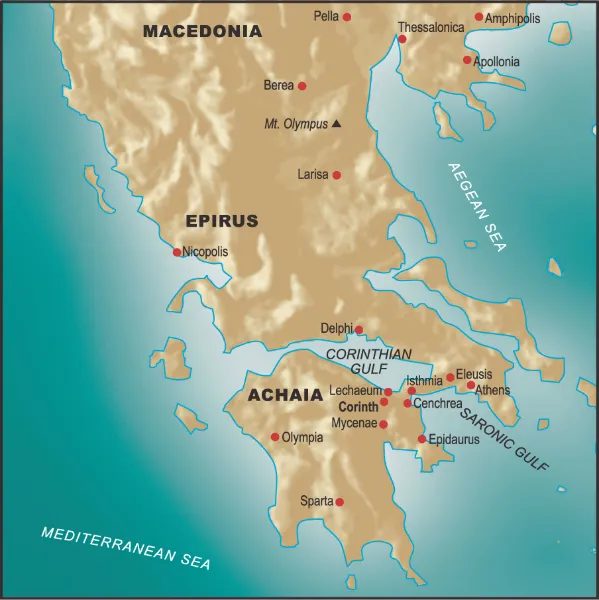
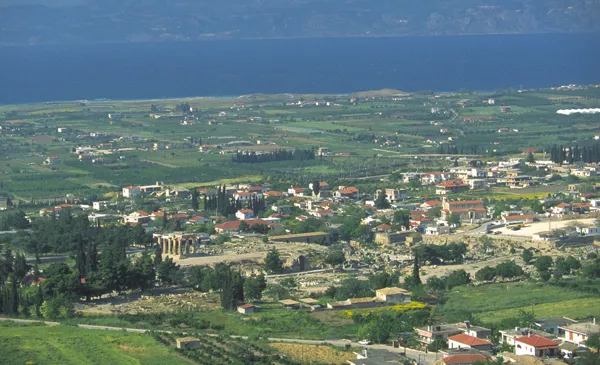
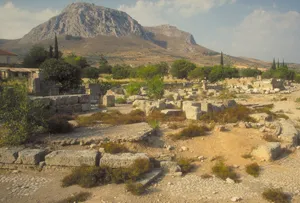
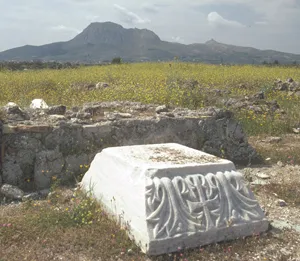
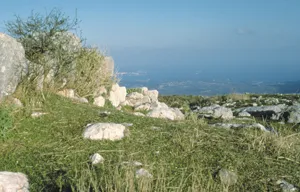
Corinth was a major city in the eastern Peloponnese of Greece.1 It lay near the narrow isthmus that joined the Peloponnese to the mainland. The city lay at the foot of a mountain, Akrocorinth (elevation 1883 feet), which also served as a location for some of the cults of the city.
The City of Corinth
The history of the city of Corinth can be traced back to the earliest periods of Greek history. In the archaic period (6th cent. B.C.) it was ruled by the Kypselid family. During the Peloponnesian War (late 5th cent. B.C.) Corinth fought against Athens. During the second century B.C. Corinth joined other Greek states to fight against the domination of Rome, and in 146 B.C. the city was captured and razed to the ground by the Roman general Mummius. As a result, the city was left derelict for over a hundred years until Julius Caesar decided to found a colony, with the full Latin title of Colonia Laus Iulia Corinthienses, in 44 B.C. As Caesar was assassinated in March of that year, it seems likely that Mark Antony, Caesar’s co-consul, may have been responsible for implementing the legislation. Some of the Roman sources suggest that the colony was established with Italian freedmen, that is, former slaves, though they probably only formed a small part of the overall population. The geographer Strabo records some of the details of the colony at this time:
Now after Corinth had remained deserted for a long time, it was restored again, because of its favourable position, by the deified Caesar, who colonised it with people that belonged for the most part to the freedman class. And when these were removing the ruins and at the same time digging open the graves, they found numbers of terracotta reliefs, and also many bronze vessels. And since they admired the worksmanship they left no grave unransacked.2
The City of Corinth
Important Facts:
■ Population: Approximately 100,000 (80,000 colony, 20,000 territorium).
■ Religion: Patron deity Aphrodite; major sanctuary of Poseidon at nearby Isthmia; numerous other deities worshiped.
■ Port city.
■ Seat of the Roman governor for the province of Achaia.
It is important to stress the lack of continuity between the Greek and Roman city. A number of buildings were demolished and the archaic temple in the heart of the town may have had its roof timbers removed. One of the famous descriptions of the ruined city occurs in a letter from Ser. Sulpicius to the Roman orator Cicero in 45 B.C.3 There are other references to individuals living among the ruins4, but the key point is that Corinth no longer existed as a political entity.
Corinth was one of a number of city-states (Gk. polis) in the Greek world. Her territory, the Corinthia, bordered on that of a number of other city-states. To the east along the isthmus that joined the Peloponnese to the Greek mainland was Megara. Northwards, along the coast of the Corinthian Gulf, was Sikyon. Along the southern side of the Corinthia was the Argolid, with cities such as Argos and Epidauros (where there was a major sanctuary for the healing-god Asklepios). Within the Corinthia were two main harbors, Lechaeum and Cenchreae, giving access respectively to the Corinthian Gulf (and Italy) and the Saronic Gulf and the eastern Mediterranean. These were some of the major harbors of the Mediterranean, rivaling those of Ostia (the port of Rome), Alexandria in Egypt, and Caesarea (the major port that gave access to Judea).
Corinth became the residence for the Roman governor of the senatorial province of Achaia, which was reestablished by Claudius in A.D. 44. Prior to that, the province had been combined with Macedonia as one of the military “imperial” provinces (see comments on 16:15). This administrative function allowed Corinth to become the leading city in the province. It seems to have attracted members of elite families to reside there, such as the Euryclids from Sparta. It also meant that individual cities would need to consult the governor at Corinth; thus, members of the Corinthian elite allowed themselves to be used as intermediaries or proxenoi. One of these proxenoi, L. Licinnius Anteros, was honored by the city of Methana near Troezen in A.D. 1/2.5
The Spiritual Climate of the Area
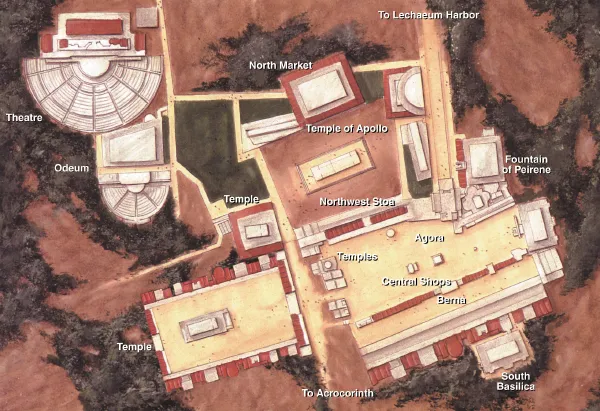
The second-century A.D. Roman orator Favorinus of Arles (in the south of France) praised Corinth as a city “favoured by Aphrodite.”6 Certainly in the Hellenistic period before the sack of the city, the sanctuary of Aphrodite on the Acrocorinth had been a complex affair. Strabo, probably drawing on classical or Hellenistic historians of the city, noted that at this earlier time, “the temple of Aphrodite was so rich that it owned more than a thousand temple-slaves, courtesans, whom both men and women had dedicated to the goddess.”7 However, Strabo’s own visit to the Acrocorinth showed that the Roman temple was far more modest: “The summit has a small temple of Aphrodite.”8 Aphrodite or Venus (her Roman name) was seen as the ancestor of Julius Caesar, the founder of the Roman colony. Indeed in the Julian Forum at Rome, completed by Caesar’s adopted son Augustus, there was a temple to Venus Genetrix. A further temple of Aphrodite at Corinth appears to have been located on a terrace at the west end of the forum, as part of an inscription has been found that links the structure to Venus.9 The second-century A.D. travel writer Pausanias also noted that this part of the forum contained a statue of Aphrodite made by the sculptor Hermogenes of Kythera (an island off the south coast of the Peloponnese).10
The forum of Corinth today is dominated by the columns of a Greek temple of the Doric order of architecture, probably erected in the sixth century B.C. It survived the sack of the city ...