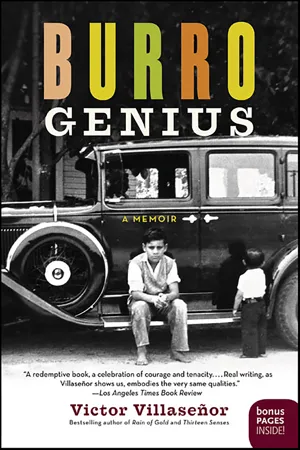
I was five years old. The year was 1945. My father, Juan Salvador Villaseñor, walked me from our old ranch house up to the corrals to talk with me.
“Mijito,” he said, “tomorrow you’ll be starting school, so it’s important for you to understand who you are and who your people are. You are un Mexicano. And Mexicanos are such good, strong people that everywhere, everyone wants to be a Mexican. Look at what used to happen back in the barrio in Carlsbad, the gringos and the negros would come to our poolhall, eat a few enchiladas, drink a couple of tequilas, and then they’d start to sing with the mariachis. That’s proof that everyone loves the Mexicans, and wants to be un Mexicano. Get it?”
I nodded. “Yes, I get it, papa.”
“Good, because now that you’re starting school, you have to be a good little man and start studying the girls, so when your time comes, you’ll know how to choose the right wife. Because the most important thing any man can do in all his life is pick the right woman to breed with—I mean, marry first, then breed, because from the woman comes the—”
“—comes the instinct to survive,” I said, having heard this for as long as I could remember.
“Good,” said mi papa, “very good. You remembered. And so for you to be attractive to girls, mijito, you can’t be picking your nose anymore and wiping it off on your pants. Do you understand? Lo cortés no quita lo valiante, y lo valiante no quita lo cortés.”
This I’d also heard for as long as I could remember, and it was one of our oldest Mexican dichos, sayings, and what it said was that manners didn’t take away bravery, and that bravery didn’t diminish manners.
“Yes,” I said, nodding, “I think I do.”
“And also,” said my dad as he continued smoking his big, long cigar and we passed under the huge old pepper tree, “from now on you got to be responsible, and this starts with every man and woman knowing how to wipe their own ass.”
I nodded again. I was listening real closely to every word that mi papa was telling me, because growing up on a ranch with horses and cattle and big trucks and tractors, I’d learned that if you didn’t pay attention real close to what you were told, the next thing you’d know, you’d be run over by a tractor, or be on horseback and have your saddle slip out from under you, or worse still, you’d have a rattlesnake scare the living shit out of you because you hadn’t been paying attention to where the Father Sun was in the sky and been watching out for the shady spots on the trail. But still, I was having a hard time listening to my dad, because my brain just kept jumping around inside of my head.
Hell, I’d never been away from mi familia before, and why did I need to go to school anyway. I was learning everything that I needed to learn there on the ranch. I knew how to milk a cow to get milk. I knew how to plant and grow corn so we could make tortillas. What else was there for me to learn?
“So are you understanding me, mijito?” my father now said to me, puffing on his cigar. “You’re going to have to now know how to be out on your own.”
I shook my head. “No, papa, I really don’t understand,” I said in Spanish. I didn’t know any English. All we ever spoke on the ranch was Spanish. “How can I stop picking my nose? When my mocos get dry”—mocos means snot in Spanish—“and begin to itch, they hurt if I don’t pick them. And my ass, I’ve never really figured out how to clean it real good yet. Do I bunch the toilet paper together, papa, or do I lay it out on the floor and fold it real carefully so that it stays flat when I wipe myself.”
“Who showed you to lay it out flat and fold it?” asked my father. “I never thought of that. I’ve always just bunched it together. My God, mijito, look at you, you haven’t even started school yet and already you’ve come up with a very good idea. I tell you, you’re going to do good in school! Hell, you’re already thinking, and that’s what education is really all about, learning how to think.”
Well, I felt good hearing this, but still, I didn’t like the idea that I was going to have to go to school. “Can I at least go to school on horseback?” I now asked. I’d been riding horses since I was three, and on top of a big horse I felt like Superman, faster than a speeding bullet and stronger than a locomotive!
“No, I don’t think so,” said my dad.
“Why not? Uncle Archie said that when he went to school, half the kids on the reservation went on horseback and they got to take their rifles, too, so they could hunt for game on their way home for supper.”
My dad pushed back his Stetson and scratched his head. “That was a long time ago, mijito. We can’t just go riding or carrying guns into town anymore. We’re civilized nowadays.”
I really didn’t like hearing this. I figured that I’d have a hell of a lot better chance at school if I could take my horse and my trusty BB gun rifle. On foot, I was still pretty damn short, and going into any new territory, I’d found out that I had a better chance if I went on horseback and was well armed.
I could hardly sleep that night—I was so nervous. I kept tossing and turning, and my older brother and sister were no help, because I’d learned so far in life that you had to take your own lumps when a horse threw you. Nothing anybody could tell you about getting bucked off could prepare you for the first time you ate dirt and felt so stunned that your brain couldn’t even work until you’d taken a few breaths. But then, after eating dirt two or three times, getting bucked off wasn’t all that bad anymore. I’d found this out first hand.
Monday morning, I got up extra early, washed, brushed my teeth, pulled up my bedding, laid out my clothes, and put on my new Levi’s and the new long-sleeve checkered shirt my mother had gotten for me at JCPenney in downtown Oceanside. I loved going to Penney’s with my mother, because at Penney’s, they had a jar attached to a wire that they’d put your money in when you paid for something and the jar was then pulled on a wire real fast up to a little window above the store floor. The jar would then somehow miraculously slow down just as the window-woman reached out, took the jar, opened it, took out your money, made your change, wrote out a receipt, and then put everything back in the jar and pulled the cord and the jar came flying back down on the wire as fast as a bird with its ass on fire. Also, I loved Penney’s because—like my mother Lupe always said—our pennies went further at Penney’s than they did at Sears. But still, Sears was where we got most of our farm and horse equipment.
After breakfast, my mother took me into the bathroom and wiped off the egg that I’d gotten on my new shirt. I could now see that my mother had been very smart in insisting I get a checkered shirt instead of the plain blue one that I’d wanted, because the wiped-wet-area where she’d cleaned on my skirt was hardly even visible with all of the checkers.
When my mother was done cleaning me, she left, and I stayed behind in the bathroom alone. I peed in our toilet that was stained all orange from our hard well-water, then I got up on my little box so I could see myself in the mirror over the sink—which was also stained orange—and I saw that my hair was just about all combed down except where it always stood straight up in the back like the quills of a porcupine. Standing on the box, I made the sign of the cross over myself and began talking with God.
“Papito,” I said, “You might have forgotten, because You’re so busy and all, but today I’m going to school all alone and I’m just a little kid, especially when I’m on foot, so I’ll need for You to please stay by my side and help me out in case I do something dumb and get in trouble. Okay? Do we got a deal, Papito, You’ll stay by my side, eh?”
Making my request, I now closed my eyes real tight like mi mamagrande Doña Guadalupe had taught me to do, so I could then hear the voice of God inside of me. But what I heard next, I don’t think was the voice of Papito, because now I heard my mother shouting, “Hurry up! You don’t want to be late on your first day of school!”
My heart started pounding. Quickly, I made the sign of the cross once again, and said, “See You at school, God,” and ran out of our smelly old bathroom, past the kitchen, out the back door, and to our car. I opened the car door, pushed the chicken off the passenger’s seat where she’d no doubt decided to nest, and my mother and I were off, with chicken feathers flying all over us. Usually my mother went to work at about this same time, but this morning she was going to drop me off at school, then go to downtown Oceanside to do her bookkeeping at our main liquor store, which was located just up from the train station, near the pier. I loved the Oceanside pier. This was where Uncle Archie would sometimes take me fishing.
My mother drove us out from under the two huge pepper trees, passed our grouping of torrey pines, and drove down the long driveway of our huge rancho grande, underneath the umbrella of tall eucalyptus trees.
“You’re going to love school,” said my mother. “Going to school with your godmother Manuelita back in La Lluvia de Oro were some of the best days of my life.”
“But weren’t you a little scared on your first day, mama?”
“Yes, I guess I was, but your godmother Manuelita was the teacher’s helper and she walked with me to school. Don’t worry,” she added. “You’ll make friends, and then with friends, school and life are much easier, mijito.”
I hoped that my mother was right, because living on a ranch, I didn’t know any kids my own age, much less have any friends. I guess that my dog Sam had been the closest thing that I’d ever had to a friend, but, then, he’d gotten run over by our German friends, Hans and Helen Huelster, about a year back.
I was looking out our car window as we drove. I could see that there were dozens of wild ringneck pheasants in our orchards of lemons and oranges. Seeing these beautiful birds gave my heart wings. Then we passed the dark orchard of huge avocado trees with the one old loquat tree where hundreds of birds liked to hang out. I laughed at seeing all the birds. Up ahead, we came to California Street. This was where we had our mailbox. Here we turned right, went past my aunt Tota’s house—she was my mother’s older sister and married to Uncle Archie—then we took a curve in the road to the left, then a sharp right-hand turn, went past the new Hightower’s Market, and came to Coast Highway, which was back then called Hill Street. At Hill Street we turned right. Hill, back then, was the biggest, widest, longest street in all of Oceanside. In fact, Hill Street was then part of the old 101 Highway, which ran up and down the whole coast of California.
Now my mother, a very good driver, speeded up and we went down a small hill, over the little bridge with the inlet of seawater that went up towards our house, up a short hill, across the railroad tracks, alongside the cemetery where my mamagrande Doña Guadalupe was buried, and then passed Short Street, which would later be renamed Oceanside Boulevard. Here was where I lost track of all the streets we passed. Because from here on, we weren’t going along the outside perimeter of our big rancho grande, and so I didn’t know my way around anymore.
Suddenly, up ahead, we turned right again and climbed a steep hill with lots of short blocks, as if we were going up to the great big Oceanside High School. And I was really glad that we’d made all right-hand turns, because I just didn’t like left-hand turns. I remembered very well that my grandmother, when we’d lived in the barrio in Carlsbad, had only made right-hand turns when she’d push me in my stroller around our block when I was little, and so to this day, I still only felt good with right-hand turns.
Then I couldn’t believe it; while I was thinking of my grandmother, my mother made a real sharp left-hand turn, and parked. My whole world felt like it had gotten all twisted around inside of my brain. Quickly, I flashed on mi mamagrande and my old dog Sam, and I just knew that I was going to need both of them, plus Papito Dios, if I were to survive the day.
“This is your school,” said my mother to me, opening her door and getting out of our car.
I didn’t like the look of things. There were kids running around all over the place and I didn’t know any of them. My mother closed her door and came around the back of our car and opened the car door for me.
“Com...