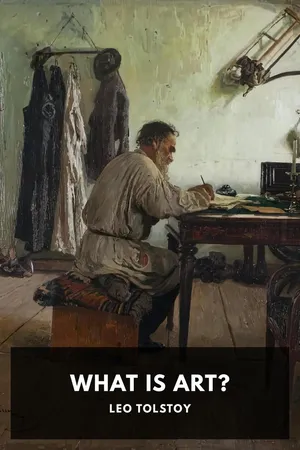
What Is Art? is an 1897 philosophical treatise by Leo Tolstoy that lays out his philosophy of aesthetics. Rejecting notions of aesthetics that center around beauty, Tolstoy instead posits that art is defined by its role in transmitting feelings between human beings, and that its quality should be judged by whether those feelings align with a society's highest moral and religious ideals.
Tolstoy makes a number of unconventional aesthetic judgments in the course of the book, dismissing works like Wagner's operas, Romeo and Juliet, and even his own War and Peace and Anna Karenina as "bad art," while praising Dickens' A Christmas Carol and Hugo's Les Miserables as examples of the highest art.
Readers who love Tolstoy's fiction will find this a fascinating, sometimes contrarian look at the mind behind it, and a bracing challenge to anyone's assumptions about what makes art good.
The source for this public-domain ebook is Standard Ebooks (standardebooks.org). Ebooks from other sources often have typos, inconsistent spelling, missing accent marks, and missing punctuation. Ebooks from Standard Ebooks are proofread line by line against a scan of the original printed pages, then proofread again from cover to cover. They are also formatted and typeset following a professional-grade style manual, resulting in new editions supporting state-of-the-art ereader technology: automatic hyphenation, popup footnotes, complete and consistent metadata, high-resolution and scalable vector graphics, and ereader-compatible tables of contents. All of this makes the finished ebooks accurate, functional, and beautiful, a pleasure to read. (Waking Lion Press is not affiliated with or endorsed by Standard Ebooks.)