eBook - ePub
Ephesians, Philippians, Colossians, Philemon
- 144 pages
- English
- ePUB (mobile friendly)
- Available on iOS & Android
eBook - ePub
Ephesians, Philippians, Colossians, Philemon
About this book
Brimming with lavish, full-color photos and graphics, the Zondervan Illustrated Bible Backgrounds Commentary walks you verse by verse through all the books of the New Testament. It's like slipping on a set of glasses that lets you read the Bible through the eyes of a first-century reader! Discoveries await you that will snap the world of the New Testament into gripping immediacy. Things that seem mystifying, puzzling, or obscure will take on tremendous meaning when you view them in their ancient context. You'll deepen your understanding of the teachings of Jesus. You'll discover the close, sometimes startling interplay between God's kingdom and the practical affairs of the church. Best of all, you'll gain a deepened awareness of the Bible's relevance for your life. Written in a clear, engaging style, this beautiful set provides a new and accessible approach that more technical expository and exegetical commentaries don't offer.
Information
Topic
Theology & ReligionSubtopic
Biblical CommentaryEphesians
by Clinton E. Arnold
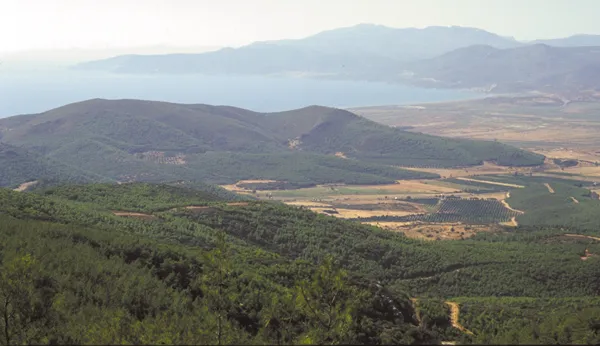
EPHESUS
The countryside around the city.
Ephesians
Important Facts:
■ AUTHOR: The apostle Paul.
■ DATE: A.D. 60–61 (Paul imprisoned in Rome).
■ OCCASION:
• To give new believers converted from a background in Judaism, local religions, magic, and astrology a positive grounding in the gospel of Christ.
• To help and admonish believers to cultivate a distinctively Christian lifestyle.
■ KEY THEMES:
1. Christ is supreme over all of creation, especially the powers of darkness.
2. Believers participate with Christ in his death, resurrection, and fullness.
3. The church is the one body of Christ and is composed of Jews and Gentiles.
Ephesus and Western Asia Minor
The city of Ephesus was the leading city of the richest region of the Roman empire. With a population of about 250,000 people, only Rome and Alexandria were larger. Ephesus served as the Roman provincial capital of Asia Minor and was a prosperous commercial center. As the principal port for Asia Minor, merchant and cargo vessels from all over the Mediterranean docked there to unload passengers and goods as well as to transport products from Asia Minor to Rome and throughout the empire. The first-century writer Strabo called Ephesus “the greatest commercial center in Asia this side of the Taurus river.”1
The city was cosmopolitan and multiethnic. In addition to the indigenous Anatolian peoples of Ionia, Lydia, Phrygia, Caria, and Mysia, Ephesus was home to Egyptian, Greek, and Roman settlers. There was also a strong Jewish community in the city since Seleucid times (3d century B.C.). It appears that the Jews of the city had a fairly cordial relationship with the civic officials and the local populace since there is no evidence of the kind of ethnic strife that rocked Alexandria and Rome. According to Josephus, they had been granted freedom to practice their religion according to their own traditions.2
The Introduction of Christianity to the City
Paul started the church at Ephesus after his eighteen-month sojourn in Corinth and following a visit to Jerusalem. He was aided significantly by the help of a Jewish-Christian couple from Rome, Priscilla and Aquila.
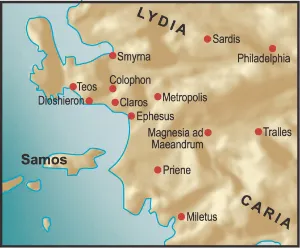
EPHESUS AND ITS SURROUNDING CITIES
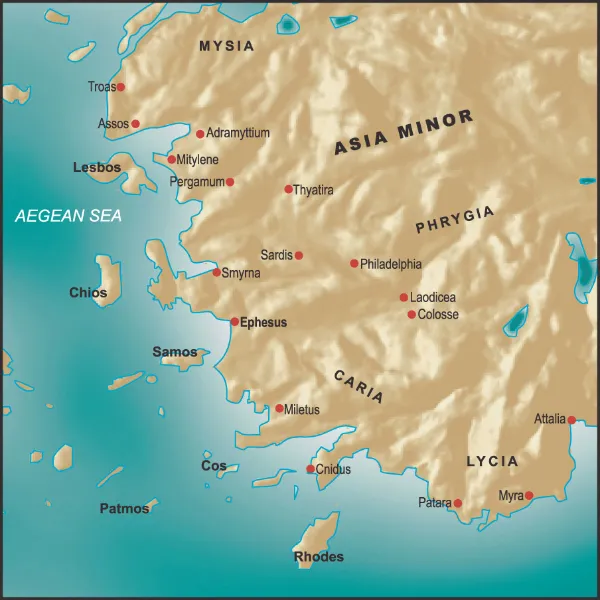
WESTERN ASIA MINOR
Luke provides us with a few of the highlights of Paul’s ministry there in Acts 19. Following the typical pattern of his missionary outreach, Paul began proclaiming the gospel in the synagogue until opposition to his preaching grew too strong. He then moved to a lecture hall in the city where he taught regularly. The Western text of the book of Acts preserves the tradition that he taught there daily between 11:00 A.M. and 4:00 P.M. Most significantly, Luke claims that not only did people in Ephesus and its environs hear the gospel during these two years, but “all the Jews and Greeks who lived in the province of Asia heard the word of the Lord” (Acts 19:10). It was during this time that churches began in various other cities of western Asia Minor including Colosse, Laodicea, Pergamum, Smyrna, Sardis, Magnesia, Tralles, and elsewhere.
The original church of Ephesus thus consisted of many converted Jews and Gentile God-fearers and sympathizers to the Jewish faith, as well as many Gentiles coming directly from the pagan cults of the city, particularly the cult of Artemis. If the silversmith guild had experienced such a sharp decline of revenues for their images of Artemis, there was probably a sizeable group of Gentiles who embraced the one true God and the Lord Jesus Christ.
It is highly unlikely that the church met as a large group in one central location. Groups of believers probably met in homes every Lord’s day in various parts of the city and in the local villages (e.g., Hypaipa, Diashieron, Neikaia, and Koloe).
The Spiritual Climate of the Area
There are some distinctive features of the religious environment of the area that help us better understand the discipleship issues these new believers faced and why Paul addressed certain topics and stressed others in his letter.
CURETES STREET
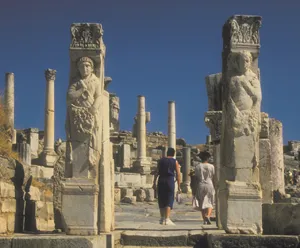
At the beginning of the street, the columns depict Hercules draped in a lion skin.
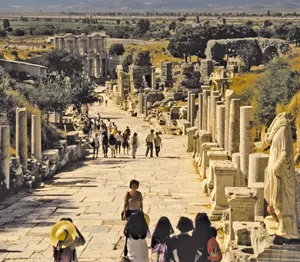
The well-preserved street passes by the principal civic buildings of Ephesus.
A religiously pluralistic environment. Although best known as the sacred home to the Artemis cult, up to fifty other gods and goddesses were worshiped in Ephesus. Among those worshiped in Ephesus were Zeus, Athena, Aphrodite, Asclepius, Apollo, Dionysus, Demeter, Hekate, Tyche, Theos Hypsistos, Meter Oreia, and Hephaistos.3 The two Egyptian deities Isis and Sarapis were also popular in the city.4 There was a spirit of religious tolerance among the people. In fact, people typically worshiped more than one deity.
The pervasive influence of the Artemis cult. Artemis of Ephesus was undeniably the most important deity to the people living in the city. Her relationship to the city was forged in terms of a divinely directed covenant relationship. One month of the year was named after her, Olympic-style games were held in her honor (the Artemisia), and the cult was the major savings and loan institution for the entire region. The temple of Artemis was lauded by ancient writers as one of the seven wonders of the ancient world.5
Magic and spirit powers. Ephesus also bore a reputation in antiquity for magic, shamanism, and the occult arts. The practice of magic was predicated on an animistic worldview in which good and evil spirits were involved in practically every area of life. Magic represented a means of harnessing spiritual power through rituals, incantations, and invocations.6 Luke informs us that many believers gathered their magical books together and burned them after a fear fell on them following Sceva’s failed exorcism of a demonized man (Acts 19:17–20). His account demonstrates the difficulty new Christians had in turning completely away from their former practices in the process of discipleship. It would have been tempting for them to continue using magical incantations and invoking other deities and helper spirits for issues in daily life.
A Portrait of the Situation
Paul engaged in his Ephesian ministry in the mid–50s (perhaps A.D. 52–55). During this time the church was established and numerous other churches in a radius from Ephesus were planted. After his abrupt departure from the city precipitated by the silversmiths and adherents to the Artemis cult, Paul traveled to Macedonia and Greece. From there he went to Jerusalem, where he was arrested (see Acts 20–21). From that point on, Paul was incarcerated by the Romans—in Caesarea and then, after his harrowing sea voyage, in Rome (A.D. 60–62). It is from his imprisonment in the capital city that Paul writes this letter, probably shortly after he writes to the Colossian believers.
In the five years or so since his departure, a lot has happened in the churches of Ephesus and its environs. The believers have continued to proclaim the gospel in the area and many more Gentiles have put their faith in Christ and joined the Christian community. These new believers have never met Paul, but they have certainly heard of him and respected his authority as an apostle of Christ.
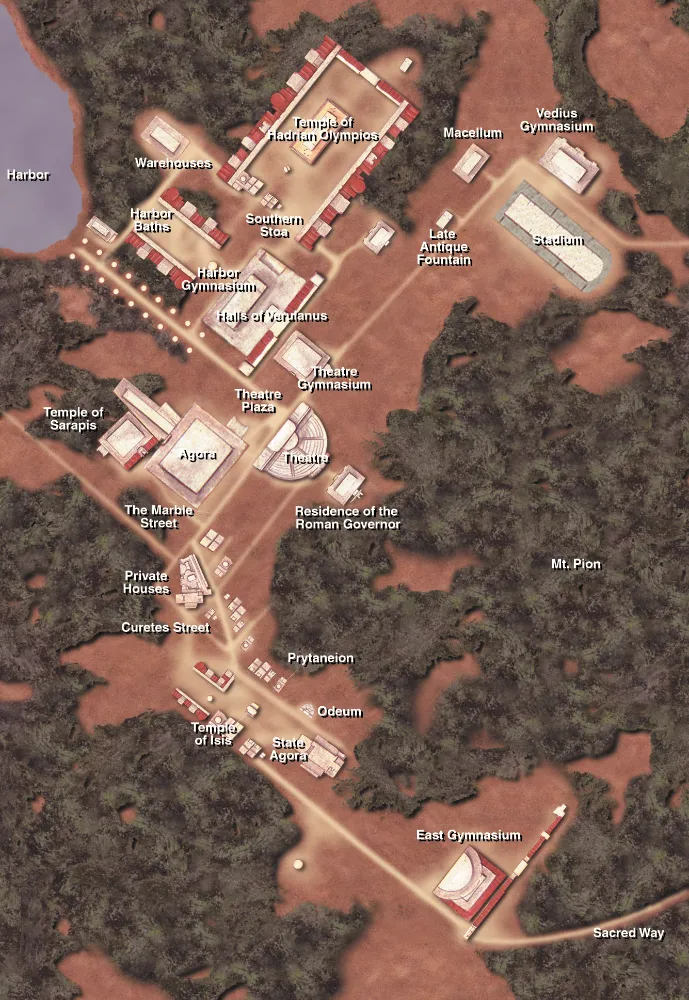
EPHESUS
Coming to Christ from a background of animism, goddess worship, magical practices, and a variety of other religions, these people need a more extensive grounding in the gospel and its implications for life. Paul writes the letter to support the Ephesian leadership in addressing a variety of concerns. Three issues in particular surface as the most prominent:
1. When these people turned to Christ and joined the community, their fear of evil spirits and demonic powers did not vanish. They would have been greatly tempted to hold onto some of their household idols and their magical texts in spite of the precedent set by the original believers of Ephesus in the histor...
Table of contents
- Cover
- Title Page
- Copyright Page
- Contents
- How to Use This eBook
- Introduction
- List of Sidebars
- List of Charts
- Index of Photos and Maps
- Abbreviations
- Ephesians
- Philippians
- Colossians
- Philemon
- Credits for Photos and Maps
- The New International Version Appendix
Trusted by 375,005 students
Access to over 1.5 million titles for a fair monthly price.
Study more efficiently using our study tools.
Frequently asked questions
Yes, you can cancel anytime from the Subscription tab in your account settings on the Perlego website. Your subscription will stay active until the end of your current billing period. Learn how to cancel your subscription
No, books cannot be downloaded as external files, such as PDFs, for use outside of Perlego. However, you can download books within the Perlego app for offline reading on mobile or tablet. Learn how to download books offline
Perlego offers two plans: Essential and Complete
- Essential is ideal for learners and professionals who enjoy exploring a wide range of subjects. Access the Essential Library with 800,000+ trusted titles and best-sellers across business, personal growth, and the humanities. Includes unlimited reading time and Standard Read Aloud voice.
- Complete: Perfect for advanced learners and researchers needing full, unrestricted access. Unlock 1.5M+ books across hundreds of subjects, including academic and specialized titles. The Complete Plan also includes advanced features like Premium Read Aloud and Research Assistant.
We are an online textbook subscription service, where you can get access to an entire online library for less than the price of a single book per month. With over 1.5 million books across 990+ topics, we’ve got you covered! Learn about our mission
Look out for the read-aloud symbol on your next book to see if you can listen to it. The read-aloud tool reads text aloud for you, highlighting the text as it is being read. You can pause it, speed it up and slow it down. Learn more about Read Aloud
Yes! You can use the Perlego app on both iOS and Android devices to read anytime, anywhere — even offline. Perfect for commutes or when you’re on the go.
Please note we cannot support devices running on iOS 13 and Android 7 or earlier. Learn more about using the app
Please note we cannot support devices running on iOS 13 and Android 7 or earlier. Learn more about using the app
Yes, you can access Ephesians, Philippians, Colossians, Philemon by Clinton E. Arnold,Frank S. Thielman,Steven M. Baugh, Clinton E. Arnold in PDF and/or ePUB format, as well as other popular books in Theology & Religion & Biblical Commentary. We have over 1.5 million books available in our catalogue for you to explore.