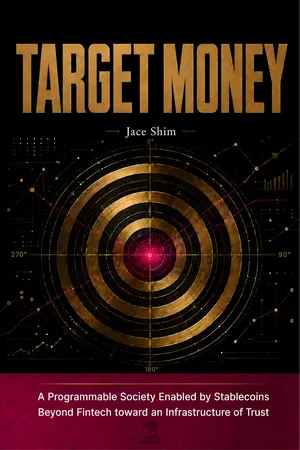
What if money could do more than simply move from one account to another?
Target Money explores how stablecoins can evolve beyond faster and cheaper payments to become programmable infrastructure for trust. Rather than treating blockchain as a purely technical innovation, the book examines how digital money can be designed around specific purposes, contractual conditions, verified performance, and real-world demand.
Drawing on economics, finance, governance, regulation, ESG, and smart-contract architecture, Jace Shim introduces a practical framework for reducing information asymmetry, settlement delays, administrative inefficiency, and the cost of distrust. The book applies this framework to sectors where conventional payment systems often fail to connect money with evidence of performance—including public welfare, care services, freelance work, environmental credits, and the emerging AI-agent economy.
At the center of the book are two proposed tokens: Care Cash (KRWC), a Korean won–denominated payment stablecoin, and Care Governance (GOVC), a governance token designed to support oversight, transparency, and ecosystem participation. Their reserve structures, redemption mechanisms, governance safeguards, risk scenarios, and illustrative smart-contract specifications are examined in detail.
Target Money does not claim that code can eliminate every legal, operational, or human risk. Instead, it asks a more practical question: How can programmable money reduce avoidable uncertainty while remaining accountable to regulation, governance, and real-world institutions?
For entrepreneurs, policymakers, financial professionals, ESG practitioners, and readers interested in the future of digital assets, this book offers a grounded blueprint for understanding stablecoins not merely as financial products, but as an emerging infrastructure of trust.