- 560 pages
- English
- ePUB (mobile friendly)
- Available on iOS & Android
eBook - ePub
About this book
The writings of John are some of the most foundational New Testament documents for today's Christians. Most evangelical teaching about the life of Jesus begins with the Gospel of John, and Christian teaching on the end times relies heavily on the book of Revelation.Students, pastors, and lay learners need solid, up-to-date resources like this book to responsibly study and understand John's writings. C. Marvin Pate addresses John's writings according to their logical divisions: the Gospel of John, the Johannine Epistles, and Revelation. Each section includes a thorough introduction to relevant interpretive issues, including historical background, cultural setting, and theological context. Pate presents a two-fold historical setting for John's gospel, encouraging readers to consider the text from the perspective of Jesus' day and from John's situation in Asia Minor sixty years later. He examines the Johannine epistles on issues like authorship, audience, and theological perspective. For the Apocalypse, Pate explores the challenges of John's first readers, the nature of apocalyptic literature, and the Roman imperial cult, including as well an explanation of how the church has interpreted Revelation over the years. With its thorough discussion, textbook design and four-color interior, The Writings of John sets the standard for introductory texts on biblical books or collections.
Information
Topic
Theology & ReligionSubtopic
Biblical StudiesPART 1
The Gospel of John
CHAPTER 1
Introduction to the Gospel of John
Objectives
After reading this chapter, you should be able to:
- Evaluate the evidence regarding the authorship of the fourth gospel.
- Explain the concept of the “Johannine school.”
- Discuss the possible backgrounds of the thought world of the fourth gospel.
- Discuss the eschatology of John.
- Describe the relationship between John, the epistles of John, and Revelation.
- Explain the genre of gospel.
- Delineate the twofold historical setting of the gospel of John.
- Point out the similarities between the Dead Sea Scrolls and the fourth gospel.
- Assess the Greek manuscript evidence for the gospel of John.
- Compare/contrast John with the Synoptic Gospels.
INTRODUCTION
I first studied the gospel of John seriously as a Bible college student in the fall semester of 1971. It was then that I was introduced to the distinctives of the fourth gospel. It is simple but profound in thought. Regarding this, Augustine supposedly said of John’s gospel, “John’s gospel is deep enough for an elephant to swim and shallow enough for a child not to drown.”
John’s language is dualistic (light versus darkness, above versus below, believers versus unbelievers, etc.). The fourth gospel records seven sign miracles and seven “I am” statements. It contains discourses rather than parables. Following a majestic prologue (John 1:1 – 18), the fourth gospel delineates certain stages of belief one proceeds through to achieve discipleship. Its polemical usage of the title “the Jews” is famous, and it is filled with realized eschatology (see below). These are but some of John’s unique features.
Yet John, like Matthew, Mark, and Luke, is obviously a gospel, a presentation of the life, death, and resurrection of Jesus Christ. And it has been beloved by both believers and heretics (see my later discussion of second-century Gnosticism’s affinity with the fourth gospel). From the end of the second century AD on, there was no doubt in the church’s mind that John belonged to the New Testament canon. It was, as Clement of Alexandria labeled it, a “spiritual gospel,”1 one to be mined for its depth of meaning. Even to day new believers are encouraged to first read the gospel of John, so beautiful and edifying is its message. Indeed, John 20:31 supports such advice: “These are written that you may believe that Jesus is the Christ, the Son of God, and that by believing you may have life in his name.”
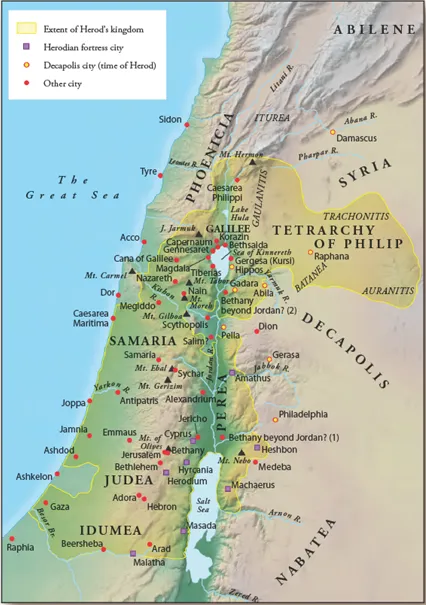
Palestine at the Time of Christ, A.D. 6–44
Scholars, too, since Origen’s third-century AD commentary on John, have been preoccupied with interpreting the fourth gospel. It is likely that it claims the attention of more scholars at the present time than any other book of the Bible. For example, from 1920 to 1965 alone, over three thousand academic works were written on the gospel of John2, and interest in it has not waned since then. Obviously, therefore, in an introductory work like this one, we can only scratch the surface of the meaning of the fourth gospel.
But wrestle with the meaning of John we will! After touching upon the key issues surrounding the fourth gospel, we will then move our way through the book chapter by chapter. So fasten your seat belt and hold on to your hat as we enter the wonderful world of the gospel of John.
We proceed now to discuss the following introductory issues associated with the fourth gospel: its authorship, its canonicity, the conceptual background of John, its historical setting, John as gospel, its structure, the Greek manuscript evidence for John, John and the Synoptic Gospels, and the theology of the fourth gospel.
I. THE AUTHORSHIP OF THE GOSPEL OF JOHN
Up until modern times, the traditional view of the authorship of the fourth gospel has been that John, “the beloved disciple,” wrote said book. I now summarize the evidence for that perspective, after which I consider alternative views of the authorship of the fourth gospel.
A. The Traditional View
The traditional view appeals to both internal evidence and external evidence in support of its claim that the apostle John wrote the fourth gospel.3 The former has to do with the contents of John, while the latter deals with the testimony of the church fathers.
1. Internal Evidence
B. F. Westcott’s classic commentary on John presents the internal evidence regarding the authorship of the fourth gospel in narrowing concentric circles, leading to the conclusion that the apostle John authored the fourth gospel. I now summarize this line of thinking.4
1. The author of John was a Jew. Thus he, like most Jews, awaited the Messiah promised in the Old Testament (John 1:21; 4:25; 6:14 – 15; 7:40–42; 12:34; et al.). He quotes the Old Testament (6:45; 13:18; 19:37). The author knows about Jewish traditions (2:6; 5:1; 10:22).
2. The author of John has a knowledge of Palestine (John 1:44; 2:1; 4:46; 5:2; 9:7; 10:22; 11:1; et al.).
3. The author presents himself as an eyewitness of the events he recorded (John 1:29, 35, 43; 2:6; 4:40, 43; 5:5; 12:1, 6, 12; 19:35; et al.).
4. The author was an apostle. He was “the Beloved Disciple” (cf. John 21:20, 24) who leaned on Jesus’ breast at the Passover supper (cf. 13:23; 19:26; 20:2; 21:7). The Synoptic Gospels (Matthew, Mark, and Luke) restrict the attendants at the Last Supper to the twelve apostles. Moreover, the author knows the disciples’ thoughts (2:11, 17, 22; 4:27; 6:19, 60; 12:16; 13:22, 28; 21:12) and Jesus’ private feelings (6:6, 61, 64; 13:1, 3, 11; 18:4; 19:28).
5. The author was the apostle John. The author was one of the inner circle of the disciples: Peter, James, and John (the latter two being the sons of Zebedee [John 13:23, 24; 20:2 – 10; 21:2, 7, 20]). Because James had long since been martyred before the writing of the fourth gospel (Acts 12:1 – 5) and Peter appears as a different person from the Beloved Disciple therein (John 21:7), only John is left to be the author.
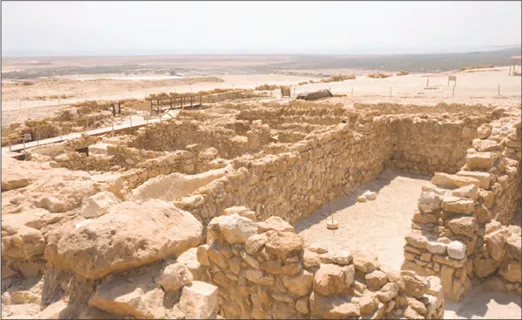
A scriptorium (a room for writing o or copying scrolls) at Qumran.
© Joseph Calev/www.istockphoto.com

The Dead Sea.
© Ella Hanochi/www.BigStockPhoto.com

The caves of Qumran adjacent to the Dead Sea. Home of the Dead Sea Scrolls.
© Dejan Gileski/www.com.BigStockPhoto.com

The entrance to cave 4, the treasure trove of the Dead Sea Scrolls’ find.
© Francesco Dazzi/www.BigStockPhoto.com
Since Westcott’s arguments, only the first two points have been confirmed. The Dead Sea Scrolls reveal the uncanny similarity of thought between the fourth gospel and their writings,5 confirming that the author was a Palestinian Jew. Not even the fact that John was written in Koine Greek detracts from its Jewish background, for more and more scholars recognize that, at the very least, Galilean Jews spoke Greek.6 But the other three of Westcott’s points are hotly contested, as we will see later.
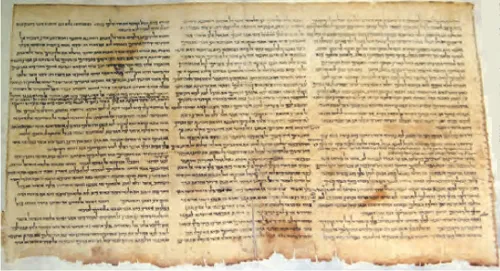
A portion of the Isaiah Scroll from Qumran (ca. 100 B.C.)
© Collection of The Israel Museum, Jerusalem and Courtesy of The Israel Antiquities Authority, Exhibited at The Shrine of the Book, The Israel Museum, Jerusalem.
2. External Evidence
External evidence from the time of the church fathers reflects an early belief that the apostle John wrote the fourth gospel. Irenaeus (AD 120 – 202) wrote, “Afterwards, John, the disciple of the Lord, who also had leaned upon His breast, did himself publish a gospel during his residence at Ephesus in Asia” (Against Heresies 3.1.1.). As for the reliability of Irenaeus, Eusebius says his authority was Polycarp (AD 70 – 155/60), who had personally heard the apostles (Eccl. Hist. 4.14).
Theophilus of Antioch (AD 115 – 88), Clement of Alexandria (AD 190), Origen (c. AD 220), Hippolytus (AD 225), Tertullian (c. AD 200), and the Muratorian Fragment (AD 170) agree in attributing the fourth gospel to John, the son of Zebedee.
Eusebius on Polycarp, Disciple of the Apostle John
I remember the events of those days more clearly than those which have happened recently, for what we learn as children grows up with the soul and becomes united to it, so I can speak even of the place in which the blessed Polycarp sat and disputed, how he came in and went out, the character of his life, the appearance of his body, the discourse which he made to the people, how he reported his converse with John and with the others who had seen the Lord, how he remembered their words, and what were the things concerning the Lord which he had heard from them, including his miracles and his teaching, and how Polycarp had received them from the eyewitnesses of the word of life, and reported all things in agreement with the Scriptures. (Eccl. Hist. 5.20.5 – 6)
One possible exception to the testimony of the church fathers is Papias’s statement (early second century AD) recorded by Eusebius (early fourth century AD), referring to two Johns:
And if anyone chanced to come who had actually been a follower of the elders, I would enquire as to the discourses of the elders, what Andrew or what Peter said, or what Philip, or what Thomas or James, or what John or Matthew or any other of the Lord’s disciples; and things which Aristion and John the elder, disciples of the Lord, say.
Eusebius then comments:
Here it is worth noting that twice in his enumeration he mentions the name of John: the former of these Johns he puts in the same list with Peter and James and Matthew and the other Apostles, clearly indicating the evangelist; but the latter he places with the others, in a separate clause, outside the number of the Apostles, placing Aristion before him; and he clearly calls him “elder.” (Eccl. Hist. 3.39.45)
Some have inferred from this comment that it was the second John...
Table of contents
- Cover
- Title Page
- CONTENTS
- List of Abbreviations
- Exctrabiblical Writings
- Introduction
- PART 1 The Gospel of John
- PART 2 The Epistles of John
- PART 3 Revelation
- Glossary
- Conclusion
- Copyright
- About the Publisher
- Share Your Thoughts
Trusted by 375,005 students
Access to over 1.5 million titles for a fair monthly price.
Study more efficiently using our study tools.
Frequently asked questions
Yes, you can cancel anytime from the Subscription tab in your account settings on the Perlego website. Your subscription will stay active until the end of your current billing period. Learn how to cancel your subscription
No, books cannot be downloaded as external files, such as PDFs, for use outside of Perlego. However, you can download books within the Perlego app for offline reading on mobile or tablet. Learn how to download books offline
Perlego offers two plans: Essential and Complete
- Essential is ideal for learners and professionals who enjoy exploring a wide range of subjects. Access the Essential Library with 800,000+ trusted titles and best-sellers across business, personal growth, and the humanities. Includes unlimited reading time and Standard Read Aloud voice.
- Complete: Perfect for advanced learners and researchers needing full, unrestricted access. Unlock 1.5M+ books across hundreds of subjects, including academic and specialized titles. The Complete Plan also includes advanced features like Premium Read Aloud and Research Assistant.
We are an online textbook subscription service, where you can get access to an entire online library for less than the price of a single book per month. With over 1.5 million books across 990+ topics, we’ve got you covered! Learn about our mission
Look out for the read-aloud symbol on your next book to see if you can listen to it. The read-aloud tool reads text aloud for you, highlighting the text as it is being read. You can pause it, speed it up and slow it down. Learn more about Read Aloud
Yes! You can use the Perlego app on both iOS and Android devices to read anytime, anywhere — even offline. Perfect for commutes or when you’re on the go.
Please note we cannot support devices running on iOS 13 and Android 7 or earlier. Learn more about using the app
Please note we cannot support devices running on iOS 13 and Android 7 or earlier. Learn more about using the app
Yes, you can access The Writings of John by C. Marvin Pate in PDF and/or ePUB format, as well as other popular books in Theology & Religion & Biblical Studies. We have over 1.5 million books available in our catalogue for you to explore.