eBook - ePub
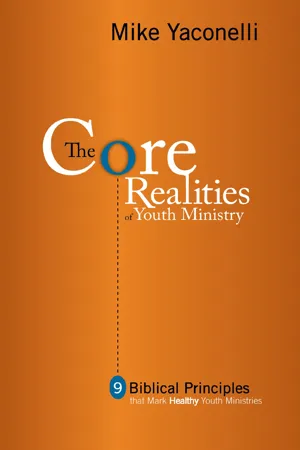
The Core Realities of Youth Ministry
Nine Biblical Principles That Mark Healthy Youth Ministries
- 144 pages
- English
- ePUB (mobile friendly)
- Available on iOS & Android
eBook - ePub
The Core Realities of Youth Ministry
Nine Biblical Principles That Mark Healthy Youth Ministries
About this book
Mike Yaconelli composes his thoughts and passions regarding the nine core realities of youth ministry: veracity (youth ministry must expose students to the life-giving truth of Jesus Christ), authenticity (authentic youth workers will draw young people to Jesus Christ), audacity (youth ministry must push students, parents, and the church outside their comfort zones), sanctuary (youth ministry must provide a safe place for students), diversity (youth ministry must challenge young people to embrace diversity), humility (youth ministry should be clothed in humility), intimacy (our relationship with Jesus is our youth ministry), mystery (youth ministry must foster mystery, rediscover astonishment, and leave room for unanswered questions), and creativity (youth ministry must free students and youth workers to discover and express their God-given creativity). As an added resource, each member of the CORE™ seminar team, including authors and speakers such as Laurie Polich, Efrem Smith, Marv Penner, Duffy Robbins, contributes sidebars throughout the book responding to Mike's thoughts.
Information
Topic
Theology & ReligionSubtopic
Inclusive EducationChapter 1
Core Foundation The Bible
Mike’s Story
I began this wild ride called youth ministry 42 years ago. Armed with a few communication skills, no experience, and a passion for God, I jumped into ministry feet first. For reasons I can’t explain, I intuitively knew I had access to what was most important—my Bible. Although I was kicked out of both Bible colleges I attended, something (or Someone) convinced me that the words written in this book were more than important—they were critical! As it turned out, the words of God kept me on the trail of God. And he is on my trail.
Looking back over the years, I realize the Bible isn’t magic, but it is corrective; it isn’t an answer book, it is a living book; it isn’t a fix-it book, it is a relationship book. When I confront God’s word, I am confronted; when I read God’s word, it reads me; when I seek God’s presence, he seeks me. The Bible has woven its way into my heart, soaked into my bones, given direction, provided hope, and demanded humility. It has been a companion along the way—a friend and a mentor. After four decades of use, it is still fresh, still relevant, and still full of life-giving truth.
So when I do youth ministry, I just grab my Bible, jump into God’s arms, and hang on for the ride.
Because the core realities are founded on the truths of Scripture, it’s important that we spend some time focusing on the Bible and understanding the role of Scripture in our ministries. Obviously, we don’t worship the Bible; we worship the God of the Bible, and it is the Bible that tells us about God. It helps us develop our relationship with God, guides us in our relationships with others, and reveals the truth for us today—here and now.
Even though the Bible was written thousands of years ago, it’s still relevant today. We believe the truths of the Bible are unchanging, but the implications of truth change continually as culture and teenagers change. This generation of students is like every generation in some ways and unlike every generation in other ways. That’s why we trust the Bible—it speaks to both realities: The unchanging human condition and the constantly changing cultural conditions. It speaks to all generations.
We trust the Bible because it’s the truth. It was the truth when it was written, and it is the truth now. It’s the truth now because it’s living truth. In our lives, the word of God acts; it affects us and lives with us. God’s words are the breath of life, a mystery, and a story. They live, reveal, interfere, inspire, and provide a solid foundation. These are just eight of the many characteristics of biblical truth, and below are the ways in which these characteristics affect us. These, we believe, are the foundations of the core realities.
1. Biblical Truth is God-breathed.
All Scripture is God-breathed and is useful for teaching, rebuking, correcting and training in righteousness…(2 Timothy 3:16)
Timothy says that the words in the Bible emanate from God, like the very breath of God, the wind of God. These words can help train us in righteousness. By reading God’s words, we can know the mysteries of God; we can know what God is up to.
Hold on. Before we get too excited, it’s important to remember the words of God in Isaiah:
“For my thoughts are not your thoughts, neither are your ways my ways,” declares the Lord.“As the heavens are higher than the earth, so are my ways higher than your ways and my thoughts than your thoughts.” (55:8-9)
Even though God’s words are directly from him, we won’t always know specifically what God is up to. God’s words can teach, rebuke, correct, and train. They also can confuse and amaze. They draw us to the shores of mystery…
2. Biblical Truth is a mystery.
Pray also for me, that whenever I open my mouth, words may be given me so that I will fearlessly make known the mystery of the gospel.(Ephesians 6:19)
The Bible is filled with awe-inspiring mystery. This mystery is part of our delight in God’s word. Our goal in youth ministry, then, is to educate teenagers in the Scriptures and to show them the mystery, to render them speechless by what they read. We want them to be literate as well as astonished, surprised, shocked, spellbound, overwhelmed, and awestruck. We want them to find answers, and we want them to meet the God beyond answers.
When Jesus met the disciples on the water (Matthew 14, Mark 6, John 6), they were terrified. Talk about drama and mystery! The disciples were frightened out of their minds…and intrigued. Jesus knew the power of the mysterious. As well as teaching his disciples, Jesus scared the sandals off them. By walking on the water, he terrified the disciples—they thought he was a ghost! Reading about the Son of God walking on the water can cause us to experience terror as well. Our task is to introduce students to the terrifying power of the Savior through the biblical story.
In my middle school days, we were herded into the gym for ballroom dancing class. Talk about torture! Coach Welch had a knack for making a waltz feel like calisthenics: “Hut-two-three-slide!” All the while, though, he kept telling us how graceful this was, how wonderful, how romantic. I remember thinking, “I wish this girl would just leave me alone and let me get these stupid steps right!”
But little did we realize that ballroom dancing is not simply about getting the steps right—it’s about a growing relationship with your partner, about moving together in an embrace of openness and developing intimacy. It’s about the mysterious connection that enables you to dance beautifully.
Often we imply that true spirituality is about getting “the steps” of the dance right. Except that the Bible doesn’t give us “five easy steps to a happy life” or “four easy steps to wonderful children” or “three easy steps to a pain-free existence.” But the mystery of the gospel is that God calls us to seek his face, to read his Word, to develop that growing intimacy—and in the mystery of that relationship, we will find we are moving in unison with him.
—Duffy Robbins
3. Biblical Truth is a story.
The Bible is not primarily a proof text or a doctrinal statement; it is a drama. It is not only theology; it is a poem. It is not only facts; it is an adventure. The biblical story is a captivating read that should leave us breathless. In fact,
Let’s not be so concerned about making sure the Bible is completely understood all the time. If I simplify the incredible mystery of Scripture to the point where an adolescent mind (or an adult one, for that matter) can fully grasp it, I reduce the author to my level. Because if God is God, his word will, by definition, be beyond me. Kids today are much more comfortable with this than most adults.
—Dave Ambrose
Hebrews 11 retells the events of the Old Testament as a story. Ultimately, this story is a love story, and this love story is made up of a collection of stories that point teenagers to the storyteller, the lover.
This story of truth and love, according to Psalm 119, is invigorating, sensual, terrifying, colorful, comforting, disturbing, visual, convicting, and penetrating. Woo hoo! It does more than stimulate our thinking; it exposes our very hearts, thoughts, desires, and passions; it defines sin; it convicts us of sin; it clarifies virtue and integrity—we read it, and it reads us!
Most people are anxious to hear the truth, and God help those who kill that expectancy by making the Bible boring. Sadly, many of us can remember attending a church, Sunday school, or youth group where our expectancy
It’s no secret that adolescents today are predisposed to experiencing life as a series of intersecting stories. Students’ identities are found in the complex relational and circumstantial plots of their formative years. “You will know me if you take the time to get to know my story” is their invitation. And one thing that makes Scripture attractive to this generation is that it’s a fascinating story in which they have a role. If I can introduce them to a script in which their personal stories are written, they can embrace the relevance of Scripture.
—Marv Penner
was smothered. Mark 10 and Luke 18 say the children ran toward Jesus. They wouldn’t be kept from him; even the disciples couldn’t keep the children away. They wanted to learn about God. Our youth groups are filled with “children” like these who are anxious to sit at Christ’s feet and hear the story.
Yet there’s a kind of antitheological bias in current youth ministry culture. It says, “Don’t give me theology; just give me Jesus.” But talking about Jesus requires theological understanding. That’s why Scripture also explores doctrinal themes in books like Romans, James, and Hebrews. The Bible is a combination of stories and statements.
—Duffy Robbins
4. Biblical Truth is alive.
For the word of God is living and active. Sharper than any doubleedged sword, it penetrates even to dividing soul and spirit, joints and marrow; it judges the thoughts and attitudes of the heart.(Hebrews 4:12)
The writer of Hebrews believes that God’s story is “living and active.” The Bible isn’t dead, reduced to a list of statements or doctrines or theological principles. It is alive! We don’t just hear truth; we taste it, smell it, touch it, wrestle with it, argue with it, confront it, turn away from it, hide from it, hold it, and fall in love with it. It is more than intellectual—it is sensual. The mystics memorized the Scriptures, said them aloud over and over again, until the words of God became a part of them, flowed through them like water, soaking into their skin and bones—until Scripture became like an old friend.
“Some people can memorize Scripture, but I just can’t.” How many times have we heard that from our students, our coworkers…or from our own lips? When we are confronted with temptation, despair, pain, persecution, loneliness, doubts, or fear, being able to speak the very words of the Bible to our hearts and souls is a gift. “Praying the Scriptures” on a daily basis, not only with the Bible open but with it closed as well, is one of the more intimate encounters we can have with Jesus. I’ve never met students (or adults) who didn’t have hundreds of pop songs memorized—shouldn’t we be at least as connected to Scripture?
—Dan Jessup
5. Biblical Truth reveals and identifies.
Nothing in all creation is hidden from God’s sight. Everything is uncovered and laid bare before the eyes of him to whom we must give account.(Hebrews 4:13)
Following this writer’s description of the living power of God’s word in 4:12, this verse is a bit humiliating; it says that God sees us naked. No pretending. No illusions. The Bible does more than speak to us, though; it penetrates our hearts and our souls. Because it is alive and has a mysterious power to penetrate us, we cannot hide anything from it.
God’s word not only exposes us, showing us naked before him, it also reveals who we are. It provides a litany of names for us: Names that define us, names that call us, names that strengthen and empower us. The Bible tells us who we are in the midst of a hostile world (aliens, strangers) and who we are in the midst of his kingdom (chosen, a royal priesthood, a holy nation). More importantly, it names us as “a people belonging to God.” We are his children, heirs with Christ, more than conquerors—we are his beloved. When the world
“Loser!” “Lazy!” “Slut!” “Stupid!” By the time many students reach early adolescence, they’ve heard these words yelled at them thousands of times. That leads to some really distorted and inaccurate conclusions about who they are—and left unchallenged, they become the basis for a distorted adult identity. The good news is that God’s Word communicated through caring adults is the most effective way to challenge their negative self-perceptions. Scripture has the power to give kids a whole new set of names, and we must be consciously committed to introducing our students to the words defining who they are in Christ.
—Marv Penner
without God says we are irrelevant, worthless, and narrow-minded losers, we can hold our heads high because the word of God says we are beloved. When others criticize, demean, and diminish us, we don’t have to fight back; we can rest in our identity in Christ. When we stand completely exposed by biblical truth, we are revealed as his beloved.
6. Biblical Truth interferes and instructs.
The Bible disturbs and interferes because it is filled with new information: New ways of looking at life, new ways of approaching relationships, new ways of living with our neighbors, new ways of treating the poor, new ways of acting toward our enemies. This new way of thinking interferes with the status quo. It forces us to revaluate, to rethink, to revise how we live our lives.
God’s word lives with us in the trenches, getting its hands dirty and interfering with our lives. It confronts, intimidates, and irritates us. Intimidate and irritate are ugly words, but they are part of the way biblical truth interferes with our lives. Intimidation invades, threatens, annoys, and inflames. And what makes the word of God invaluable is the intimidating quality of truth. The Bible speaks the truth even when we would rather not hear it. That is irritating. God’s word makes us feel good, and it makes us feel bad. When our behavior is biblically challenged, when Scripture informs it, it means our lives are constantly open to change; our behavior is always in process, always being revived.
Timothy’s words in 2 Timothy 3:16, “rebuking, correcting and training,” are all about change, about learning how to do things in a new way, about correcting and altering our course, even while we’re on course. When a momma bird pushes her little chick out of the nest, she’s training. This kind of training interferes with our lives of contentment. We’re not talking about a nice comfortable classroom where the lessons can be learned in safety and written on a blackboard; we’re talking about being pushed unwillingly out of the nest, plunging toward our death, and being forced to use wings we didn’t know we had—that is biblical instruction.
7. Biblical Truth inspires.
As it interferes with our lives, confronting and challenging us, the Bible also motivates, encourages, and affirms us. It brings us to new heights and places we never thought we’d go. It causes us to do things we never thought we would do, motivates us when we want to give up, and gives us courage when we are afraid. It inspires ...
Table of contents
- Cover Page
- Title Page
- Table of Contents
- Introduction: The Core Realities of Youth Ministry
- Chapter 1 Core Foundation The Bible
- Chapter 2 Core Reality Veracity
- Chapter 3 Core Reality Authenticity
- Chapter 4 Core Reality Audacity
- Chapter 5 Core Reality Humility
- Chapter 6 Core Reality Diversity
- Chapter 7 Core Reality Sanctuary
- Chapter 8 Core Reality Intimacy
- Chapter 9 Core Reality Mystery
- Chapter 10 Core Reality Creativity
- Preview
- Copyright
- About the Publisher
- Share Your Thoughts
Trusted by 375,005 students
Access to over 1.5 million titles for a fair monthly price.
Study more efficiently using our study tools.
Frequently asked questions
Yes, you can cancel anytime from the Subscription tab in your account settings on the Perlego website. Your subscription will stay active until the end of your current billing period. Learn how to cancel your subscription
No, books cannot be downloaded as external files, such as PDFs, for use outside of Perlego. However, you can download books within the Perlego app for offline reading on mobile or tablet. Learn how to download books offline
Perlego offers two plans: Essential and Complete
- Essential is ideal for learners and professionals who enjoy exploring a wide range of subjects. Access the Essential Library with 800,000+ trusted titles and best-sellers across business, personal growth, and the humanities. Includes unlimited reading time and Standard Read Aloud voice.
- Complete: Perfect for advanced learners and researchers needing full, unrestricted access. Unlock 1.5M+ books across hundreds of subjects, including academic and specialized titles. The Complete Plan also includes advanced features like Premium Read Aloud and Research Assistant.
We are an online textbook subscription service, where you can get access to an entire online library for less than the price of a single book per month. With over 1.5 million books across 990+ topics, we’ve got you covered! Learn about our mission
Look out for the read-aloud symbol on your next book to see if you can listen to it. The read-aloud tool reads text aloud for you, highlighting the text as it is being read. You can pause it, speed it up and slow it down. Learn more about Read Aloud
Yes! You can use the Perlego app on both iOS and Android devices to read anytime, anywhere — even offline. Perfect for commutes or when you’re on the go.
Please note we cannot support devices running on iOS 13 and Android 7 or earlier. Learn more about using the app
Please note we cannot support devices running on iOS 13 and Android 7 or earlier. Learn more about using the app
Yes, you can access The Core Realities of Youth Ministry by Mike Yaconelli in PDF and/or ePUB format, as well as other popular books in Theology & Religion & Inclusive Education. We have over 1.5 million books available in our catalogue for you to explore.