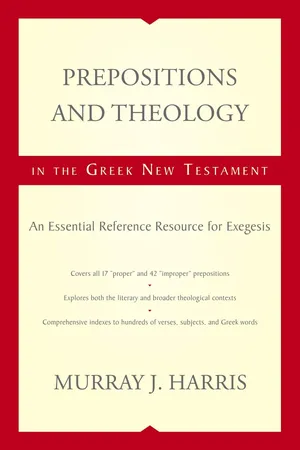
Prepositions and Theology in the Greek New Testament
eBook - ePub

Prepositions and Theology in the Greek New Testament

An Essential Reference Resource for Exegesis

  1. 304 pages
  2. English
  3. ePUB (mobile friendly)
  4. Available on iOS & Android
eBook - ePub

Prepositions and Theology in the Greek New Testament

An Essential Reference Resource for Exegesis

About this book

Prepositions are important in the exegesis of the Greek New Testament, but they are at the same time very slippery words because they can have so many nuances. While Prepositions and Theology in the Greek New Testament rejects the idea of a “theology of the prepositions,” it is a study of the numerous places in the Greek New Testament where prepositions contribute to the theological meaning of the text.

Offered in the hope that it might encourage close study of the Greek text of the New Testament, its many features include the following:

  • Coverage of all 17 “proper” and 42 “improper” prepositions
  • Explores both literary and broader theological contexts
  • Greek font—not transliteration—used throughout
  • Comprehensive indexes to hundreds of verses, subjects, and Greek words
  • Discussion of key repeated phrases that use a particular preposition

Trusted byĀ 375,005 students

Access to over 1.5 million titles for a fair monthly price.

Study more efficiently using our study tools.

Information

Year
2017
eBook ISBN
9780310531050

Chapter 1

Introduction

A. The Phases of the Greek Language

The following stages may be identified:
  1. 1. Ancient Greek, a category that here includes both pre-Classical (especially Homer) and Classical Greek.
  2. 2. Classical Greek, c. 450 BC–c. 330 BC, chiefly the Attic form.
  3. 3. Hellenistic/Koine Greek, c. 330 BC–AD 330, į¼” κοινὓ Γιάλεκτος (ā€œthe common languageā€), in its literary and vernacular forms, is marked by a virtual absence of dialectal forms except for local differences in pronunciation, and what Bortone (239 n.3) calls ā€œslight regional variations.ā€1 The six main sources for our knowledge of Hellenistic Greek are: literary texts by writers such as Polybius and Epictetus; the Septuagint; the New Testament and other early Christian literature; the Ptolemaic papyri; the inscriptions; and the observations of grammarians such as Moeris and Phrynichus. The expression ā€œBiblical Greekā€ is a convenient and traditional way of referring to the Greek of the LXX and the NT, without suggesting it forms a defined dialect of Hellenistic/Koine Greek.
  4. 4. Medieval Greek/Byzantine Greek, AD 330 (the removal of the seat of government from Rome to Constantinople)—1453 (the conquest of Constantinople by the Turks).
  5. 5. Modern Greek, AD 1453—the present; but specifically, in the present work, the Greek written or spoken at the present day, ā€œcontemporary standard Greekā€ (Bortone 238 n.1), in which two strands are interwoven—a popular, vernacular strand (Demotic) and an archaizing or Atticizing ā€œpuristā€ strand (Katharevousa).
The five stages isolated by Caragounis (in 2004) (XIII; and for more detail XX, 1–63) are (after the Mycenaean or Linear B stage [15th–12th century BC]):
  1. 1. Archaic or Epic Greek (800–500 BC)
  2. 2. The Classical (Attic) Period (500–300 BC)
  3. 3. Post-classical Greek (c. 300 BC–AD 600)
  4. 4. Byzantine-Mediaeval Greek (AD 600–1500)
  5. 5. The Neohellenic Period (AD 1500–2000)
ā€œNeohellenic at present (i.e., the language spoken and written today) is very broad, since it encompasses (simple) Katharevousa, moderate Demoticism and extreme Demoticismā€ (Caragounis 56–57). ā€œA more cultivated Demotic is in effect a simple Katharevousa, and conversely, a simple Katharevousa, is a more cultivated Demoticā€ (58).
At an earlier time (1897) Jannaris (xv, xxii) delineated five periods:
  1. 1. Attic (500–300 BC)
  2. 2. Hellenistic (300–150 BC)
  3. 3. Greco-Roman (150 BC–300 AD)
  4. 4. Transitional (300–600 AD)
  5. 5. Neohellenic (600–1900 AD)
    • • Byzantine (600–1000 AD)
    • • Mediaeval (1000–1450 AD)
    • • Modern (1450–1800 AD)
    • • Restorative (1800 AD–present)
However we divide up the stages of the Greek language, all agree ā€œthat greater changes took place during the 600 years separating Polybios from Homeros than during the 2,100 years between Polybios and our timeā€ (Caragounis 68). This shows that ā€œin the development of Greek time-length and change do not go hand in hand: contrary to what might be expected, greater changes may take place in a briefer period, while a more protracted period may be attended by slower changeā€ (Caragounis 89).

B. Terminology

1. ā€œPrepositionā€

The term ā€œprepositionā€ ultimately comes from Ļ€ĻĻŒ-ĪøĪµĻƒĪ¹Ļ‚, ā€œa placing before, a fore-placementā€ (a term used by the Greek grammarian Dionysius Thrax), via the Latin prae-positio, also meaning ā€œa placing before.ā€ In Greek grammar it denotes an indeclinable word that is placed before a substantive or pronoun or prefixed to a verb. But originally ā€œprepositionsā€ followed the substantive (as still done in the NT with ἕνεκεν and χάριν) and therefore were ā€œpostpositionsā€! Etymology apart, a preposition is basically a word that denotes a relationship between other words—hence the German term for preposition, VerhƤltniswort, ā€œword of relationship.ā€ In each Greek preposition, it seems, there is an inherent, foundational meaning that is further defined by a particular context.2

2. ā€œProperā€ and ā€œImproperā€ Prepositions

Those prepositions (such as ἐν) that can also serve as prefixes in compound w...

Table of contents

  1. Cover Page
  2. Title Page
  3. Copyright Page
  4. Dedication
  5. Contents
  6. Preface
  7. Select Bibliography and Abbreviations
  8. 1. Introduction
  9. 2. Distinctive Features of Prepositional Usage in New Testament Greek
  10. 3. Dangers to Be Avoided in Any Examination of New Testament Prepositional Usage
  11. 4. į¼ˆĪ¼Ļ†ĪÆ and Ἀνά
  12. 5. į¼ˆĪ½Ļ„ĪÆ
  13. 6. į¼ˆĻ€ĻŒ
  14. 7. Διά
  15. 8. Εἰς
  16. 9. Ἐκ
  17. 10. Ἐν
  18. 11. į¼˜Ļ€ĪÆ
  19. 12. ĪšĪ±Ļ„Ī¬
  20. 13. ĪœĪµĻ„Ī¬
  21. 14. Παρά
  22. 15. Περί
  23. 16. Πρό
  24. 17. Ī ĻĻŒĻ‚
  25. 18. Ī£ĻĪ½
  26. 19. Ὑπέρ
  27. 20. į½™Ļ€ĻŒ
  28. 21. Prepositions with Βαπτίζω
  29. 22. Prepositions with Ī Ī¹ĻƒĻ„ĪµĻĻ‰ and Ī ĪÆĻƒĻ„Ī¹Ļ‚
  30. 23. ā€œImproperā€ Prepositions
  31. 24. Notable Uses of Selected ā€œImproperā€ Prepositions
  32. Index of Biblical References
  33. Index of Greek Words and Expressions
  34. Index of Subjects

Frequently asked questions

Yes, you can cancel anytime from the Subscription tab in your account settings on the Perlego website. Your subscription will stay active until the end of your current billing period. Learn how to cancel your subscription
No, books cannot be downloaded as external files, such as PDFs, for use outside of Perlego. However, you can download books within the Perlego app for offline reading on mobile or tablet. Learn how to download books offline
Perlego offers two plans: Essential and Complete
  • Essential is ideal for learners and professionals who enjoy exploring a wide range of subjects. Access the Essential Library with 800,000+ trusted titles and best-sellers across business, personal growth, and the humanities. Includes unlimited reading time and Standard Read Aloud voice.
  • Complete: Perfect for advanced learners and researchers needing full, unrestricted access. Unlock 1.5M+ books across hundreds of subjects, including academic and specialized titles. The Complete Plan also includes advanced features like Premium Read Aloud and Research Assistant.
Both plans are available with monthly, semester, or annual billing cycles.
We are an online textbook subscription service, where you can get access to an entire online library for less than the price of a single book per month. With over 1.5 million books across 990+ topics, we’ve got you covered! Learn about our mission
Look out for the read-aloud symbol on your next book to see if you can listen to it. The read-aloud tool reads text aloud for you, highlighting the text as it is being read. You can pause it, speed it up and slow it down. Learn more about Read Aloud
Yes! You can use the Perlego app on both iOS and Android devices to read anytime, anywhere — even offline. Perfect for commutes or when you’re on the go.
Please note we cannot support devices running on iOS 13 and Android 7 or earlier. Learn more about using the app
Yes, you can access Prepositions and Theology in the Greek New Testament by Murray J. Harris in PDF and/or ePUB format, as well as other popular books in Theology & Religion & Biblical Reference. We have over 1.5 million books available in our catalogue for you to explore.