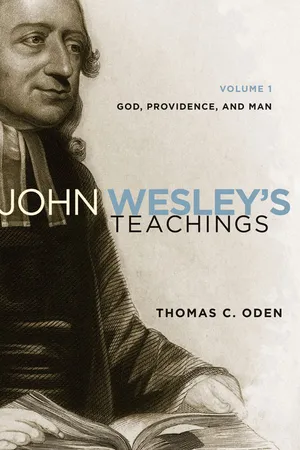
The first presentation of John Wesley's doctrinal teachings in a systematic form that is also faithful to Wesley's own writings in ebook format. Wesley was a prolific writer and commentator on Scripture, yet it is commonly held that he was not systematic or internally consistent in his theology and doctrinal teachings. On the contrary, Thomas C. Oden intends to demonstrate here that Wesley displayed a remarkable degree of consistency over sixty years of preaching and ministry. The book helps readers to grasp Wesley's essential teachings in an accessible form so that the person desiring to go directly to Wesley's own writings (which fill eighteen volumes) will know exactly where to turn. This volume focuses on Wesley's doctrinal teaching. Other volumes in this series deal with his ethical and pastoral care teachings.
- 240 pages
- English
- ePUB (mobile friendly)
- Available on iOS & Android
eBook - ePub
About this book
Information
Topic
Theology & ReligionSubtopic
Christian TheologyVOLUME ONE
GOD AND PROVIDENCE
JOHN WESLEY’S
TEACHINGS
CHAPTER 1
God
In a series of homilies from his mature years, Wesley entered into a meticulous, detailed consideration of the divine attributes, especially the eternity, omnipresence, and unity of God. Though sparse, these homilies convey sufficient argument to indicate the main lines of Wesley’s doctrine of God.
A. Attributes of God
The ancient Christian writers and the earliest ecumenical councils formed the foundation for the Anglican evangelicalism that Wesley affirmed. He was also very close to classic Protestant sources — Luther and Augsburg, Calvin and the Heidelberg Confession — regarding the knowledge and attributes of God.
Wesley summarized key points of the doctrine of God he had received in his renowned “Letter to a Roman Catholic”: “As I am assured that there is an infinite and independent Being and that it is impossible there should be more than one, so I believe that this one God is the Father of all things,” especially of self-determining rational creatures, and that this one “is in a peculiar manner the Father of those whom he regenerates by his Spirit, whom he adopts in his Son as coheirs with him.”1 The eternity of God received more explicit treatment in Homily #54, “On Eternity.”
1. The Eternity of God
a. Eternity Past and Future
The text of the homily “On Eternity” is Psalm 90:2: “From everlasting to everlasting, thou art God” [Homily #54 (1789), B 2:358–72; J #54, VI:189–98].
As immensity is boundless space, so eternity is “boundless duration.”2 As omnipresence refers to God’s relation to space, as present in every location, eternity refers to God’s sovereign relation to time. God is intimately present in every moment.
There was no time when God was not. There will be no time when God will not be.3 If eternity is from everlasting to everlasting, it can be thought of as distinguishable in two directions: (1) Eternity past is that duration that reaches from everlasting, eternity before creation, time viewed as before, the eternity that precedes this now and all past nows, which Wesley calls a parte ante. (2) Eternity yet to come is the duration that reaches to everlasting, which will have no end, the whole of time after now, everything eternally on the future side of now (a parte post).4
Time viewed synoptically is a “fragment of eternity broken off at both ends.”5 The eternity of God embraces and surrounds time. Time is that portion of duration that begins when the world begins and ends when the world comes to its final days. We do not see all of time, but only a momentary glimpse, which we call the present.6
b. Eternity as Decision Now
The faithful stand before God in a way that keeps them in the presence of eternity. When faith receives God as the Lord of time, everything is changed, all relationships are reshaped, all are reborn, all things become new. Social and ethical responsibility come from that change of heart of each person one by one, in due time affecting the flow of the political order and economic life. Only the renewed, whole person who is serious about eternity is rightly prepared to work effectively to make a better society.
Wesley offered a practical way of thinking personally about the eternity of God by placing his hearer imaginatively on the brink of a here-and-now decision: think of yourself as deciding now for or against eternal life. Each hearer is invited to enter now into an unending relationship with the Eternal by choosing a happy eternity, a life of eternal blessedness, or the misery of missing what is eternally good and worthy of worship. This is the choice being offered in the emerging reign of God. This decision is being made implicitly every temporal moment. It is hidden tacitly in every single human experience of time.
This continuing act of choosing has vast consequences for human happiness. It is no exaggeration to view human existence as deciding every moment toward the joy of eternal life or the despair of eternal emptiness.7 Only when we think of ourselves as standing on the edge of either a happy or a pitiable eternity does present life become meaningful and serious. “The Creator bids thee now stretch out thy hand either to the one or to the other.”8
Even if we doubt this, we can test the hypothesis that our personal lives will continue beyond bodily death in eternity. We all have a high stake in our relation to our eternal future. This premise alone has the latent power of transforming human actions.
2. Time
a. The Fleet Flow of Time
Every moment of time has the fleeting character of beginning and ending. That is what characterizes it as time.9 It is not a sad thought that time, which had a finite beginning in God and which has a fleeting present, will have a consummate ending in God. The faithful know that the Sovereign over time is in process of duly completing and fittingly refinishing the good but fallen creation. Nothing that happens within the distortions of history has power to undo God’s long-range eternal purpose within time.10
It is evident that we experience our living souls only as embodied within space. Similarly, we experience eternity only from within the crunch of time. This is why we who are so enmeshed in time and its demands are so permeated with finitude. We have great difficulty in grasping the very concept of eternity because of this condition of being so wrapped up in time. Our human awareness, as creatures of fleeting time, can form only a veiled idea of eternity, and that only by fragile analogies. As God is immense beyond any conceivable finite immensity, so eternity is infinite beyond any imaginable duration of time.11
Time remains for temporal minds an ever-flowing mystery. There is no nontemporal moment or place for the finite mind to step away, as if to depart from time, to think trans-temporally about time, as if we had a point outside time to perceive time. Time is an uncommon mystery. It is difficult to wrap our minds around precisely because we are creatures lodged in time. It is right here in time that we are called to understand ourselves within the frame of reference of eternity, living life in this world as if accountable to the giver of time.12
b. God in the Now
What divides past and future is now, the infinitely fleeting moment that can never be possessed as a fixed entity. We can never capture or hold a moment except in the tenuous form of memory. This is why temporal life is rightly compared to a dream.13
What we call “now” keeps on vanishing, eluding our grasp, changing its face. Yet the present is the only position from which anyone can ever know or see the world, through the tiny keyhole of this constantly disappearing moment we call “now.” This fleeting present lies “between two eternities.”14 The moment we say “now,” we have already lost the now in which we just said “now.” We have this little splinter of ongoing time, which itself is a continuing refraction of the eternal.15
God meets us in time, but as the incomparable Creator of time, God is not bound by time. Only one who is simultaneously present with every moment of time can fully know the future and past reaches of eternity.16 That one we call God.
c. Knowing Time from within Time
God is radically different from creatures in that God inhabits all eternity, whereas creatures inhabit fleeting successive temporal moments held together by memory and imagination.
Since God has a present relation to all past and future moments, God can know time in a far larger way than our knowing. The whole of time is beyond our knowing.
God’s complete memory and foreknowledge of time do not coercively predetermine events to come or arbitrarily undo events that have occurred.17 God’s relation to the future and past is entirely different from ours.
Time-drenched minds have limited access through memory to their personal past and to their future through imagination. Meanwhile, the eternal God is always already present to the past. God embraces the entirety of all times.
Harder to conceive is the premise that God is present to all future moments, a premise essential to the Christian teaching of the eternal God — that God already knows the future because he is eternally present to all moments. “Strictly speaking, there is no ‘fore’knowledge, no more than ‘after’knowledge with God: but all things are known to Him as present from eternity to eternity.”18
This does not mean that God determines the future so as to ignore or arbitrarily overrule human freedom. Divine...
Table of contents
- Cover
- Title Page
- Dedication
- Contents
- Preface
- Abbreviations
- Introduction
- VOLUME ONE: GOD AND PROVIDENCE
- APPENDIX A: Alphabetical Correlation of the Sermons in the Jackson and Bicentennial Editions
- APPENDIX B: Bicentennial Volume Titles Published to Date
- Subject Index
- Scripture Index
- About the Author
- Copyright
- About the Publisher
Trusted by 375,005 students
Access to over 1.5 million titles for a fair monthly price.
Study more efficiently using our study tools.
Frequently asked questions
Yes, you can cancel anytime from the Subscription tab in your account settings on the Perlego website. Your subscription will stay active until the end of your current billing period. Learn how to cancel your subscription
No, books cannot be downloaded as external files, such as PDFs, for use outside of Perlego. However, you can download books within the Perlego app for offline reading on mobile or tablet. Learn how to download books offline
Perlego offers two plans: Essential and Complete
- Essential is ideal for learners and professionals who enjoy exploring a wide range of subjects. Access the Essential Library with 800,000+ trusted titles and best-sellers across business, personal growth, and the humanities. Includes unlimited reading time and Standard Read Aloud voice.
- Complete: Perfect for advanced learners and researchers needing full, unrestricted access. Unlock 1.5M+ books across hundreds of subjects, including academic and specialized titles. The Complete Plan also includes advanced features like Premium Read Aloud and Research Assistant.
We are an online textbook subscription service, where you can get access to an entire online library for less than the price of a single book per month. With over 1.5 million books across 990+ topics, we’ve got you covered! Learn about our mission
Look out for the read-aloud symbol on your next book to see if you can listen to it. The read-aloud tool reads text aloud for you, highlighting the text as it is being read. You can pause it, speed it up and slow it down. Learn more about Read Aloud
Yes! You can use the Perlego app on both iOS and Android devices to read anytime, anywhere — even offline. Perfect for commutes or when you’re on the go.
Please note we cannot support devices running on iOS 13 and Android 7 or earlier. Learn more about using the app
Please note we cannot support devices running on iOS 13 and Android 7 or earlier. Learn more about using the app
Yes, you can access John Wesley's Teachings, Volume 1 by Thomas C. Oden in PDF and/or ePUB format, as well as other popular books in Theology & Religion & Christian Theology. We have over 1.5 million books available in our catalogue for you to explore.