Many today find the Old Testament a closed book. The cultural issues seem insurmountable and we are easily baffled by that which seems obscure. Furthermore, without knowledge of the ancient culture we can easily impose our own culture on the text, potentially distorting it. This series invites you to enter the Old Testament with a company of guides, experts that will give new insights into these cherished writings. Features include • Over 2000 photographs, drawings, maps, diagrams and charts provide a visual feast that breathes fresh life into the text. • Passage-by-passage commentary presents archaeological findings, historical explanations, geographic insights, notes on manners and customs, and more. • Analysis into the literature of the ancient Near East will open your eyes to new depths of understanding both familiar and unfamiliar passages. • Written by an international team of 30 specialists, all top scholars in background studies.

- 218 pages
- English
- ePUB (mobile friendly)
- Available on iOS & Android
eBook - ePub
1 and 2 Kings
About this book
Information
Topic
Theology & ReligionSubtopic
Christian Ministry1 Kings
by John Monson
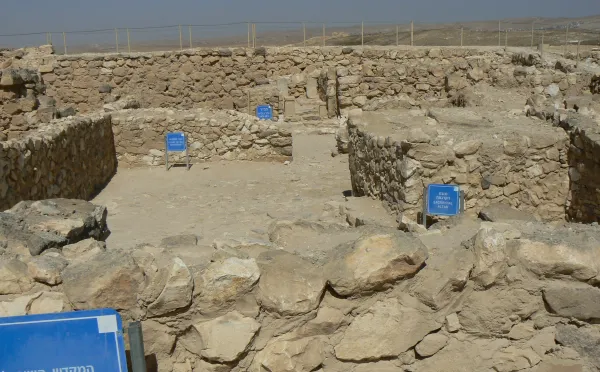
Arad Temple from the monarchy period
Kim Walton
Introduction
Geographical Setting
Throughout the course of ancient Near Eastern history the land of the Bible served as a bridge between Mesopotamia in the north and Egypt in the south. This book documents the first time that a local kingdom was able to exert its power beyond the traditional confines of the land up to the borders of Egypt and Mesopotamia. David and Solomon created a political hegemony that included the entire Levant (Phoenicia, Aram, Israel, Philistia, Ammon, Moab, Edom), and perhaps even Egypt.1 The height of Israel’s fortune, therefore, represents an anomaly in the history of the ancient Near East. When considered in broad geographical and historical perspective, the Israelite kingdoms are not to be compared to the “might that was Assyria” or the “greatness that was Babylon.”2 The frequent regional conflicts and military campaigns described in 1 Kings are the result of ascendant nationalism—in contrast to the imperial priorities of distant empires—together with local competition for trade and resources.
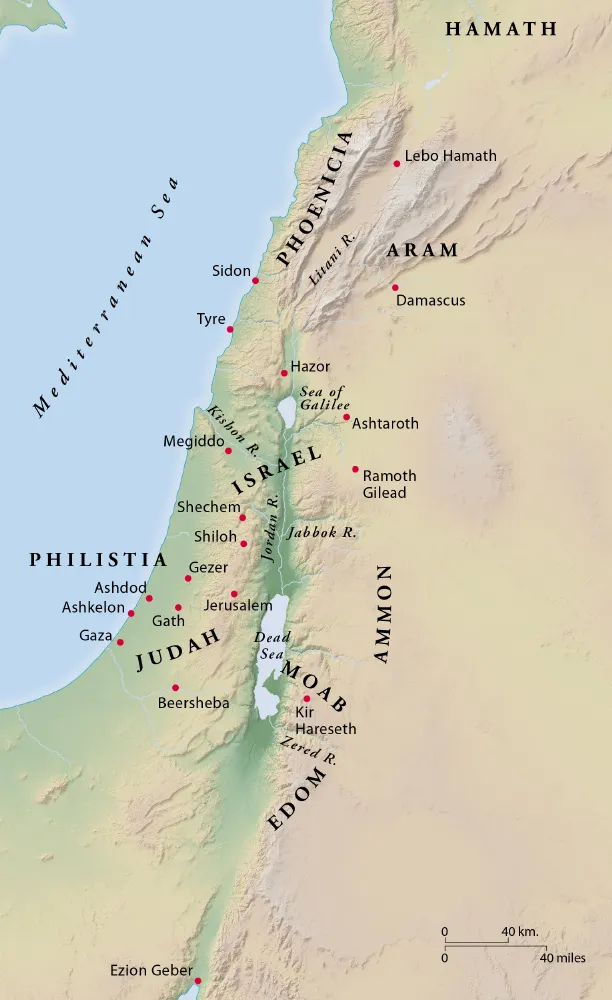
Israel Under David and Solomon
The geographical diversity of the land of the Bible is also important for understanding the events recorded in 1 Kings. Differences between “northerners” and “southerners” were every bit as noticeable in ancient Israel as they are in the United States today. The southern tribe of Judah was largely confined to the central hill country and was bordered by desert regions to the south and the east. The northern tribes were spread across diverse fertile regions such as Galilee and Samaria that were open to foreign invasion and cultural influence.
Given the geographical settings of the northern and southern tribes, it is not at all surprising that Israel split into northern and southern kingdoms soon after Solomon’s death. It was a return to the natural state of affairs. Judah maintained the stable, more insular Davidic dynasty whereas Israel, her more prosperous neighbor to the north, suffered dynastic intrigue, pagan religion, and premature exile. Understood in geographical context, the historical record of 1 Kings is a logical series of geopolitical developments through which the author illustrates the covenant faith of Israel or the lack thereof.
An appreciation for allusions to biblical geography and surrounding regions in the book of 1 Kings can also help to enliven and clarify the text and its message. Solomon entertains the Queen of Sheba (10:1–13). Hiram of Phoenicia supplies artisans and raw materials for Solomon’s building projects (5:13–18), and the Aramean kings wage war on the strategic border zones of the Transjordanian heights (chs. 20; 22). Diverse geographical settings, like the sets in a drama, are also noted in the text. At the beginning of his reign Solomon ascends to a “high place” (3:4) from which he can see the entire region (probably Nebi Samwil of today). The entire populace of Jerusalem hears the trumpets of Adonijah resonating through the city (1:41). Elijah entreats Yahweh to rout Baal at a location from which storm clouds typically came into view (ch. 18). These and numerous other stories in 1 Kings come to life through the colorful geographical settings in which they take place.3

View of the territory of Benjamin to the west from Nebi Samwil
David Bivin/www.LifeintheHolyLand.com
Historical Setting
The historical setting of 1 Kings can be understood either as the time of the book’s composition or as the same era as the final events described in the book. Its composition, along with 2 Kings, is likely late in the Judean monarchy (the late 600s B.C.), when the northern kingdom had gone into exile and a similar devastation of the Davidic dynasty seemed unavoidable. The author traces the monarchy’s history through a combination of original accounts and his own moral lessons. However, the actual events recounted in 1 Kings are known to have transpired between 1000 and 850 B.C. This can be known from the good number of extrabiblical texts and archaeological finds that corroborate the biblical record.4 This is the most appropriate timeframe for understanding the history recorded in 1 Kings.
The book is set in an age of nationalism that began when the Egyptian empire lost control of the Levant in approximately 1200 B.C. Israel was one of many emerging nations that were growing into full-blown kingdoms at this time. Foremost among Israel’s challengers at this time were the Philistine immigrants from the Aegean, who, like every people in the region, were vying for control of trade routes, natural resources, and places to expand their regions of settlement. David accomplished in Israel what the earlier confederation of tribes and the leadership of Saul could not. By 1000 B.C. he subdued the Philistines and expanded the Israelite monarchy well beyond the highlands that had demarcated its territory for several centuries.
The following two centuries can be subdivided into three broad historical periods, each with its own subdivisions. The era of David and Solomon is commonly known as the “united monarchy.” This period, which lasted from 1000 to 931 B.C., was a time in which Israel became the dominant nation in the ancient Near East (1 Kings 1–11). David’s successful military campaigns extended his control over neighboring and distant lands while Solomon’s administration capitalized on Israel’s strength to bring vast wealth and cultural resources into the kingdom. Israel became a mini-empire that conformed to the conventional Near Eastern model, complete with alliances, cosmopolitan influences, and fortified administrative centers with palaces and military garrisons. With its success, Israel also faced the temptation to abandon its traditional institutions, particularly after the schism between the northern and southern tribes.
The second era recorded in 1 Kings lasted from approximately 931 B.C. until 880 B.C. (1 Kings 12–16). This first part of the period known as the “divided kingdom” began when the northern Israelites failed to ratify an extension of Judahite leadership over the tribes of Israel after the death of Solomon. As a result, two less powerful Israelite kingdoms fought each other and their neighbors for supremacy in the region. Both suffered crushing defeats when Pharaoh Shishak of Egypt made a lightning raid through the region. Judah (the southern Israelite kingdom) remained weak while Israel (the northern Israelite kingdom) witnessed dynastic rivalries and accompanying changes in administration and capital cities.
Both Israel and Judah tried to outmaneuver each other by forging temporary alliances with neighboring kingdoms, most notably Aram. Wary of losing influence to Judah and its Jerusalem temple, Jeroboam established new religious shrines at Dan and Bethel, a clear violation of the biblical covenant (12:26–33). This strategy only served to deepen the distrust between the two kingdoms and weaken them in advance of Pharaoh Shishak’s invasion of 927 B.C. The tension escalated into ...
Table of contents
- Cover
- Title Page
- Copyright Page
- Table of Contents
- How to Use This eBook
- Acknowledgments
- Methodology: An Introductory Essay
- General Bibliography
- Abbreviations
- 1 Kings
- 2 Kings
- Picture Index
- The New International Version Appendix
Trusted by 375,005 students
Access to over 1.5 million titles for a fair monthly price.
Study more efficiently using our study tools.
Frequently asked questions
Yes, you can cancel anytime from the Subscription tab in your account settings on the Perlego website. Your subscription will stay active until the end of your current billing period. Learn how to cancel your subscription
No, books cannot be downloaded as external files, such as PDFs, for use outside of Perlego. However, you can download books within the Perlego app for offline reading on mobile or tablet. Learn how to download books offline
Perlego offers two plans: Essential and Complete
- Essential is ideal for learners and professionals who enjoy exploring a wide range of subjects. Access the Essential Library with 800,000+ trusted titles and best-sellers across business, personal growth, and the humanities. Includes unlimited reading time and Standard Read Aloud voice.
- Complete: Perfect for advanced learners and researchers needing full, unrestricted access. Unlock 1.5M+ books across hundreds of subjects, including academic and specialized titles. The Complete Plan also includes advanced features like Premium Read Aloud and Research Assistant.
We are an online textbook subscription service, where you can get access to an entire online library for less than the price of a single book per month. With over 1.5 million books across 990+ topics, we’ve got you covered! Learn about our mission
Look out for the read-aloud symbol on your next book to see if you can listen to it. The read-aloud tool reads text aloud for you, highlighting the text as it is being read. You can pause it, speed it up and slow it down. Learn more about Read Aloud
Yes! You can use the Perlego app on both iOS and Android devices to read anytime, anywhere — even offline. Perfect for commutes or when you’re on the go.
Please note we cannot support devices running on iOS 13 and Android 7 or earlier. Learn more about using the app
Please note we cannot support devices running on iOS 13 and Android 7 or earlier. Learn more about using the app
Yes, you can access 1 and 2 Kings by John M. Monson,Iain Provan, John H. Walton in PDF and/or ePUB format, as well as other popular books in Theology & Religion & Christian Ministry. We have over 1.5 million books available in our catalogue for you to explore.