- 432 pages
- English
- ePUB (mobile friendly)
- Available on iOS & Android
eBook - ePub
About this book
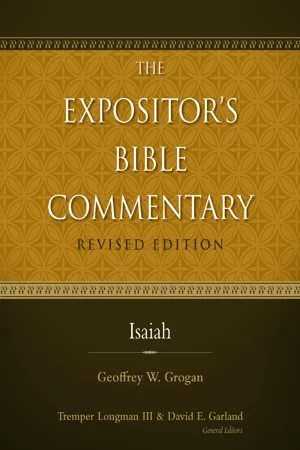
Continuing a Gold Medallion Award-winning legacy, the completely revised Expositor's Bible Commentary puts world-class biblical scholarship in your hands.
A staple for students, teachers, and pastors worldwide, The Expositor's Bible Commentary (EBC) offers comprehensive yet succinct commentary from scholars committed to the authority of the Holy Scriptures. The EBC uses the New International Version of the Bible, but the contributors work from the original Hebrew and Greek languages and refer to other translations when useful.
Each section of the commentary includes:
- An introduction: background information, a short bibliography, and an outline
- An overview of Scripture to illuminate the big picture
- The complete NIV text
- Extensive commentary
- Notes on textual questions, key words, and concepts
- Reflections to give expanded thoughts on important issues
The series features 56 contributors, who:
- Believe in the divine inspiration, complete trustworthiness, and full authority of the Bible
- Have demonstrated proficiency in the biblical book that is their specialty
- Are committed to the church and the pastoral dimension of biblical interpretation
- Represent geographical and denominational diversity
- Use a balanced and respectful approach toward marked differences of opinion
- Write from an evangelical viewpoint
For insightful exposition, thoughtful discussion, and ease of use—look no further than The Expositor's Bible Commentary.
Frequently asked questions
Yes, you can cancel anytime from the Subscription tab in your account settings on the Perlego website. Your subscription will stay active until the end of your current billing period. Learn how to cancel your subscription.
No, books cannot be downloaded as external files, such as PDFs, for use outside of Perlego. However, you can download books within the Perlego app for offline reading on mobile or tablet. Learn more here.
Perlego offers two plans: Essential and Complete
- Essential is ideal for learners and professionals who enjoy exploring a wide range of subjects. Access the Essential Library with 800,000+ trusted titles and best-sellers across business, personal growth, and the humanities. Includes unlimited reading time and Standard Read Aloud voice.
- Complete: Perfect for advanced learners and researchers needing full, unrestricted access. Unlock 1.4M+ books across hundreds of subjects, including academic and specialized titles. The Complete Plan also includes advanced features like Premium Read Aloud and Research Assistant.
We are an online textbook subscription service, where you can get access to an entire online library for less than the price of a single book per month. With over 1 million books across 1000+ topics, we’ve got you covered! Learn more here.
Look out for the read-aloud symbol on your next book to see if you can listen to it. The read-aloud tool reads text aloud for you, highlighting the text as it is being read. You can pause it, speed it up and slow it down. Learn more here.
Yes! You can use the Perlego app on both iOS or Android devices to read anytime, anywhere — even offline. Perfect for commutes or when you’re on the go.
Please note we cannot support devices running on iOS 13 and Android 7 or earlier. Learn more about using the app.
Yes, you can access Isaiah by Rev. Geoffrey W. Grogan, Tremper Longman III,David E. Garland in PDF and/or ePUB format, as well as other popular books in Theology & Religion & Biblical Criticism & Interpretation. We have over one million books available in our catalogue for you to explore.
Information
Text and Exposition
I. ORACLES CONCERNING JUDAH AND JERUSALEM (1:1–12:6)
OVERVIEW
Isaiah 1–12, because of their biographical features, have been well called the “Memoirs of Isaiah,” though the title is sometimes restricted to a smaller passage, such as 6:1–8:18. Except perhaps for ch. 1, Isaiah’s “Memoirs” appear to belong to an early period of the prophet’s ministry, during the reigns (probably) of Jotham (750–731 BC) and (certainly) of Ahaz (735–715 BC).
Some scholars, notably A. H. Bartelt (The Book around Immanuel: Style and Structure in Isaiah 2–12 [BJS 4; Winona Lake, Ind.: Eisenbrauns, 1996]), view chs. 2–12 as a literary unit. A study of Bartelt’s argument even in broad outline would take up far too much space here, but the following conclusion from his studies is well worth noting (243): “Chaps. 2–4, as a whole, introduce chaps. 2–12. They announce a future and a hope, but only after the present situation has been dealt with. The theme of future restoration is picked up again . . . in 10:5–12:6, but only after the present situation described in 5:1–10:4 has been dealt with,” and he goes on to write of “the focus of the entire literary unit upon the present situation, namely, the fearful and faithless response of Ahaz to the Syro-Ephraimite threat.” This is the situation now specifically addressed by the book.
A. God’s Charge against His People (1:1–31)
OVERVIEW
Isaiah 1 opens the book in a most appropriate fashion. Vigorously and with many a memorable phrase it sums up the teaching not only of Isaiah but also of the whole prophetic movement. This is widely agreed by scholars who take quite different views as to the authorship of the book. M. A. Sweeney (Isaiah 1–4 and the Post-Exilic Understanding of the Isaianic Tradition [BZAW 171; Berlin: de Gruyter, 1988]), for example, after a full discussion, writes (186):
Isaiah 1 is the prologue to the entire book in its present form. It presents YHWH’s offer of redemption to the people and thus serves as an exhortation which summarizes the message of the entire book. . . . By portraying the contrasting fates of the righteous and the wicked, the chapter attempts to convince the people to choose the path of righteousness so that they will share in the coming redemption of Zion.
Deuteronomy also sharply distinguishes the paths and consequences of obedience and disobedience (e.g., Dt 28), and there are many points of connection with Isaiah 1, as the commentary will show. Its frank presentation of these alternatives reminds us also of Psalm 1 and its function as an introduction to the Psalter. Proverbs, too, in passage after passage clearly distinguishes the righteous way of wisdom and the unrighteous way of folly.
Isaiah 1 evinces clear thematic unity, and the ordinary reader is unlikely to detect any disjointedness in thought. To see it as a series of distinct oracles linked by “catchwords” and assembled here to provide a fitting introduction seems hardly necessary, though this view of the chapter is widely held. In fact, the chapter abounds in literary devices such as assonance, alliteration, word-order emphasis, and so on (cf. comments on vv.2–3 below). Moreover, material linked by catchwords is not necessarily composite, as a glance at James 1 will reveal. Some of the word-idea links run through much of the chapter. They include not only a theological motif (e.g., rebellion—vv.2, 5, 20, 23, 28) but also a recurrent visual image, such as burden-bearing, suggested by the reference in v.3 to domestic beasts and developed in vv.4, 14, 24, in the last of which it is represented in the English by “get relief.” Such features make oracular unity more likely than the activity of a later redactor, although the combination by Isaiah himself of some originally distinct oracles cannot be excluded.
If ch. 1 is a unity, substantially at least, what is its date? Because of their conviction that the oracles in chs. 1–39 are arranged in approximate chronological order, Hayes and Irvine, 70, say that it comes from the time of the devastating earthquake in Uzziah’s reign (Am 1:1; Zec 14:5) but without giving any evidence for this. The period of the Syro-Ephraimite threat to Judah (735–732 BC) has had its advocates, but most recent scholars favor the time of Sennacherib’s invasion (701 BC). The description of Jerusalem isolated and beleaguered in vv.7–9 (see comment there) harmonizes so well with Sennacherib’s own description.
Seitz, 23, sees the chapter as a summary recapitulation of Isaiah’s vision relevant to the period mentioned at 1:1, probably summarizing his preaching from a penitential perspective following the 701 deliverance. Motyer (1993, in loc.) is correct, however, when he says of the oracles recorded here, “Their significance does not arise from their historical setting but from their searching exposure of sin and its consequences in the people of God.”
This is essentially the view of R. F. Melugin (“Figurative Speech and the Reading of Isaiah 1,” in New Visions of Isaiah, ed. R. F. Melugin and M. A. Sweeney [JSOTSup 214; Sheffield: Sheffield Academic Press, 1996], 282–305). On page 285 Melugin refers to Ricoeur’s differentiation of the functions of oral and written discourse and says that in the latter, author and reader do not normally occupy the same situations of space and time, but the text can still address the reader, and, if it is biblical, as God’s word to him. He points out that the metaphors of the law court and of eating dominate vv.2–20 and then are replaced by that of the unfaithful bride in vv.21–31. He goes on to say (291), “A funeral lament is sung over a city metaphorically portrayed as a once-faithful wife turned harlot.” Then he shows how this picture of the unfaithful bride is set within the metaphor of a funeral (291–92). So here is “metaphor within metaphor.” Then the metaphor moves. The city is purified and then becomes faithful again. This ends at v.26.
1The vision concerning Judah and Jerusalem that Isaiah son of Amoz saw during the reigns of Uzziah, Jotham, Ahaz and Hezekiah, kings of Judah.
2Hear, O heavens! Listen, O earth!
For the LORD has spoken:
“I reared children and brought them up,
but they have rebelled against me.
3The ox knows his master,
the donkey his owner’s manger,
but Israel does not know,
my people do not understand.”
4Ah, sinful nation,
a people loaded with guilt,
a brood of evildoers,
children given to corruption!
They have forsaken the LORD;
they have spurned the Holy One of Israel
and turned their backs on him.
5Why should you be beaten anymore?
Why do you persist in rebellion?
Your whole head is injured,
your whole heart afflicted.
6From the sole of your foot to the top of your head
there is no soundness—
only wounds and welts
and open sores,
not cleansed or bandaged
or soothed with oil.
7Your country is desolate,
your cities burned with fire;
your fields are being stripped by foreigners
right before you,
laid waste as when overthrown by strangers.
8The Daughter of Zion is left
like a shelter in a vineyard,
like a hut in a field of melons,
like a city under siege.
9Unless the LORD Almighty
had left us some survivors,
we would have become like Sodom,
we would have been like Gomorrah.
10Hear the word of the LORD,
you rulers of Sodom;
listen to the law of our God,
you people of Gomorrah!
11“The multitude of your sacrifices—
what are they to me?” says the LORD.
“I have more than enough of burnt offerings,
of rams and the fat of fattened animals;
I have no pleasure
in the blood of bulls and lambs and goats.
12When you come to appear before me,
who has asked this of you,
this trampling of my courts?
13Stop bringing meaningless offerings!
Your incense is detestable to me.
New Moons, Sabbaths and convocations—
I cannot bear your evil assemblies.
14Your New Moon festivals and your appointed feasts
my soul hates.
They have become a burden to me;
I am weary of bearing them.
15When you spread out your hands in prayer,
I will hide my eyes from you;
even if you offer many prayers,
I will not listen.
Your hands are full of blood;
16wash and make yourselves clean.
Take your evil deeds
out of my sight!
Stop doing wrong,
17learn to do right!
Seek justice,
encourage the oppressed.
Defend the cause of the fatherless,
plead the case of the widow.
18“Come now, let us reason together,”
says the LORD.
“Though your sins are like scarlet,
they shall be as white as snow;
though they are red as crimson,
they shall be like wool.
19If you are willing and obedient,
you will eat the best from the land;
20but if you resist and rebel,
you will be devoured by the sword.”
For the mouth of the LORD has spoken.
21See how the faithful city
has become a harlot!
She once was full of justice;
righteousness used to dwell in her—
but now murderers!
...Table of contents
- Cover
- Title Page
- Copyright Page
- Contents
- Contributors
- Preface
- Abbreviations
- Isaiah
- Introduction
- I. ORACLES CONCERNING JUDAH AND JERUSALEM (1:1–12:6)
- II. GOD AND THE NATIONS (13:1–23:18)
- III. GOD AND THE WHOLE WORLD (24:1–27:13)
- IV. GOD AND HIS PEOPLE (28:1–33:24)
- V. GOD’S PURPOSES OF JUDGMENT AND SALVATION (34:1–35:10)
- VI. ISAIAH AND HEZEKIAH, ASSYRIA AND BABYLON (36:1–39:8)
- VII. THE SOLE SOVEREIGNTY AND SURE PROMISES OF THE LORD (40:1–48:22)
- VIII. THE GOSPEL OF THE SERVANT OF THE LORD (49:1–55:13)
- IX. GOD AS JUDGE AND SAVIOR (56:1–66:24)