- 144 pages
- English
- ePUB (mobile friendly)
- Available on iOS & Android
eBook - ePub
Hebrews, James
About this book
Brimming with lavish, full-color photos and graphics, the Zondervan Illustrated Bible Backgrounds Commentary walks you verse by verse through all the books of the New Testament. It's like slipping on a set of glasses that lets you read the Bible through the eyes of a first-century reader! Discoveries await you that will snap the world of the New Testament into gripping immediacy. Things that seem mystifying, puzzling, or obscure will take on tremendous meaning when you view them in their ancient context. You'll deepen your understanding of the teachings of Jesus. You'll discover the close, sometimes startling interplay between God's kingdom and the practical affairs of the church. Best of all, you'll gain a deepened awareness of the Bible's relevance for your life. Written in a clear, engaging style, this beautiful set provides a new and accessible approach that more technical expository and exegetical commentaries don't offer.
Information
Topic
Theology & ReligionSubtopic
Biblical CommentaryHebrews
by George H. Guthrie

ROME
The Tiber River.
Hebrews
Important Facts:
■ AUTHOR: Unknown, but someone like Apollos.
■ DATE: Approximately A.D. 64–66.
■ OCCASION:
• To address the problem of apostasy among the recipients.
• To bolster the resolve of Christians facing persecution.
• To challenge the believers to move on to maturity, in terms of theological understanding and practical obedience.
• To address friction between the members of the church and their leaders.
■ THEMES:
1. God has spoken and we should obey him.
2. God has spoken ultimately in the person and work of his Son.
3. The Son is incarnate and exalted.
4. The high-priestly ministry of the Son is manifested through his death and exaltation.
5. The Son’s person and work form a superior basis for perseverance in the face of trial.
6. There are terrible consequences for those who reject the salvation provided by the Son’s person and work.
Who Wrote Hebrews?
Unlike most other New Testament works, the book of Hebrews does not reveal the identity of its author. Since the second century, people have loved to speculate concerning that identity. The early church fathers were mixed in their opinion on the matter. Scholars of the eastern part of the Mediterranean world often suggested that the apostle Paul wrote the book. Scholars in the West, focused in Rome, argued against that opinion. Even those who held to Pauline authorship, such as Clement of Alexandria and Origen, recognized that the style of the book differs sharply from Paul’s writings.
THE SYNAGOGUE AT CAPERNAUM

Aerial view of the remains.
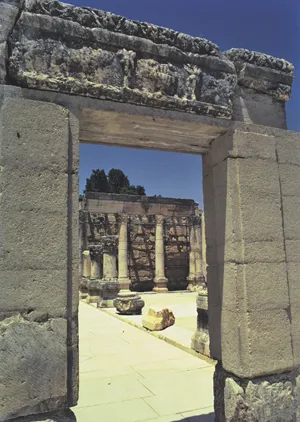
The lintel above the entrance.
Today few scholars of any theological tradition hold to Pauline authorship for the following reasons. (1) Many of the book’s images, theological motifs, and terms are not found in the Pauline literature. For instance, the image of Christ as high priest is unique to Hebrews, and 169 words used in Hebrews are not used anywhere else in the New Testament. (2) The author introduces his quotations of the Old Testament in a different manner from what Paul normally does. Paul usually uses the phrase, “It is written”; Hebrews, following the style of sermons in the Greek-speaking, Jewish synagogues of the Mediterranean world, introduces scriptural quotations with some form of God speaking (e.g., “he says”). (3) Finally, the author of Hebrews depicts himself as having received the gospel from the original witnesses commissioned by the Lord (2:3), and, in light of his often-made assertions to the contrary, it is difficult to imagine Paul making such a statement!1
Through the centuries other names have been put forward, such as Luke, Clement of Rome, Barnabas, Jude, Apollos, Philip, Silvanus, and Priscilla. What do we know about the author who wrote this intriguing book?
First, the author is a dynamic preacher who really knows his Old Testament and has been trained in the forms of interpretation common in Jewish synagogues. The synagogue was the center of social and religious life for the Jews, and the worship service was at the center of the synagogue service. Focal to the worship service was an exposition of what we now call the Old Testament Scriptures. Hebrews exhibits a number of characteristics of a first-century sermon. The author uses techniques and patterns in his expositions of the Old Testament that were common sermonic features, and he uses these techniques and patterns with great skill and eloquence. Moreover, the book is packed with references to the Old Testament. There are some thirty-five quotations, thirty-four allusions, and numerous summaries of material and references to names and topics given. What is clear is that the author has a broad grasp of Scripture and a heart committed to its authority.
Second, the person who wrote Hebrews is obviously highly educated, which means that he has advanced training in rhetoric. At the heart of ancient rhetorical training was education in the art of expression and argumentation, and numerous stylistic forms were learned as tools to these ends. Such forms are found throughout Hebrews, so the author brings a wealth of education to bear on his task of communicating his message.
Third, the author serves as a Christian leader of the church and exhibits a deep concern for the spiritual state of the book’s recipients. All of his background in the synagogue forms of preaching, his copious understanding of the Old Testament, and his training in the art of rhetoric are brought to bear on the task of challenging this group of Christians to stay the course of commitment to Christ. He shows a detailed understanding of the congregation’s past and present situations and demonstrates great urgency about their condition.
Although any suggestion as to the authorship of Hebrews must remain in the category of a “best guess,” a number of scholars since the time of Martin Luther have followed the Reformer in putting forth Apollos as the best guess on who penned the work. In Acts 18:24–26 Luke describes Apollos as follows:
Meanwhile a Jew named Apollos, a native of Alexandria, came to Ephesus. He was a learned man, with a thorough knowledge of the Scriptures. He had been instructed in the way of the Lord, and he spoke with great fervor and taught about Jesus accurately, though he knew only the baptism of John. He began to speak boldly in the synagogue.
Several of the descriptors used by Luke of this early Christian leader seem to fit the author of Hebrews. (1) Apollos was from Alexandria, and numerous terms used in Hebrews are also found in the works of Philo of Alexandria and Wisdom of Solomon, a book also associated with that city. We should not overstate the significance of the verbal parallels here since these literary achievements enjoyed wide readership in the Mediterranean world, but the vocabulary shared by these works from Alexandria and Hebrews does provide a possible connection with Apollos. (2) Luke refers to Apollos as “a learned man.” The Greek term can also be translated as “eloquent” and was used of those with rhetorical training. Alexandria was a major center for such training. (3) Luke writes that Apollos had a thorough grasp of the Scriptures (i.e., the Old Testament) and spoke with great fervor in the synagogue. Hebrews demonstrates a broad understanding of the Old Testament and a great fervor, and it exhibits characteristics of a synagogue homily in Greek-speaking synagogues of that time. While with Origen we must confess that only God knows who wrote Hebrews, we can also reasonably say that “someone like Apollos” wrote the book.2
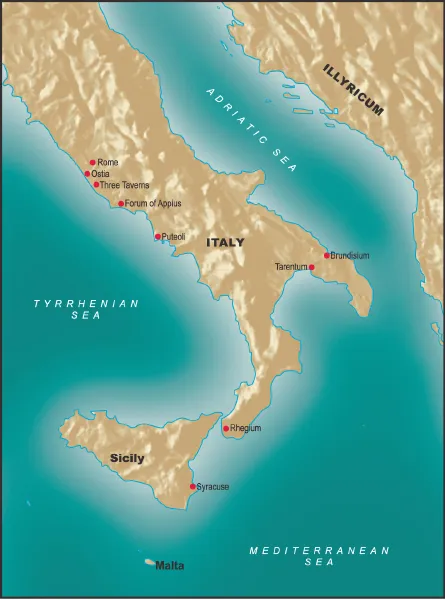
ITALY
To Whom Was Hebrews Written and Why?
The Recipients. As is the case with authorship, the first recipients of Hebrews are not explicitly identified in the book. What the interpreter is left to, therefore, is sorting through clues to their identity. Fortunately, a number of such clues exist.
First, the author seems to address a group of people who have some background in the Jewish synagogue. His use of the Old Testament seems to assume a fairly broad understanding of the Scriptures. Also, theological concepts popular in the Greek-speaking synagogues of the day are found in the book—such as a special veneration of Moses, the mediatorial role of angels in relation to the old covenant law, and interest in the role of the divine Wisdom in creation.
Second, some associated with this Christian community seem to have abandoned the Christian faith and, perhaps, returned to Judaism proper, and others are struggling with the temptation to do so.
Third, the church addressed is likely located in the city of Rome. Among the over one million inhabitants of Rome in the first Christian century, some forty to sixty thousand were Jews. Many of these were Roman citizens, had Greek or Latin names, and spoke Greek. Acts 2 tells us that there were Jews from Rome at the Pentecost event, and it may be that some of these converted to Christianity, returning to the capital to establish a church there. In Hebrews 13:24 the author writes, “Those from Italy send you their greetings.” Although the phrase “from Italy” is ambiguous, the same phrase is used of Aquila and Priscilla in Acts 18:2. In context it refers to those from Rome who then reside somewhere other than Rome. Therefore, it seems that the author is writing back to Rome while associated with some who are from there.
ROME
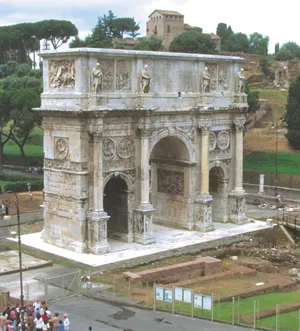
The Arch of Constantine.

The Via Sacra leading to the Colosseum.
Table of contents
- Cover
- Title Page
- Copyright Page
- Contents
- How to Use This eBook
- Introduction
- List of Sidebars
- List of Charts
- Index of Photos and Maps
- Abbreviations
- Hebrews
- James
- Credits for Photos and Maps
- The New International Version Appendix
Trusted by 375,005 students
Access to over 1.5 million titles for a fair monthly price.
Study more efficiently using our study tools.
Frequently asked questions
Yes, you can cancel anytime from the Subscription tab in your account settings on the Perlego website. Your subscription will stay active until the end of your current billing period. Learn how to cancel your subscription
No, books cannot be downloaded as external files, such as PDFs, for use outside of Perlego. However, you can download books within the Perlego app for offline reading on mobile or tablet. Learn how to download books offline
Perlego offers two plans: Essential and Complete
- Essential is ideal for learners and professionals who enjoy exploring a wide range of subjects. Access the Essential Library with 800,000+ trusted titles and best-sellers across business, personal growth, and the humanities. Includes unlimited reading time and Standard Read Aloud voice.
- Complete: Perfect for advanced learners and researchers needing full, unrestricted access. Unlock 1.5M+ books across hundreds of subjects, including academic and specialized titles. The Complete Plan also includes advanced features like Premium Read Aloud and Research Assistant.
We are an online textbook subscription service, where you can get access to an entire online library for less than the price of a single book per month. With over 1.5 million books across 990+ topics, we’ve got you covered! Learn about our mission
Look out for the read-aloud symbol on your next book to see if you can listen to it. The read-aloud tool reads text aloud for you, highlighting the text as it is being read. You can pause it, speed it up and slow it down. Learn more about Read Aloud
Yes! You can use the Perlego app on both iOS and Android devices to read anytime, anywhere — even offline. Perfect for commutes or when you’re on the go.
Please note we cannot support devices running on iOS 13 and Android 7 or earlier. Learn more about using the app
Please note we cannot support devices running on iOS 13 and Android 7 or earlier. Learn more about using the app
Yes, you can access Hebrews, James by George H. Guthrie,Douglas J. Moo, Clinton E. Arnold in PDF and/or ePUB format, as well as other popular books in Theology & Religion & Biblical Commentary. We have over 1.5 million books available in our catalogue for you to explore.