- 192 pages
- English
- ePUB (mobile friendly)
- Available on iOS & Android
eBook - ePub
About this book
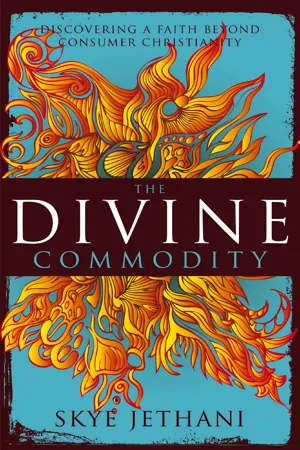
The challenge facing Christianity today is not a lack of motivation or resources, but a failure of imagination.A growing number of people are disturbed by the values exhibited by the contemporary church. Worship has become entertainment, the church has become a shopping mall, and God has become a consumable product. Many sense that something is wrong, but they cannot imagine an alternative way. The Divine Commodity finally articulates what so many have been feeling and offers hope for the future of a post-consumer Christianity.Through Scripture, history, engaging narrative, and the inspiring art of Vincent van Gogh, The Divine Commodity explores spiritual practices that liberate our imaginations to live as Christ's people in a consumer culture opposed to the values of his kingdom. Each chapter shows how our formation as consumers has distorted an element of our faith. For example, the way churches have become corporations and how branding makes us more focused on image than reality. It then energizes an alternative vision for those seeking a more meaningful faith. Before we can hope to live differently, we must have our minds released from consumerism's grip and captivated once again by Christ.
Information
Topic
Theology & ReligionSubtopic
Christian MinistryCHAPTER 1: SLUMBER OF THE IMAGINATION
Do not quench your inspiration and your imagination;
do not become the slave of your model.
do not become the slave of your model.
Vincent van Gogh
WALTOPIA
Soaring above the wetlands of central Florida, like an iridescent pearl on green velvet, is Spaceship Earth. The massive geodesic sphere is the heart of Disney’s Epcot Center, and an architectural monument to Walt Disney’s greatest dream. The sublime beauty of the silver orb is matched only by its colossal failure.
The final years of Walt Disney’s visionary life were consumed with the goal of solving the problems facing the world’s cities by utilizing advances in science, industry, and urban design. After building Disneyland in California, Walt purchased forty-seven square miles of Florida wilderness not simply to reproduce his West Coast theme park, but to build a fully functional city of the future. He called it E.P.C.O.T. — Experimental Prototype Community of Tomorrow.
In his final film, Walt Disney revealed his plans for Epcot that included schools, residential neighborhoods, parks, churches, advanced public transportation, even skyscrapers and a sports arena. He said Epcot would be a showcase that will “always be in a state of becoming. It will never cease to be a living blueprint of the future where people actually live a life they can’t find anyplace else in the world.”1
In Walt Disney’s imagination every detail of Epcot was already real. He even envisioned how the garbage would be collected. But others believed Walt’s vision was so fantastical, so beyond convention, that it couldn’t possibly be realized. Behind his back company managers referred to his dream as “Waltopia” — from the Greek word utopia meaning “no place.”
After Disney’s unexpected death in 1966, his successors didn’t know how to proceed with Epcot. Rather than an advanced city unlike any in the world, company executives who lacked Walt’s ability to see beyond proven formulas retreated to a more conventional concept. The new president of the Disney Company said Epcot was now being reconsidered “from the point of view of economics, operations, technology, and market potential.”2
By the time Epcot opened on October 1, 1982, little remained of Walt’s dream. Rather than a stream of residents commuting to their first day at work, it was an ocean of tourists who walked beneath the reflective belly of Spaceship Earth ready to buy souvenirs and consume prefabricated experiences. The grand city of tomorrow never lived beyond Walt’s imagination. Instead, Epcot became a theme park — a pragmatic and proven idea Disney’s managers could execute and stockholders could embrace.
Today, Epcot is the least popular amusement park in Disney’s vacation kingdom. Incapable of inspiring the citizens of the world as Walt had dreamed, it has become a subject of ridicule and mockery. Comedian P. J. O’Rourke has remarked, “With Epcot Center the Disney Corporation has accomplished something I didn’t think possible in today’s world. They have created a land of make-believe that’s worse than regular life.”3
The gleaming pearl on the horizon of central Florida’s wilderness is a reminder that imagination is in a battle with conventionality, and conventionality is a powerful foe.
TRIUMPH AND TRAGEDY
In July 2003, not far from the shadow of Epcot’s silver sphere in Orlando, ten thousand Christian retailers gathered for the fifty-fourth annual Christian Booksellers Association convention. The CBA represents the $4.2 billion industry that sells Bibles, books, bubblegum, and bracelets to Christian consumers. The economic power wielded by the CBA has grown so rapidly that President George W. Bush has even taken notice.
Bush, whose ascent to the presidency would not have been possible without conservative evangelicals, addressed the 2003 CBA convention via video. “You know as I do the power of faith can transform lives,” he said. “You bring the Good News to a world hungry for hope and comfort and encouragement.”4 Interestingly, Bush was praising Christian retailers, not churches, for spreading the light of Christ. The fact that the president of the United States, the most powerful political figure on the planet, would address the merchants of Christian books and baubles reveals the economic and political influence Christian consumers have attained.
The other memorable appearance at the 2003 CBA convention was actor/director Mel Gibson. The Hollywood hero and devout Roman Catholic gave a preview of his upcoming film The Passion of the Christ. Gibson’s movie was promoted as a way for Christian retailers to leverage the Easter holiday. The CBA’s president said, “We want to play a role in reclaiming the holiday for Christ. We want to draw people into our stores and drive seekers into the church.”5 Of course, The Passion of the Christ became one of the most profitable films in history, grossing nearly $700 million worldwide and triggering a new wave of Christian-friendly Hollywood productions.
The presence of both political and pop-culture royalty at the CBA convention would have been unimaginable just a few years earlier. In the mid-twentieth century some feared America would follow the path of Europe, where the church atrophied to become an emaciated shell of its former glory. That fear drove evangelical Christians to seek cultural, political, and economic influence as a way of ensuring survival. The 2003 CBA convention represented the culmination of their cultural revolution. Like Epcot’s beautiful geodesic sphere, the church had soared to become a powerful icon on the horizon of the American cultural landscape. But like Epcot, the church’s stunning ascent has been matched only by its colossal failure.
Christian researcher George Barna concludes, “American Christianity has largely failed since the middle of the twentieth century because Jesus’ modern-day disciples do not act like Jesus.”6 During the same half century that evangelicals were climbing to the pinnacle of cultural influence, the church has largely lost its ability to transform lives and teach people to practice the values championed by Christ. Research conducted by sociologists and pollsters shows that “evangelical Christians are as likely to embrace lifestyles every bit as hedonistic, materialistic, self-centered, and sexually immoral as the world in general.”7 Despite the influence of Jesus Christ over Washington, Hollywood, and Wall Street, his power over the hearts and minds of people in America is far less evident.
Along with suffering a deficit of qualitative distinctiveness, the church is also losing ground quantitatively. The percentage of Americans engaged in a local congregation has been declining for years. In 1990 approximately 20 percent of the population attended church on any given weekend. By 2004 the figure had dropped to 17 percent. If the trend continues, by 2050 only 11 percent of Americans will attend church. Although megachurches have multiplied across the fruited plains, the numbers show that Christianity in America has been consolidating and not expanding.8
PARALLEL UNIVERSE
The challenge facing Christianity today is not a lack of motivation or resources, but a failure of imagination.
Walt Disney’s successors wanted to honor their founder’s dream. That laudable motivation is what kept the Epcot project alive. The problem was not their motivation; it was their lack of imagination. They did not possess Disney’s ability to see beyond what was conventionally possible. They simply could not see the city he wanted to build in their mind’s eye. As a result they reinterpreted Epcot through the only framework they could comprehend — pragmatics, economics, and market potential.
Likewise, the paradoxical rise of Christian political/economic influence and decline of Christian moral influence is not the product of devious or ignoble motivation. Christian leaders in America are largely admirable men and women who passionately love God and genuinely desire to honor Christ. Many sacrifice time, income, and emotional energy giving themselves to what they believe matters most: Christ and his kingdom. And we certainly do not lack resources. In fact, based on the CBA’s own numbers we have spent more money equipping the church than any other Christians in history.
Our deficiency is not motivation or money, but imagination. Our ability to live Christianly and be the church corporately has failed because we do not believe it is possible. Like Disney’s successors we simply cannot imagine how to carry out the fantastical mission of our leader. Wanting to obey Christ but lacking his imagination, we reinterpret the mission of the church through the only framework comprehendible to us — the one we’ve inherited from our consumer culture.
Many books about the crisis facing the American church have been added to our shelves in recent years. Most of these well-intentioned reads suggest a new model of church, a new method of cultural engagement, or a new strategy for missions. Certainly there is a place for models, strategies, and methods, but before a solution can be implemented it must be imagined. Without imagination any solution we conceive will be rooted to the very system we must transcend. How can a prisoner plot his escape if he doesn’t believe a world exists outside the prison walls? The prisoner’s imagination must be free before his body can follow. As Albert Einstein observed, “Problems cannot be solved with the same consciousness that created them.” And Walter Brueggemann declares, “Questions of implementation are of no consequence until the vision can be imagined. The imagination must come before implementation. Our culture is competent to implement almost anything and to imagine almost nothing.”9
The emergence of a Christian subculture that parallels the secular culture in every way reveals the captivity of our imaginations. With a speed matched only by the Chinese black market, Christian merchandisers produce knockoffs of every secular phenomenon virtually overnight. Whether a new music genre, diet program, or fashion trend, you are sure to find a Jesus version in your local Christian store in time for Christmas. (I was recently given a poker chip that said, “Jesus went all in for you. So ante up and give your heart to him.”) If imitation is the highest form of flattery, than Christians have become pop culture’s most devoted admirers.
This bizarre parallel universe is not limited to kitschy Christian knickknacks. We also manage our churches with repackaged secular business principles and methodologies pioneered by marketers. A prominent pastor was asked what was distinctly spiritual about his leadership. The pastor responded, “There’s nothing distinctly spiritual. . . . One of the criticisms I get is ‘Your church is so corporate. . . .’ And I say, ‘OK, you’re right. Now why is that a bad model?’ ” Justifying his use of secular business models the pastor said, “A principle is a principle, and God created all the principles.” 10
In his defense, for decades ministers have been conditioned by books, conferences, and seminaries to revere how secular corporations accomplish their work. It is assumed that the way Home Depot or Starbucks reacts to consumers’ desires is how the church ought to react as well. Whether one is selling Chryslers, Coca-Cola, or Christ is irrelevant, the principles of marketing and persuasion apply equally to all. So, why not learn from the biggest and best? Lyle Schaller, one of the most popular church consultants, has said, “The big issue . . . is not whether one applauds or disapproves of the growth of consumerism. The central issue is that consumerism is now a fact of life.”11 In his book, The Very Large Church, Schaller goes on to coach pastors on how to appeal to spiritual consumers, but he never expects the church to transcend or transform these cultural values. This posture of resignation to consumer culture reveals the utter captivity of our imaginations.
The eagerness to defend conventionality found in both church leaders and lay people explains why sociologists can no longer differentiate the lives of Christians from non-Christians, or the behavior of churches from corporations. We have lost the ability to imagine. We have abandoned the vision that Christianity is an alternative way. We cannot see our lives, our households, or our churches operating any differently than the world around us. As Brueggemann says, “The key pathology of our time, which seduces us all, is the reduction of our imagination so that we are too numbed, satiated, and co-opted to do serious imaginative work.”12 Our spiritual imaginations have fallen asleep on the comfortable mattress of the consumer culture, and before any remedy for the church can be prescribed our dormant imaginations must be stirred from their slumber.
A CHILD WILL LEAD THEM
“Come on. That’s a good girl. Come on.” I peeked over the screen of my laptop. Alone in the family room with Zoe, my four-year-old daughter, I wondered who she was talking to. I had been checking my email while she entertained herself with the dolls and paper and crayons strewn on the floor. “Come on, you’re almost there,” she said.
“Who are you talking to, Zoe?” I asked. She was walking slowly through the room holding one hand behind her.
“Sandy,” she replied. I scanned the dolls on the floor. There was Baby Blue, Baby Pink, Baby Red, and the most beloved Baby Too (a name Zoe assumed for the doll because her mother and I would frequently ask, “Would you like your baby too?”). But I saw no doll that might be a new Baby Sandy.
“Who is Sandy?” I asked.
“Daddy!” she sighed and rolled her eyes with the condescension of a teenager. “Sandy is my horse.” The duh at the end of her sentence was implied as she motioned to the invisible filly in the middle of our family room. “I’m taking her to the barn so she can eat her lunch.”
“And what are you going to feed her?” I was happy to play along.
Zoe shook her head. “Horses eat hay, Dad.” A fact so well known that my question was clearly out of line even in Zoe’s imaginary world. She proceeded to the kitchen/barn where Sandy enjoyed her lunch.
My brief encounter with Zoe’s imagination resurrected memories of my own. A photo album opened in my mind, and I saw faded scenes from a friendship long ago. Wanda and I playing on the swing set. The two of us gazing at the fish bowl. And, of course, Wanda and I discovering the endless joy of Legos. She was my imaginary friend. “Wanda from Toronto” is what I called her when I was four years old. (To my knowledge I’ve never been to Toronto, and to this day Wanda remains my only friend from the city.) Her unannounced appearance at a family gathering or dinner party was always a point of conflict. My older brother and cousins loved to tease me, but I learned how to defend my unconventional relationship with Wanda. That’s what friends do.
With Sandy eating her lunch in the kitchen/barn and Zoe brushing her mane, I reflected on the distant joy of a childish imagination. What happened to Wanda? I thought. She returned to Toronto many years ago and never visited me again. She probably sensed that she was no longer welcomed. Like the disciples who tried to keep the children away from Jesus, most of my adult life has been spent repressing my imagination. Such things are childish and have no place in the serious Christian life, I thought. The fertile land of imagination is a terrain we pass through, not a field we cultivate. Didn’t the apostle Paul say, “When I was a child, I talked like a child, I thought like a child, I reasoned like a child. When I became a man, I put childish ways behind me.”13
I have been told many reasons for keeping the imagination out of my Christian life. The imagination is for New Age spirituality. Imagination is sinful. Imagination leads to heresy. You don’t need imagination, you have the Bible. But then I remember Jesus calling the children. “Let the little children come to me and do not hinder them,”14 he said. I so easily forget that Jesus welcomes all of me, even my childishness. I wonder what that boy felt when Jesus put him in front of those men bickering about who was th...
Table of contents
- COVER PAGE
- TITLE PAGE
- COPYRIGHT PAGE
- CONTENTS
- INTRODUCTION
- CHAPTER 1: SLUMBER OF THE IMAGINATION
- CHAPTER 2: THE CANVAS OF SILENCE
- CHAPTER 3: BRANDING OF THE HEART
- CHAPTER 4: AT ETERNITY’S GATE
- CHAPTER 5: WIND IN A BOTTLE
- CHAPTER 6: THE LAND OF DESIRE
- CHAPTER 7: A REFUGE FOR MANY
- CHAPTER 8: AROUND THE TABLE
- CHAPTER 9: TEACHING THE WORLD TO SING
- EPILOGUE
- QUESTIONS FOR REFLECTION AND CONVERSATION
- NOTES
- ABOUT THE PUBLISHER
Trusted by 375,005 students
Access to over 1.5 million titles for a fair monthly price.
Study more efficiently using our study tools.
Frequently asked questions
Yes, you can cancel anytime from the Subscription tab in your account settings on the Perlego website. Your subscription will stay active until the end of your current billing period. Learn how to cancel your subscription
No, books cannot be downloaded as external files, such as PDFs, for use outside of Perlego. However, you can download books within the Perlego app for offline reading on mobile or tablet. Learn how to download books offline
Perlego offers two plans: Essential and Complete
- Essential is ideal for learners and professionals who enjoy exploring a wide range of subjects. Access the Essential Library with 800,000+ trusted titles and best-sellers across business, personal growth, and the humanities. Includes unlimited reading time and Standard Read Aloud voice.
- Complete: Perfect for advanced learners and researchers needing full, unrestricted access. Unlock 1.5M+ books across hundreds of subjects, including academic and specialized titles. The Complete Plan also includes advanced features like Premium Read Aloud and Research Assistant.
We are an online textbook subscription service, where you can get access to an entire online library for less than the price of a single book per month. With over 1.5 million books across 990+ topics, we’ve got you covered! Learn about our mission
Look out for the read-aloud symbol on your next book to see if you can listen to it. The read-aloud tool reads text aloud for you, highlighting the text as it is being read. You can pause it, speed it up and slow it down. Learn more about Read Aloud
Yes! You can use the Perlego app on both iOS and Android devices to read anytime, anywhere — even offline. Perfect for commutes or when you’re on the go.
Please note we cannot support devices running on iOS 13 and Android 7 or earlier. Learn more about using the app
Please note we cannot support devices running on iOS 13 and Android 7 or earlier. Learn more about using the app
Yes, you can access The Divine Commodity by Skye Jethani in PDF and/or ePUB format, as well as other popular books in Theology & Religion & Christian Ministry. We have over 1.5 million books available in our catalogue for you to explore.