- 192 pages
- English
- ePUB (mobile friendly)
- Available on iOS & Android
eBook - ePub
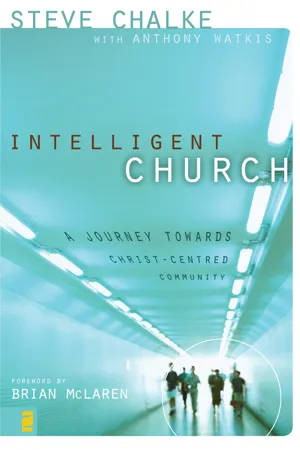
Intelligent Church
About this book
'As St. John of the Cross said: "Mission is putting love where love is not." This book is full of ideas. It should prompt us all to examine the effectiveness of the way local churches are organized.'—The Most Reverend and Right Honourable Dr. John Sentamu, Archbishop of York 'Everything that Steve Chalke writes is insightful and cutting-edge. Here he argues in favor of a church that thinks and acts in ways that make the Kingdom of God visible and reasonable in a secular society.'--Tony Campolo, PhD Eastern University, Pennsylvania, USA The task of the Church is "to be the irrefutable demonstration and proof of the fact that God is love," claims Steve Chalke. An intelligent church intentionally connects the Bible and its twenty-first-century culture, is authentic and, most importantly, has thought through its practice. In other words, the way it does church is a reflection of its understanding of who God is. This foundational issue must be addressed by pastors, church and ministry leaders, small group leaders and others as we continue to grapple with the shape of effective church in the postmodern, post-Christian West. As Chalke unpacks central theological concepts, such as the incarnation, human sinfulness and the Trinity, he points us to the corresponding characteristics of an intelligent church, such as inclusiveness, messiness and diversity. Each thought-provoking chapter concludes with a 'Yes but How?' section, which gives practical suggestions for moving your church along this path.
Information
Topic
Theology & ReligionSubtopic
Christian MinistryCHAPTER 1
INTELLIGENT
CHURCH
CHURCH
I had a strange experience recently. I was at a weekend retreat in the Wiltshire countryside with some of the leadership team of my church. At lunchtime on Saturday a few of us ventured to the supermarket in the nearest town to buy food. As we walked up to the doors of the shop, we noticed a few people standing outside the building with a banner announcing Saint Luke’s Church. Thinking that this was part of the church’s mission to the local community, we decided to stop for a chat and to offer some encouragement. Incredibly, though, as we approached, a man in clerical dress started shaking a collection tin in our faces. He was, it seems, of the belief that we (and, presumably, the rest of those out shopping for groceries) should make a donation to Saint Luke’s organ refurbishment fund. We stopped and talked, but however hard we tried to change the conversation, they were only interested in discussing keyboards, pedals and pipes. As we wandered off I was overcome by the sad realisation that the only message the shoppers heard from the church that day was, ‘We’re broke. Please save us!’
This story is a modern-day parable. I can almost hear it — told with style — on the lips of Jesus. It triggers me to consider again the purpose of the church. Have we concentrated our efforts in the right place? Are we trying so hard to save ourselves that we’ve forgotten what we are really here to do? Who are we? Why do we exist? How do we develop an intelligent response to the communities in which we find ourselves living?
REDEFINITION
Intelligent churches in the twenty-first century will take many different forms, but window dressing is not our concern here. Rather, the task ahead is to nail down what it means to be church — to discern what core values, principles, and theology should be the hallmarks of our churches. We will determine not what shape churches should take as much as from what substance they should be formed.
A former archbishop of Canterbury, William Temple, prophetically warned, ‘If a man’s concept of God is at error, the more fundamentally committed he is to it, the more damage he will do.’With that in mind, we need to consider again the way in which we approach the task of being church by reflecting on who God is. What we believe about God fundamentally shapes our view of the church, and that, in turn, determines how we live out its mission. Our behaviour, both personally and communally, is simply an outworking of our beliefs.
It is critical that our generation redefine what the church has to say to the world, engaging with and critiquing our culture as many of the generations before us have engaged with theirs. But we will not recapture the success of the church of ages past simply by replicating their methods or even, to an extent, their message. As Franklin D. Roosevelt famously stated, ‘Eternal truths will neither be true nor eternal unless they have fresh meaning for every new social situation.’ We need an intelligent response to our society — by which I do not mean cerebral or intellectual, but rather wise, relevant, and authentic. We need churches that make sense of both the Bible and of conventional wisdom. We need Christians who know theology, culture, and the application of one to the other.
STATE OF THE CHURCH
At present it seems that no matter how you look at the situation of the church, something has gone wrong. The signs are not good. Every few months or so, the people who are interested in counting, calculating and forecasting confront us with a new bundle of depressing statistics about the church in the West. Church attendance figures, they tell us, are tumbling. Although by no means uniform across the denominations or the nations, the statistics for the Western church as a whole look, at best, grim.
Looking farther afield than the United Kingdom, it would be easy to conclude that matters are much better. The church in the United States is, on one level, thriving. The United States is home to some of the most enormous and influential churches on earth — some attracting tens of thousands of people each week. However, an increasing number of churches are finding their pews or chairs emptier with each passing Sunday.
While speaking at a conference run by the Southern Baptist denomination, addressing the nation’s church planters, I congratulated them on their astonishing success. However, when I went out for a meal with a group of their national leaders, I was told that half of their churches had far fewer in their congregations than I had assumed. The average size of a Southern Baptist church, they informed me, was under fifty members — a marked decline when compared to the situation just a few years earlier. The symptoms of the fall of Christendom are, it seems, creeping up on the United States too. Though the media is keen to point to the power of America’s religious right, a walk through most of the country’s multicultural cities reveals a very different story.
Even weddings, funerals and christenings (previously the big three events that would draw people into church buildings) are becoming less commonly ‘Christian’. People are often getting married and buried in secular, or at least secularized, ceremonies. The baptism of infants, too, is increasingly rare among nominally Christian families. And religious festivals (such as Good Friday and Easter), which in decades past were guaranteed pew fillers, now seldom attract more than a handful of unfamiliar faces. Christmas is the only Christian holiday that retains a semblance of theological imagery and attracts the casual believer to a church service — and even that is fading as Winterval, the secularized holiday, becomes increasingly prevalent.
But why should this be the case? Jesus still commands huge respect. I remember chatting with a friend over dinner shortly after he’d been invited to speak at Harvard University. He told me that he had asked the president of the university why he had been given such a wonderful opportunity. The president responded with an intriguing story. He explained that some months earlier he had gathered together a group of his senior faculty for a discussion day during which he had raised the subject of Jesus. The response was overwhelmingly positive. Jesus was described as wise, compassionate, generous, gracious, liberating and forgiving. But later that day, when he asked the same group of tutors their opinions of the church, they gave very different answers — judgemental, bigoted, self-righteous, censorious, finger-wagging and excluding. My friend had been invited to ‘redress the balance’. But the president’s words to him were stern: ‘You’ve got a problem — a very big problem.’
SPIRITUAL HUNGER
The church is often tempted to lay the blame for our decline on the values of the culture in which we live. People nowadays, we say, aren’t interested in church because they have been seduced by the corrupting influences of the age — the sex, the drugs, the rock and roll, the consumerism and the leisure — and have little concept of sin. But, while it is true that many of the trappings of Western culture are greatly distracting, this is no more true for us than it was for our counterparts living within the first-century Roman Empire — the years that saw the church grow from a clutch of people hiding in an upper room in Jerusalem into a movement that changed the world.
People within our post-Christian society are hungry for spiritual insight and direction. After his son’s birth, the world-famous soccer star David Beckham somewhat obliquely commented, ‘I’ve a definite sense of spirituality. I want Brooklyn to be christened, but I don’t know into what religion yet.’ Though they might not necessarily use familiar language to describe it, people are longing for meaning and purpose in their lives, acutely aware of their failings and inconsistencies — they are searching for God. References to spirituality are everywhere. Religion, albeit noninstitutional, is a boom market. People in our postmodern, post-Christian age are certainly not closed to matters spiritual; indeed, I believe they are as spiritually open and searching as any generation that preceded them.
A few years back I was frequently invited to speak to university students addressing the question, ‘How can I believe in God in an age of science?’ For a number of years it was without doubt the subject I was asked to address most often — so pressing was the question. But it’s been so long since I was last booked to speak on this once hot potato that I’ve forgotten what I used to say. What was once a burning issue is now seen as irrelevant.
Today vast numbers of people have an intrinsic understanding of spirituality — they see it as part of everyday life. And yet fewer and fewer of them venture across the threshold of our church buildings. In spite of a deep, indeed growing, sense of spiritual awareness and genuine longing for God (whatever the conception of the divine), fewer people would consider visiting a church building than even a decade ago. Why?
Last year I was given the opportunity to run in the New York Marathon, and so I found myself on the eve of the race in Times Square with my wife, Cornelia. As we wandered around, dazzled by the bright lights of the gigantic billboards, we became aware of a group of eight or ten well-built, muscular men in their twenties and thirties, one of whom was shouting at the crowd and waving a big stick at them. Curious as to what was going on we rather gingerly drew closer to the group to hear what they were saying. As we did so, it became obvious that they were Christians and that they were engaged in some sort of street outreach. The man with the stick was pointing it at the passersby and shouting at the top of his voice about their ‘iniquitous lives’. Every now and then he would turn to an even bigger man beside him (bearing a striking similarity to Mr. T from the old television series The A-Team) who was holding a huge Bible. The leader would order Mr. T to read a verse from the Scriptures.
‘Give me that Deuteronomy 32:22,’ he would shout.
‘ “For a fire has been kindled by my wrath, one that burns to the realm of death below. It will devour the earth and its harvests and set afire the foundations of the mountains,” ’ would come Mr. T’s dutiful reply. Their message was clear to everyone in the square — God doesn’t like you very much, and if you don’t change your ways he’s going to burn you.
I decided, much to Cornelia’s embarrassment and fear, that I had to get involved. I walked into the centre of the group and interrupted the show to remind all who were gathered of God’s overwhelming, unstoppable and undeserved love for them and all humanity. The crowd was growing all the time, and so, my confidence rising, I turned to Mr. T and ordered, ‘Give me 1 John 4:9 – 10.’ He didn’t move a muscle. So I quoted it as best I could from memory. ‘This is how God showed his love among us: He sent his one and only Son into the world that we might live through him. This is love: not that we loved God, but that he loved us and sent his Son as an atoning sacrifice for our sins.’
All I could hear was my heart beating much louder than normal and a few of the onlookers who had started to snigger. The silence was broken when the group’s leader pointed at Mr. T and boomed at me, ‘He reads only what I tell him to read!’
We are not changed by moral exhortation but rather by being shown a different and better reality. The best starting point is always to affirm rather than condemn. The great sweep, the meta-narrative, of the Bible is of God’s love for us, and communicating that message to our generation is our primary task — indeed to fail to do so is to fail to preach an authentic gospel. The task of the church is to be the irrefutable demonstration and proof of the fact that God is love. God’s nature is revealed through his works. If the church is part of the work of God then its primary responsibility is to announce this truth. Donald English once called this the ‘deep resonance of the biblical text’. When people are lost it does not help to rub it in by reminding them of the fact. Instead the lost need hope from a guide they can trust. If you are sinking in quicksand, you don’t need to know the exact chemical composition of the substance or the precise workings of gravity and suction that are slowly dragging you down — what you long for is a rescuer who is standing on solid rock.
If our first understanding of God is more about his anger and judgement than about his love, mercy and generosity, it is not only natural but indeed inevitable that we come to outwork these values ourselves. If we believe that God doesn’t ‘take’ to those outside the church, we too, in turn, will begin to despise or patronize them. Each of us is made in the image of our god; our view of God’s character will reflect itself in our attitudes, behaviour, tone and body language. Behaviour is always the echo of belief.
Clearly at present something about the way many churches present the gospel simply turns people off. They don’t see how our gospel equates with anything that might bear the label ‘good news’. They have seen what the church has to offer and, frankly, are not interested. At one and the same time, the opportunity for the church has never been greater, and the relevance of the church to whole swathes of the population has seldom been less.
None of this is to argue that the gospel of Christ does not bear a natural offense. From the very beginnings of the church, the gospel was understood to be controversial, scandalous and subversive — we serve a Saviour who was crucified for the good news he dared to bring. Indeed, in the following chapters we will explore some of the reasons for that offence — the upside-down values by which Christ called his followers to live. All too often, however, the unchurched many who are longing for their world to be turned upside down are offended by the wrong thing: the poor manners, rudeness or judgementalism of zealous Christians.
Jesus’ story of the prodigal son is the tale of a boy who has deeply wronged his father; when he has run out of money and realises that his life is screwed up, he turns and heads for home simply because he has nowhere else to go. When he arrives home he is not met with a sermon. He endures no recriminations, ‘lessons we can learn from this’ or ‘I told you so’s’. His father does not come out with a ‘So you think you can walk back in here like nothing ever happened, do you? Well, it’s just not that easy!’ speech. Instead the son is met with open arms, love, celebration and forgiveness before it’s been asked for; the fatted calf is killed in his honour, and a great party is thrown.
God gently woos those who do not yet know him — should our churches not do the same? God comes to embrace, not to bully. He is a lover, not a rapist. The gospel of the big stick is no gospel at all. It is time for our churches to more fully embrace a gospel whose first gentle note is love.
SOCIAL CREATURES
A great craving of our age is for meaning through community. In the film The Shawshank Redemption one of the characters (an old man named Brooks Hatlan) is released from the prison that has been his home for most of his life. He finds himself in a world he doesn’t recognise; he longs for his old life back in prison, where, although he didn’t have freedom, he had friends. In a letter ‘home’ to his buddies in Shawshank he says, ‘The world went and got itself in a big damn hurry.’
In a particularly moving scene we find out that Brooks would rather kill himself than live as an alien in the modern world. Authorities, no doubt, locked Brooks up under the belief that he belonged in prison — it only took time, though, for prison to become the place where even he felt he belonged. In prison, another of the inmates observes, ‘[Brooks was] an important man, an educated man. A librarian. Out there, he’s nothing.’ The sudden dislocation from his friends, his identity and his home leaves him unable to cope. Ultimately he commits suicide.
Millions of people feel like Brooks Hatlan. We live in a high-speed world full of labour-saving technologies, and we never seem to have enough hours in the day. Though our impressive new communications mean that we can be in contact with anyone we choose in an instant, more and more of us live in isolation. A great many people feel that they have lost their sense of belonging. It is interesting to note that the statistics for suicide reveal that worldwide young men (ages fifteen to thirty-four) are the most vulnerable group — and in my experience they are also...
Table of contents
- Cover Page
- Title Page
- Copyright
- Contents
- Forword
- Introduction
- 1. Intelligent Church
- 2. Inclusive Church
- 3. Messy Church
- 4. Honest Church
- 5. Purposeful Church
- 6. Generous Church
- 7. Vulnerable Church
- 8. Political Church
- 9. Diverse Church
- 10. Dependent Church
- 11. Transforming Church
- Afterword
- Acknowledgements
- About Faithworks
- Bibliography
- About The Publisher
- Share Your Thoughts
Trusted by 375,005 students
Access to over 1.5 million titles for a fair monthly price.
Study more efficiently using our study tools.
Frequently asked questions
Yes, you can cancel anytime from the Subscription tab in your account settings on the Perlego website. Your subscription will stay active until the end of your current billing period. Learn how to cancel your subscription
No, books cannot be downloaded as external files, such as PDFs, for use outside of Perlego. However, you can download books within the Perlego app for offline reading on mobile or tablet. Learn how to download books offline
Perlego offers two plans: Essential and Complete
- Essential is ideal for learners and professionals who enjoy exploring a wide range of subjects. Access the Essential Library with 800,000+ trusted titles and best-sellers across business, personal growth, and the humanities. Includes unlimited reading time and Standard Read Aloud voice.
- Complete: Perfect for advanced learners and researchers needing full, unrestricted access. Unlock 1.5M+ books across hundreds of subjects, including academic and specialized titles. The Complete Plan also includes advanced features like Premium Read Aloud and Research Assistant.
We are an online textbook subscription service, where you can get access to an entire online library for less than the price of a single book per month. With over 1.5 million books across 990+ topics, we’ve got you covered! Learn about our mission
Look out for the read-aloud symbol on your next book to see if you can listen to it. The read-aloud tool reads text aloud for you, highlighting the text as it is being read. You can pause it, speed it up and slow it down. Learn more about Read Aloud
Yes! You can use the Perlego app on both iOS and Android devices to read anytime, anywhere — even offline. Perfect for commutes or when you’re on the go.
Please note we cannot support devices running on iOS 13 and Android 7 or earlier. Learn more about using the app
Please note we cannot support devices running on iOS 13 and Android 7 or earlier. Learn more about using the app
Yes, you can access Intelligent Church by Steve Chalke,Anthony Watkis in PDF and/or ePUB format, as well as other popular books in Theology & Religion & Christian Ministry. We have over 1.5 million books available in our catalogue for you to explore.