Like nothing else, small groups have the power to change lives. They are the ideal route to discipleship—a place where the rubber of biblical truth meets the road of human relationships. However, church leaders often feel at a loss when it comes to assessing the strengths and weaknesses of group life in a church, and they struggle with understanding and solving the root causes of problems. Group Life resources provide in this ebook the practical tools and training resources needed to develop life-changing small group leaders, coaches to shepherd group leaders, and ultimately, a thriving church-wide small group ministry. These resources include the updated and revised versions of the best-selling Leading Life-Changing Small Groups and Coaching Life-Changing Small Group Leaders, the new Building a Life-Changing Small Group Ministry and the supplemental Group Life Training DVD. Appropriate for individual or group study, the books function as manuals and workbooks that teach and allow readers to process and record information as they learn. Downloadable web-based vision clips and supplemental videos in the DVD help readers explore and discuss topics further. Group Life Resources conveniently integrate with the ReGroupTM curriculum, giving trainers the option to use them together. Church leaders can use the revised edition of Bill Donahue and Greg Bowman's Coaching Life-Changing Small Group Leaders participant's guide and the supplemental DVD and vision clips to prepare small group coaches to nurture and develop small group leaders. The guide functions as a manual and workbook that allows trainees to process and record information as they learn. Trainers can use the materials during group or individual sessions.
eBook - ePub
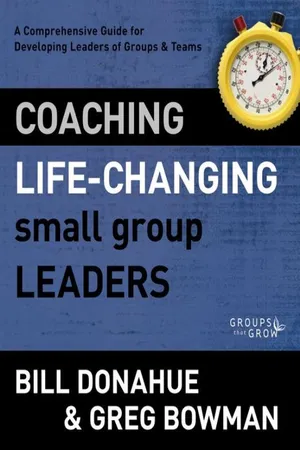
Coaching Life-Changing Small Group Leaders
A Comprehensive Guide for Developing Leaders of Groups and Teams
- 176 pages
- English
- ePUB (mobile friendly)
- Available on iOS & Android
eBook - ePub
Coaching Life-Changing Small Group Leaders
A Comprehensive Guide for Developing Leaders of Groups and Teams
About this book
Information
Topic
Theology & ReligionSubtopic
Christian ChurchChapter 1
A VISION FOR COACHING
What does it mean to be a coach? Why is it so essential to have people in the church who are willing to guide and encourage leaders of groups and teams? What does it look like when someone takes on this role and invests in the life of a leader?
To become effective coaches in the church, first we need to embrace a vision for the practice of coaching. It is often a misunderstood role, mistaken by some to mean “boss” or “faultfinder.” That’s not coaching, at least not when the spiritual growth of leaders and church members is at stake. Coaching is different from mere oversight or supervision. It is personal, developmental, and supportive. Coaches bring out the best in leaders. Let’s take a few moments to get a clearer picture of what it means to coach leaders in the church.
EVERYONE HAS A STORY
Every coach has a story. Every leader has a story. Each one has his or her struggles and successes. Each group, each ministry team, has a beginning. It has, or soon enough will have, its share of problems, relational challenges, victories and breakthroughs. And at some point, everyone’s leadership of his or her group, or the group itself, will come to an end.
What will make the difference in a leader’s story? Each day, leaders write a page in their leadership narrative. Every aspect of life is a part of their unfolding story: every decision they face, every conversation they have, every prayer they offer, every relationship they forge, every gathering they participate in, every new skill they learn and practice, every way they try to balance their personal time with their leadership responsibilities. What makes the difference in a leader finding joy and fulfillment as they live out their story?
Woven into the leader’s story line are people who offer sage counsel as the story progresses. It’s not important that these influencers have all the answers or that their stories are picture perfect. What is important is the willingness to graciously share life in a way that helps other leaders grow. As Proverbs 13:10 tells us, wisdom comes when we listen to each other’s counsel.
In many vocations and avocations, this wisdom comes from someone called a coach. This is not a term unique to leaders in our world. Coaches exist everywhere, in every kind of work. Use any search engine on the internet, and you will find millions of sites offering information about the word coach.
Executives hire professional coaches to get their businesses running at peak performance and keep their leadership skills sharp. Scan a handful of professional coaching sites, and a few key words and phrases keep popping up: focus, effectiveness, results, motivation, skill, clarity, time management, follow-through, commitment, cooperation. Interestingly, coaches for these corporate executives often stress a balance between work and play, business and family.
John Russell, managing director of Harley-Davidson Europe, Ltd., is an avid fan of coaching because of its ability to bring out the best in leaders. He says, “I never cease to be amazed at the power of the coaching process to draw out the skills or talent that was previously hidden within an individual, and which invariably finds a way to solve a problem previously thought unsolvable.”
Life coaches are quick to emphasize they are not therapists; they are more than a friend and more than a consultant. Life coaches are there to help you be successful—to clarify your goals and help you take action. They are there to help you do whatever it takes: eliminate the distractions that suck time, energy, and money from life, upgrade your friends (getting interested?), smooth out your life wrinkles, and create a life plan that works. (Honestly, these words were taken from real websites!) Good life coaches will, in fact, challenge your thinking. They will help you alter ingrained behavior patterns. They can help you make real and lasting changes.
Once used to bolster troubled staffers, coaching now is part of the standard leadership development training for elite executives and talented up-and-comers at IBM, Motorola, J.P. Morgan, Chase, and Hewlett Packard. These companies are discreetly giving their best prospects what star athletes have long had: a trusted adviser to help them reach their goals.
— CNN.com
The world of creative arts has long adhered to a coaching model in many disciplines. Dance, drama, sculpting, painting—the list is endless. Coaches are also coming forward to help artists build their business; some are calling it “left-brained skills for right-brained people.” These coaches are wise in the way they are tailoring their counsel to the natural ways that artists think and process their world, and the best coaches are helping them bring their artistic discipline to the business of art.
Even in the construction trades (carpentry, electrical work, plumbing), there is a coaching relationship between skilled workers and their apprentices. There are skills to be learned, tools and techniques to be mastered, a language to be understood, relationships and deadlines to be managed. The apprentice takes cues and counsel from the tradesman, his or her coach, who in this case has years of on-the-job experience.
Last, and most obviously, is the world of sports. The list of legendary coaches is topped by names like John Wooden, the UCLA coach whose record of ten NCAA national championships in a twelve-year period is unmatched by any other college basketball coach. Or Pat Summit, who in her four decades as coach of women’s basketball at the University of Tennessee has changed the way women’s hoops is viewed. Vince Lombardi led his Green Bay Packers football team to five NFL championships in the 1960s. Butch Harmon, the top swing coach for ten years running in the world of golf, has helped shape the game of professionals like Phil Mickelson, Tiger Woods, Ernie Els, and Greg Norman.
Sports coaches help athletes do their best, stay grounded in the fundamentals, never get complacent, overcome the little mistakes that lead to big errors, and always give their all. The best coaches will also help their players with integrity on and off the playing field. It doesn’t take long to come up with a list of athletes whose promising careers have been cut short by failings that had little to do with their athletic prowess or performance. As John Wooden said, the challenge is always to give that coaching without causing resentment.
Even the best leaders need a coach, whether they are the top athletes in their chosen sport or successful executives in a large corporation. Leaders need someone to offer a gentle course correction when they stray from the fundamentals. They need a safe environment to process the challenges of leadership, to celebrate the victories, and to determine what actions to take next. Every leader needs a coach who can step into his or her story and bring clarity when the plotline gets confusing, when the narrative is heavy or troubling or involves something the leader has never faced before.
Every leader has a story, and woven into that story are a number of coaches, individuals who have had a positive influence in the leader’s growth and development over time.
REFLECTION
Take a few minutes and think through your leadership story. What individuals have offered sage counsel to you at various points in your journey? If it is helpful, break your story into ten-year periods of life and single out one or two people who were most influential in a coaching role in each of those periods.
What was it about each coach’s relationship and interaction with you that was most helpful?
GOD’S STORY
The Bible is full of stories that describe what happens when a coach or mentor speaks into the life of an ordinary person, investing in an individual who shows leadership potential.
Moses with Joshua
According to Numbers 11, Joshua was one of several men who served as aides to Moses, and Joshua did so from an early point in his life. Moses evidently spotted some leadership potential in him, because over time Joshua was given increasing amounts of leadership responsibility and opportunity.
By the time we encounter Joshua and Moses in the book of Exodus, Joshua has been elevated to the level of a personal assistant to Moses. He experiences lots of up close and personal interaction with Moses. He observes Moses as he leads the nation of Israel spiritually and militarily. Those opportunities contain many great coaching moments.
Moses develops Joshua spiritually by exposing him to incredible experiences with God, like ascending Mount Sinai with Moses to receive the Ten Commandments (Ex. 24). Moses takes Joshua with him into the tabernacle whenever God speaks directly to him (Ex. 33). Moses also takes the opportunity to develop Joshua militarily by asking him to lead the nation into battle (Ex. 17).
Moses coaches Joshua’s leadership decision making all along the way. In Numbers 11:27–29, at God’s direction, Moses is choosing seventy elders and leaders for Israel. As Moses is talking to the nation, God breaks in and begins speaking as a sign of affirmation for Moses’s choices. As God speaks, his Spirit falls on the seventy men, and all of them—including Eldad and Medad, who aren’t at the tabernacle with Moses and the others—begin to prophesy.
Joshua expresses a fair amount of jealousy and anger that these two men might be taking Moses’s position of leadership. It’s understandable that Joshua has grown close to his coach and mentor, but his actions are clearly out of line. Moses corrects Joshua’s attitude and teaches him a valuable leadership lesson.
Through Moses’s careful coaching, Joshua grows from a timid young man into a man of strong character and strong faith, strong enough that he becomes one of two leaders who profess a belief that Israel can conquer the Promised Land. Joshua takes on partial leadership of Israel (Num. 27:18–23) and eventually, at Moses’s death, becomes the sole spiritual and military leader of the nation (Josh. 1:1–9).
Jesus with Peter
The public opinion on Peter was less than kind. One religious group referred to him as “uneducated and inexperienced” (Acts 4:13 CEV). Yet Jesus saw enough potential in Peter to make him one of the first disciples called to join his ministry (Matt. 4:18–20). Peter had leadership gifts and abilities; he just needed a coach who believed in him, a coach who would invest in him and help him grow into the leader God had already gifted him to be.
Over the next three and a half years, Jesus coached Peter’s development by
• encouraging Peter to take risks and step out in faith, even when others were afraid to follow (Matt. 14:25–31);
• allowing Peter to speak his opinions but correcting his thinking when he was off base (Matt. 16:22–23);
• exposing Peter to experiences that would stretch his faith as well as his understanding of God’s calling on his life (Luke 8:40–56; 9:28–36);
• recognizing when Peter was open to deeper teaching, and directly answering his questions (Matt. 15:15–20; 18:21–35);
• speaking hard truth to Peter when necessary (Matt. 26:34);
• giving Peter specific tasks that would develop his leadership gifts and abilities (Luke 9:1–2; 22:8).
Few leaders have failed Christ as badly as Peter. He denied his friend and teacher three times in his hour of greatest need. Yet Peter rose past his failures and became the rock-solid foundation of the early church. Peter was able to rise above his mistakes, his deficiencies in education, and people’s lack of faith in him. He was able to overcome all those obstacles because of the nurture and development he received in his time with Jesus.
Priscilla and Aquila with Apollos
Intimidated by the prospect of coaching people more gifted than you? Take a good look at this New Testament couple. Recruited by Paul in Corinth, Priscilla and Aquila were in the business of tentmaking. When Paul left for Ephesus, they accompanied him in his church-planting ventures. Knowing what we do of Paul, we can easily imagine that the three-hundred-mile journey by boat from Corinth to Ephesus was filled with coaching conversations.
Upon arrival in Ephesus, Paul parted company with this dynamic couple, who apparently felt energized for ministry. Soon they found themselves coaching the great orator Apollos, a superstar communicator who taught some questionable doctrine. Though he could teach circles around them, Priscilla and Aquila guided and coached him, releasing him back into ministry.
What made Pricilla and Aquila the right coaches for Apollos was not superior training, skills, or experience. It was their ability to speak truth to Apollos in such a way that he could receive it and immediately apply it to his life.
An easily overlooked aspect of these stories in Acts 18 is that high-impact coaching can take place in a relatively short time span. Coaches can catalyze growth in leaders in a single interaction. It doesn’t always take months or years to make a difference in a leader’s life.
Paul with Timothy
If you read the book of Acts through the coaching lens, the apostle Paul stands out for the energy he invested to raise up and develop new leaders. The list of people he coached includes not only Priscilla and Aquila but also Barnabas, John Mark, Silas, and a young man named Timothy, whom Paul encountered in the city of Lystra.
Timothy had a good reputation with the church there and also in the nearby town of Iconium (Acts 16:2), where he had evidently done some work. Paul saw enough potential in this young leader to take him along on...
Table of contents
- Cover
- Title Page
- CONTENTS
- Introduction
- 1. A Vision for Coaching
- 2. Coaching’s Core Practices
- 3. The Coach’s Toolbox
- 4. The Coach’s Life
- Appendix 1: Personal Spiritual Practices
- Appendix 2: Key Coaching Resources
- Appendix 3: Coaching Hot Potatoes
- Acknowledgments
- About the Author
- Books in the Groups That Grow Series
- Copyright
- About the Publisher
- Share Your Thoughts
Trusted by 375,005 students
Access to over 1.5 million titles for a fair monthly price.
Study more efficiently using our study tools.
Frequently asked questions
Yes, you can cancel anytime from the Subscription tab in your account settings on the Perlego website. Your subscription will stay active until the end of your current billing period. Learn how to cancel your subscription
No, books cannot be downloaded as external files, such as PDFs, for use outside of Perlego. However, you can download books within the Perlego app for offline reading on mobile or tablet. Learn how to download books offline
Perlego offers two plans: Essential and Complete
- Essential is ideal for learners and professionals who enjoy exploring a wide range of subjects. Access the Essential Library with 800,000+ trusted titles and best-sellers across business, personal growth, and the humanities. Includes unlimited reading time and Standard Read Aloud voice.
- Complete: Perfect for advanced learners and researchers needing full, unrestricted access. Unlock 1.5M+ books across hundreds of subjects, including academic and specialized titles. The Complete Plan also includes advanced features like Premium Read Aloud and Research Assistant.
We are an online textbook subscription service, where you can get access to an entire online library for less than the price of a single book per month. With over 1.5 million books across 990+ topics, we’ve got you covered! Learn about our mission
Look out for the read-aloud symbol on your next book to see if you can listen to it. The read-aloud tool reads text aloud for you, highlighting the text as it is being read. You can pause it, speed it up and slow it down. Learn more about Read Aloud
Yes! You can use the Perlego app on both iOS and Android devices to read anytime, anywhere — even offline. Perfect for commutes or when you’re on the go.
Please note we cannot support devices running on iOS 13 and Android 7 or earlier. Learn more about using the app
Please note we cannot support devices running on iOS 13 and Android 7 or earlier. Learn more about using the app
Yes, you can access Coaching Life-Changing Small Group Leaders by Bill Donahue,Greg Bowman in PDF and/or ePUB format, as well as other popular books in Theology & Religion & Christian Church. We have over 1.5 million books available in our catalogue for you to explore.