![]()
CHAPTER 1
TRAPPED IN “EITHER/OR” THINKING
“I am so mad!” These words were cried out by a young woman after she stood up during the middle of a class in my college course on science and religion. I slowly sank down behind the lecture stand, quickly glancing at my notes, hoping to find what I had said that triggered her outburst. And she wasn’t finished. “I’m mad at my parents for putting me in an expensive Christian school where teachers taught me that Satan had concocted the so-called ‘theory’ of evolution. I am angry with my youth pastor for telling me that I had to choose between evolution and creation. And I’m furious with the senior pastor at my church. On Sunday mornings, he has preached that evolutionists cannot be true Christians!”
Finally, she sat down. I relaxed, realizing that her rage was not directed at me. I said to her, “You must always remember that your parents love you and care for you. The fact that they paid a lot of money to send you to a private Christian school instead of public school shows they were giving you the opportunity for your faith to mature. I am also certain that the pastors in your church wanted the best for you. But many of them are taught in theology school that evolution can destroy our faith in Jesus.”
I added, “I completely understand your frustration. I have lived your story of being forced into making a choice between evolution and creation, and this led me to pick science over my Christian faith. But as you are seeing in this course, there are a variety of different ways to embrace both God and modern science. My challenge to you and your classmates is this: You are the next generation of leaders in the church. What can you do to improve this situation?”
Like many Christians today, the parents and pastors of my students are fearful of evolution. They assume that if evolution is true, then God did not create the world and Christianity must be false. More specifically, if the universe and life were not made in six literal days about six thousand years ago, then the Bible is a lie, and we cannot trust anything it says about Jesus and our salvation. Some people go so far as to say that if life evolved, then God does not exist. I understand this type of thinking because I lost my faith as a freshman in college after taking just one course on evolution. I was trapped in the assumption that I had to choose between evolution and creation, and between modern science and Christian faith. By the time I left college, I was an atheist.
As an evolutionist, I assumed that the entire cosmos and every living organism had evolved only through blind chance. My existence had no purpose or ultimate meaning whatsoever. With such a dark and dreary picture of the world, I thought that the best way to live my life was to live for me and me alone. Selfishness marked my lifestyle. I didn’t believe in morality because I didn’t think there was any ultimate right or wrong. From my perspective, humans were nothing but animals evolved through a completely random process. I saw myself to be no different than any other animal and tried living like one. I’ll spare you the details. I’m embarrassed by things I did and people I hurt. For many Christians, this is another fear of evolution. They assume that it leads to immorality.
My story is not unique. Many Christian students have lost their faith over the issue of evolution. Today they are leaving Christianity in greater numbers and at a much earlier age. A 2011 Barna Group survey reveals that 59 percent of young people “disconnect either permanently or for an extended period of time from church life after age 15.” The issue of science is one of the reasons why they leave the church. This study records that 25 percent of them perceive that “Christianity is anti-science,” and 23 percent have “been turned off by the evolution-versus-creation debate.”1 Every Christian should be concerned with this shocking loss of faith among the younger generation.
I wrote this book to address problems Christian students face regarding modern science and the origin of the world. It is based on the traditional belief of a fruitful relationship between God’s Two Books. The Book of God’s Words is the Bible. Scripture reveals spiritual truths concerning our Creator, his creation, and us. The Book of God’s Works is the physical world. Science is a wonderful gift from the Lord to explore the heavens and the earth and all the wonderful creatures. Through microscopes and telescopes we can see that nature “declare[s] the glory of God” (Ps. 19:1). Together, God’s Two Books—Scripture and nature—provide us with a divine revelation of who created the world and how he created it.
My hope for this book is that it helps you to develop your view of the relationship between Christianity and science and in particular your position on origins. My goal is for readers to have a stronger God-centered biblical faith and a great admiration for modern science, including evolution. It’s worth pointing out that there is not just one way to view God’s Two Books, but many different ways. I will also share with you my own approach to relating Scripture and nature.
This book is personal. It’s not merely about theories and concepts. It’s about an experience I had. I wrestled with evolution and Christian faith over a period of about twenty years. I’ll share many mistakes that I made, and hopefully you will avoid making these same errors.
Forced to Choose between Evolution and Creation
When the topic of origins first came to my attention, there was a serious problem with the way I thought about evolution and Christianity. Like most people, I was trapped in “either/or” thinking. This forced me to assume that there are only two possible positions with regard to the origin of the universe and life. I thought I had to choose either evolution or creation.
An issue that is divided into only two simple positions is called a “dichotomy.” This term is made up of the Greek word dicha, which means “in two,” and temnō is the verb “to cut.” A dichotomy forces people to pick between one of two choices. It completely blinds them from seeing a wide range of other possibilities. For example, why could there not be a third choice for origins, where the God of Christianity used evolution as his method to create the entire cosmos and every plant and animal?
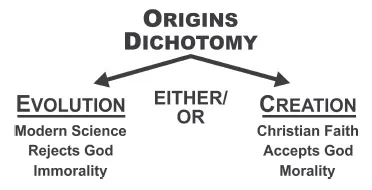
Figure 1–1. The Origins Dichotomy.
Figure 1–1 presents the origins dichotomy. It has been incredibly destructive both inside and outside of the church. For those who love modern science and accept evolution, this dichotomy has driven them away from God and even led to immoral lifestyles. It has also forced a number of scientists to assume that in order to become a Christian, they have to give up their scientific views. On the other hand, many Christians reject evolution and modern science because the origins dichotomy is taught in their churches. Evolution is presented as a lie that Satan uses to destroy belief in God. This fuels fear and turns Christian students away from studying science, especially the age of the earth and the evolution of life.
Personally, I know the destructive power of the evolution vs. creation dichotomy. I was raised in a good Christian home and went to a fine Christian school. During a biology class in high school, I was introduced to the theory of evolution. One of my favorite teachers pointed out that evolution could be seen as God’s way of creating all living organisms. This teacher, a wonderful Christian, added that biological evolution was not a reason for us to reject our faith.
However, looking back at this critical moment in my life, I now realize that just telling high school students that God could have used evolution is not enough information to protect them from the origins dichotomy. Students need to be given a variety of reasons why it might be true that the Lord created through an evolutionary process. Over the years I have spoken to high school students on many occasions. They always ask excellent questions about origins. Parents, pastors, and Christian teachers need to deal directly with these questions. They have to stop giving routine shallow answers that are entrenched in the origins dichotomy.
When I left high school, I was not equipped to protect my faith from the attacks of a secular education at a public college. Within only the first few weeks of my freshman year, professors and older students were telling me that intelligent people do not believe in God. According to them, religion is just a phase of human evolution, and we are in the process of shedding it away. They added that the only people who accept God are those who are either uneducated or near their death.
My college education was also claiming that science is the only credible form of thinking because science deals with hard facts and real truth. After all, just look around at how our lives have been improved by amazing scientific discoveries. NASA, not religion, put humans on the moon. Medicine, not prayer, cures diseases. In this way, I was being trapped in another notorious dichotomy. College was forcing me to choose either science or religion.
My first biology course in the first term of college was on evolution. The basic message was quite obvious. Life originated through an evolutionary process with no plan, no purpose, and definitely no God. Humans were nothing but an unintended fluke of nature. I got the distinct impression that to be a real scientist, you had to be an atheist. By the end of the course, I came to what I thought was a completely logical conclusion: since evolution is true, then the Bible must be false and Christianity a lie.
Like most Christians, I read the Bible literally, and I knew that the first chapter of the book of Genesis stated the world was created in six 24-hour days. However, in biology class I was being shown a wide range of scientific evidence for the evolution of living organisms over billions of years. I was hopelessly trapped in the origins dichotomy and “either/or” thinking. I had no idea that there was an intellectually respectable middle position between atheistic evolution and six day creation.
Losing My Faith in College
Toward the end of my first term, my parents discovered that I was no longer attending church. At the Christmas break, they sat me down to find out why. I can remember the conversation as if it were yesterday. Actually, it wasn’t a conversation. It was a nasty argument. I pounded on the kitchen table, raised my voice, and claimed that evolution is a fact and that the world was not created in six days. To the horror of my parents, I then told them that the Bible is complete nonsense and nothing but a fairy tale. Needless to say, this was not the Christmas present they were expecting.
My mother and father did not have the privilege of a college education. They could not respond to my scientific arguments. In fact, I was the first in my family to go to college. There was no aunt, uncle, or cousin who could have helped me with questions about evolution and Christianity. As I mentioned earlier, I simply wasn’t equipped to face the attacks of a secular education on my faith.
This is the main reason why I have written this book. I want Christian students to be prepared to face the challenges of secular education. I want them to know all their options so they can make informed decisions about what they believe about science and faith. I don’t want students to get trapped in the origins dichotomy or the science vs. religion dichotomy. This is the book I wish I could have read when I entered college.
At the end of my first year of college, I wrote in my diary, “It seems that humans are nothing but mere chemical reactions programmed by DNA. . . . But there’s more, I’m sure.” Although I had rejected the God of Christianity, I did not at that time become an atheist. I still believed in a god who was responsible for humans being “more” than just “mere chemical reactions.” I was sort of spiritual, but I was definitely not religious. I thought that religion was a scam to make money and that most ministers and priests were crooked.
In reality, I lived as if this god did not exist—except when I desperately needed him, such as when I thought my girlfriend was pregnant. In other words, I had a so-called “god-of-the-emergencies.” I prayed to him only to save me from my stupidity and immorality. Clearly, I was a hypocrite.
After two years of college, I was accepted into dental school. I joined the military to pay for my education. A number of my classmates were marvelous Christians. They often shared their faith with me. I even found some of their reasons for believing in Jesus to be persuasive. But it was their godly lifestyle that impacted me more than any argument for religion. I wanted what they had even though I couldn’t put it into words at the time. I wanted holiness, and I wanted God in my life. Yet the issue of origins was the looming problem. My Christian friends rejected evolution. So once again, that dreadful dichotomy appeared in my life and forced me to assume I had only two choices: either purposeless evolution with no God or creation in six 24-hour days through the God of Christianity.
Although the powerful reality of Jesus was being brilliantly displayed in the lives of some of my dental classmates, I gradually moved away from believing in a mostly absent god during my early years of college. I slipped in and out of periods of uncertainty regarding whether God existed (called “agnosticism”) until finally I became an atheist.
In another revealing entry in my diary I wrote, “Love is a protective response characteristic of all animals, except expressed to greater levels in humans because of their superior intelligence.” From my perspective, love was merely an illusion. It was just a meaningless idea found in romance novels and fairy tales that weak-minded people had invented. What everyone called “love” was nothing but an animal instinct selected by evolution so that living organisms could continue to reproduce and evolve. With this view of love, it takes little effort to imagine how I treated women. I’m not proud of that. For me, an atheistic view of evolution led to an immoral lifestyle.
I graduated from dental school and began to serve as a military dentist. My secular college education had completely brainwashed me into believing that happiness was to be found in a self-serving lifestyle. This meant treating women disrespectfully, abusing drugs and alcohol, driving fast cars, and playing sports as much as possible. I partied as hard as I could. From a distance, it looked like I was having the time of my life. But inwardly, I sensed that there was something wrong with my selfish way of living. At a logical level, I recognized the foolishness in running around, getting high, buying cars, and being consumed by sports. Deep inside me, I had an uncomfortable feeling. There was a profound emptiness in my soul. I also had a distinct sense of being dirty and unclean.
Returning to Faith, but Still Trapped in Dichotomies
One of my first military posts was on the island of Cyprus in the Mediterranean, where I served as a United Nations peacekeeper. By God’s grace and in an answer to my mother’s prayers, it was during that six-month tour that I returned to my Christian faith through reading the gospel of John in the Bible. There were no dramatic events or major crises in my life at that time. I was completely fed up with living a selfish and filthy lifestyle. I wanted God in my life and I wanted holiness. As I went through the gospel of John, I could sense the Lord gently working in my heart. And there was a feeling of being freed and cleansed from the dirt of my sins.
On Good Friday, I went to church for the first time in more than seven years. God revealed to me the meaning of his death on the Cross: Jesus loves us so much that he died for us (John 3:16). Think about that. The Creator of this astonishing universe suffered death on the Cross to show how much he loves each and every one of us! I began to weep during the Scripture reading on the Crucifixion and continued for the rest of the service. Miraculously, the Lord’s peace entered my soul.
The Cyprus posting changed my life forever. I have never once regretted my return to Christianity. When I left home ...