eBook - ePub
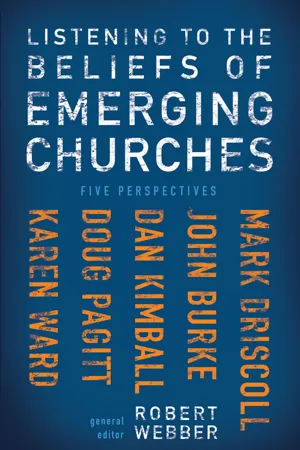
Listening to the Beliefs of Emerging Churches
Five Perspectives
- 240 pages
- English
- ePUB (mobile friendly)
- Available on iOS & Android
eBook - ePub
Listening to the Beliefs of Emerging Churches
Five Perspectives
About this book
What are the beliefs of the new movement known as the emerging church? In thought-provoking debate, prominent emerging leaders John Burke, Mark Driscoll, Dan Kimball, Doug Pagitt, and Karen Ward discuss their sometimes controversial views under the editorship of author and educator Robert Webber. Hear what they say about their views of Scripture, Christ, the atonement, other world religions, and other important doctrines, so you can come to your own conclusions about the emerging church.
Information
Topic
Theology & ReligionSubtopic
Christian ChurchCHAPTER 1
THE EMERGING
CHURCH AND
BIBLICIST THEOLOGY
CHURCH AND
BIBLICIST THEOLOGY

MARK DRISCOLL
THE EMERGING
CHURCH AND
BIBLICIST THEOLOGY
MARK DRISCOLL
During the mid-1990s, at the same time I founded Mars Hill Church in Seattle, I was part of what is now known as the emerging church in its embryonic days. Since that time I have been encouraged by the resurgent interest of doing missions in emerging American culture. I have also been greatly concerned by some of the aberrant theological concepts gaining popularity with some fellow emerging-type younger pastors.
This chapter is my attempt to address three of the hottest theological issues in our day and to correct emerging error with biblical orthodoxy. As a devoted biblicist I am seeking to be as faithful to Scripture as possible, which explains the many Scripture references in this chapter.*
I will explore what is arguably most distinctive about Christianity, namely the nature of God’s revelation, the nature of God, and the means by which God has chosen to save some sinners. The topics the publisher chose for this book are the essential elements of the Christian gospel according to the apostle Paul, who said that the second member of the Trinity, Jesus Christ, atones for our sins by his death and resurrection in fulfillment of the Scriptures.1
As I studied these doctrines in preparation for writing this chapter, God the Holy Spirit devastated me regarding the atoning death of Jesus. I spent many nights awake while my wife and children slept; as I visualized the agony of Jesus’ death for my sins, tears soaked the pages of my Bible, the same one I was reading when saved in 1990. Before we begin, I would like to thank you for taking the time to read this chapter, and I apologize in advance for having to condense so much theology. As a pastor who deeply loves his people, I wish I had more space to tell you the stories of the thousands of lives God has tranformed through these great truths, but perhaps you will simply need to come and visit our church and meet them for yourself.
*All Scripture quotations referenced by Mark Driscoll are from the New International Version.
How Does God Speak? Scripture.
No one is born with a clear comprehension of who God is. So, in an effort to know about God, various philosophers and religious leaders have presented their speculations about God with seemingly endless and contradictory declarations.
But God has chosen to lift the fog of human speculation with divine revelation. Whereas speculation is the human attempt to comprehend God, revelation is God’s communication to humanity with clarity that is otherwise impossible. The object of that revelation is the sixty-six books of Scripture.
What does Scripture say about Scripture?
Before arriving at a conclusive position about Scripture, it is fitting to first investigate what Scripture says about itself. If Scripture does not declare to be from God, without error, or helpful, then it is foolish to attribute something to Scripture that it does not claim for itself. The following list is a brief selection of some of the statements Scripture makes about itself:
Nothing to be taken from or added to (Deut. 4:2; 12:32;
Prov. 30:6)
Effective (Isa. 55:11)
Pure (Ps. 12:6; 119:140)
Perfect (Ps.19:7)
Precious (Ps. 19:10)
A life guide (Ps. 119:105)
Soul food (Jer. 15:16)
A fire that purifies and a hammer that breaks us (Jer. 23:29) True (Ps.119:160; John 17:17)
Helpful (Prov. 6:23)
Flawless (Prov. 30:5)
To be obeyed (Luke 8:21; James 1:22)
All we need to know God (Luke 16:29, 31)
The standard by which all teaching is to be tested (Acts 17:11) Faith-building (Rom. 10:17)
For everyone (Rom. 16:26)
Sin-cleansing (Eph. 5:26; James 1:21)
The sword for spiritual battle (Eph. 6:17; Heb. 4:12)
The very words of God (1 Thess. 2:13)
Divinely inspired (2 Tim. 3:16; 2 Peter 1:19 – 21)
Life-changing (Heb. 4:12)
Life-giving (James 1:18)
Spiritual nourishment (1 Peter 2:2)
Jesus is the key focus of Scripture and the most significant religious teacher in the history of the world. Therefore, it is also prudent to examine Jesus’ view and use of Scripture along with the disciples’, whom he trained as teachers.
Jesus summarized the Old Testament Scripture as existing in three parts: the Law, the Prophets, and the Psalms.2 He accepted the Old Testament Canon as it exists today, without any modifications, and he came to fulfill it.3
Jesus treated Old Testament narratives as straightforward facts: Genesis 1 and 2,4 Abel,5 Noah,6 Abraham,7 Sodom and Gomorrah,8 Lot,9 Isaac and Jacob,10 the manna,11 the wilderness serpent,12 Moses as lawgiver,13 false prophets, 14 and Jonah.15 Regarding authorship, Jesus said Scripture was given by Moses,16 Isaiah, 17 David, 18 and Daniel. 19
In matters of controversy, Jesus used the Old Testament as his court of appeals. 20 And in times of crisis, Jesus quoted Scripture. 21 Jesus repeatedly taught that Old Testament prophecy had been fulfilled because it was true. 22Jesus taught that the Scriptures could not be broken. 23
Jesus claimed that all Scripture, including the Law, the Prophets, and the Psalms, was fulfilled in him.24 Jesus also said the primary purpose of the Old Testament was to reveal himself. 25
Jesus promised that the Holy Spirit would inspire the writing of the Gospels and Epistles.26 And he said that his people would recognize his teaching. 27 This is possible because the Holy Spirit who inspired the writing of Scripture also teaches it to God’s people in whom he dwells. 28
Following his return to heaven, Jesus’ students wrote the remaining books of Scripture and likewise upheld Scripture as God’s unique, perfect, authoritative, helpful, and powerful revelation to humanity. The New Testament writers claim that the Old Testament is sacred Scripture. 29 Furthermore, New Testament authors quote the Old Testament roughly three hundred times.
Paul used Scripture and God’s spoken word interchangeably. 30 The New Testament teaches that what the Bible says is what God says. 31 And Peter and Paul claimed that Scripture has dual authorship by both men and God. 32
Most New Testament writers were eyewitnesses of Jesus. 33 Others received firsthand information from other reliable witnesses. Luke received his information from Paul 34 and numerous eyewitnesses, 35 Mark received his information from Peter, 36 and James and Jude were closely associated with the apostles and were probably Jesus’ brothers. Paul claimed that Jesus was speaking through him. 37 Paul quotes Luke as Scripture. 38 New Testament writers claimed that their writings were holy. 39 They said that their writings were the very words of God. 40 Peter called Paul’s writings Scripture. 41 Paul commanded that his letters be read in the churches and obeyed. 42 And the early church treated the apostles’ teaching as authoritative. 43
Also, at the time of its writing, upward of one-quarter of Scripture was prophetic in nature, promising future events hundreds, even a thousand, years in advance. These facts include Jesus’ virgin mother, 44 birth in Bethlehem, 45 flight to Egypt,46 entrance into the temple that was destroyed in AD 70, 47 betrayal for thirty pieces of silver, 48 clothing divided by the casting of lots, 49 crucifixion, 50 death and burial in a rich man’s tomb, 51 and resurrection from death.52
The Bible is clearly a book of history and not just philosophy, because it continually promises concrete historical events that, in time, come to pass exactly as promised. These fulfillments of prophetic promises show the divine inspiration of Scripture and prove that a sovereign God rules over human history and brings events to pass as he ordains them. Consequently, we can trust the internal consistency of the Bible to be a chorus of faithful witnesses who sing together in harmony. Nonetheless, not everyone accepts the teachin...
Table of contents
- Cover Page
- Title Page
- Copyright Page
- Contents
- Acknowledgments
- Introduction: The Interaction of Culture and Theology
- Chapter 1 The Emerging Church And Biblicist Theology
- Chapter 2 The Emerging Church And Incarnational Theology
- Chapter 3 The Emerging Church And Missional Theology
- Chapter 4 The Emerging Church And Embodied Theology
- Chapter 5 The Emerging Church And Communal Theology
- Conclusion : Assessing Emerging Theology
- Contributors
- Resources Recommended By Contributors And Editor
- Appendix 1: The Common Creeds Of The Church
- Appendix 2 : What Is The Ancient-Future Vision?
- Appendix 3 : A Call To An Ancient Evangelical Future
- Notes
- About The Publisher
- Share Your Thoughts
Trusted by 375,005 students
Access to over 1.5 million titles for a fair monthly price.
Study more efficiently using our study tools.
Frequently asked questions
Yes, you can cancel anytime from the Subscription tab in your account settings on the Perlego website. Your subscription will stay active until the end of your current billing period. Learn how to cancel your subscription
No, books cannot be downloaded as external files, such as PDFs, for use outside of Perlego. However, you can download books within the Perlego app for offline reading on mobile or tablet. Learn how to download books offline
Perlego offers two plans: Essential and Complete
- Essential is ideal for learners and professionals who enjoy exploring a wide range of subjects. Access the Essential Library with 800,000+ trusted titles and best-sellers across business, personal growth, and the humanities. Includes unlimited reading time and Standard Read Aloud voice.
- Complete: Perfect for advanced learners and researchers needing full, unrestricted access. Unlock 1.5M+ books across hundreds of subjects, including academic and specialized titles. The Complete Plan also includes advanced features like Premium Read Aloud and Research Assistant.
We are an online textbook subscription service, where you can get access to an entire online library for less than the price of a single book per month. With over 1.5 million books across 990+ topics, we’ve got you covered! Learn about our mission
Look out for the read-aloud symbol on your next book to see if you can listen to it. The read-aloud tool reads text aloud for you, highlighting the text as it is being read. You can pause it, speed it up and slow it down. Learn more about Read Aloud
Yes! You can use the Perlego app on both iOS and Android devices to read anytime, anywhere — even offline. Perfect for commutes or when you’re on the go.
Please note we cannot support devices running on iOS 13 and Android 7 or earlier. Learn more about using the app
Please note we cannot support devices running on iOS 13 and Android 7 or earlier. Learn more about using the app
Yes, you can access Listening to the Beliefs of Emerging Churches by Zondervan, Robert E. Webber,Robert E. Webber in PDF and/or ePUB format, as well as other popular books in Theology & Religion & Christian Church. We have over 1.5 million books available in our catalogue for you to explore.