"Ryken's Worldly Saints offers a fine introduction to seventeenth-century Puritanism in its English and American contexts. The work is rich in quotations from Puritan worthies and is ideally suited to general readers who have not delved widely into Puritan literature. It will also be a source of information and inspiration to those who seek a clearer understanding of the Puritan roots of American Christianity." -Harry Stout, Yale University "…the typical Puritans were not wild men, fierce and freaky, religious fanatics and social extremists, but sober, conscientious, and cultured citizens, persons of principle, determined and disciplined excelling in the domestic virtues, and with no obvious shortcomings save a tendency to run to words when saying anything important, whether to God or to a man. At last the record has been put straight." -J.I. Packer, Regent College "Worldly Saints provides a revealing treasury of primary and secondary evidence for understanding the Puritans, who they were, what they believed, and how they acted. This is a book of value and interest for scholars and students, clergy and laity alike." -Roland Mushat Frye, University of Pennsylvania "A very persuasive...most interesting book...stuffed with quotations from Puritan sources, almost to the point of making it a mini-anthology." -Publishers Weekly "With Worldly Saints, Christians of all persuasions have a tool that provides ready access to the vast treasures of Puritan thought." -Christianity Today "Ryken writes with a vigor and enthusiasm that makes delightful reading-never a dull moment." -Fides et Historia "Worldly Saints provides a valuable picture of Puritan life and values. It should be useful for general readers as well as for students of history and literature." -Christianity and Literature
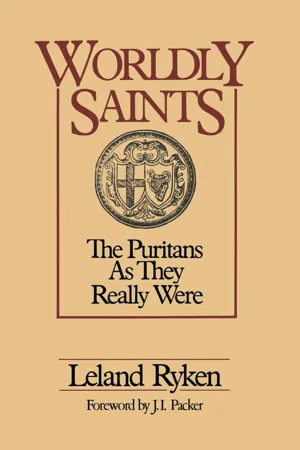
- 300 pages
- English
- ePUB (mobile friendly)
- Available on iOS & Android
eBook - ePub
About this book
Information
Topic
Teologia e religioneSubtopic
Denominazioni cristianeChapter 1
What Were the Original Puritans Like?
I serve a precise God.—RICHARD ROGERS
Puritanism is the haunting fear that someone, somewhere, may be happy.” So said a modern debunker of the Puritans.1
But a contemporary of William Tyndale, often considered the first Puritan, gave exactly the opposite assessment. Thomas More, the great Catholic, found the Protestant religion of Tyndale overly indulgent. He described its adherents as people who “loved no lenten fast” but instead “eat fast and drink fast and lust fast in their lechery.”2 Their theology, according to More, erred in the direction of making the Christian life too easy: “I could for my part be very well content that sin and pain and all were as shortly gone as Tyndale telleth us: but I am loathe that he deceived us.”3
Puritanism, we are told today, “damages the human soul, renders it hard and gloomy, deprives it of sunshine and happiness.”4 This charge would have come as quite a surprise to the Quaker George Fox, a contemporary of the Puritans who despised their “ribbons and lace and costly apparel,” their “sporting and feasting.”5
When authorities such as C. S. Lewis, Christopher Hill, and A. G. Dickens say such things as the following, it will pay us to keep an open mind to the possibility that we have been seriously misled regarding the Puritans:
We must picture these Puritans as the very opposite of those who bear that name today.6Very few of the so-called “Puritans” were “Puritanical” in the nineteenth-century sense of that word, obsessed by sex and opposed to fun: “Puritanism” of this sort was largely a post-Restoration creation.7When you think about Puritanism you must begin by getting rid of the slang term “puritanism” as applied to Victorian religious hypocrisy. This does not apply to seventeenth-century Puritanism.8
In the introduction that follows, I have attempted under a variety of formats to suggest the main outlines of the Puritan “mind” or “temperament” or “spirit.” The purpose of this overview is to provide a landscape that the remaining chapters will fill in with details. The opening chapter states my “thesis”; the rest of the book is documentation.
“Everybody Knows That the Puritans Were…”
No group of people has been more unjustly maligned in the twentieth century than the Puritans. As a result, we approach the Puritans with an enormous baggage of culturally ingrained prejudice. As an entry into the subject, therefore, I propose that we take a brief look at the usual charges against the Puritans, noting the truth or falseness of those charges.
The Puritans were against sex. Ridiculous. An influential Puritan said that sexual intercourse was “one of the most proper and essential acts of marriage” and something in which a couple should engage “with good will and delight, willingly, readily, and cheerfully.”9 Another began his list of the duties between husband and wife with “the right and lawful use of their bodies or of the marriage bed, which indeed is an essential duty of marriage.”10
The Puritans never laughed and were opposed to fun. Only partly true. The Puritans were serious people, but they also said such things as this: “God would have our joys to be far more than our sorrows”;11 “there is a kind of smiling and joyful laughter…which may stand…with the best man’s piety”;12 Christians “may be merry at their work, and merry at their meat”;13 “joy is the habitation of the righteous.”14 Thomas Gataker wrote that it is the purpose of Satan to persuade us that “in the kingdom of God there is nothing but sighing and groaning and fasting and prayer,” whereas the truth is that “in his house there is marrying and giving in marriage,…feasting and rejoicing.”15 William Tyndale described the Christian gospel as “good, merry, glad and joyful tidings, that maketh a man’s heart glad, and maketh him sing, and dance, and leap for joy.”16
The Puritans wore drab, unfashionable clothes. Untrue. The Puritans dressed according to the fashions of their class and time. It is true that black carried connotations of dignity and formality (as it does today) and was standard for clothes worn on Sundays and special occasions. But daily dress was colorful. The American Puritan William Brewster wore a blue coat, a violet coat, and a green waistcoat.17 Anthony Wood described how John Owen looked during his days as vice-chancellor at Oxford University: “hair powdered, cambric band with large costly band strings, velvet jacket, breeches set round at knees with ribbons pointed, and Spanish leather boots with cambric tops.”18 Russet or various shades of orange-brown were the most common color for clothes, but surviving inventories also show many items in red, blue, green, yellow, purple, and so forth.19
The Puritans were opposed to sports and recreation. Largely false. A book-length study has shown that the Puritans enjoyed such varied activities as hunting, fishing, a form of football, bowling, reading, music, swimming, skating, and archery.20 A Puritan pastor said regarding recreations that Christians should “enjoy them as liberties, with thankfulness to God that allows us these liberties to refresh ourselves.”21 It is true that the Puritans banned all recreation on Sundays and all games of chance, gambling, bear baiting, horse racing, and bowling in or around taverns at all times. They did so, not because they were opposed to fun, but because they judged these activities to be inherently harmful or immoral.
The Puritans were money-grubbing workaholics who would do anything to get rich. Generally untrue. The Puritans were obsessed with the dangers of wealth. In fact, they would hardly get off the subject when discussing business. Lord Montagu told his son, “Travail not too much to be rich.…He that is greedy of gain troubleth his own soul.”22 “Remember that riches are no part of your felicity,” wrote Richard Baxter; “riches are nothing but plentiful provision for tempting corruptible flesh.”23 “I had rather be a miserable saint than a prosperous sinner,” wrote Thomas Adams.24 On the positive side, the Puritans did believe that work was a moral virtue, that idleness was a vice, and that thrift or deliberate underconsumption for the sake of moderation and avoiding debt was a good thing.
The Puritans were hostile to the arts. Partly true, but not as true as most moderns think. The misunderstanding stems from the fact that the Puritans removed music and art from the churches. But this was an objection to Catholic worship and ceremony, not to music and art themselves.25 The Puritans removed organs and paintings from churches but bought them for private use in their homes.26 In a treatise stating the usual objections to musical instruments in church, John Cotton added that he did not “forbid the private use of any instrument of music.”27 Oliver Cromwell removed an organ from an Oxford chapel to his own residence at Hampton Court, where he employed a private organist. When one of his daughters was married, he engaged an orchestra of forty-eight to accompany the dancing.28 While confined to prison, John Bunyan secretly made a flute out of a chair leg.29
The Puritans were overly emotional and denigrated reason. Nonsense. They aimed at a balance of head and heart. “Man is a rational creature, and apt to be moved in a reasoning way,” wrote Richard Baxter.30 “The believer is the most reasonable man in the world,” wrote Samuel Rutherford; “he who doth all by faith, doth all by the light of sound reason.”31
Puritanism was an old-fashioned movement that appealed only to people over seventy suffering from tired blood. Exactly wrong. Puritanism was a youthful, vigorous movement. C. S. Lewis calls the early Puritans “young, fierce, progressive intellectuals, very fashionable and up-to-date.”32 The Puritans “thought young,” whatever their chronological age. The youthfulness of Elizabethan Puritans was a common taunt against them by their Anglican enemies; in 1583 Archbishop Whitgift said condescendingly to a group of Puritan ministers, “You are…but boys in comparison of us, who have studied divinity before you…were born.”33 An Anglican bishop was alarmed by the way in which the Puritans had “drawn divers young ministers” into their ranks,34 while at St. Albans it was the “young men and young women” who made a practice of “gadding” to the neighboring parish where the Puritan William Dyke preached.35 One anti-Puritan father arranged for his son to be educated by a Puritan “to sicken him of Puritanism,” only to find that his son became a Puritan.36
The Puritans were repelled by the human body and the physical world. Not true, except for a few Puritans suffering from psychological aberrations. Increase Mather wrote in his diary, “Jesus Christ intends to bestow eternal glory on my body as well as my soul, and therefore he will not deny unto me so small a matter as bodily health.”37 William Ames declared, “Our bodies are to be offered to God, Rom. 12:1, and God is to be glorified in our bodies.”38 As for the physical world, the Puritans said such things as this: “grace is hid in nature…as sweet-water in rose leaves”;39 “God hath given us several senses that so we might enjoy the delights of them all”;40 “this world and the things thereof are all good, and were all made of God, for the benefit of his creature.”41
The Puritans were intolerant toward people who disagreed with them. True by modern standards, but not by the standards of their day. No group in the sixteenth and seventeenth centuries was prepared to grant full religious and political toleration. There was one official church and government, and dissidents were punished for their dissent.
Compared with other religious groups in England, Puritan tolerance receives high marks. W. K. Jordan, whose books on the development of religious toleration in England are the standard sources on the subject, credits Puritanism for contributing to “liberty of dissent,” “religious liberty,” and “the right of freedom of conscience.”42 Cromwell was prepared to allow Anglicans and Catholics to hold their services in private homes (something that had largely been denied to Puritans), and he permitted the Jews to return to England and to have their own synagogue and cemetery in London.43 Despite all their anti-Catholicism, Puritans did not generally deny that many Catholics had been true Christians.44 And part of the time, at least, Puritans rose above party spirit, as in Samuel Fairclough’s statement, “If a man lives holily, and walks humbly with God, I shall ever love him, notwithstanding his conformity [to the Church of England]; and if he be proud, contentious and profane, I will never think well of him for his non-conformity.”45
The Puritans were overly strict. Often true. Samuel Ward’s college diary consists of a cataloging of his failings, and his self-accusations include such offenses as these: going “to bed without prayer,” falling asleep without his last thought being about God, “unwillingness to pray,” not preparing adequately for Sunday on the preceding Saturday night, immoderate eating, “also my immoderate laughter in the hall at nine o’clock,” impatience, and talking on Sunday of “other matters than are meet to be talked of on the Sabbath.”46
When the English Puritan preacher Richard ...
Table of contents
- Cover Page
- Title Page
- Dedication
- Table of Contents
- Excerpt
- FOREWORD Why We Need the Puritans J I. PACKER
- Preface
- Chapter 1 What Were the Original Puritans Like?
- Chapter 2 Work
- Chapter 3 Marriage and Sex
- Chapter 4 Money
- Chapter 5 Family
- Chapter 6 Puritan Preaching
- Chapter 7 Church and Worship
- Chapter 8 The Bible
- Chapter 9 Education
- Chapter 10 Social Action
- Chapter 11 Learning From Negative Example: Some Puritan Faults
- Chapter 12 The Genius of Puritanism: What the Puritans Did Best
- Notes
- Bibliography
- Acknowledgments
- Copyright
- About the Publisher
- Share Your Thoughts
Trusted by 375,005 students
Access to over 1.5 million titles for a fair monthly price.
Study more efficiently using our study tools.
Frequently asked questions
Yes, you can cancel anytime from the Subscription tab in your account settings on the Perlego website. Your subscription will stay active until the end of your current billing period. Learn how to cancel your subscription
No, books cannot be downloaded as external files, such as PDFs, for use outside of Perlego. However, you can download books within the Perlego app for offline reading on mobile or tablet. Learn how to download books offline
Perlego offers two plans: Essential and Complete
- Essential is ideal for learners and professionals who enjoy exploring a wide range of subjects. Access the Essential Library with 800,000+ trusted titles and best-sellers across business, personal growth, and the humanities. Includes unlimited reading time and Standard Read Aloud voice.
- Complete: Perfect for advanced learners and researchers needing full, unrestricted access. Unlock 1.5M+ books across hundreds of subjects, including academic and specialized titles. The Complete Plan also includes advanced features like Premium Read Aloud and Research Assistant.
We are an online textbook subscription service, where you can get access to an entire online library for less than the price of a single book per month. With over 1.5 million books across 990+ topics, we’ve got you covered! Learn about our mission
Look out for the read-aloud symbol on your next book to see if you can listen to it. The read-aloud tool reads text aloud for you, highlighting the text as it is being read. You can pause it, speed it up and slow it down. Learn more about Read Aloud
Yes! You can use the Perlego app on both iOS and Android devices to read anytime, anywhere — even offline. Perfect for commutes or when you’re on the go.
Please note we cannot support devices running on iOS 13 and Android 7 or earlier. Learn more about using the app
Please note we cannot support devices running on iOS 13 and Android 7 or earlier. Learn more about using the app
Yes, you can access Worldly Saints by Leland Ryken in PDF and/or ePUB format, as well as other popular books in Teologia e religione & Denominazioni cristiane. We have over 1.5 million books available in our catalogue for you to explore.