- 160 pages
- English
- ePUB (mobile friendly)
- Available on iOS & Android
eBook - ePub
Romans, Galatians
About this book
Brimming with lavish, full-color photos and graphics, the Zondervan Illustrated Bible Backgrounds Commentary walks you verse by verse through all the books of the New Testament. It's like slipping on a set of glasses that lets you read the Bible through the eyes of a first-century reader! Discoveries await you that will snap the world of the New Testament into gripping immediacy. Things that seem mystifying, puzzling, or obscure will take on tremendous meaning when you view them in their ancient context. You'll deepen your understanding of the teachings of Jesus. You'll discover the close, sometimes startling interplay between God's kingdom and the practical affairs of the church. Best of all, you'll gain a deepened awareness of the Bible's relevance for your life. Written in a clear, engaging style, this beautiful set provides a new and accessible approach that more technical expository and exegetical commentaries don't offer.
Information
Topic
Theology & ReligionSubtopic
Biblical CommentaryRomans
by Douglas J. Moo
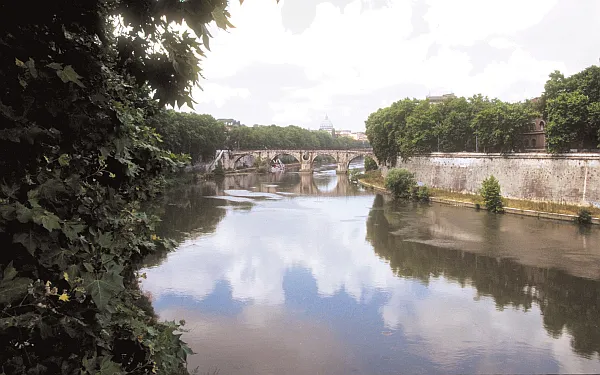
TIBER RIVER
All kinds of issues would need to be tackled in a full-scale introduction to Paul’s letter to the Romans: not least the questions about the letter’s purpose and theme. But the introductory remarks that follow will concentrate on the background issues that are the focus of this commentary. Other issues will be ignored or touched on only briefly.
Romans
Important Facts:
■ AUTHOR: Paul the apostle.
■ DATE: A.D. 57.
■ OCCASION: Paul writes toward the end of the third missionary journey to a church that is divided between Jewish and Gentile Christians.
■ PURPOSE: To help the Roman Christians understand the gospel, especially in its implications for the relationship of Jew and Gentile in the church.
Events Leading up to Paul’s Writing of Romans
Understanding Paul’s own situation as he writes Romans helps us appreciate the purpose and theme of the letter. In 15:14–22, he looks back at a period of ministry just concluded. “From Jerusalem all the way around to Illyricum,” Paul tells us, “I have fully proclaimed the gospel of Christ” (15:19). This verse indicates that Paul’s ministry has reached a significant geographical turning point. As Luke tells us in Acts, Paul first preached Christ in Damascus (and perhaps Arabia) after his conversion (Acts 9:19–22; cf. Gal. 1:17). Only after three years did he go to Jerusalem to preach, and then only briefly (Gal. 1:18; cf. Acts 9:28–29). Why, then, mention Jerusalem as the starting point for his ministry? For two reasons. First, the city represents the center of Judaism, and Paul is concerned to show how the gospel spread from the Jews to the Gentiles. Second, the city stands at one geographic extremity in his missionary travels. At the other extremity is Illyricum, the Roman province occupying what is today Albania and parts of Yugoslavia and Bosnia-Herzegovina. Only here does Paul refer to missionary work in this province, although such a ministry can be fit easily into the movements of Paul on his third missionary journey (see comments on Rom. 15:19). An “arc” drawn from Jersualem to Illyricum, therefore, passes over, or nearby, the important churches that Paul has planted in south Galatia (Pisidian Antioch, Lystra, Iconium, Derbe), Asia (Ephesus), Macedonia (Philippi, Thessalonica, Berea), and Achaia (Corinth).
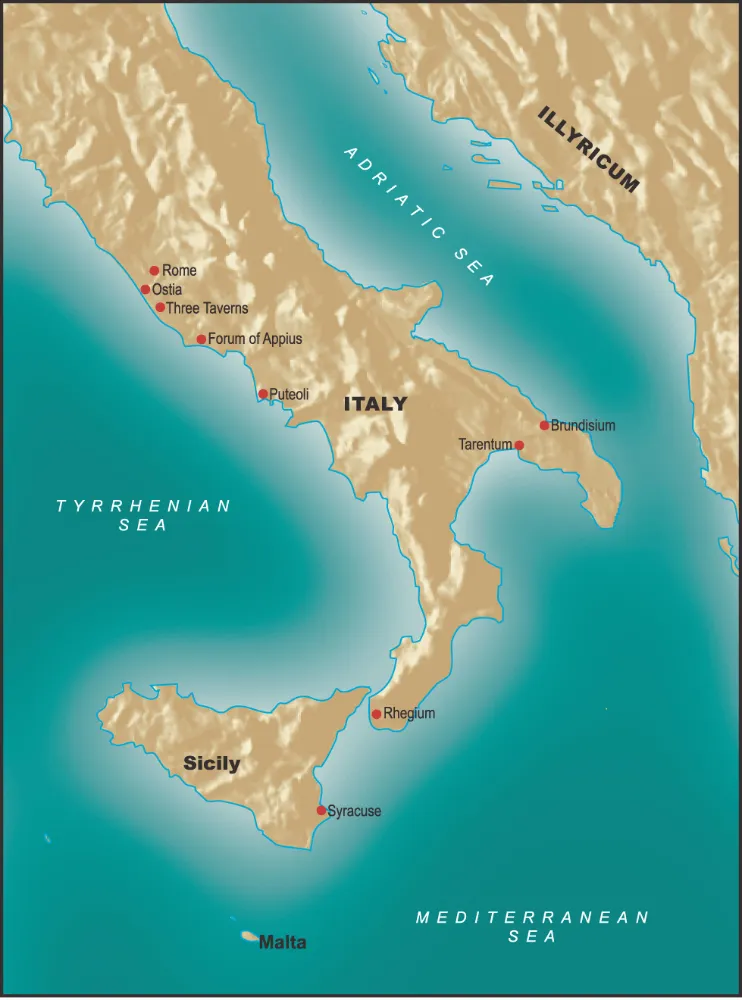
ITALY
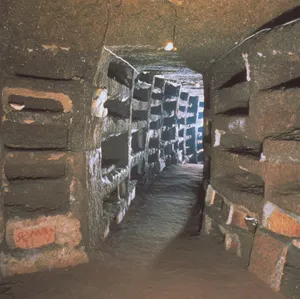
ROMAN CATACOMB
The “Priscilla Catacomb” dates to the second or third century A.D. and contains hundreds of burial niches.
But what does Paul mean when he claims that he has “fully proclaimed” the gospel in these areas? The Greek has simply the equivalent of our verb “fulfill” (peplērōkenai). To “fulfill” the gospel, therefore, probably means to preach it sufficiently such that viable churches are established. These churches can then carry on the task of evangelism in their own territories while Paul moves on to plant new churches in virgin gospel territory (cf. 15:20–21).
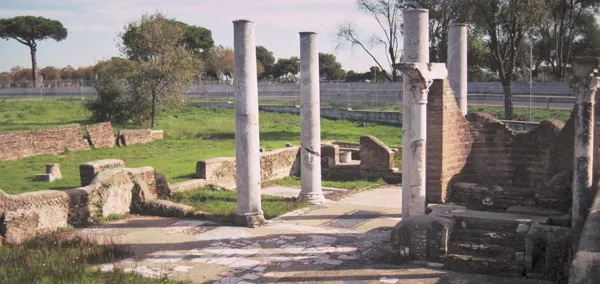
SYNAGOGUE REMAINS
The ruins of the synagogue at Ostia, the port city of Rome.
In pursuit of this calling, Paul is moving on to Spain (15:24). On the way, he hopes to stop off in Rome, evidently to enlist the Roman Christians’ support for his new gospel outreach (see comments on 15:24). But before he can begin his trip to the western Mediterranean, he must first return to Jerusalem (15:25). Throughout the third missionary journey, Paul has collected money from the Gentile churches he planted to bring back to the impoverished Jerusalem believers. Now he is ready to embark on this trip, and he earnestly asks the Roman Christians to pray for it (15:30–33). The collection represents for Paul a key step in what he hopes will be the reconciliation of Jewish and Gentile Christians in the early church.
The Life-Situation of Paul and Why He Wrote
Four pieces of information from 15:23–33 are especially helpful in understanding the situation of Paul as he writes Romans. First, he is almost certainly writing the letter during his winter stay in Corinth at the end of the third missionary journey (Acts 20:2–3; cf. 2 Cor. 13:1). Not only does this place and time best fit the movements Paul describes in chapter 15; it also explains why he commends to the Romans’ attention a prominent woman from the church in Cenchrea, the seaport of Corinth (16:1–2).
Second, Paul is conscious of having reached a significant turning point in his missionary career. He has “fulfilled” the gospel task in the eastern Mediterranean and is now ready for new, fresh fields, “white for the harvest.” Such a turning point is a natural time for Paul to reflect on the gospel he has preached and the controversies he has come through.

THE MEDITERRANEAN WORLD
Judea to Spain.
Third, Paul is deeply concerned about the results of his impending trip to Jerusalem with all its implications for what is to him, and to many others, a central theological issue in the early church: the integration of Gentiles into the people of God. We should not be surprised, then, that this issue plays such a large role in Romans.
ROME
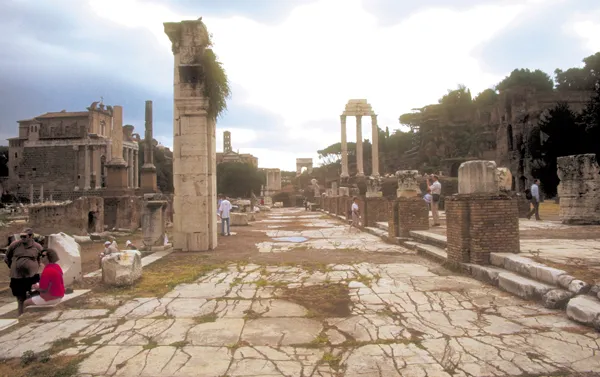
The Forum.
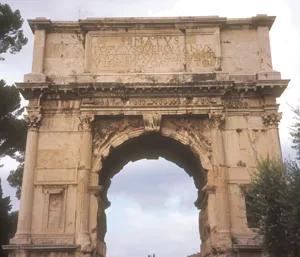
The Arch of Titus, built by Domitian to celebrate his brother’s military victory over Jerusalem and Judea.
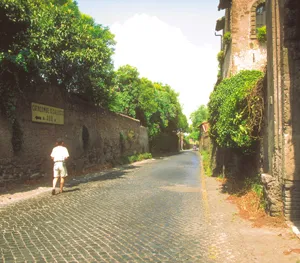
The Via Appia.
Finally, Paul is seeking the support of the Roman Christians for his new ministry in Spain. Perhaps one of the reasons Paul writes this letter to the church in Rome is to introduce himself and explain his theology so that the church will feel comfortable in supporting him.
Rome and Its Church
Some scholars surmise that Paul’s own circumstances suffice to explain why he writes Romans. At a key transition point in his ministry, the apostle sets forth the gospel he preaches to the Roman Christians so that they can pray intelligently for his visit to Jerusalem and so that they will be willing to support his new evangelistic effort in Spain. But left out in all this is the Roman church itself. And what we know about that church provides further critical information about the nature and purpose of Romans.
We have no direct evidence about the origins of Christianity in Rome. The tradition that Peter (or Peter and Paul together) founded the church is almost certainly erroneous.1 Not only is it difficult to place Peter in Rome at such an early date, but it is difficult to imagine Paul writing to a church founded by Peter in the way he does, considering his expressed principle not to build “on someone else’s foundation” (15:20). No other tradition from the ancient church associates any other apostle with the founding of the church.
Thus, the assessment of the fourth-century Ambrosiaster is probably accurate: the Romans “embraced the faith of Christ, albeit according to the Jewish rite, without seeing any sign of mighty works or any of the apostles.”2 Luke tells us that “visitors from Rome” were present on the day of Pentecost (Acts 2:10). Some of them were probably converted as a result of Peter’s powerful speech. They would have returned to their home city and begun preaching Jesus as the Messiah. We know that enough Jews had emigrated to Rome by the first century B.C. to make up a significant portion of the population.3 The Jewish community was not apparently unified, with many synagogues independent of one another.4 This circumstance may help explain why the Christians in Rome are also divided.
Table of contents
- Cover
- Title Page
- Copyright Page
- Contents
- How to Use This eBook
- Introduction
- List of Sidebars
- List of Charts
- Index of Photos and Maps
- Abbreviations
- Romans
- Galatians
- Credits for Photos and Maps
- The New International Version Appendix
Trusted by 375,005 students
Access to over 1.5 million titles for a fair monthly price.
Study more efficiently using our study tools.
Frequently asked questions
Yes, you can cancel anytime from the Subscription tab in your account settings on the Perlego website. Your subscription will stay active until the end of your current billing period. Learn how to cancel your subscription
No, books cannot be downloaded as external files, such as PDFs, for use outside of Perlego. However, you can download books within the Perlego app for offline reading on mobile or tablet. Learn how to download books offline
Perlego offers two plans: Essential and Complete
- Essential is ideal for learners and professionals who enjoy exploring a wide range of subjects. Access the Essential Library with 800,000+ trusted titles and best-sellers across business, personal growth, and the humanities. Includes unlimited reading time and Standard Read Aloud voice.
- Complete: Perfect for advanced learners and researchers needing full, unrestricted access. Unlock 1.5M+ books across hundreds of subjects, including academic and specialized titles. The Complete Plan also includes advanced features like Premium Read Aloud and Research Assistant.
We are an online textbook subscription service, where you can get access to an entire online library for less than the price of a single book per month. With over 1.5 million books across 990+ topics, we’ve got you covered! Learn about our mission
Look out for the read-aloud symbol on your next book to see if you can listen to it. The read-aloud tool reads text aloud for you, highlighting the text as it is being read. You can pause it, speed it up and slow it down. Learn more about Read Aloud
Yes! You can use the Perlego app on both iOS and Android devices to read anytime, anywhere — even offline. Perfect for commutes or when you’re on the go.
Please note we cannot support devices running on iOS 13 and Android 7 or earlier. Learn more about using the app
Please note we cannot support devices running on iOS 13 and Android 7 or earlier. Learn more about using the app
Yes, you can access Romans, Galatians by Douglas J. Moo,Ralph P. Martin,Julie Wu, Clinton E. Arnold in PDF and/or ePUB format, as well as other popular books in Theology & Religion & Biblical Commentary. We have over 1.5 million books available in our catalogue for you to explore.