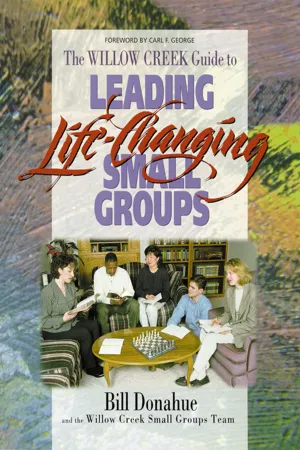
The best-selling small group guidebook—over 100,000 sold. NOW UPDATED. Like nothing else, small groups have the power to change lives. They're the ideal route to discipleship—a place where the rubber of biblical truth meets the road of human relationships. For six years Bill Donahue provided training and resources for small group leaders so that Willow Creek could build a church of small groups. Now he is committed to creating tools that will help church leaders pursue the same goal—to provide a place in community for everyone in their congregation. In Leading Life-Changing Small Groups, Donahue and his team share in depth the practical insights that have made Willow Creek's small group ministry so effective. The Comprehensive, Ready-Reference Guide for Small Group Leaders The unique, ready-reference format of this book gives small group leaders, pastors, church leaders, educators, and counselors a commanding grasp of: ·Group formation and values ·Leadership requirements and responsibilities ·The philosophy and structure of small groups ·Meeting preparation and participation ·Discipleship within the group ·Leadership training . . . and much more From an individual group to an entire small group ministry, Leading Life-Changing Small Groups gives you the comprehensive guidance you need to cultivate life-changing small groups . . . and growing, fruitful followers of Christ.
- 192 pages
- English
- ePUB (mobile friendly)
- Available on iOS & Android
eBook - ePub
Leading Life-Changing Small Groups
About this book
Information
Topic
Theology & ReligionSubtopic
Christian Church
Small Group Philosophy
The term “philosophy” may trigger memories of Socrates, Plato, Kant, or Nietzsche for some people. Others may think it is a waste of paper and you are ready to skip to the next section. Not so fast. What you believe about ministry directly affects how you go about it. And small group ministry is not different. If you are trying to figure out where your group fits in to the overall strategy in your church, then you’ll find help here. And if you are responsible for leading the ministry, these next few pages will give you some solid ideas.
Every small group ministry needs leaders who are guided by a clear vision and core values. And every small group strategy needs a structure, a way to organize groups so that lasting life-on-life ministry flows throughout the church without getting tangled up in organizational chaos.
So let’s take a careful look at your mission, what kind of disciples you seek to produce, the biblical community you want to develop, and the kind of structure that will help bring all this together in your particular setting. Once you get a handle on that, you’ll be able to move ahead to discussing leadership issues and qualifications. (For those of you leading the ministry in the church, you will find even more information on these subjects in the book Building a Church of Small Groups.
Mission, Values, and Vision
Mission Statement and Ministry Philosophy for Small Groups
A mission statement and ministry philosophy are key to the success of your ministry because they function as navigational tools necessary to chart an accurate course toward a worthy destination. The statement used to launch small group ministry of Willow Creek Community Church in South Barrington, Illinois, serves as an example. Below, and on the following pages, you’ll find our view of small groups outlined and explained. As you read it, consider how you might shape and articulate your church’s vision and values.
The overriding mission at Willow Creek is to “turn irreligious people into fully devoted followers of Christ.” In order to accomplish that mission, a variety of ministries exist at Willow Creek. From the weekend service to the midweek New Community believer’s service to the various subministries throughout Willow Creek, we are committed to moving people toward Christlikeness. Since small groups have become our way of doing ministry, it is essential that we understand the role they play in carrying out our overall mission.
Below, you will notice the mission statement for the purpose of small groups at Willow Creek and how small groups are used to accomplish our overriding mission. The questions “Why do small groups exist?” and “For what purpose do small groups exist?” are answered in the mission statement. Following the mission statement you will find a philosophy of ministry structured around five key values we believe will shape the way Willow Creek does ministry for the coming years. These five statements are beliefs or values, based on Scripture, that under-gird our ministry philosophy.
Mission: Building a Community to Reach a Community
To connect people into groups of four to ten who come together on a regular basis for a common purpose and are led by an identified leader who is assisting them in their progress toward full devotion to Christ by intentionally providing an environment for connection, community, and spiritual formation.
5 Core Values

Jesus Christ, as Head of the church, intends His followers to become like Him
It is God’s plan that those who call on His name should be like Him in attitude and behavior. The church exists not just to collect followers, but to transform them.
Church life is the sum of all the activities that promote Christ’s work of transformation. Programs and subministries in a church should be designed to serve His goal of changing lives, and should be surrendered as obsolete when they fail to achieve this end.
We describe the life change the church exists to produce with “The Five G’s”: Grace (to personally appropriate and extend the saving work of Christ), Growth (pursuing Christlikeness), Group (connecting with others in significant relation-ships), Gifts (serving Christ’s body according to spiritual giftedness and passion), and Good stewardship (honoring God with our resources through what we give to the church and what we keep).
“...I have set you an example that you should do as I have done for you.”
John 13:15
Other Scriptures:
John 14:15 Romans 6:12–13, 17–19;
8:29 Philippians 1:6 Colossians 1:28; 2:6–7 1 John 2:6
The Five G’s


A small group provides the optimal environment for the life change Jesus Christ intends for every believer
Significant relationships (including one-to-one) occur best in the context of a small group. Connecting people in a small group is not an optional subministry of the church—it is essential for growth. Without this connection, people can, at best, attend meetings, but they aren’t truly participating in church.
A small group of believers who love one another with God’s love will experience the life Christ promised at the deepest level possible. This love radically transforms them and demonstrates His power. A group that by design does not contribute to this goal of spiritual maturity may well be a collection of Christians, but it is not a successful small group.
“He appointed twelve—designating them apostles—that they might be with him.”
Mark 3:14
Other Scriptures:
Exodus 18:17–27 Acts 2:46
A variety of small groups are necessary to meet the individual needs of believers, as well as the diverse needs of the body as a whole. People can grow in Christ-likeness, care for each other, and make a contribution in any group, whether it be a disciplemaking group, task group, nurture group, Christian twelve-step group, counseling group, or any other type. However, ministries in a local church that don’t have small groups built into their structure generally can’t produce optimal life change for people looking to that ministry for growth and service opportunities.

The most strategic person in the life-change process of the church is the small group leader
The priority of church leadership is to help small group leaders succeed through support and training. To that end, the best resources of the church should be employed to make sure the small group leader has everything necessary for effectiveness.
Small group leaders cannot flourish in a vacuum. Leaders need to band together periodically with other leaders for encouragement and accountability (huddling). Additionally, church staff and other leaders must provide training in skills necessary for group life (skill training) and reminders of the purpose and goals that drive the ministry (vision casting). Basic skills necessary for effective leadership of a small group are the same whether one is leading a task group of volunteers, a youth team, or a couples small group.
“It was he who gave some to be apostles, some to be prophets, some to be evangelists, and some to be pastors and teachers, to prepare God’s people [average believers] for works of service.”
Ephesians 4:11–12
Other Scriptures:
1 Corinthians 16:15–16...
Table of contents
- Cover Page
- Title Page
- Copyright Page
- Dedication
- Contents
- Preface
- Introduction: A Structure That Serves People
- Part 1: Small Group Philosophy
- Part 2: Small Group Leadership
- Part 3: Developing Apprentice Leaders
- Part 4: Group Life
- Part 5: Conducting Meetings
- Part 6: Shepherding Members
- Part 7: Multiplying Your Ministry
- Part 8: Starting Small Groups in Your Church
- Acknowledgments
- About The Publisher
- Share Your Thoughts
Trusted by 375,005 students
Access to over 1.5 million titles for a fair monthly price.
Study more efficiently using our study tools.
Frequently asked questions
Yes, you can cancel anytime from the Subscription tab in your account settings on the Perlego website. Your subscription will stay active until the end of your current billing period. Learn how to cancel your subscription
No, books cannot be downloaded as external files, such as PDFs, for use outside of Perlego. However, you can download books within the Perlego app for offline reading on mobile or tablet. Learn how to download books offline
Perlego offers two plans: Essential and Complete
- Essential is ideal for learners and professionals who enjoy exploring a wide range of subjects. Access the Essential Library with 800,000+ trusted titles and best-sellers across business, personal growth, and the humanities. Includes unlimited reading time and Standard Read Aloud voice.
- Complete: Perfect for advanced learners and researchers needing full, unrestricted access. Unlock 1.5M+ books across hundreds of subjects, including academic and specialized titles. The Complete Plan also includes advanced features like Premium Read Aloud and Research Assistant.
We are an online textbook subscription service, where you can get access to an entire online library for less than the price of a single book per month. With over 1.5 million books across 990+ topics, we’ve got you covered! Learn about our mission
Look out for the read-aloud symbol on your next book to see if you can listen to it. The read-aloud tool reads text aloud for you, highlighting the text as it is being read. You can pause it, speed it up and slow it down. Learn more about Read Aloud
Yes! You can use the Perlego app on both iOS and Android devices to read anytime, anywhere — even offline. Perfect for commutes or when you’re on the go.
Please note we cannot support devices running on iOS 13 and Android 7 or earlier. Learn more about using the app
Please note we cannot support devices running on iOS 13 and Android 7 or earlier. Learn more about using the app
Yes, you can access Leading Life-Changing Small Groups by Bill Donahue in PDF and/or ePUB format, as well as other popular books in Theology & Religion & Christian Church. We have over 1.5 million books available in our catalogue for you to explore.