![]()
Text and Exposition
I. GENERAL INTRODUCTION (PREAMBLE) (1:1–5)
OVERVIEW
Following the pattern of a bilateral covenantal treaty document (suzerain-vassal treaty; see Introduction), the book of Deuteronomy begins with a preamble. This introductory section provides the backdrop for the book of Deuteronomy, the parties involved, and other relevant information (elements commonly found in treaty documents). It provides the geographical and historical setting for Moses’ covenantal message.
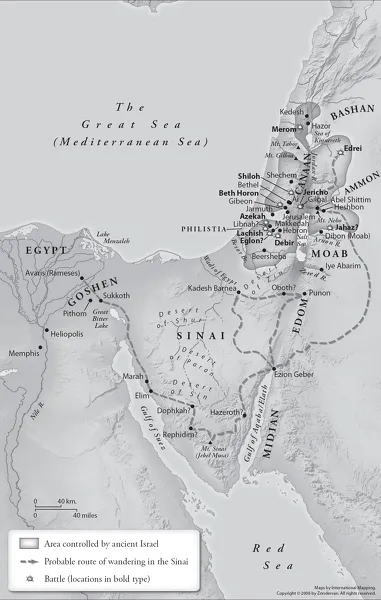
1These are the words Moses spoke to all Israel in the desert east of the Jordan—that is, in the Arabah—opposite Suph, between Paran and Tophel, Laban, Hazeroth and Dizahab. 2(It takes eleven days to go from Horeb to Kadesh Barnea by the Mount Seir road.) 3In the fortieth year, on the first day of the eleventh month, Moses proclaimed to the Israelites all that the LORD had commanded him concerning them. 4This was after he had defeated Sihon king of the Amorites, who reigned in Heshbon, and at Edrei had defeated Og king of Bashan, who reigned in Ashtaroth. 5East of the Jordan in the territory of Moab, Moses began to expound this law, saying:
COMMENTARY
1 Almost forty years after the law was given at Sinai, Moses provides an exposition of that law to the surviving second-generation Israelites encamped at the edge of the Promised Land. As the covenantal mediator, Moses speaks “the words” (that God commanded him; v.3) to Israel. Although Moses indeed communicates through words, the term here signifies the covenantal text and its demands in a broad sense (cf. 1:18; 4:2; 6:6; 11:18; 30:14). Moses addresses these speeches to “all Israel,” or rather representatives of the nation instead of the entire nation. Beyond this address, the material was intended for all Israel, in Moses’ time and later, and would be accessible to all after it was committed to written form.
Moses provides three relatively clear geographical and topograhical reference points, then six that are less clear. The “desert” (or wilderness) is a broad term for the opposite of urban and semiurban territory. It refers to actual desert as well as transitional semiarid land that is suitable for pasturage (Diamond, NIDOTTE, 4:520). The area on the eastern side of the Jordan River was a high plateau (ca. 3,500 ft above sea level) and served better as pastureland than for raising crops. While the “Arabah” could signify a less than abundant region around a given city (Ge 21:14; 37:22), here it refers to a specific geographical region that follows a fault line in the earth that extends north–south through this region. The biblical writers call the depression or valley that extends along this fault line the “Arabah.”
The phrase “opposite Suph” probably describes the part of the Arabah Moses had in view. Although some scholars regard Suph as a city in the area of Edom or Moab (Craigie, 90; Mayes, 114), the designation probably refers to the part of the Arabah that is near the Gulf of Elath, the eastern branch of the Red Sea (both are called yam sûp, “Red Sea”—Ex 10:19; 15:4, 22; “Gulf of Elath”—Nu 21:4; Dt 1:40; 2:1). Of the remaining five sites (see Tigay, Deuteronomy, xlv, 417–22, for a helpful overview of geographical references and a map), only Paran and Hazeroth can be identified with any confidence. “Paran” refers to much of the Sinai Peninsula and the southern region of the Negev (Nu 10:12; 12:16; 13:26), while “Hazeroth” has been identified with sites in southern or northeastern Sinai (Tigay, Deuteronomy, xlv, 419). Although a number of scholars locate these places on the route Israel took between Sinai and Kadesh Barnea (Kalland, 20; Merrill, Deuteronomy, 63), others identify them as places in the area around the Israelite encampment on the plains of Moab (Craigie, 90–91; Ridderbos, 52). The reference to Israel’s journey from Sinai to Kadesh Barnea in the next verse favors the former alternative.
2 The Israelites took eleven days to journey from Sinai to Kadesh Barnea (ca. 140 miles apart). This time frame indicates the ruggedness of the terrain and serves as a clear contrast to the almost forty years of wilderness wandering occasioned by their rebellion at Kadesh (see comments on 1:26–40). “Mount Seir” serves as a broad reference for the region of Seir or Edom (Aharoni, 40). “Horeb” is an alternative term for “Sinai” favored by the book of Deuteronomy, in which “Horeb” occurs nine times (1:2, 6, 19; 4:10, 15; 5:2; 9:8; 18:16; 29:1), compared with a single instance of “Sinai” (33:2).
3 Moses begins addressing the Israelites slightly less than forty years (thirty-nine years, nine months, sixteen days) after they departed from Egypt (first year, first month, and fifteenth day—the day after their first Passover celebration; Ex 12:18), ca. 1406 BC (see Introduction). Since the Israelite crossing of the Jordan River (Jos 4:19—forty-first year, first month, tenth day) represented the beginning of the conquest of Canaan, the transition from Moses to Joshua (with Moses preaching the content of Deuteronomy, his death, burial, and the transferral of leadership to Joshua) occurred within about one and one-third months of Moses’ addressing the Israelites with this material.
4 In addition to this calendric information, Moses begins this address after the Israelite conquest of two Amorite kings, Sihon and Og (3:8; 4:47; cf. Nu 21; see comments on 2:26–3:11).
5 The chiastic structure of these verses (see Craigie, 92, n. 17; Tigay, Deuteronomy, 3, for different elements of this chiasm) gives emphasis to the geographical, chronological, and theological backdrop for Deuteronomy. In addition to the geographical and chronological features already discussed (see above), these verses prepare the way for the following context. They introduce two pivotal themes: the disastrous effects of not trusting God and the overwhelming victory provided by God to those who trust him.
A These are the words Moses spoke
B In the desert east of the Jordan
C Kadesh Barnea—a place of judgment because of Israel’s rejection of God’s intervention
D The time of Moses’ address: fortieth year, on the first day of the eleventh month
C´ Sihon and Og—victory because of Israel’s reliance on God’s intervention
B´ East of the Jordan in the territory of Moab
A´ Moses began to expound this law, saying:
“This law,” along with “the words” (1:1), refers in a broad sense to the covenantal document as a whole (see Notes on 4:44) and represents all that the Lord commanded (1:3). The “law” served as the foundation for Israel’s covenantal relationship with Yahweh. In his addresses to the Israelites, Moses provides an exposition of “this law.” Although the verb bʾr can mean to write or inscribe something clearly (27:8; Hab 2:2), here it signifies Moses’ explanation or elucidation of the Law (HALOT, 106; cf. Satterthwaite, NIDOTTE, 1:578).
It is essential for any reader of Deuteronomy to understand that this book represents an exposition of the law, which God had already given at Sinai, and not a second giving of the law. It does not serve as a simple repetition of the law, nor does it constitute a contradiction of those divine standards. Moses provides an exposition of God’s law as a means of preparing God’s children for the daunting task that lay before them.
NOTES
1, 5 The expression
(
haddebārîm, “the words”) and related ones can also refer to individual stipulations (12:28; 15:15; 24:18, 22) as well as to the Decalogue as a whole (4:10, 13, 36; 5:5, 22; 9:10; 10:2, 4).
The expression
(
beʿ
ēber hayyardēn, “on the other side of the Jordan”) can refer to the territory to the east (1:1, 5; 3:8; 4:41, 46–47; Jos 1:14–15; etc.) or to the west (Dt 3:20, 25; 11:30; Jos 9:1; etc.) of the Jordan River. Many have argued that the expression requires that the writer be located on the opposite side of the river. Consequently, this phrase would serve as an example of a post-Mosaic expression. Although this argument is plausible, the usage of this expression by the same author (e.g., Jos 1:14–15; 9:1) suggests that it is simply a regional reference whose precise connotation the immediate context makes clear. The phrase is a technical geographical expression for the area near the Jordan River that does not make explicit the location of the speaker/writer (cf. B. Gemser, “
Beʿēber Hajjardēn: In Jordan’s Borderland,”
VT 2 [1952]: 355).
![]()
II. HISTORICAL RETROSPECT (1:6–4:49)
OVERVIEW
Moses reviews the manner in which the Lord brought Israel safely through the wilderness wanderings (the consequence of their faithless rebellion at Kadesh Barnea) and assisted them in the conquest of Heshbon and Bashan, and he exhorts the nation once again to obey the Lord and worship him alone.
This historical overview has two parts. In the section’s first three chapters, Moses summarizes Israel’s experiences from the time of lengthy encampment at Mount Sinai to the time depicted by the book of Deuteronomy. In ch. 4, building on that presentation of God’s expectations of his chosen p...