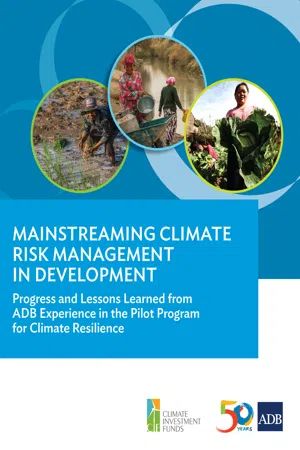
The Pilot Program for Climate Resilience (PPCR) is a funding window of the Climate Investment Funds, of which the Asian Development Bank (ADB) is a major partner in Asia and the Pacific, delivering investments through six country programs (Bangladesh, Cambodia, Nepal, Papua New Guinea, Tajikistan, and Tonga) and one regional program for the Pacific. This study looks back at the development of PPCR funding from an ADB perspective, documents the contributions of the PPCR to country readiness for adaptation planning and climate finance, and identifies some early lessons learned from Cambodia, Nepal, and Tajikistan.
- 102 pages
- English
- ePUB (mobile friendly)
- Available on iOS & Android
eBook - ePub
About this book
Information
2 FINDINGS
1 Cambodia
1.1 DEVELOPMENT OF THE CAMBODIA STRATEGIC PROGRAM FOR CLIMATE RESILIENCE
1.1.1 Introduction: Climate Change Risks and Vulnerability in Cambodia
The Cambodian climate is dominated by the southwest monsoon, which gives rise to a rainy season from May to November and a dry season from November to May. The country is typically prone to periodic droughts and floods; extreme events frequently result in serious natural disasters. Between 1990 and 2010, eight major floods and three major droughts affected the lives of more than 20 million people. Climate change is expected to intensify such events. For Cambodia and much of the Lower Mekong Basin, the most important climate variables are related to changes in the complex hydrology of the river, its many tributaries and floodplains, and the Tonle Sap Lake.
Data suggest that the climate in Cambodia is already changing (Heng 2015). Annual mean temperature anomalies have increased by 0.81°C since 1950 and mean annual precipitation has been decreasing at the rate of 0.184%. In the dry season, both temperature and rainfall changes are more pronounced. Recent modeling suggests that across Cambodia the rate of temperature change will continue to rise, and the warming rates are likely to be greater in the high-altitude areas in the southwest than in low-altitude regions such as the central and northeast. The models also indicate increases in mean annual rainfall—wet-season rainfall will increase but dry-season precipitation will decrease—thus tending to accentuate and amplify the drought-and-flood cycles. Extreme weather events, including damaging cyclones, are also likely to become more frequent. These changes adversely affect agriculture, infrastructure, and biodiversity, and potentially reduce the fertile land area suitable for cultivation. In the longer term, rising sea levels could pose a significant threat to fertile coastal areas, which are already experiencing storm surges, high tides, beach erosion, and saltwater intrusion.
Cambodia’s low adaptive capacity, encompassing socioeconomic, institutional, and technological issues, significantly heightens its vulnerability to the impact of climate change. The country has a narrow economic base: 80% of the population depends on small-scale, rain-fed agriculture concentrated mainly in vulnerable floodplains and low-lying coastal areas. While the government has made significant strides toward poverty reduction (the poverty rate fell sharply from 47.8% in 2007 to 18.9% in 2012), 41% of the population in 2011 still lived on less than $2 per day. Weak governance of the natural resources management system remains a problem. Legal and regulatory frameworks are insufficient and relevant policies needed to manage the impact of climate change are poorly enforced. There is a significant deficit in the technology and infrastructure for climate change adaptation, particularly with respect to roads, irrigation, and flood protection.
1.1.2 Preparation of the Cambodia Strategic Program for Climate Resilience
A preparatory phase 1 TA ($1.5 million, administered by the World Bank), aimed at supporting the preparation of the SPCR and establishing an appropriate institutional, policy, and planning framework to facilitate its implementation, was approved in late 2010 and took effect in early 2011. Implementation was held back for more than a year, however, by the recruitment of suitable personnel and by technical and organizational capacity. As a result, SPCR preparation, originally envisaged among the tasks under the TA, was completed separately by the government, MDBs, and other stakeholders in a consultative process in April and May of 2011. The TA, with its five remaining components (Table 3), was implemented by two consulting companies and a group of independent national and international consultants from January 2012 to April 2013.
Table 3: Components of the Phase 1 Technical Assistance for the Cambodia Strategic Program for Climate Change
| Component | Immediate Outcome |
| Component 1: National-level mainstreaming | Improved consideration of climate resilience in the planning, budgeting, and investment appraisal processes of the finance, planning, environment, agriculture, forestry and fisheries, water resources and meteorology, rural development, and public works and transport ministries, and of the National Committee for Disaster Management |
| Component 2: Subnational mainstreaming | Improved consideration of climate resilience in the budgeting, planning, and financing mechanisms of subnational government and service delivery |
| Component 3: Strengthening of civil society and private sector engagement and gender considerations in climate change adaptation | Strengthened engagement of civil society and the private sector in the climate change adaptation agenda, and inclusion of gender considerations, thereby broadening awareness of climate risks and increasing the participation of a broad group of stakeholders |
| Component 4: Science-based adaptation planning | Improved integration and accuracy of climate and weather forecasting, with hydrologic features relevant to government, the private sector, and local communities |
| Component 5: Outreach and preparation of phase 2 | Improved understanding of government (at all levels), civil society, and the private sector to address climate resilience through a program-based approach |
Source: Government of Cambodia (2010).
The Cambodia SPCR was endorsed by the CIF in June 2011 with a total financial envelope of $404 million—a requested $50 million in grants and $36 million in concessional loans from the CIF, and anticipated leveraging of $299 million in cofinancing, predominantly from ADB. The design and MDB processing of the SPCR investment projects had already begun at the time of SPCR approval and currently continues; six of the eight SPCR projects have been approved and are already being implemented. In February 2014, a revised version of the SPCR, accommodating changes in the project portfolio and allocating additional PPCR funding of $5 million in grants, was endorsed. The final financial envelope of $561 million comprised $55 million in grants and $41 million in concessional loans from the PPCR, and $465 million in cofinancing. The PPCR contribution includes an allocation of $5 million for a project under the CIF private sector set-aside program.3 Figure 2 shows the main milestones in the development of the SPCR.
Figure 2: Key Milestones in the Development of the Cambodia Strategic Program for Climate Change

SPCR = Strategic Program For Climate Resilience, TA = technical assistance.
Source: ADB.

The project output for phase 1 was mostly satisfactory; but the achievement of project outcomes was only moderately satisfactory. In particular, the implementation of components related to mainstreaming did not fully meet expectations (ADB 2013b). Despite many challenges, phase 1 contributed significantly to climate change response in Cambodia. These contributions included valuable resources that have supported the development and implementation of phase 2 and other programs (Box 1), as well as lessons learned regarding readiness for climate change adaptation and climate finance, (section 1.2).
Box 1: Mainstreaming Resources Prepared in Phase 1
Component 1
• Guideline on Mainstreaming Climate Resilience and Disaster Risk Reduction into National Investment Planning
• Guideline on Mainstreaming Climate Resilience and Disaster Risk Reduction into National Development Planning
Component 2
• Guideline on Mainstreaming Climate Resilience and Disaster Risk Reduction into Subnational Development and Investment Planning
• Discussion paper on Climate Change Implications for National Planning
• Climate Screening Toolkit
Component 3
• Strengthening CSO Engagement in Mainstreaming Climate Resilience in SPCR
• Outline of Master Plan on Gender and Climate Change Adaptation
• Private Sector Scoping Study: Engaging Private Sector in Climate Change Adaptation Investments
Component 4
• Synthesis Report on the Cambodia Hydrometeorological Information System
• Succinct Analytical Report on the Value of Multi-Model Downscaled Climate Scenarios for Cambodia in Terms of Direct Application for Policy and Plan Making
• Synthesis Report on Vulnerability and Adaptation Assessment for the Key Sectors
• Concise Report on Suitability and Relevance of Currently Available Climate Resilience Decision Support Tools in Cambodia
• Conceptual Framework for Incorporating SESA into Climate Change Adaptation and Resilience Projects in Cambodia
Component 5
• Policy briefs on Climate Change Issues
• Concept note for preparation of M&E Framework for PPCR Phase II
• Consolidated Final Report
CSO = civil society organization, M&E = monitoring and evaluation, PPCR = Pilot Program for Climate Resilience, SESA = Social Entrepreneurship in Southeast Asia, SPCR = Strategic Program for Climate Resilience.
Source: ADB (2013b).
Both the World Bank and the IFC stopped participating in the Cambodia PPCR in 2011 because of matters related to the implementation of an ongoing World Bank project. ADB guided the final preparation of the SPCR, which includes only ADB-administered projects. The portfolio is quite ambitious. It comprises seven investment projects encompassing rural and urban infrastructure and agricultural development, as well as a major TA project supporting the mainstreaming of climate resilience into development planning (Table 4). The investment projects were identified from pipeline ADB investments that provided clear opportunities for enhancing climate-resilient output using PPCR funds. There are now five active loan projects, four of which were deployed in 2014. The mainstreaming TA began its activities in October 2013, but issues with technical consultancy led to the termination of the consultants’ contract in 2014 and to a rebidding process (now completed). In the revised SPCR (2013), a stalled water resources project was replaced with a rural roads project at the request of the government. Although implementation is at an early stage, the preparation of these projects has already yielded lessons and improved understanding of the design of adaptation projects, particularly the role of capacity building and vulnerability assessments (section 1.2).
Table 4: Cambodia Strategic Program for Climate Change—Project Portfolio and Progress Update


CIF = Climate Investment Funds, GMS = Greater Mekong Subregion, M&E = monitoring and evaluation, NGO = nongovernment organization, PPCR = Pilot Program for Climate Resilience, SPCR = Strategic Program for Climate Resilience, TA = technical assistance.
* As of January 2015.
Source: ADB.
1.1.3 Challenges Faced in the Development of the Cambodia Strategic Program for Climate Resilience
The introduction, planning, and development of a $531 million portfolio of climate change adaptation projects in a nascent environment for climate change action was a significant achievement. In addition to the anticipated capacity limitations of the government and other stakeholders at the outset, the development of the SPCR faced a number of challenges including effectively engaging stakeholders, establishing government ownership of the program, and fitting the design and approach of the SPCR to the rapidly evolving context for climate action in Cambodia as external assistance for climate change increased.
When PPCR funding for Cambodia was first discussed, the government had already begun to address climate change (section 1.2.2); however, the nature of climate change risk and the need to integrate it into government policies and processes could have been better understood, particularly outside the Ministry of Environment (MOE), the designated focal point for climate change. The MOE itself had barely enough human and financial resources to manage the development of a complex program, and it had limited influence or capacity to engage and coordinate with other agencies. Outside government, international nongovernment organizations (INGOs) were starting to take action on climate change mainstreaming, but for the most part, local civil society, the private sector, and the public did not know enough about the potential impact of climate change in Cambodia and of adaptation needs and approaches. Given the significant growth in finance for adaptation, represented by the PPCR, even the capacity of consultants and MDB staff to prepare major investments in adaptation was sometimes stretched. All these challenges delayed and disrupted decision making and processing against very ambitious deadlines, created external perceptions of PPCR funding as a process driven by donors and specifically MDBs, and limited the involvement of subnational entities in the preparation activities (ADB 2013b).
Stakeholder participation was an important aspect of the development of the SPCR, and the high expectations generated by news of the PPCR funding resulted in strong interest from national-level stakeholders, particularly civil society (ADB 2013c). However, the withdrawal of the World Bank Group from the SPCR in 2011 presented some challenges. Nongovernment organizations (NGOs) and development partners experienced a loss of momentum and transparency in the process at this time and engagement with the private sector slowed.
NGOs became concerned about the perceived move away from a consultative approach to SPCR development. The withdrawal also resulted in the separate administration of phases 1 and 2 (phase 1 by the World Bank and phase 2 by ADB), the subsequent change in design and approach making alignment of the two phases more difficult. Although the phase 1 TA was designed in anticipation of an SPCR comprising public and private sector projects administered by the World Bank, ADB, and the IFC, the final SPCR contained only ADB-administered public sector investments predominantly addressing infrastructure. Establishing ownership of the process in government was also a challenge, given its capacity and the preeminence of the MDBs in facilitating the process. However, government engagement was strong from the start and ownership strengthened as SPCR preparation progressed (ADB 2013b).
At the time of SPCR preparation, the context for action on climate change was changing rapidly. In particular, a major climate change initiative, the Cambodia Climate Change Alliance (CCCA),4 funded by the European Union (EU), was approved in late 2009 and began implementation in 2010. The CCCA and the SPCR shared many objectives and their action plans converged, especially regarding building the capacity of government and civil society and mainstreaming and raising awareness of climate change adaptation. Development partners tried their best to bring the two initiatives together. But limitations in enabling contributions to the CCCA Trust Fund from ADB-administered funds and management changes within the MOE made closer integration of the two initiatives difficult. The rising demands on the MOE also presented challenges. In an effort to spread the load (and benefits) of the growth in climate finance, SPCR preparation and implementation was placed under the Environment Conservation Department instead of the Climate Change Department (CCD). Because of this move, the credibility of the program became harder to establish as most government and external stakeholders regarded the CCD, which was already implementing the CCCA, as the focus of climate change knowledge and activities. This issue was later dealt with through the ap...
Table of contents
- Front Cover
- Title Page
- Copyright Page
- Contents
- Tables, Figures, and Boxes
- Foreword
- Preface
- Acknowledgments
- Executive Summary
- Abbreviations
- I Introduction
- II Findings
- III Summary and Conclusions
- Appendix: Persons Consulted during the Study
- References
- Back Cover
Trusted by 375,005 students
Access to over 1.5 million titles for a fair monthly price.
Study more efficiently using our study tools.
Frequently asked questions
Yes, you can cancel anytime from the Subscription tab in your account settings on the Perlego website. Your subscription will stay active until the end of your current billing period. Learn how to cancel your subscription
No, books cannot be downloaded as external files, such as PDFs, for use outside of Perlego. However, you can download books within the Perlego app for offline reading on mobile or tablet. Learn how to download books offline
Perlego offers two plans: Essential and Complete
- Essential is ideal for learners and professionals who enjoy exploring a wide range of subjects. Access the Essential Library with 800,000+ trusted titles and best-sellers across business, personal growth, and the humanities. Includes unlimited reading time and Standard Read Aloud voice.
- Complete: Perfect for advanced learners and researchers needing full, unrestricted access. Unlock 1.5M+ books across hundreds of subjects, including academic and specialized titles. The Complete Plan also includes advanced features like Premium Read Aloud and Research Assistant.
We are an online textbook subscription service, where you can get access to an entire online library for less than the price of a single book per month. With over 1.5 million books across 990+ topics, we’ve got you covered! Learn about our mission
Look out for the read-aloud symbol on your next book to see if you can listen to it. The read-aloud tool reads text aloud for you, highlighting the text as it is being read. You can pause it, speed it up and slow it down. Learn more about Read Aloud
Yes! You can use the Perlego app on both iOS and Android devices to read anytime, anywhere — even offline. Perfect for commutes or when you’re on the go.
Please note we cannot support devices running on iOS 13 and Android 7 or earlier. Learn more about using the app
Please note we cannot support devices running on iOS 13 and Android 7 or earlier. Learn more about using the app
Yes, you can access Mainstreaming Climate Risk Management in Development by in PDF and/or ePUB format, as well as other popular books in Biological Sciences & Global Warming & Climate Change. We have over 1.5 million books available in our catalogue for you to explore.