From in-country to cross-country connections, whether by land, air, or water, transport is a key ingredient that enables nations to achieve economic and social development goals. The Asian Development Bank has been working with developing member countries to improve roads, airports, waterways, and other transport infrastructures to provide people with better access to economic opportunities, public services, domestic and international markets. This publication shares 20 case stories bearing practical knowledge and lessons for transport projects across Asia and the Pacific region under different socioeconomic and political situations.
- 154 pages
- English
- ePUB (mobile friendly)
- Available on iOS & Android
eBook - ePub
About this book
Information
1 WATERWAYS
Lester Ledesma | ADB Photo Library.
Lester Ledesma | ADB Photo Library.
THE RIVER MORE TRAVELED:
NAVIGABLE INLAND WATERWAY IN THE PEOPLE’S REPUBLIC OF CHINA

CONTEXT
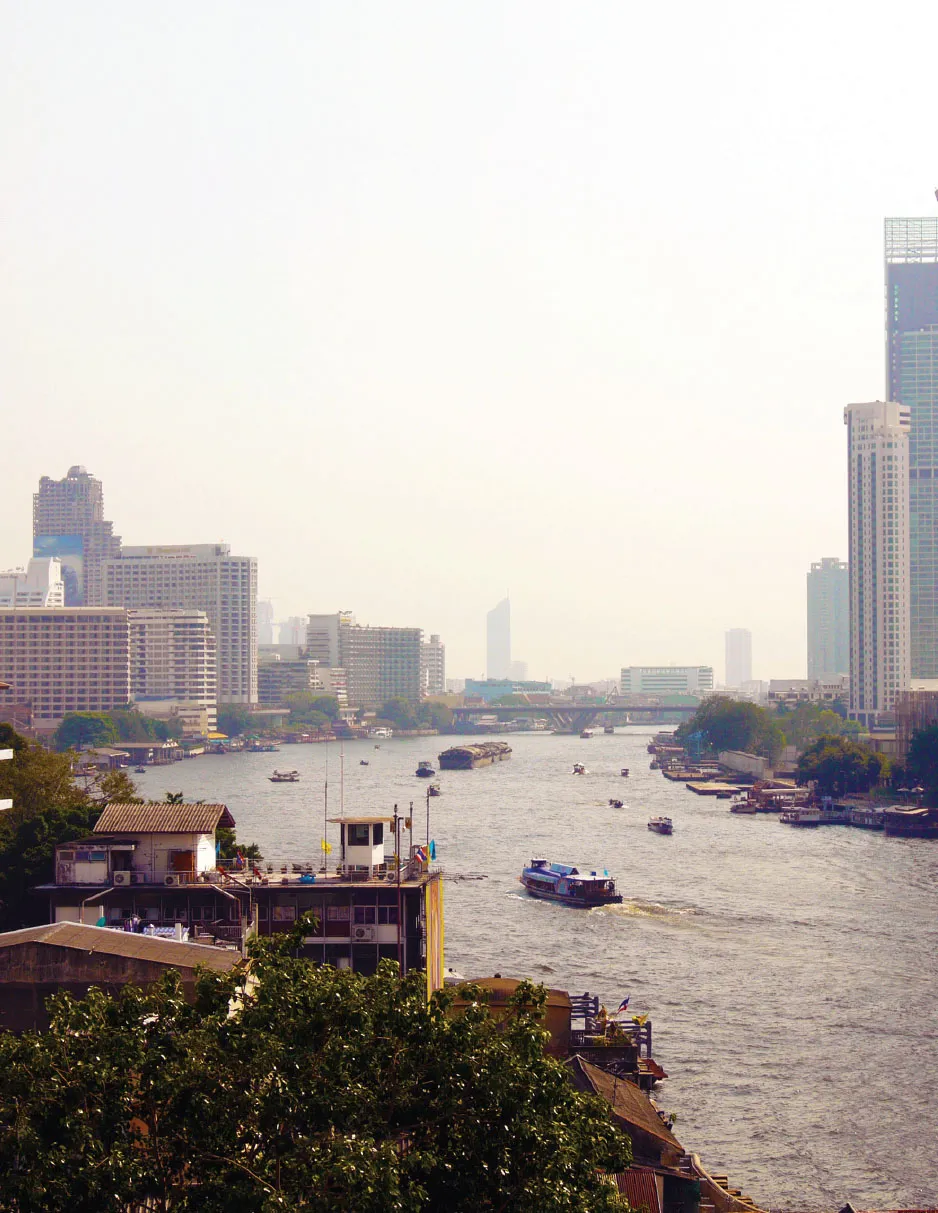
Inland waterway transport (IWT) can be an efficient, cost-effective, and environmental-friendly option to move people and bulk commodities over long distances. By transporting people and goods over navigable rivers and canals, IWT reduces road and rail congestion, road crashes, pollution, emissions, and energy consumption.
The People’s Republic of China (PRC) has long appreciated the importance of IWT. It has the world’s largest IWT network, both in terms of length and freight volume. However, investments for the maintenance and modernization of IWT infrastructure have been overtaken by investments for highways and rail. Many ports are outdated, with no specialized berths and modern handling equipment.1
This has kept IWT in the PRC from reaching its full potential. However, in recent years, the PRC has given renewed priority investment in IWT, recognizing it as an essential part of its transport system.2
The province of Hunan, which has one of the biggest IWT networks in the country, has been deeply involved in the PRC’s efforts to improve IWT infrastructure. Hunan is a landlocked province with around 68.4 million residents. The Xiang River, one of the largest tributaries of the Yangtze River in the PRC, flows through six cities in the province. 773 kilometers (km) of its total length of 969 kilometers pass through Hunan, making it the province’s biggest river (footnote 1). It forms part of an intricate IWT network in the PRC, which has over 11,495 kilometers of waterways, 107 ports, and 1,880 berths.
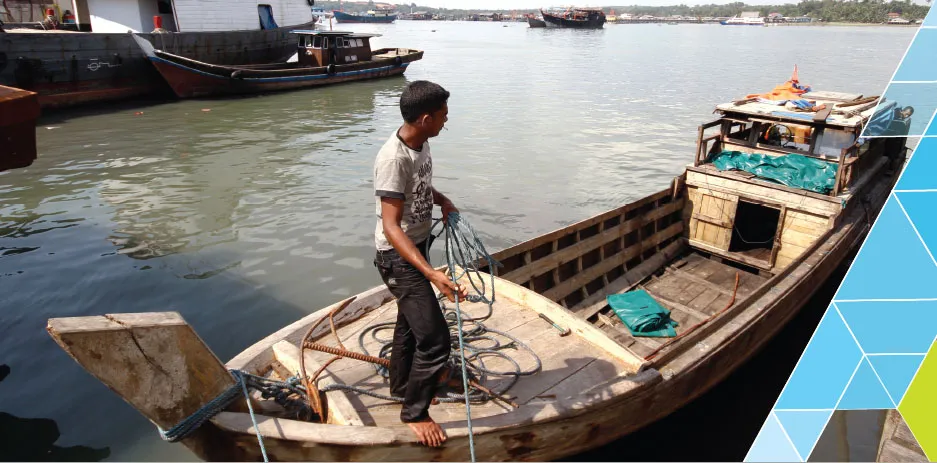
Hunan’s IWT infrastructure needed vast improvement. Only 6% of its waterways and berths can accommodate vessels with a carrying capacity of 1,000 tons. The limited depth of the river and its long rocky shoals have prevented safe year-round access by larger vessels. Traffic growth is also constrained by obsolete and insufficient infrastructure and loading facilities in the river’s ports. In 2009, the network carried only 10% of the overall freight transported in the province in terms of ton-kilometers.
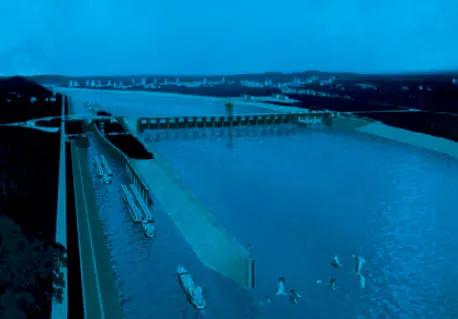
Planned arrangement of the navigatoin complex. Source: ADB Project Team.
To address these constraints, the PRC prepared the Xiang River Network Master Plan, which emphasizes IWT infrastructure development. Hunan has already executed several IWT infrastructure improvements in the river in line with the master plan, which aims to gradually make the Xiang River navigable year-round for barges of up to 1,000 deadweight tons (dwt) on its middle and upper reaches and for barges of up to 2,000 dwt on its lower reaches. Once the plan fully is implemented, the Xiang River will become one of the most important freight corridors in Hunan.3
In 2011, the PRC sought ADB’s assistance in achieving its vision for the IWT network in Hunan. Together, they initiated a project—the Hunan-Xiangjiang Inland Waterway Transport Project—that aimed to construct a new navigation complex—the Tugutang Navigation Complex—with a ship lock capacity that can accommodate class III vessels,4 a run-of-the-river barrage to regulate river levels and flows, and an associated hydropower plant with a capacity of 90 megawatts (MW). In addition, this project will also construct cargo terminal berths and improve public landing stages, which will provide rural communities with improved access to river transport to different parts of the province and maximize the potential of industrial sites in the area.
The project, which is ADB’s first IWT project, is an important element in the Xiang River Network Master Plan. Without the Tugutang Navigation Complex, prior investments given to enhance IWT facilities upstream of the river will be less beneficial.
SOLUTIONS
Barrage design and construction. A barrage is a structure that controls river level and flow. In this project, the barrage design considered several important dimensions. First, its design aims to raise water levels in the river so that class III vessels can navigate through it. Second, its design will integrate a hydropower plant with a total installed capacity of 90 MW. It was essential for the project to choose the best location for the barrage given its multipurpose nature. Geography, geology, river navigation, adjacent developments, and ease of construction were considered. The project chose from among three options: at the upper portion of the river in Hengnan County in Hunan, at a lower portion of the river in Chejiang Town, and at a middle site about 8.8 kilometers downstream from the upper portion of the river in Hengnan. The site in the upper portion of the river in Hengnan was ultimately chosen. In this area, the river channel is straight, providing ships adequate space to maneuver. In addition, this area is highly rural and has no environmentally sensitive sites, thus social and environmental impacts are minimized (footnote 3).
The project’s barrage which forms part of the navigation complex, will have 17 sluice gates. Each gate will be 20-meter wide. A sluice gate is the barrage’s “doors”—the mechanisms that can be opened or closed to control river flow. Each bay or opening will have metal radial sluice gates, which can be lowered or raised by pistons supported by bearings fixed to the pier walls. Each gate will be provided with an alternative source of power for backup in the event of main electricity supply failure.
The gates will be controlled and operated automatically, but will have a manual override option. Moreover, the barrage was designed to discharge a flow with a 1:50 year return period5 and verified as structurally able to withstand a catastrophic flood with a 1:500 year return period (footnote 3).
The barrage will include a run–of–the–river hydropower generation plant with a total installed capacity of 90 MW and normal annual energy output of 358.2 million kilowatt–hours. The plant will have four turbine units, a power house, tailrace, transformer yard, and transmission lines to connect to the regional electricity grid on the west side of the barrage.
The construction of the hydropower plant was not a mere afterthought. Rather, the barrage was designed to be multipurpose, with hydroelectricity generation providing a revenue that would help the province recover the investment cost.
Ship lock. For vessels to pass the barrage, they go through a ship lock which is a chamber with gates at each end. Ship locks enable vessels to navigate through steep changes in the level of the river. The project’s ship lock is located on one side of the river, and was designed to hold up to four 1,000–ton vessels. To fill the chamber, the ship lock has three inlet conduits where water regulated by the gates will flow. The chamber’s walls were treated with manifold arrangement to minimize the whipping of turbulent waters on ships within the lock.
Ports development. As the navigation complex is projected to attract more freight traffic, ports in Hunan must also be enhanced. Cargo terminals in the project site only had main moorings and loading ramps for small vessels, with the biggest berth capable of receiving vessels with capacities of only 300 tons. The project sought to increase the port capacity of the province’s IWT network. Engineering designs for two cargo terminals, each with a 100 m concrete berth, have been completed. The project will expand and improve the berths so that they can handle vessels up to 1,000 tons. Aside from improving the berths, new facilities will be added to the terminals, such as open cargo storage areas, warehouses, and workshops, among others.
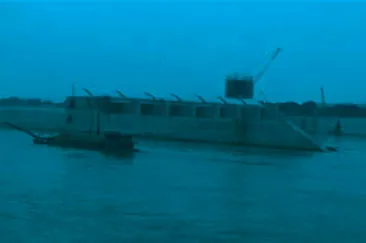
The shiplock under construction on the back of the river.
Source: ADB Photo Library.
Source: ADB Photo Library.
Fish pass. The project incorporated a fish pass into its design, to ensure that no fish and other aquatic animals will be carried into the hydropower turbines. The fish pass will be 774 meters long, and will provide a channel where aquatic animals can pass. In addition, important fish habitats will be identified and protected.
Institutional development. Alongside infrastructure development, reforms were also introduced in the institutions involved in IWT in the province. First, to improve coordination among the many institutions with responsibilities concerning the waterway, the province set up the Water Transport Development Committee to foster IWT development. Through the project, the province started introducing modern IWT management and support systems and provided trainings in monitoring, inspection and emergency response to the Hunan provincial department of transport, the Hunan Maritime Affairs Bureau, and the Hunan Xiangjiang Navigation Construction and Development Company. The project has also helped establish an IWT enterprise that will construct, de...
Table of contents
- Front Cover
- Title Page
- Copyright Page
- Contents
- Foreword
- Acknowledgment
- Abbreviations
- Overview
- Waterways
- Up in the Air
- On Track
- Urban Transport Solutions
- Cross–Country Corridors
- In–Country Expressways
- Rural Road Connections
- Road Maintenance
- Back Cover
Trusted by 375,005 students
Access to over 1.5 million titles for a fair monthly price.
Study more efficiently using our study tools.
Frequently asked questions
Yes, you can cancel anytime from the Subscription tab in your account settings on the Perlego website. Your subscription will stay active until the end of your current billing period. Learn how to cancel your subscription
No, books cannot be downloaded as external files, such as PDFs, for use outside of Perlego. However, you can download books within the Perlego app for offline reading on mobile or tablet. Learn how to download books offline
Perlego offers two plans: Essential and Complete
- Essential is ideal for learners and professionals who enjoy exploring a wide range of subjects. Access the Essential Library with 800,000+ trusted titles and best-sellers across business, personal growth, and the humanities. Includes unlimited reading time and Standard Read Aloud voice.
- Complete: Perfect for advanced learners and researchers needing full, unrestricted access. Unlock 1.5M+ books across hundreds of subjects, including academic and specialized titles. The Complete Plan also includes advanced features like Premium Read Aloud and Research Assistant.
We are an online textbook subscription service, where you can get access to an entire online library for less than the price of a single book per month. With over 1.5 million books across 990+ topics, we’ve got you covered! Learn about our mission
Look out for the read-aloud symbol on your next book to see if you can listen to it. The read-aloud tool reads text aloud for you, highlighting the text as it is being read. You can pause it, speed it up and slow it down. Learn more about Read Aloud
Yes! You can use the Perlego app on both iOS and Android devices to read anytime, anywhere — even offline. Perfect for commutes or when you’re on the go.
Please note we cannot support devices running on iOS 13 and Android 7 or earlier. Learn more about using the app
Please note we cannot support devices running on iOS 13 and Android 7 or earlier. Learn more about using the app
Yes, you can access Lessons from ADB Transport Projects by in PDF and/or ePUB format, as well as other popular books in Business & Transportation Industry. We have over 1.5 million books available in our catalogue for you to explore.