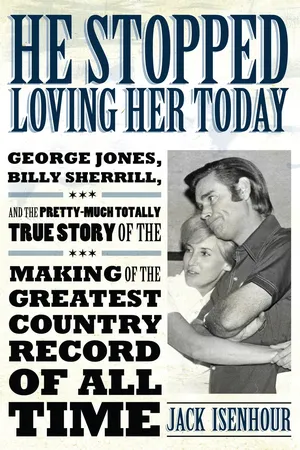
When George Jones recorded "He Stopped Loving Her Today" more than thirty years ago, he was a walking disaster. Twin addictions to drugs and alcohol had him drinking Jim Beam by the case and snorting cocaine as long as he was awake. Before it was over, Jones would be bankrupt, homeless, and an unwilling patient at an Alabama mental institution. In the midst of all this chaos, legendary producer Billy Sherrill—the man who discovered Tammy Wynette and cowrote "Stand by Your Man"—would somehow coax the performance of a lifetime out of the mercurial Jones. The result was a country masterpiece. He Stopped Loving Her Today, the story behind the making of the song often voted the best country song ever by both critics and fans, offers an overview of country music's origins and a search for the music's elusive Holy Grail: authenticity. The schizoid bottom line—even though country music is undeniably a branch of the make-believe world of showbiz, to fans and scholars alike, authenticity remains the ultimate measure of the music's power.
eBook - ePub
He Stopped Loving Her Today
George Jones, Billy Sherrill, and the Pretty-Much Totally True Story of the Making of the Greatest Country Record of All Time
- 232 pages
- English
- ePUB (mobile friendly)
- Available on iOS & Android
eBook - ePub
He Stopped Loving Her Today
George Jones, Billy Sherrill, and the Pretty-Much Totally True Story of the Making of the Greatest Country Record of All Time
About this book
Information
Subtopic
MusicLIVE GEORGE JONES
1
VACANT, INERT CIPHER
Saturday, downtown Nashville. The early arrivals, packed cheek to jowl, flowed downhill on the sidewalks flanking the Ryman Auditorium. On the Fifth Avenue side, the crowd split as it neared the auditorium, the George Jones fans peeling off to the left and the sports fans continuing on down toward the arena. The temperature was in the sixties and the forecast rain, but after a day of sunshine there wasn’t an umbrella in sight. Over on Fourth Avenue, a scalper moved up the slope against the grain, one baby step at a time, holding a small sign above his head: I NEED TICKETS PLEASE.
At the Ryman’s east entrance dozens of fans milled around while others, mostly seniors, sat on the low brick walls surrounding the courtyard, some at the feet of a statue of Captain Tom Ryman, the building’s namesake. The hard-drinking riverboat captain had built what was first a religious meeting house after he was “saved” by a Bible-thumping evangelist in 1885.
Seeing the statue, it was obvious we should’ve planned our rendezvous at this landmark. Instead, my wife Dana Moore and Judge-John-Brown (it’s always one word: “Judge-John-Brown;” never just “Judge” or “Judge Brown”) had decided we would meet at George Jones’s tour bus to pick up backstage passes. Turned out there were three identical purple and silver buses in the Jones entourage, all unmarked.
Back when George was a pup, a bus with your name plastered all over it, a rolling billboard, was a coming-of-age status symbol for a country singer. No more. Now there are too many crazies out there to offer yourself up as a clay pigeon in the skeet shoot of life, so to speak. Not that it was that hard to figure out which of the three buses belonged to George. The line of twenty-five or so autograph seekers was a dead giveaway, as people handed this and that through the bus door for George to sign.
That was at the bus on the far left. The next bus over belonged to the band. Then came a white RV carrying the band’s instruments where they had made up for the lack of labeling on the buses by stenciling “George Jones Concert Tour” in big letters on the side. The last bus was for “Barry and Sheri”: that’s Barry Smith and Sheri Copland, the husband and wife act that would share the stage with George. Think Donnie and Marie with about half the teeth.
A forty-something couple in matching western-detailed red shirts and black cowboy hats asked me to take their picture in front of George’s black BMW. George drove and his wife Nancy rode, the guy assured me. He said to make sure I got the noshow2 vanity plate in the picture. Done.
Still no Judge-John-Brown.

The George Jones “He-Stopped-Loving-Her-Today” project had officially begun about a year before when the white limo rented for the occasion rolled up the driveway of Jones’s Franklin, Tennessee home. On board, Dana’s old friend, Davidson County sheriff Daron Hall and his wife Ginger, Dana and me, and a visiting sheriff from North Carolina with his family. The visiting sheriff was in town for a meeting of the National Sheriffs’ Association and he had called ahead asking for an audience with Jones. That’s like a tourist in Rome asking to do brunch with the Pope, but Daron managed to pull it off. Then Daron made the mistake of mentioning this to Dana and me. So here we all were on George Jones’s doorstep, soon to get an up close and personal view of the legend himself.
We were met by a third sheriff, this one from Williamson County, who ushered us inside. Soon we were all standing around in the living room of “the greatest country singer of all time.”
Unreal.
George showed up and it was clear he didn’t know who we were or why we were there. Whatever. After more than fifty years in show business, he had marched to this tune before and soon the pictures were being taken and the autographs being signed.
Neat as a pin, every strand of white hair perfectly placed, George wore starched, ironed jeans; a crisp, short-sleeved shirt with a red and blue windowpane plaid; and rose-tinted glasses. George had been wearing those glasses ever since his self-described “beady brown eyes” led a couple of deejays to nickname him “Possum” back in the days of the coal-fired pedal steel.
Later, George, who’s seen the inside of a jail or two, ended up posing with three high sheriffs at once. When somebody pointed that out, he faked a flinch and eyed the nearest exit. That’s about as animated as the man got.
Some stars handle these “meet and greets” differently. Like Dolly Parton. From the moment she enters a room, she’s in total control. Chatting nonstop, she poses for pictures, autographs whatever is put under her nose, and spends time with everybody while at the same time keeping it moving. (I know this because Dana worked for Dolly for a couple of years.) George, on the other hand, doesn’t act, he reacts. Dolly’s active. He’s passive. She’s an extrovert. He’s shy by nature. This passivity has led some folks to misread him.
A decade or so back, writer Nick Tosches described George as “vacant,” as “a man whose unequivocal soulfulness abided incongruously beneath an inert mind.”
“Without a song,” wrote Tosches, “he was a cipher.”
So Tosches all but called the man a moron. Admittedly, George Jones is not the most articulate guy in the world. What’s more, in public, he’s not the least bit philosophical about his life or his music, and he once described himself to the Village Voice as “just an ignorant country boy who never had much schoolin’.” But vacant, inert, a cipher? That’s cold. Consider the source. Nick Tosches was born in Newark, New Jersey, and didn’t have the benefit of growing up in the small town South where you can always find a couple of characters like George Jones hanging around.
“What I like most about George is that when you meet him, he is just like some ole guy that works down at the gas station,” said Alan Jackson.
Exactly. “Nondescript” is too gaudy a word for George Jones. The man is as plain as an unbuttered biscuit. Then he opens his mouth to sing and it’s apparent that the difference between George and all those vacant, inert ciphers sitting on benches in the courthouse square whittling points on the ends of sticks is that God, in his infinite wisdom, loaded up George Jones with all the talent. He’s better at what he does than anybody else. Ever. That’s not me talking. It’s the opinion of people like Johnny Cash, Waylon Jennings, Garth Brooks, and Tom T. Hall.
“I’ve never talked to a country music person whose favorite singer wasn’t George Jones,” said Hall.
Even Frank Sinatra once called George “the second best male singer in America.” A Time magazine critic took it even further, calling Jones “the greatest American popular singer of the twentieth century.” But however he is ranked, everybody agrees there’s nothing vacant, inert, or cipherish about George Jones’s talent. Meanwhile the rest of us are left wondering, “Why him and not me?” Why exactly did God give all the talent to Jones, this alcoholic grade school dropout, this person of lesser virtue, when all of us happy white Christian Rotarians were ready and willing to bear the burden? Well, now, that will just have to remain one of the mysteries.
The seed was planted when the out-of-town sheriff handed George a hardback copy of I Lived to Tell It All, the singer’s autobiography. While signing the book, George said he wished the publisher had included more stuff about the music.
“Nobody has ever done a book about the music,” he said.
In the made-for-TV movie, I’ll leap forward right then and say, “George, I’ll write that book and we’ll sell a million of ’em!”
Didn’t happen.
I was slow on my feet and it would be months before I did the research and found out George was right. The three George Jones biographies are more about drinking and drugging than picking and singing. Same goes for George’s autobiography, a book that critic Nicholas Dawidoff called “a massive chronicle of vile behavior related with brutal candor” in which “next to nothing revealing is said about the art of singing.”
So I made a call here and a call there, decided to focus on “He Stopped Loving Her Today,” got George’s blessing, and soon began writing a book “about the music.” Then there was a happy accident. In the midst of learning pretty much everything anybody would ever need to know about the making of “He Stopped Loving Her Today,” I found out pretty much everything a fan needs to know about country music. The gist? Well, as you’ll see throughout the rest of this tome, you can’t believe everything you read in the popular media. So put aside all those fan-mag assumptions and get ready for a bumpy ride.
Judge-John-Brown finally showed up at the Ryman. He was running late after having spent the previous evening at a Willie Nelson concert in Tunica, Mississippi, about five hours south. His driver didn’t get him home until 2:45 in the morning.
Judge-John-Brown stood out in this crowd, looking natty in his hunter green blazer; light blue Oxford cloth shirt; khaki pants; and maroon and white bowtie. He was in his sixties, bald on top with a white beard and moustache; wore thick, wire-rimmed glasses; and, like most of us, could stand to lose a few pounds. While he may not have looked the part, Judge-John-Brown probably was the biggest country fan there. This was his seventy-somethingth time to see George Jones and he has been to over six hundred Willie Nelson concerts.
The judge pulled out an “All Access” pass that he had figured would get me, at least, backstage. But there was a major hitch. The pass was from the previous year and nobody would honor it. He knew this because George’s manager already had tried an identical pass at the stage door.
“He said, ‘I’m Reggie Mac. I’m his manager,’” said Judge Brown. “And the guy says, ‘I don’t care who you are, you can’t get in without a pass.’”
Judge-John-Brown has an Old South drawl thick as chilled molasses. When he says “am” it comes out “a.m.” It’s an accent so thick even southerners take notice; so exaggerated that an actor using it—maybe playing Big Daddy in Cat on a Hot Tin Roof— would be accused of stooping to caricature. So how does Judge Brown describe his accent?
“Nashville,” he said.
Maybe so, but I’ve been in town over twenty-five years and I’ve never heard anything like it.
“Who else in town talks like that?” I asked.
“I dunno,” said the Judge. “Y’know, most of them talk wrong, I guess.” He smiles. “It’s just sort of southern, slow. And I’m always surprised when I hear myself.”
It’s people like the Judge who can really throw you when you’re trying to describe a typical country music fan. He’s as southern as pecan pie, but he’s also a lawyer, a pharmacist (the family business), and the stepfather of a onetime captain of the Dartmouth football team.
Some critics still cling to the notion that country fans are from the southern working class. Others talk about hillbillies, rednecks, trailer trash. But the idea that most country fans come from the underbelly of society has long been wrong.
A survey cited in the New York Times in 2003 showed that, in the New York market, country radio listeners were all but identical to those of leading adult contemporary stations. The difference? Country music fans tended to be “a little more affluent,” and were more likely to have “managerial” jobs.
I checked out the fans in line at the Ryman. There was a teenaged boy, maybe sixteen, still with a little baby fat, wearing a brown T-shirt that read “Save a tree, harvest a buck.” So add flabby, teenage, deer hunters to the list and NASCAR fans. Dana spotted three men in Dale Earnhardt Jr. T-shirts. Then there were all the seniors: keepers of the Roy Acuff–Hank Williams, hillbilly honky-tonk flame, I suspect. Off to the side, a very tall, war-prisoner-thin man channeled Hank in his brown, western cut leather jacket, cowboy hat, and boot-leg jeans. Later I would see a Chinese guy and a bespectacled, forty-something preppy in a blue blazer and khakis. All country music fans. It’s going to take a lot of fence to corral all these folks. Maybe Bill Ivey can help.
Back when Ivey headed the Country Music Foundation, the scholarly arm of the Country Music Hall of Fame, he came up with what he called an “industry” definition of country music. Country music, wrote Ivey, is “records that country radio will play and that country fans will buy.” Following that same train of thought, a Bill Ivey country fan might be anybody that listens to country radio, buys country recordings, and attends country concerts. That‘ll fence in our deer-hunting teenager, both Presidents Bush, Judge-John-Brown, poor white trash, and the urbane Ivey himself, who served some time as the Chairman of the National Endowment for the Arts.
For the time being, forget that the beauty (and the ugly) of the Ivey approach is that these definitions can be applied without ever once talking about the music itself. (This is helpful in a category of music whose charts have at one time or another laid claim to both Hank Williams and Engelbert Humperdinck.)
One more thing.
Card-carrying country fans are not like pop music fans. It goes much deeper. Country fans “define themselves in and through the music,” seeing themselves as outsiders versus the mainstream, observed country music scholar Joli Jensen. Vanderbilt’s Richard Peterson took it a step further. “Identification with country music today is like identification with an ethnic group,” he wrote. And with that comes an “associated way of life,” and an “imagined place in society.” Like other ethnicities, membership is not predicated on money or class. So there’s room in the country corral not only for waitresses, truck drivers, and farmers—the working class—but also for all the professors, lawyers, doctors, and CEOs who in the privacy of their own home—“Pull down the shades, Adelaide!”—prefer a fiddle to a violin.
2
ART AND MONEY
Judge-John-Brown reappeared with a fist full of “All Access” passes. They were about half-again as big as a credit card, laminated to last, and had a color picture of George on the front. With these babies we would be able to roam around the Ryman Auditorium at will and, if anybody asked, could answer with that line we’d been waiting a lifetime to deliver: “I’m with the band.”
“I have to have these back,” said Judge-John-Brown as we looped the passes around our necks.
We made our way to the alley running down the south side of the Ryman. Like most alleys, it was not inviting. We passed a line of grubby, oversized, plastic garbage cans as Judge Brown stuffed something in his ears. I jumped in with some small talk about earplugs and how annoyingly loud the music can get even at country concerts.
Oops.
“I’ve completely lost my hearing in one ear,” said Judge-John-Brown, not the least bit offended, and it was only then I spotted the amber-colored, coiled plastic tube winding its way into his ear.
The tourist haunts that front what the locals call Lower Broadway have rear entrances which open into the Ryman alley. We passed the back door of a honky tonk called the Stage, then Jack’s BBQ, where the smell of smoked pork wafted over a small, uninviting patio with three or four tables. Soon we heard bluegrass spilling out the back door of “the world famous” Tootsie’s Orchid Lounge, once the Opry’s unofficial watering hole.
From the alley we could see over Tootsie’s to the sports arena and the decorative spire out front that’s meant to look like the old WSM radio antenna. There’s another WSM-like “antenna” perched on top of the Country Music Hall of Fame a block away. These nods to Nashville’s WSM are appropriate. The creative, technical, and business people who at one time or another worked at WSM, whether for the station, the Grand Ole Opry, or both, pretty much built Music City U.S.A. People like Fred Rose, w...
Table of contents
- Cover Page
- Title Page
- Copyright Page
- Dedication
- Contents
- Acknowledgments
- Prologue: Shattering Glass in a Minor Key
- Part One
- Part Two
- Part Three
- Part Four
- Part Five
- Part Six
- Epilogue: True Love Purgatory
- Sources
- Index
- Color Plates
Trusted by 375,005 students
Access to over 1.5 million titles for a fair monthly price.
Study more efficiently using our study tools.
Frequently asked questions
Yes, you can cancel anytime from the Subscription tab in your account settings on the Perlego website. Your subscription will stay active until the end of your current billing period. Learn how to cancel your subscription
No, books cannot be downloaded as external files, such as PDFs, for use outside of Perlego. However, you can download books within the Perlego app for offline reading on mobile or tablet. Learn how to download books offline
Perlego offers two plans: Essential and Complete
- Essential is ideal for learners and professionals who enjoy exploring a wide range of subjects. Access the Essential Library with 800,000+ trusted titles and best-sellers across business, personal growth, and the humanities. Includes unlimited reading time and Standard Read Aloud voice.
- Complete: Perfect for advanced learners and researchers needing full, unrestricted access. Unlock 1.5M+ books across hundreds of subjects, including academic and specialized titles. The Complete Plan also includes advanced features like Premium Read Aloud and Research Assistant.
We are an online textbook subscription service, where you can get access to an entire online library for less than the price of a single book per month. With over 1.5 million books across 990+ topics, we’ve got you covered! Learn about our mission
Look out for the read-aloud symbol on your next book to see if you can listen to it. The read-aloud tool reads text aloud for you, highlighting the text as it is being read. You can pause it, speed it up and slow it down. Learn more about Read Aloud
Yes! You can use the Perlego app on both iOS and Android devices to read anytime, anywhere — even offline. Perfect for commutes or when you’re on the go.
Please note we cannot support devices running on iOS 13 and Android 7 or earlier. Learn more about using the app
Please note we cannot support devices running on iOS 13 and Android 7 or earlier. Learn more about using the app
Yes, you can access He Stopped Loving Her Today by Jack Isenhour in PDF and/or ePUB format, as well as other popular books in Media & Performing Arts & Music. We have over 1.5 million books available in our catalogue for you to explore.