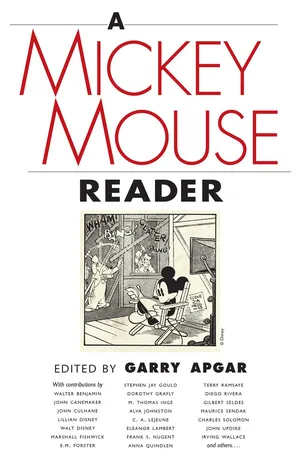
Contributions by Walter Benjamin, Lillian Disney, Walt Disney, E. M. Forster, Stephen Jay Gould, M. Thomas Inge, Jim Korkis, Anna Quindlen, Diego Rivera, Gilbert Seldes, Maurice Sendak, John Updike, Irving Wallace, Cholly Wood, and many othersRanging from the playful, to the fact-filled, and to the thoughtful, this collection tracks the fortunes of Walt Disney's flagship character. From the first full-fledged review of his screen debut in November 1928 to the present day, Mickey Mouse has won millions of fans and charmed even the harshest of critics. Almost half of the eighty-one texts in A Mickey Mouse Reader document the Mouse's rise to glory from that first cartoon, Steamboat Willie, through his seventh year when his first color animation, The Band Concert, was released. They include two important early critiques, one by the American culture critic Gilbert Seldes and one by the famed English novelist E. M. Forster. Articles and essays chronicle the continued rise of Mickey Mouse to the rank of true icon. He remains arguably the most vivid graphic expression to date of key traits of the American character—pluck, cheerfulness, innocence, energy, and fidelity to family and friends. Among press reports in the book is one from June 1944 that puts to rest the urban legend that "Mickey Mouse" was a password or code word on D-Day. It was, however, the password for a major pre-invasion briefing. Other items illuminate the origins of "Mickey Mouse" as a term for things deemed petty or unsophisticated. One piece explains how Walt and brother Roy Disney, almost single-handedly, invented the strategy of corporate synergy by tagging sales of Mickey Mouse toys and goods to the release of Mickey's latest cartoons shorts. In two especially interesting essays, Maurice Sendak and John Updike look back over the years and give their personal reflections on the character they loved as boys growing up in the 1930s.
- 430 pages
- English
- ePUB (mobile friendly)
- Available on iOS & Android
eBook - ePub
A Mickey Mouse Reader
About this book
Trusted by 375,005 students
Access to over 1 million titles for a fair monthly price.
Study more efficiently using our study tools.
Information
1. The Early Years
1928–1931
In March 1927, Universal Pictures hired Walt Disney to produce Oswald the Lucky Rabbit. Five months later, in a squib labeled “Short Subjects,” the trade paper Film Daily termed the feature “a riot.” Despite Oswald’s success, however, when Walt’s contract came up for review, he was offered a reduction in pay, not the raise he felt he deserved. He rejected the proposed terms and, in short order, in concert with his ace animator, Ub Iwerks, and brother Roy, created Mickey.
No one then imagined Mickey Mouse becoming “one of the most famous actors on the screen,” as journalist Harry Carr, in “The Only Unpaid Movie Star” (March 1931),* put it. For Walt, making a go of Mickey was all about the survival of his studio, not the making of an idol for the ages.
Disney’s shabby treatment by Universal was too painful, or embarrassing, to be discussed at length (if at all) in early accounts of how Mickey was conceived. According to Harry Carr, Walt could only say that “we were rather indebted to Charlie Chaplin for the idea.” There was more to the story than that, of course. Not only was Mickey Mouse born of necessity, he arose from a wide array of sources, including—but not limited to—Chaplin, Douglas Fairbanks, Felix the Cat, Oswald the Rabbit, and frisky cartoon mice like those that abounded in mid-’20s animations such as the Farmer Al Falfa and Krazy Kat series and Disney’s own Alice and Oswald one-reelers.
Plane Crazy, the very first Mickey cartoon chronologically, though not the first to be released, was inspired by the exploits of a real-life hero, aviator Charles Lindbergh. It was animated at almost warp speed by Iwerks, whose role in crafting the original Mouse films was so crucial that the opening credits read: “A Walt Disney Comic by Ub Iwerks.” In 1930, after Ub and Walt had gone their separate ways, several critics intimated or, as Maurice Bessy did, affirmed outright that Mickey was the “offspring of the cartoonist Ub Iwerks.”* Bessy was wrong. As will be evident in the pages that follow, Walt, who, for over two decades, provided Mickey’s voice, was always the driving force behind the invention and animated adventures of Mickey Mouse.
Work on Plane Crazy commenced in March or April 1928, and was previewed in mid May at a theater on Sunset Boulevard. A second cartoon, The Gallopin’ Gaucho, went into production almost immediately, but both films were silent, and Disney could find no takers for the series. Although Al Jolson’s The Jazz Singer had, in October 1927, presaged the coming of talking pictures, distributors and theater owners in the spring and summer of 1928 were still unsure of what lay ahead for the movie business. Sound versions of Gallopin’ Gaucho and Plane Crazy would not be released until December 30, 1928, and March 17, 1929, respectively, after Steamboat Willie had proven a hit.
Animation on Steamboat Willie—Walt’s first cartoon planned from scratch as a talkie—was completed by late August 1928. The soundtrack was recorded on September 30th. Which is why, throughout the 1930s, the studio fêted Mickey’s birthday on or about October 1st. In the 1970s, The Walt Disney Company began celebrating the event on November 18th, since it was on that date in 1928 that Willie premiered at the Colony Theatre on Broadway, as part of a lavish bill featuring a live orchestra and the now-forgotten mob movie, Gang War. Steamboat Willie was applauded by audiences and critics alike. Walt must have been especially gratified when he and Mickey were singled out in a review of the day’s doings by Mordaunt Hall in the New York Times:
On the same program is the first sound cartoon, produced by Walter Disney, creator of “Oswald the Rabbit.” This current film is called “Steamboat Willie,” and it introduces a new cartoon character, henceforth to be known as “Micky Mouse.” It is an ingenious piece of work with a good deal of fun. It growls, whines, squeaks and makes various other sounds that add to its mirthful quality.
The New York Times has committed countless column inches ever since to Mickey, by way of hundreds if not thousands of news briefs, wire service reports, full-length articles, and opinion pieces. On November 21st, two days after Hall’s critique appeared, the trade paper Variety printed the first item focused exclusively on the Mouse.* The Times and Variety, like several other publications at the time, raved about how novel and amusing Steamboat Willie was. They also commended Disney and the Powers Cinephone System—whose product was used to make the film’s soundtrack—for demonstrating that, as Variety put it, “interchangeablity” among competing sound technologies was feasible for “all wired houses.”
Mickey, circa 1930, didn’t just growl, whine, and squeak. He was, as previously noted, more impish than the little guy we now know, and periodically made headlines for running afoul of the censor, both abroad (Canada and Germany) and at home. In February 1931, in “Regulated Rodent,”* Time magazine gleefully reported that Clarabelle Cow, a prominent member of Mickey’s supporting cast, was reproached for too readily revealing her “famed udder,” and for being seen on screen reading a mildly erotic novel, Three Weeks, by Elinor Glin.
These spicy contretemps merely added to Mickey’s charm at a time when intellectuals, notably in Europe, like the motion picture critics Caroline (C. A.) Lejeune,* Maurice Bessy, and Pierre Scize,* were starting to sing his praises. In November 1929, a private group of elite enthusiasts, the London Film Society, organized a program that featured Sergei Eisenstein’s Battleship Potemkin and a Mickey Mouse cartoon, The Barn Dance. Ten months later, Eisenstein visited Walt’s studio, proudly posing for photos with a cut-out image of Mickey, and in November 1930 the Soviet director was quoted in the Manchester Guardian (“Art & Hollywood: Sergei Eisenstein Gives it Up”) saying “that the only artistic success yet achieved by the talkies” was in the Mickey Mouse cartoons. In Germany in 1931, a cardboard effigy of Mickey was glimpsed in a pastry shop in Fritz Lang’s proto-noir masterpiece, M, and Walter Benjamin, also in 1931, commented favorably on the character in his private journal.*
Meanwhile, in the world of commerce, the Mouse was taking on a life of his own. In an article in the Windsor Magazine in October 1931,* Disney would boast that “manufacturers of every kind of commodity” were “using Mickey to promote the sale of their goods.” By late December 1931, it could be said that Walt and Mickey had truly “arrived” after Gilbert Seldes, the nation’s most distinguished media maven, published an extensive profile of the young producer in the New Yorker, entitled “Mickey-Mouse Maker.”*
Steamboat Willie
Land (Robert J. Landry)
Variety, November 21, 1928. Copyright ©2012 Reed Business Information, a division of Reed Elsevier, Inc.
Not the first animated cartoon to be synchronized with sound effects but the first to attract favorable attention. This one represents a high order of cartoon ingenuity cleverly combined with sound effects. The union brought forth gags galore. Giggles came so fast at the Colony they were stumbling over each other.
It’s a peach of a synchronization job all the way, bright, snappy and fitting the situation perfectly. Cartoonist, Walter Disney.
With most of the animated cartoons qualifying as a pain in the neck it’s a signal tribute to this particular one. If the same combination of talent can turn out a series as good as “Steamboat Willie” they should find a wide market if interchangeability angle does not interfere.
Recommended unreservedly for all wired houses.
• This item was published four days after Mordaunt Hall lauded Steamboat Willie (and Mickey Mouse by name) in the New York Times. Willie and its star had, however, been mentioned one week earlier, both perhaps for the first time in print, by Film Daily, in its November 13, 1928, issue (“First Four Cinephone Cartoons Under Way”):
Four of a series of 26 new all sound animated cartoons to be made by Walter Disney, creator of the Oswald cartoons, are now in work at the new Powers Cinephone studio in New York. The new series is tentatively titled “Micky Mouse.” The first subject has been fully completed and three others will be ready for screening within the next week or ten days.
Each of the 26 subjects will have a distinguishing title. The first will be known as “Steamboat Willie” to be followed by “The Barn Dance,” “The Galloping Gaucho” and “Plain [sic] Crazy.”
“Steamboat Billie” / Walt Disney Cartoon / Real Entertainment
Film Daily, November 25, 1928
This is what “Steamboat Willie” has: First, a clever and amusing treatment; secondly, music and sound effects added via the Cinephone method. The result is a real tidbit of diversion. A maximum has been gotten from the sound effects. Worthy of bookings in any house wired to reproduce sound-on-film. Incidentally, this is the first Cinephone-recorded subject to get public exhibition and at the Colony, New York, is being shown over Western Electric equipment. Distribution has not been set.
• Distribution in the United States for Steamboat Billie [sic] and the other early Mickey cartoons would be managed on a states rights basis by Patrick A. Powers (1869–1948), a colorful and rather ruthless figure in movie history, whose career is touched upon in “Mickey Mouse’s Financial Career” by Arthur Mann* and Jim Korkis’s “Secrets of Steamboat Willie.”* Powers had a propensity for legal entanglements, among them a lawsuit with Buffalo Bill Cody, in which the fiercely competitive Irishman prevailed.
The Barn Dance/Draughtsman . . . Walt Disney
London Film Society
The Film Society Programme, November 10, 1929
The Mickey Mouse series of films presents a model of synchronisation. It consists of animated cartoons, of that kind of which Mutt and Jeff, The Katzenjammer Kiddies (renamed during the war The Prohibition Children) and Æsop’s Fables were among the earliest examples and of which Felix the Cat is perhaps the most celebrated. The personality of Felix is no doubt more individual than are those of the protagonists of Mickey Mouse, but the drawings of the latter series are superior in fertility of invention. In his limited field, Mickey Mouse has achieved that perfect blend between visual and aural impulses towards which other sound-film technicians are yet striving, and of which Mr. Meisel’s scores for ‘Potemkin’ and ‘Berlin’ were the first hints. The film is shown courtesy of British International Film Distributors Ltd.
• The Barn Dance, the fourth Mickey Mouse cartoon released by Walt Disney, was screened for The Film Society of London at the Tivoli Palace, on the Strand, Sunday afternoon, November 10, 1929. It was part of a bill comprised of three full-length motion pictures, The Fall of the House of Usher (1928), directed by Jean Epstein, John Grierson’s Drifters (1928), and Sergei Eisenstein’s Battleship Potemkin (1925). Eisenstein and Aldous Huxley were in attendance. The Disney animated short and three feature films formed the thirty-third in a series of programs presented by the Society, established in 1925 by Ivor Montagu and Sidney Bernstein. Iris Barry, film critic for the Observer, and later first director of the Film Library at the Museum of Modern Art in New York, established in 1935, was a founding member of the Society. In 1930 Ivor Montagu would accompany Eisenstein to New York and Hollywood, where, as already noted, the Soviet director visited the Disney studio.
Mickey Mouse
C. A. (Caroline Alice) Lejeune
Observer, December 8, 1929. Copyright Guardian News & Media Ltd 1929.
To my mind, Walt Disney’s cartoons of Mickey Mouse are the most imaginative, witty, and satisfying productions that can be found in the modern cinema. It is surely beside the point to argue that cartoon is not, and never can be, the highest form of expression in any medium. The cinema has not yet discovered its highest form of expression, but it has discovered, and perfected, the cartoon. I can imagine finer films than Mickey Mouse, but I cannot walk into a theatre and see them. Walt. Disney’s work is here, and it is good; that somebody else’s work must eventually be better does not affect my pleasure in Mickey to-day.

The tradition of cartoon in the cinema goes back to a very early stage of film development, and springs directly from the comic strip of the American newspapers. The minute draughtsmanship and endless labour required in arranging these drawn figures in a sequence close enough and long enough to provide material for the film has always limited the output: but the few artists who have seriously employed themselves in cartoon-photography have proved, by series after series of successes, the remarkable aptness of this kind of production for the screen. Walt. Disney’s cartoons have a fine genealogy, in which Felix the Cat is perhaps the most famous name. But Mickey Mouse, while drawing so much from the past, is a real creature of the present; his line is freer and richer in comedy than that of any of his predecessors, and combined with it is a line of burlesque music, a kind of animal obbligato, with a scale and rhythm altogether its own.
Every Mickey Mouse cartoon is complete in itself, a single manifestation of its hero’s activities, but the whole series is linked together by cast, environment, and idea. Mickey, like Krazy Kat of the comic strip, is always a lover; his mouse “sweetie” inspires and shares in all the best of his music; they are a country couple, finding their adventures among the other creatures of the farmyard and countryside. As a rule they move in front of a static drawn background, and such accessories as the story needs are developed one out of another, transformed, with the barest economy of line. There is something reminiscent of Chaplin’s method in the integral use of accessory in the Mickey Mouse cartoons; Mickey dances on the platform boards, and creates a xylophone, pulls the spaghetti out of the tin and plays on it with a ’cello bow. Every line in the film is pregnant with the next; every movement is resolved, every gesture has its structural use. And matched with the burlesque tripping measure that runs through all the cartoons is a burlesque patter of music—a kind of musicbox jingle with thin, tinkling silences. The whole cunning of Mickey lies in its deliberate sub-tones—it is a whispered and wicked commentary on Western civilization through the medium of civilisation’s newest and most cherished machine.
Perhaps the surest proof of the value of the Mickey Mouse cartoons is their acceptance by men and women of every type of ...
Table of contents
- Cover
- Half title
- Title
- Copyright
- Dedication
- Contents
- Introduction
- 1. The Early Years, 1928–1931
- 2. Into the Realm of High Art, 1932–1933
- 3. “You’re the Top,” 1934–1935
- 4. Glory Days in Color, 1936–1939
- 5. World War II into the Seventies, 1941–1977
- 6. The Nostalgia Begins, 1978–1989
- 7. Into a New Millennium, 1991–2012
- Appendices
- Bibliography
- Authors
- Acknowledgments
- Index
Frequently asked questions
Yes, you can cancel anytime from the Subscription tab in your account settings on the Perlego website. Your subscription will stay active until the end of your current billing period. Learn how to cancel your subscription
No, books cannot be downloaded as external files, such as PDFs, for use outside of Perlego. However, you can download books within the Perlego app for offline reading on mobile or tablet. Learn how to download books offline
Perlego offers two plans: Essential and Complete
- Essential is ideal for learners and professionals who enjoy exploring a wide range of subjects. Access the Essential Library with 800,000+ trusted titles and best-sellers across business, personal growth, and the humanities. Includes unlimited reading time and Standard Read Aloud voice.
- Complete: Perfect for advanced learners and researchers needing full, unrestricted access. Unlock 1.4M+ books across hundreds of subjects, including academic and specialized titles. The Complete Plan also includes advanced features like Premium Read Aloud and Research Assistant.
We are an online textbook subscription service, where you can get access to an entire online library for less than the price of a single book per month. With over 1 million books across 990+ topics, we’ve got you covered! Learn about our mission
Look out for the read-aloud symbol on your next book to see if you can listen to it. The read-aloud tool reads text aloud for you, highlighting the text as it is being read. You can pause it, speed it up and slow it down. Learn more about Read Aloud
Yes! You can use the Perlego app on both iOS and Android devices to read anytime, anywhere — even offline. Perfect for commutes or when you’re on the go.
Please note we cannot support devices running on iOS 13 and Android 7 or earlier. Learn more about using the app
Please note we cannot support devices running on iOS 13 and Android 7 or earlier. Learn more about using the app
Yes, you can access A Mickey Mouse Reader by Garry Apgar in PDF and/or ePUB format, as well as other popular books in Social Sciences & Popular Culture. We have over one million books available in our catalogue for you to explore.