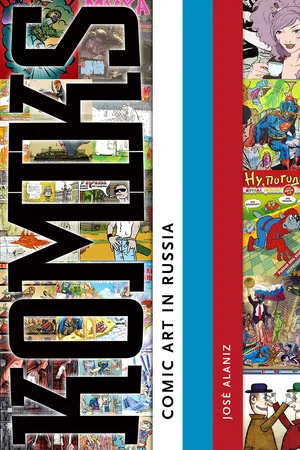
José Alaniz explores the problematic publication history of komiks —an art form much-maligned as "bourgeois" mass diversion before, during, and after the collapse of the USSR—with an emphasis on the last twenty years. Using archival research, interviews with major artists and publishers, and close readings of several works, Komiks: Comic Art in Russia provides heretofore unavailable access to the country's rich—but unknown—comics heritage. The study examines the dizzying experimental comics of the late Czarist and early revolutionary era, caricature from the satirical journal Krokodil, and the postwar series Petia Ryzhik (the "Russian Tintin"). Detailed case studies include the Perestroika-era KOM studio, the first devoted to comics in the Soviet Union; post-Soviet comics in contemporary art; autobiography and the work of Nikolai Maslov; and women's comics by such artists as Lena Uzhinova, Namida, and Re-I. Alaniz examines such issues as anti-Americanism, censorship, the rise of consumerism, globalization (e.g., in Russian manga), the impact of the internet, and the hard-won establishment of a comics subculture in Russia Komiks have often borne the brunt of ideological change—thriving in summers of relative freedom, freezing in hard winters of official disdain. This volume covers the art form's origins in religious icon-making and book illustration, and later the immensely popular lubok or woodblock print. Alaniz reveals comics' vilification and marginalization under the Communists, the art form's economic struggles, and its eventual internet "migration" in the post-Soviet era. This book shows that Russian comics, as with the people who made them, never had a "normal life."
eBook - PDF
About this book
Information
Table of contents
- Contents
- Acknowledgments
- Introduction: Komiks Agonistes
- PART I: HISTORICAL BACKGROUND
- PART II: CLOSE READINGS
- Conclusion: Impolitic Thoughts
- Notes
- Bibliography
- Index
Trusted by 375,005 students
Access to over 1.5 million titles for a fair monthly price.
Study more efficiently using our study tools.
Frequently asked questions
Yes, you can cancel anytime from the Subscription tab in your account settings on the Perlego website. Your subscription will stay active until the end of your current billing period. Learn how to cancel your subscription
No, books cannot be downloaded as external files, such as PDFs, for use outside of Perlego. However, you can download books within the Perlego app for offline reading on mobile or tablet. Learn how to download books offline
Perlego offers two plans: Essential and Complete
- Essential is ideal for learners and professionals who enjoy exploring a wide range of subjects. Access the Essential Library with 800,000+ trusted titles and best-sellers across business, personal growth, and the humanities. Includes unlimited reading time and Standard Read Aloud voice.
- Complete: Perfect for advanced learners and researchers needing full, unrestricted access. Unlock 1.5M+ books across hundreds of subjects, including academic and specialized titles. The Complete Plan also includes advanced features like Premium Read Aloud and Research Assistant.
We are an online textbook subscription service, where you can get access to an entire online library for less than the price of a single book per month. With over 1.5 million books across 990+ topics, we’ve got you covered! Learn about our mission
Look out for the read-aloud symbol on your next book to see if you can listen to it. The read-aloud tool reads text aloud for you, highlighting the text as it is being read. You can pause it, speed it up and slow it down. Learn more about Read Aloud
Yes! You can use the Perlego app on both iOS and Android devices to read anytime, anywhere — even offline. Perfect for commutes or when you’re on the go.
Please note we cannot support devices running on iOS 13 and Android 7 or earlier. Learn more about using the app
Please note we cannot support devices running on iOS 13 and Android 7 or earlier. Learn more about using the app
Yes, you can access Komiks by José Alaniz in PDF and/or ePUB format, as well as other popular books in Literature & Russian History. We have over 1.5 million books available in our catalogue for you to explore.