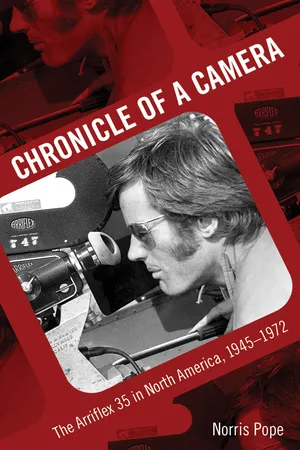
This volume provides a history of the most consequential 35mm motion picture camera introduced in North America in the quarter century following the Second World War: the Arriflex 35. It traces the North American history of this camera from 1945 through 1972—when the first lightweight, self-blimped 35mm cameras became available. Chronicle of a Camera emphasizes theatrical film production, documenting the Arriflex's increasingly important role in expanding the range of production choices, styles, and even content of American motion pictures in this period. The book's exploration culminates most strikingly in examples found in feature films dating from the 1960s and early 1970s, including a number of films associated with what came to be known as the "Hollywood New Wave." The author shows that the Arriflex prompted important innovation in three key areas: it greatly facilitated and encouraged location shooting; it gave cinematographers new options for intensifying visual style and content; and it stimulated low-budget and independent production. Films in which the Arriflex played an absolutely central role include Bullitt, The French Connection, and, most significantly, Easy Rider. Using an Arriflex for car-mounted shots, hand-held shots, and zoom-lens shots led to greater cinematic realism and personal expression.
- 202 pages
- English
- ePUB (mobile friendly)
- Available on iOS & Android
eBook - ePub
About this book
Information
Topic
ArtSubtopic
PhotographyChapter 1
INTRODUCTION
A Thirteen-Pound Wonder
The Arriflex 35 was the most consequential 35mm motion picture camera introduced in North America during the quarter century following the Second World War—and it also became, for filmmakers working outside the studio establishment, the most hip.1 Unveiled by the German firm Arnold & Richter at the Leipzig Trade Fair in 1937, the Arriflex was a lightweight, highly portable, reflex camera—the first commercially manufactured motion picture camera designed with a rotating-mirror reflex shutter (the basis for all modern reflex motion picture cameras), and thus the first professional motion picture camera to allow a cinematographer to see, while filming, the exact visual field being recorded on the film.2 Described by a later authority as “the archetypal go-anywhere, do-anything 35mm camera,”3 the Arriflex 35 proved to be rugged, dependable, and capable of reliably capturing theater-quality images. Over time, it came to serve in a variety of circumstances as a lightweight alternative to the Mitchell, long the standard camera for 35mm professional cinematography in America. Indeed, by the time the revolutionary 35mm Arriflex BL was released in North America in 1972—the first lightweight self-blimped 35mm camera—the Arriflex II had become a familiar tool for American cinematographers involved in all areas of 35mm film production, from newsreels, sports films, documentaries, government work, industrial films, and educational projects, to commercials, television series, and feature films. The basic design, which was given a technical Academy Award in 1967, proved highly enduring: later models of the camera, notably the IIB and especially the IIC, are still sometimes used in professional film work today.
This book seeks to provide a brief history of the Arriflex 35 in North America from the end of the Second World War up through the introduction of the 35mm Arriflex BL in 1972.4 It emphasizes theatrical film production, documenting the Arriflex’s increasingly important role in expanding the range of production choices, styles, and even content of American motion pictures in this period, culminating most strikingly in examples found in feature films dating from the 1960s and early 1970s, including a number of films associated with what came to be known as the “Hollywood New Wave.”5 The book will argue that the Arriflex’s impact proved particularly marked in three areas: in the encouragement the camera provided for location shooting; in the options the camera gave cinematographers for intensifying visual style and content; and in the doors the camera opened for low-budget and independent production.
Brief comments about each of these three areas provide a helpful starting point, beginning with the role of the camera in encouraging location shooting. In 1957, to take one example, an advertisement in American Cinematographer, the leading professional journal in the field, reminded filmmakers that the Arriflex 35 had proved “ideal for location shots under the most difficult conditions.”6 This is scarcely surprising: as a lightweight, highly portable, battery-powered camera, the Arriflex greatly simplified location shooting for non-sync material. It could be easily carried by one person, set up quickly almost anywhere, and yield theater-quality results. By 1971, an important guide to film production was prepared to conclude confidently that “the Arriflex is probably the closest to an ideal camera for use on location shooting” as any camera available.7
Second, the Arriflex encouraged an intensification of film style and content. Location shooting was obviously part of this, contributing directly to the quest for more persuasive realism and authenticity. But the Arriflex also permitted a more intimate physical relationship between photographic equipment and subject matter. The camera showed that theatrical films need not be shot with a large and difficult-to-maneuver industrial machine, operated primarily in an industrial setting, and placed imposingly between filmmaker and subject. Moreover, the Arriflex enabled filmmakers to seek new levels of immediacy by allowing the camera to mimic the suppleness and mobility of the human body—serving as a prosthetic device for personalized vision and allowing the creation of a level of immersive visual content that was much harder to achieve with a studio camera.8 As an Arriflex advertisement put it in the late 1960s, the Arriflex 35 could be used not just as a medium, “but as an extension of the viewer’s senses, to involve him fully in the emotional turmoil of what’s happening.”9
An Arriflex advertisement in 1970 expressed the overall point a little differently: the Arriflex was “the only 35 small enough [and] fast enough to be used for the high pitched, intense, deeply involved camerawork now part of the grammar of contemporary films.”10 This claim overlooked the Éclair Caméflex (CM3), but it nevertheless expressed an important aspect of the shift in film styles and audience sensibilities bound up with the use of lightweight cameras. For one thing, as John Cassavetes observed, “A hand-held camera … pushes the actors’ tempo up without words.”11 In addition—and more importantly—hand-held shooting rapidly became a tool for matching the intensification of a film’s dramatic action with an intensification of shooting style. Ed Digiulio, a leading figure in camera innovation, cited the “enormous rise in the use of hand-held cinematography” in the period running from the mid-1960s to the mid-1970s, a development clearly related to Arriflex use that DiGiulio ascribed to “the desire for realism, the increasing use of location filming, the need to film practical interiors, and the creative need of both cameraman and director to produce new and imaginative imagery.”12 Flexible shooting options, along with reflex viewing and focusing, thus allowed the Arriflex to play a significant part (for better or worse) in the modern predilection for increasingly graphic film styles and content—material that seeks an immediate visceral response from viewers rather than appealing to viewers’ emotions (in the manner of classical Hollywood cinema) primarily through dialogue and story elements.13
Moreover, whereas all motion picture cameras had view-finders of varying degrees of accuracy, reflex viewing, as the master cinematographer Conrad Hall later noted, led to “a whole new style of filmmaking” in which “the cameraman could now be more involved in immediate choices.”14 This viewing system, pioneered by the Arriflex’s rotating-mirror reflex shutter, inevitably enhanced the role of cinematographers by allowing them to frame and focus on the fly, giving them an increased degree of authorship over film images. Reflex viewing also allowed an unprecedented degree of spontaneity within shots, especially when camera movement was involved, thereby placing critical decisions directly in the hands of cinematographers (particularly in hand-held shooting)—decisions that were outside the strict control of the film’s director or producer (at least in the period before the ubiquity of video-assist).15 Additionally, on a more practical level, reflex viewing prompted much greater use of very long and very short focal-length lenses, as well as zoom lenses, and it also encouraged, with long lenses, techniques involving selective focus—approaches to image-making that could only be managed effectively while looking through the taking lens. (The use of long lenses, it should be noted, was not always just an aesthetic choice: it went hand in hand with the use of practical locations, since populated locales often dictated the need to set the camera up at some remove from the characters and action.16 In addition, selective focus could be used to avoid the added costs of unnecessary coverage17; and zoom lenses could reduce the number of lens changes and camera setups, thereby helping to speed up production.)
Third, the Arriflex helped to open doors for low-budget and independent productions. Indeed, the camera was much more economical to own or rent—or to operate—than a Mitchell. According to an October 1958 article in American Cinematographer, the newly released Arriflex IIB—including a wild motor and battery cable (but no matte box, lenses, magazines, or battery)—cost only $1,645 brand new.18 A few months later, Birns & Sawyer was renting out Arriflex IIB models with three lenses and three magazines at $15 per day, or $60 per week.19 This provided remarkably inexpensive access to equipment that permitted shooting theater-quality material. When sync sound was required, sound blimps and sync recorders obviously added to these costs; but the general economy of shooting with an Arriflex unquestionably gave a boost to independent and low-budget production, as well as to films by outsiders and Hollywood renegades (often using non-union crews). Such economies also stimulated interest in greater cinematic experimentation, based in part on examples found in foreign cinema and in underground films. Finally, whereas production economies have always mattered, they mattered particularly during the sharp economic slump in feature filmmaking in the period 1968–1972,20 a period that gave rise to a lot of non-studio production and Arriflex use.
This economic point leads to a word of caution: the expanding use of the Arriflex in the postwar decades must be understood as part and parcel of a set of wider changes in American filmmaking with which the Arriflex’s capabilities were intertwined.21 Whereas the goal of this book is to highlight the ways in which the Arriflex 35 encouraged, facilitated, and abetted these changes, it is not to propose a determinist or monocausal explanation of change. The changes under consideration obviously took place within a web of reciprocal relationships between changes in technology and shifts in the broader conditions and circumstances of film production. And these circumstances were not simply economic (the decline of the studio system; the changing demographics of film audiences; and the rise of television entertainment); they were also linked to yet other technological developments (such as faster film emulsions and innovations in sound-recording technology) as well as to shifting cultural norms, audience expectations, and aesthetic sensibilities. These wider circumstances provided the essential preconditions for the Arriflex’s increasing importance—an importance that has been widely acknowledged but has not hitherto been systematically studied.
In addition, an assessment of the Arriflex’s influence on North American filmmaking must also take into account the fact that the Arriflex was not the only lightweight professional motion picture camera available for 35mm production. In prewar and early postwar Britain, the Newman-Sinclair was often used, especially for documentaries, and in France, the still-older Debrie was used. In the United States, there was the wind-up, spring-driven Bell & Howell Eyemo, a camera that became famous as the primary 35mm American combat camera of the Second World War. And in 1947, the battery-powered French Éclair Caméflex, a reflex camera like the Arriflex, was introduced to considerable acclaim. Indeed, the Caméflex was encouragingly reviewed in a 1950 article in the Journal of the Society of Motion Picture Engineers,22 and the camera eventually developed a number of enthusiastic American admirers. (Foremost among these in the 1960s was the highly regarded cinematographer Haskell Wexler, who used the camera to shoot hand-held material for the 1966 film Who’s Afraid of Virginia Woolf?, for which he won the Academy Award for black-and-white cinematography, and again extensively for his own influential 1969 film Medium Cool, which he directed as well as shot.23 In addition, Francis Ford Coppola is said to have purchased an Éclair Caméflex in Britain to shoot his 1969 film The Rain People, sometimes using the camera in a cumbersome sound blimp made by the cinematographer Carroll Ballard, who was also a Caméflex proponent.24 Finally, Orson Welles allegedly preferred the Caméflex over earlier Arriflex models because the former’s tilt-up eyepiece made it much easier to frame low-angle shots.25)
Despite the appeal of the Caméflex, however, the Arriflex proved much more popular, emerging well ahead of the Caméflex as the dominant high-quality, lightweight 35mm motion picture camera in North America. When Panavision purchased the MGM camera department in 1970, for example, the MGM 35mm inventory consisted of fourteen Mitchell BNCs, twelve Mitchell NCs, three Mitchell high-speed cameras, one Bell & Howell 2709 (used in the animation department), and seven Arriflexes. There were no Éclairs. The Fox camera department inventory, which came up for sale at around the same time, did include an underwater Éclair along with three others; but this contrasts with seven Arriflex 35mm cameras (along with fifteen Mitchell BNCs, three Mitchell NCs, eighteen standard Mitchells, four high-speed Mitchells, and twelve Fox-designed Simplex-made cameras).26 A number of factors account for the greater popularity of the Arriflex in comparison with the Éclair. To begin with, the Arriflex was linked in people’s minds with Germany’s long-standing preeminence in the manufacture of high-quality cameras and optics. Moreover, as a result of its German wartime service, the Arriflex was understood to be exceptionally rugged and reliable (whereas the Caméflex developed a reputation as a more delicate camera). Indeed, to note just one example, John Alonzo cited the Arriflex’s wartime record in connection with his extensive use of the camera to film Richard Sarafian’s Vanishing Point (1971). Not only did the camera need to survive the intense dust and heat of the American southwest, but Alonzo often “put it in the front of a car and shook the shit out of it.” “We used [the Arriflex] constantly,” he went on to say, “because it was a rugged piece of equipment.” Not a single frame of negative was lost.27
In addition, from the early 1950s onward, the Arriflex had the backing of extensive North American marketing campaigns, which often mentioned noteworthy material shot with the camera; and it benefited from the ready availability of parts and (later) of factory-trained technicians. Finally, the Arriflex became available in rental houses in significantly greater numbers than the Caméflex—in part because of its widespread use in industrial and documentary filmmaking. All of these factors acted in concert to establish the Arriflex II (and especially the IIC) very firmly in North America as the lightweight, high-quality camera of choice in the period up to 1972 (and beyond), enabling an advertisement in the second edition of The American Cinematographer Manual (1967) to proclaim that the “Arriflex, because of its versatility, ruggedness, and reliability, has become the most popular portable professional motion picture camera in America today.”28
In this context, however, a further important point should be made: despite the increased use of the Arriflex and other lightweight cameras in this period, Hollywood studios and studio cinematographers remained deeply loyal to the heavy and thoroughly tested, pin-registered Mitchell, which American Cinema-tographer labeled unambiguously in 1959 as “Hollywood’s favorite studio camera.”...
Table of contents
- Cover Page
- Title Page
- Copyright Page
- Dedication
- Contents
- Acknowledgments
- A Note on Terms
- 1. Introduction: A Thirteen-Pound Wonder
- 2. Advantages of Portability: The Early Postwar Years
- 3. Increasing Usefulness: The Fifties
- 4. Technical Innovation: The Fifties and Sixties
- 5. A Secondary Camera of Choice: The Sixties and Early Seventies
- 6. Shooting Low-Budget Features: The Sixties and Early Seventies
- 7. Mainstream Successes: The Sixties and Early Seventies
- 8. Conclusion: Master Shot
- Appendix: Foreign Influences: The Arriflex 35 Overseas
- Notes
- Photo Credits
- Index
Trusted by 375,005 students
Access to over 1.5 million titles for a fair monthly price.
Study more efficiently using our study tools.
Frequently asked questions
Yes, you can cancel anytime from the Subscription tab in your account settings on the Perlego website. Your subscription will stay active until the end of your current billing period. Learn how to cancel your subscription
No, books cannot be downloaded as external files, such as PDFs, for use outside of Perlego. However, you can download books within the Perlego app for offline reading on mobile or tablet. Learn how to download books offline
Perlego offers two plans: Essential and Complete
- Essential is ideal for learners and professionals who enjoy exploring a wide range of subjects. Access the Essential Library with 800,000+ trusted titles and best-sellers across business, personal growth, and the humanities. Includes unlimited reading time and Standard Read Aloud voice.
- Complete: Perfect for advanced learners and researchers needing full, unrestricted access. Unlock 1.5M+ books across hundreds of subjects, including academic and specialized titles. The Complete Plan also includes advanced features like Premium Read Aloud and Research Assistant.
We are an online textbook subscription service, where you can get access to an entire online library for less than the price of a single book per month. With over 1.5 million books across 990+ topics, we’ve got you covered! Learn about our mission
Look out for the read-aloud symbol on your next book to see if you can listen to it. The read-aloud tool reads text aloud for you, highlighting the text as it is being read. You can pause it, speed it up and slow it down. Learn more about Read Aloud
Yes! You can use the Perlego app on both iOS and Android devices to read anytime, anywhere — even offline. Perfect for commutes or when you’re on the go.
Please note we cannot support devices running on iOS 13 and Android 7 or earlier. Learn more about using the app
Please note we cannot support devices running on iOS 13 and Android 7 or earlier. Learn more about using the app
Yes, you can access Chronicle of a Camera by Norris Pope in PDF and/or ePUB format, as well as other popular books in Art & Photography. We have over 1.5 million books available in our catalogue for you to explore.