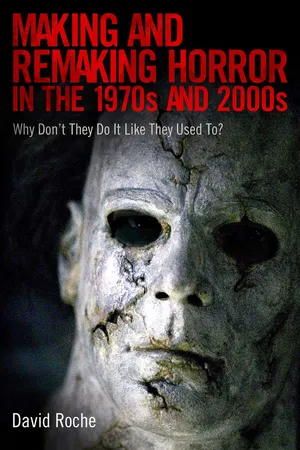
In Making and Remaking Horror in the 1970s and 2000s author David Roche takes up the assumption shared by many fans and scholars that original horror movies are more "disturbing, " and thus better than the remakes. He assesses the qualities of movies, old and recast, according to criteria that include subtext, originality, and cohesion. With a methodology that combines a formalist and cultural studies approach, Roche sifts aspects of the American horror movie that have been widely addressed (class, the patriarchal family, gender, and the opposition between terror and horror) and those that have been somewhat neglected (race, the Gothic, style, and verisimilitude). Containing seventy-eight black-and-white illustrations, the book is grounded in a close comparative analysis of the politics and aesthetics of four of the most significant independent American horror movies of the 1970s— The Texas Chain Saw Massacre, The Hills Have Eyes, Dawn of the Dead, and Halloween —and their twenty-first-century remakes. To what extent can the politics of these films be described as "disturbing" insomuch as they promote subversive subtexts that undermine essentialist perspectives? Do the politics of the film lie on the surface or are they wedded to the film's aesthetics? Early in the book, Roche explores historical contexts, aspects of identity (race, ethnicity, and class), and the structuring role played by the motif of the American nuclear family. He then asks to what extent these films disrupt genre expectations and attempt to provoke emotions of dread, terror, and horror through their representations of the monstrous and the formal strategies employed? In this inquiry, he examines definitions of the genre and its metafictional nature. Roche ends with a meditation on the extent to which the technical limitations of the horror films of the 1970s actually contribute to this "disturbing" quality. Moving far beyond the genre itself, Making and Remaking Horror studies the redux as a form of adaptation and enables a more complete discussion of the evolution of horror in contemporary American cinema.
eBook - ePub
Making and Remaking Horror in the 1970s and 2000s
Why Don't They Do It Like They Used To?
- 344 pages
- English
- ePUB (mobile friendly)
- Available on iOS & Android
eBook - ePub
Making and Remaking Horror in the 1970s and 2000s
Why Don't They Do It Like They Used To?
About this book
Chapter 1
TEXT, SUBTEXT, AND CONTEXT
In “The American Nightmare” (1979), Robin Wood declared that the horror movie became “in the 70s the most important of all American genres and perhaps the most progressive, even in its overt nihilism—in a period of extreme cultural crisis and disintegration, which alone offers the possibility of radical change and rebuilding” (76). In the wake of Wood’s famous article, most studies of American horror movies of the 1970s have underlined connections between the violence and horror depicted in the films and the historical and cultural context. The civil rights and women’s movement, Vietnam and antiwar demonstrations, Watergate, and the oil and economic crises are regularly mentioned as events that influenced the films (Waller, American 12). In order to analyze the subtext, critics have mainly relied on the films’ images and motifs, as well as on statements made by the filmmakers themselves. Matt Becker has stated that the casts and crews of Night of the Living Dead (1968), The Last House on the Left (1972), and The Texas Chain Saw Massacre (1974) more or less explicitly described themselves as hippies (44), and that the political ambivalence of a film like Night of the Living Dead, with its biting critique of American society and utterly hopeless ending, could be linked to “growing attitudes among the hippies during the late 1960s and early 1970s of both political powerlessness … and political disengagement” (43).
This chapter explores the extent to which context is embedded in the films and productive of what we usually call a subtext, i.e., an implicit meaning or theme, in the independent horror movies of the 1970s and the remakes of the 2000s, with two main questions in mind. First, do the remakes also reflect or tap into context-related anxieties and, if so, are they in any way similar to those critics have identified in the films of the 1970s? The second line of investigation is, to my mind, more important in assessing the “disturbing” quality of the films. That is, to what degree is context a matter of text or subtext? In other words, is it embedded in the film’s structure or is it merely decorative? I will attempt to gauge not so much whether “the signs of cohesion” are “concealed” (Jullier 189–90), as whether they are grounded in the narrative structure. The chronological analysis of the films that follows serves as an introduction to the study of the politics of these films that will be pursued in the next three chapters and that will be considered largely in terms of this relationship between text, subtext, and context.
Context in the 1970s
While, according to Rick Worland, the word “massacre” had, in the American mind, “become inseparably linked with the My Lai Massacre in Vietnam” by the early 1970s (211), The Texas Chain Saw Massacre (1974) has mainly been read as intensely reflecting the economic context. Early in the film, Franklin and Hitchhiker discuss the relationship between technological progress and unemployment. Franklin believes technology has made it possible to kill livestock almost painlessly, while Hitchhiker argues that “the old way” was better: “With the new way, people put out of jobs” [12:00]. These people include his brother Leatherface and himself. Later, in one of the film’s most amusing scenes, Old Man, who has just stuffed Sally into his pickup, goes back to the gas station to turn off the lights; when he climbs back into the cab, he tells Sally, “Had to lock up and get the lights. Cost of electricity is enough to drive a man out of business” [63:20]. Clearly, the economic context determines, to some extent, the characters’ situations and behaviors.
Jean-Baptiste Thoret has shown how the motif of energy, metonymically represented by the generator and the chainsaw, links the excess of violence to the lack of fuel (Expérience 19, 63–64). Chuck Jackson (2008) has focused on the way “the material presence of a national energy crisis haunts” Texas (1974), offering an astute analysis of the scene where Franklin, urinating on the side of the road, gets knocked over by the wind from a passing truck [5:35].
The toppling of Franklin, the homely, broken fluid-machine whose flow gets disrupted, links the disabled, Texas body to global conditions signified by both the unsettling news and by the force of the enormous truck, which will continue its destruction as it heads into new territories that are replete with their own “Franklins,” waiting to be pushed out of the way.…
The film thus shows us, from its very beginning, how, for large corporations, humans matter only once their bodies are reconfigured as slick machines, and that when these machines fail to produce or function in standardized ways, they, like the black smoke that leaves the eighteen-wheeler’s exhaust pipe, become industrial waste.
This scene, which evokes a ruthless economic situation that threatens consumer bodies, has its inverted double at the end of the movie [80:05]. In the later scene, the truck, as synecdoche of the economy, can no longer ignore the bodies (Sally and Hitchhiker) in the middle of the road; this second truck attempts to avoid running over Hitchhiker, while the first just drove on, oblivious to the effect it had on Franklin. If the grainy cinematography makes it impossible to read the license plate, the initials of three states (CAL, TEX, and NM) are written on the driver’s door [80:35]; presumably, the truck fulfills the economic function of linking these southwestern states. That the trailer is meant to transport livestock recalls the Family’s former trade, the fact that it is empty reflecting their current state of affairs. This second truck, then, reflects the Family’s economic situation and how it is connected to the nation’s. Its forced stop symbolizes the momentary disruption in the “normal” economy caused by Hitchhiker and Leatherface’s “monstrous” behavior that the subtext suggests is at least partly a consequence of their economic situation; moments before, they had attempted to kill Sally with a blow to the head as they would with cattle [70:40]. Leatherface even pauses to take his rage out on the driver’s door with his chainsaw, making childish gashes, in the same shot that enables us to see the initials of the three states.
If the unhealthy, dehumanizing economy is to blame, it thus makes sense that only a halt in the economy, symbolizing an acknowledgment of the situation, can bring attention to the effects it has on human beings, including the Family’s perversions. Apparently, the Family has degenerated because the economy has passed them by, a situation which also ensures they will not be found out. The economic context is thus deeply embedded in the narrative economy, more specifically the plot and narrative structure. Hence, the teenagers visit the house and decide to go swimming because the gas station is out of gas and they are stuck there [20:05]; Kirk and Pam are drawn to the Family’s house by the sound of a generator which has led them to believe they might purchase some gasoline from its inhabitants [31:50]; Leatherface is at home when the teenagers come knocking because he is unemployed. On the level of the soundtrack, Jackson has noted that “the loud rattle and hum of the generator matches with the buzz and splutter of the chainsaw,” foreshadowing its later rage. Whether intentional or not,1 the context is very much present in the text, thus explaining the political subtext identified by Wood and taken up by later critics. For Wood, “the psychotic family” are “representatives of an exploited and degraded proletariat” (82), “victims … of capitalism” (83), who “only carr[y] to its logical conclusion the basic, though unstated, tenet of capitalism, that people have the right to live off other people” (84). Thus, the Family’s degeneracy is immanent2 to capitalist society, and the microeconomy it has created represents a perversion of the larger economy; there is no reason to leave the house as “the slaughterhouse has invaded the home” (Wood 82) and human livestock keeps on turning up on their doorstep. The repetitions in the narrative—most notably Sally’s visiting the house [55:10, 66:45] and jumping out its windows twice [56:10, 79:00]—underline that all paths lead back to the Family’s house. Like an eddy, the Family’s perverse economy is circular and remains on the side of the main flow of the American economy it feeds on.3 This connection signifies, and thereby constitutes an acknowledgment of, the perverse return of the local economy simultaneously repressed and produced by the main economy.
Tony Williams has compared the hill-dwellers in The Hills Have Eyes (1977) to the Viet Cong because of their use of captured enemy equipment like binoculars and walkie-talkies (Hearths 146), and Craven has retrospectively attributed his own realistic approach to violence in his first films to the influence of Vietnam War documentaries (Robb 24). One major narrative twist, the car accident, occurs when Big Bob loses control because he is frightened by the roar of fighter jets after yelling that they are “not on a bomb range” [9:30], another element that could recall Vietnam.
However, as far as context is concerned, it seems to me that Hills (1977) takes its main cue from Texas (1974), tapping into its economics by way of the gas station. Fred, the gas station attendant, represents the hill-dwellers’ only link to the outside world. He tells Jupiter’s daughter, Ruby:
I’m sorry, Ruby, I know you’re starvin’, but I got nothin’ else to trade. I got no more gas, no more cartridges, no more food. And the folks in Corn Creek have cut me off already. There’s even talk of blocking off this whole section and marching the National Guard through. See what they can find. [2:35]
Even in its remote location, Jupiter’s family is clearly suffering from the economic crisis and, presumably, the aridity of their natural and economic environment and their estrangement from Corn Creek have led them to eat anything they can get their hands on, including human beings. The “blocking off” of the area suggests a denial of the fact that their existence and conditions depend on the outside world, which the idea that the National Guard might come looking for something nevertheless contradicts, especially since the hill-dwellers reside on Nellis Air Force Range and Nuclear Testing Site [9:15]. The hill-dwellers’ perverse economy, which resembles that of the Family in Texas (1974), also requires the connection with the main economic flow it feeds on, otherwise the eddy will eventually stop moving. The narrative is thus partly determined by Fred’s threat to abandon the hill-dwellers [2:00], which he makes right before describing their current situation, and Jupiter’s patricide is a premeditated act of vengeance that severs his connection with the outside world [3:25, 30:40]. With Fred out of the way, Hills (1977) can, as we shall see in Chapter 3, organize itself around the various binary oppositions between the two families it sets up only to deconstruct.
No critical attention has been given to the relationship between Halloween (1978) and its historical context. True, nothing indicates civil, economic, or political strife; on the contrary, Haddonfield seems to represent an idealized picture of small-town America, with Laurie surrounded by “explicit 1950s cultural references” (Worland 239). And yet an important element is announced at the very beginning of the film: Judith Myers is murdered in 1963 [1:15], three weeks before John F. Kennedy. The year 1963 provides an indication of Judith’s age (fifteen or sixteen) at the time of her death, but it does not provide a clear indication of Laurie Strode’s. At best, one could imagine that Laurie and her friends were born the same year Michael’s crime was committed, even though nothing explicitly tells us they are fifteen. In the documentary The American Nightmare,4 Carpenter evokes the trauma of watching the Kennedy assassination live on TV. Carpenter (born in January 1948) was also fifteen at the time. Fifteen is also the number of years that have gone by between Judith’s murder and Michael’s subsequent crimes. It could, then, be argued that the date establishes a parallel between Michael’s crime and the Kennedy assassination, connecting the micro- and the macrocosm, the community, the family, and the nation, as in Wood’s analysis of the horror genre (114). Both crimes are traumatic and announce a period of darkness: a series of assassinations in the 1960s, a series of murders on Halloween night, 1978. The date thereby contributes to constituting Haddonfield as a synecdoche of the U.S. If the degenerates of Texas (1974) and Hills (1977) remain in remote areas, Michael Myers’s return to his hometown is a literal return of the repressed which indicates that his perverse condition is immanent to the suburban middle-class community and, metonymically, to the U.S. It seems that the time-setting of Halloween (1978) identifies 1963 as the year the U.S. lost its innocence while watching a traumatic event on TV. The opening scene, which enables the spectator to watch the original murder (only this time through the killer’s eyes), is framed by the voices of innocents: anonymous children chanting a Halloween nursery rhyme which fades out before the scene starts [1:15], and Judith singing to herself before she is murdered [3:40]. This aural frame, which links childhood and adolescence, foreshadows the last line of the movie, when Laurie both acknowledges the existence of evil and returns to a state of innocence, wondering, as Tommy had, if The Shape isn’t the bogeyman [84:10]. Thus, contextual events are not woven into the narrative, as they are in Texas (1974) and Hills (1977), which may explain why the date has gone unnoticed, but the time-setting does provide a structural frame and suggest a political subtext, however vague.
Romero’s living dead films have often been analyzed as critiques of various aspects of American culture. Although Romero himself said the cast and crew were not concerned with the allegorical dimension of the film (27), Night of the Living Dead (1968) has been read in the light of the Vietnam war (Higashi 1990; Williams, Knight 30; Humphries, “Zombie” 84) and the civil rights movement, mainly because of the character of Ben, “a black man who has reached the lower middle-class ladder of economic success made possible after the gains of the 1960s” (Williams, Knight 26) and who is shot down at the end of the movie by a white militia. Wood, and Williams after him, have analyzed Day of the Dead (1985) as a critique of Reaganite politics and a parody of 1980s action movies (Wood 117; Williams, Knight 130, 132, 139). Dawn of the Dead (1978) also plays on imagery of civil unrest and evokes the oil crisis. The second scene in the housing project is “reminiscent of a 1960s urban riot” (Waller, “Land” 299), while “lack of fuel dogs the protagonists’ existence throughout the film, as it did America’s at the time” (Paffenroth 48); energy, however, is no longer a problem in the mall which may be powered by a nuclear plant [28:50]. Though Williams has stated that the film is “inextricably linked to Vietnam’s effect on American culture,” he has not identified such associations in Dawn (1978) the way he has in his discussion of The Crazies (Romero, 1973) (Hearths 143, 149). Generally speaking, if imagery can recall specific events, relations to context could probably not have been as specific as in Texas (1974) and Hills (1977), if only because, as a sequel, Dawn (1978) builds on the fantasy initiated by Night of the Living Dead (1968).
Most studies of the second installment have focused on its critique of consumer society. For Wood, the living dead “represent, on the metaphorical level, the whole dead weight of patriarchal consumer capitalism” (105). Of course, consumer capitalism is not specific to the 1970s—Williams has even seen connections with Zola’s Au Bonheur des Dames (Knight 86)—but “giant shopping malls were new in 1978” (Paffenroth 49), which explains why Stephen wonders “what the hell” it is when he first sees it [27:15].5 The premise of Dawn (1978)—four survivors hole up in a mall—is, then, enabled by the setting, which “may be regarded as … the epitome of corporate capitalism” (Harper 2002), and thus by the context.6 Like Kirk and Pam in Texas (1974), the characters are drawn to the availability of certain products and, more generally, to the sense of stability provided by the mall’s microeconomy. In contrast to the first scenes depicting chaos, the rest of the narrative is centered on establishing and maintaining order in the mall. Kyle William Bishop has pointed out that malls had a social and commercial function in the 1970s and 1980s (240). Because of the rise of the living dead, the mall is now cut off from these functions, so that the social and economic network it represents for the characters has, as in Texas (1974) and Hills (1977), been perverted, in...
Table of contents
- Cover Page
- Title Page
- Copyright Page
- Contents
- Acknowledgments
- Introduction
- Chapter 1 Text, Subtext, and Context
- Chapter 2 (Dis)Connecting Race, Ethnicity, and Class
- Chapter 3 The (Dys)Functional American Nuclear Family
- Chapter 4 Gender and Sexual Troubles
- Chapter 5 (Re)Situating and (Re)Playing the Genre
- Chapter 6 Monsters and Masks (Horror and Terror, Part 1)
- Chapter 7 Strategies and Style (Horror and Terror, Part 2)
- Chapter 8 Constraints and Verisimilitude: A Tentative Conclusion
- Notes
- Works Cited
- Index
Trusted by 375,005 students
Access to over 1.5 million titles for a fair monthly price.
Study more efficiently using our study tools.
Information
Publisher
University Press of MississippiYear
2014Print ISBN
9781496802545
9781617039621
Subtopic
Film & VideoeBook ISBN
9781626742468
Frequently asked questions
Yes, you can cancel anytime from the Subscription tab in your account settings on the Perlego website. Your subscription will stay active until the end of your current billing period. Learn how to cancel your subscription
No, books cannot be downloaded as external files, such as PDFs, for use outside of Perlego. However, you can download books within the Perlego app for offline reading on mobile or tablet. Learn how to download books offline
Perlego offers two plans: Essential and Complete
- Essential is ideal for learners and professionals who enjoy exploring a wide range of subjects. Access the Essential Library with 800,000+ trusted titles and best-sellers across business, personal growth, and the humanities. Includes unlimited reading time and Standard Read Aloud voice.
- Complete: Perfect for advanced learners and researchers needing full, unrestricted access. Unlock 1.5M+ books across hundreds of subjects, including academic and specialized titles. The Complete Plan also includes advanced features like Premium Read Aloud and Research Assistant.
We are an online textbook subscription service, where you can get access to an entire online library for less than the price of a single book per month. With over 1.5 million books across 990+ topics, we’ve got you covered! Learn about our mission
Look out for the read-aloud symbol on your next book to see if you can listen to it. The read-aloud tool reads text aloud for you, highlighting the text as it is being read. You can pause it, speed it up and slow it down. Learn more about Read Aloud
Yes! You can use the Perlego app on both iOS and Android devices to read anytime, anywhere — even offline. Perfect for commutes or when you’re on the go.
Please note we cannot support devices running on iOS 13 and Android 7 or earlier. Learn more about using the app
Please note we cannot support devices running on iOS 13 and Android 7 or earlier. Learn more about using the app
Yes, you can access Making and Remaking Horror in the 1970s and 2000s by David Roche in PDF and/or ePUB format, as well as other popular books in Media & Performing Arts & Film & Video. We have over 1.5 million books available in our catalogue for you to explore.