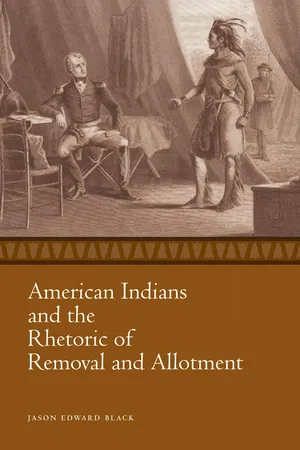
Jason Edward Black examines the ways the US government's rhetoric and American Indian responses contributed to the policies of Native–US relations throughout the nineteenth century's removal and allotment eras. Black shows how these discourses together constructed the perception of the US government and of American Indian communities. Such interactions—though certainly not equal—illustrated the hybrid nature of Native–US rhetoric in the nineteenth century. Both governmental, colonizing discourse and indigenous, decolonizing discourse shaped arguments, constructions of identity, and rhetoric in the colonial relationship.
American Indians and the Rhetoric of Removal and Allotment demonstrates how American Indians decolonized dominant rhetoric through impeding removal and allotment policies. By turning around the US government's narrative and inventing their own tactics, American Indian communities helped restyle their own identities as well as the government's. During the first third of the twentieth century, American Indians lobbied for the successful passage of the Indian Citizenship Act of 1924 and the Indian New Deal of 1934, changing the relationship once again.
In the end, Native communities were granted increased rhetorical power through decolonization, though the US government retained an undeniable colonial influence through its territorial management of Natives. The Indian Citizenship Act and the Indian New Deal—as the conclusion of this book indicates—are emblematic of the prevalence of the duality of US citizenship that fused American Indians to the nation yet segregated them on reservations. This duality of inclusion and exclusion grew incrementally and persists now, as a lasting effect of nineteenth-century Native–US rhetorical relations.
- 228 pages
- English
- ePUB (mobile friendly)
- Available on iOS & Android
eBook - ePub
American Indians and the Rhetoric of Removal and Allotment
About this book
Information
Topic
StoriaSubtopic
Storia nordamericanaCHAPTER ONE
The Ties That Colonize: Rhetoric from Nationhood to Removal
THE COLONIAL RHETORICAL RELATIONSHIP BETWEEN THE US GOVERNment and American Indian nations did not begin in the 1830s with the Indian Removal Act. The relationship started even before the formation of the American republic, well back into the first Western-recorded contact between Natives and early European settlers. Of course, as Jill Lepore explains, the confluence of European cultures and Native populations in the New World later “would form the basis of American nationalism as it emerged in the late eighteenth and early nineteenth centuries.”1 Ostensibly, then, early interactions between European and Native cultures marked the genesis of Native-US relations. Though European-Native cultures and discourses first mingled with the arrival of the Scandinavians, Portuguese, Spanish, Dutch, and French, the story of US removal is really entrenched in the British period of contact. Specifically, the period between British settlement of North America and the Jacksonian era of the 1830s is a rich space to access as a fertile context for the removal policy and the interactive discourses extant during removal. Before delving into removal rhetoric, early characteristics of the Native-US relationship ought to be outlined, albeit briefly, before engaging in a textual analysis of the relationship itself.
The ascendance of the British Empire in the seventeenth century marked the continuation of a relationship with Native communities based on the juxtaposition of civilized and savage identities, as well as economic modalities. Differences over views of land—for the British government, it was a site of production and commodification; for Natives, it was a space of spirituality and inheritance—led to conflict among the groups. Great Britain’s colonial assailment over Natives prompted the elevation of European American identities as superior to weakened Native character. Ultimately, colonizing aggressiveness became a form of tutelage, wherein the British government involved itself in guiding Native nations through conversions to Christianity, adaptations to agriculture, and dependence on trade. This latter policy arose when the British began their “benevolent policy era” following the French and Indian War.
In the wake of the settlement of Jamestown (1607) and Plymouth (1620), British colonists and Native peoples continued engaging in an assortment of relationships regarding land exchange. Natives soon realized that the colonists were remaining on the land for good, but also expanding throughout it. Captain John Smith, for instance, reminded both his fellow Jamestown colonists and a group of the Powhatan Nation in 1620 that “by reducing [Indian land], God [would] be served, His Majesties Empire enlarged by the addition of . . . large Territories . . . and the Planters themselves enriched by the trafficke and commerce.”2 The early British colonists planned to broaden their territories to the detriment of Native holdings.
Native communities typically viewed their relationships with the British as unhealthy, especially when the colonists insisted on “treating the Indians despicably” in trade and land exchanges.3 The more Natives extended their hands to the colonists, the more the British trespassed on their lands. As tribesperson Wahunsonacock (Powhatan) explained to Smith in 1622, “Yes, Captain Smith, some doubt I have of your coming hither, [which] makes me not so kindly seeke to relieve you as I would: for many inform me your coming is not for trade, but to invade my people and posesse my Country.”4 Moreover, as Natives opened the door to the material exchange of goods, British colonists sought to trade language, Christianity, and European culture such as dress, virtues, and economic systems at a feverish pace.5
As the British colonials became more involved in Native cultures and the process of land exchange, aggression between British and Native groups increased. In a sense, then, the pattern of “hostility and open war” arose as a “dominant part of English-Native relations until almost the end of the nineteenth century.”6 One of the first foundational moments of aggression between British colonists and indigenous nations stemmed from white attempts to colonize Native nations. In 1675, a group of the Wampanoag Nation under the leadership of King Philip, or Metacom, rose up against the tide of encroachment in New York, Connecticut, and Massachusetts. The ensuing attacks from the British and further response from the Wampanoags garnered the title “King Philip’s War.”7 Metacom eventually lost the war and was beheaded. Colonial leader Increase Mather remarked that “the memorable day” of the chief’s death was “a monument of revenging Justice” that witnessed the chief’s limbs “hewn in pieces before the Lord.”8 Seemingly, this violence was committed under providential watch. The war led to European acquisition of land and the re-entrenchment of British-Native identities. The war confirmed the instability of the American frontier, and set into motion an endless repeatability in which the British government advanced its influence over Natives and their land as it tramped westward.
These actions, and the rhetoric that justified the intrusions, arose from and perpetuated the identity changes facing the British colonists. They directed most of their attention toward their errand into the wilderness—the settling of the West as made manifest by providence. Part of this wilderness involved the inferior identities of Natives. Ward Churchill describes the situation as “resulting [in] rhetoric of dehumanization directed at indigenous peoples, juxtaposed as it was to a contemporaneous rhetoric of ‘civilization’ by which Europeans were indoctrinated to view themselves as the world’s inherently superior race.”9 This became the key rallying discourse of the colonists. It remained easier for the British settlers to view themselves as civilized when, comparatively, they considered Indians, as colonist Cotton Mather labeled them, “wild, cruel, barbarous, bruitish [sic], diabolicall creatures . . . the worst of the heathen.”10
The bond between territory and inclusion was vital during the British colonial period. And this association was rooted in the errand. The one universal requirement for inclusion as active members of colonial life was some sort of a landed property qualification for citizenship. British jurist William Blackstone, for instance, argued that colonists without property lacked the resolve to civilize the wilderness. They had neither the motivation to protect the Crown nor the connection to the land that stimulated virtuous citizenship. He wrote in 1765 that “the true reason of requiring any qualification, with regard to property” for citizenship within the British Empire, was “to exclude such persons as [were] in so mean a situation as to be esteemed to have no will of their own.”11 Blackstone’s directives additionally rejected those so-called racial inferiors who occupied but did not own land.
Ironically, disastrous events like King Philip’s War allowed Native communities to construct and reconstruct their identities and to understand better those of the British. This was an early form of decolonization whereby the motives of the British colonizers were laid bare by the marginalized Native groups.12 That resistance still exists today is telling for the presence of Native back talk, even if it did not mete out material successes. At any rate, these indigenous nations realized quickly that the British could not always be trusted. Before his beheading, Metacom reminded his community of the dangers associated with the British: “You now see the foe before you, that they have grown insolent and bold; that all our ancient customs are disregarded. . . . These people from the unknown world will cut down our groves, spoil our hunting and planting grounds, and drive us and our children from the graves of our fathers.”13 Here, Wampanoag identity was centered on ancestral connections to the land; that customs would be overlooked and grounds spoiled affronted Metacom. His warning also foreshadowed the dangerous land wrangling that would soon follow.
The next pivotal moment that helped shape the British-Native landscape involved the peace treaty accorded Britain in the wake of the French-Indian War of 1756–1763. The campaigns therein witnessed the British and their American colonists battling the French and their Native supporters on the frontiers of North America. The battle lines were drawn between the British (and the colonists hoping to secure French and Native lands) and the French (along with Natives who desired the expulsion of the British).14 The British and French empires had been battling militarily and politically for a number of years. Native-colonist tensions in North America figured in as yet another venue through which to grapple over the New World.
When the French lost the war, the Peace of Paris established the boundaries of new British areas in North America, settled former Native lands, and demarcated the boundaries of “Indian country.” In his famous Proclamation of 1763, King George III reserved the right to extinguish all Indian title. That is, the British would control the land upon which Natives lived. He announced to the American colonists, “We issue this Royal Proclamation . . . to erect within the countries and islands ceded and confirmed to us by said treaty distinct governments in the Indian territories.”15 French and Spanish officials, Christian missionaries, and others tied to Natives were to remove immediately following the establishment of new British territories.
The Proclamation of 1763 set into motion a newly tweaked phase of Native-British relations: the benevolent policy era. In exchange for possessing Native lands, Britain promised to protect Natives as wards. King George III noted, “The Indians with whom we are connected, and who live under our protection, should not be molested or disturbed in the possession of such parts or our dominions and territories.”16 Notice the construction of Natives as subordinates in need of protection. Of course, as protector, the Crown made no qualms about “declaring it to be our royal will and pleasure” to seize these indigenous territories.17
American colonial identities, which were predicated on territorial expansion and agricultural use of the land, did not go unnoticed by American Indians. To the charge that Natives were “brutes” who “passed away their time”18 and squandered fertile lands, Native people like Canassateego (Onondaga) argued that American Indians did understand land value: “We know our lands are now become more valuable. The white people think we do not know their value; but we are sensible that the land is everlasting, and the few goods we receive for it are soon worn out and gone.”19 He intimated that ancestral land was eternal, even though what the British considered of value (i.e., timber, soil, and minerals) might have been short-lived. Here, Native conceptions of land as sacred and everlasting borrowed from and disputed the common European view of land as commodity.
American Indian rebellions also challenged the governing role bequeathed to the colonists by the Proclamation of 1763. Chief Pontiac (Ottawa), for instance, confronted British forts along the Upper Mississippi Valley. He traveled from the Upper Midwest down to Creek territory (mostly in what is now Alabama) enlisting support for his coup. In a rallying call to a council at River Ecores on April 27, 1763, Pontiac exhorted a pan-Indian gathering to contest British encroachment: “My children, you have forgotten the customs and traditions of your forefathers. Why do you not clothe yourselves in skins, as they did, and use the bows and arrows, and the stone-pointed lances, which they used?”20 In this oration, Pontiac resituated Native identities within the frames of ancestry and tradition. He continued, “You have bought guns, knives, kettles and blankets, from the white men, until you can no longer do without them . . . Fling all these things away; live as your wise forefathers lived before you.”21 He agonized that the accoutrements of colonialism had diminished the heritage of the gathered nations’ ancestors. The chief’s centering of customs and land within the purview of Native ancestry occluded European influence.
Pontiac was not alone in his agitation, as American Indians often met to discuss territorial grievances against the Crown. These meetings among Native nations, and also between Natives and British colonials, continued into the Revolutionary era. In such a gathering, in 1774, Mihnehwehna (Ojibway) railed against colonists to a group of kindred Native nations and some representatives of the Crown: “Although you have conquered the French you have not conquered us! We are not your slaves. These lakes and woods and mountains were left to us by our ancestors. They are our inheritance and we will part with them to none.”22 Like Pontiac, Mihnehwehna hearkened to the gathered nations’ moral inheritance of their ancestral identity. Land, so vital to American Indians, was sacred in part because it was bestowed by ancestors. That the British predicated their identity on their ownership and production of the lands fell on deaf ears.
The confluence of US and American Indian discourses continued, following the American Revolution, within the parameters of economics and territoriality. Picking up Britain’s lead, the US government instituted a treaty system predicated on protectionism. The government promised security to American Indians in exchange for safe passage through Indian territory and the surrender of Native lands. This was a colonizing strong-arming on the part of the US government, which led to clashes over understandings of land. As a result, the United States and Native nations negotiated the meanings of their identities through treaty meetings and councils. The US government worked from an identity of superiority, modeled after the British, while simultaneously constituting Native identities as ward-like and dependent. American Indians, however, challenged these identity constructions by asserting their sovereignty.
The treaty era arguably peaked during a 1778 exchange between the Continental Congress and the Delaware Nation. It seems, according to Francis Paul Prucha, that the government graciously inherited Britain’s control over American Indian nations through “the use of treaties, carried over from Brit...
Table of contents
- Cover
- Half title
- Title
- Copyright
- Dedication
- Contents
- Acknowledgments
- Introduction: Colonization and Decolonization in the Native-US Relationship
- 1. The Ties That Colonize: Rhetoric from Nationhood to Removal
- 2. Governmental Colonizing Rhetoric During Indian Removal
- 3. Native Decolonial Resistance to Removal
- 4. Colonization and the Solidification of Identities in the General Allotment Act
- 5. Pan-Indianism and Decolonial Challenges to Allotment
- Conclusion: Identity Duality and the Legacies of Colonizing and Decolonizing Rhetoric
- Notes
- Bibliography
- Index
Trusted by 375,005 students
Access to over 1.5 million titles for a fair monthly price.
Study more efficiently using our study tools.
Frequently asked questions
Yes, you can cancel anytime from the Subscription tab in your account settings on the Perlego website. Your subscription will stay active until the end of your current billing period. Learn how to cancel your subscription
No, books cannot be downloaded as external files, such as PDFs, for use outside of Perlego. However, you can download books within the Perlego app for offline reading on mobile or tablet. Learn how to download books offline
Perlego offers two plans: Essential and Complete
- Essential is ideal for learners and professionals who enjoy exploring a wide range of subjects. Access the Essential Library with 800,000+ trusted titles and best-sellers across business, personal growth, and the humanities. Includes unlimited reading time and Standard Read Aloud voice.
- Complete: Perfect for advanced learners and researchers needing full, unrestricted access. Unlock 1.5M+ books across hundreds of subjects, including academic and specialized titles. The Complete Plan also includes advanced features like Premium Read Aloud and Research Assistant.
We are an online textbook subscription service, where you can get access to an entire online library for less than the price of a single book per month. With over 1.5 million books across 990+ topics, we’ve got you covered! Learn about our mission
Look out for the read-aloud symbol on your next book to see if you can listen to it. The read-aloud tool reads text aloud for you, highlighting the text as it is being read. You can pause it, speed it up and slow it down. Learn more about Read Aloud
Yes! You can use the Perlego app on both iOS and Android devices to read anytime, anywhere — even offline. Perfect for commutes or when you’re on the go.
Please note we cannot support devices running on iOS 13 and Android 7 or earlier. Learn more about using the app
Please note we cannot support devices running on iOS 13 and Android 7 or earlier. Learn more about using the app
Yes, you can access American Indians and the Rhetoric of Removal and Allotment by Jason Edward Black in PDF and/or ePUB format, as well as other popular books in Storia & Storia nordamericana. We have over 1.5 million books available in our catalogue for you to explore.