Winner of the 2017 Diamond Anniversary Book Award and the African American Communication and Culture Division's 2017 Outstanding Book Award, both from the National Communication Association
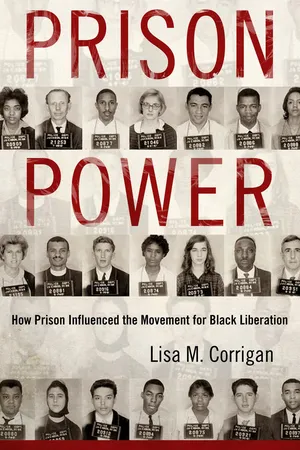
In the Black liberation movement, imprisonment emerged as a key rhetorical, theoretical, and media resource. Imprisoned activists developed tactics and ideology to counter white supremacy. Lisa M. Corrigan underscores how imprisonment—a site for both political and personal transformation—shaped movement leaders by influencing their political analysis and organizational strategies. Prison became the critical space for the transformation from civil rights to Black Power, especially as southern civil rights activists faced setbacks.
Black Power activists produced autobiographical writings, essays, and letters about and from prison beginning with the early sit-in movement. Examining the iconic prison autobiographies of H. Rap Brown, Mumia Abu-Jamal, and Assata Shakur, Corrigan conducts rhetorical analyses of these extremely popular though understudied accounts of the Black Power movement. She introduces the notion of the "Black Power vernacular" as a term for the prison memoirists' rhetorical innovations, to explain how the movement adapted to an increasingly hostile environment in both the Johnson and Nixon administrations.
Through prison writings, these activists deployed narrative features supporting certain tenets of Black Power, pride in Blackness, disavowal of nonviolence, identification with the Third World, and identity strategies focused on Black masculinity. Corrigan fills gaps between Black Power historiography and prison studies by scrutinizing the rhetorical forms and strategies of the Black Power ideology that arose from prison politics. These discourses demonstrate how Black Power activism shifted its tactics to regenerate, even after the FBI sought to disrupt, discredit, and destroy the movement.
- 208 pages
- English
- ePUB (mobile friendly)
- Available on iOS & Android
eBook - ePub
About this book
Information
Topic
Sciences socialesSubtopic
Droits civiques en politiqueCHAPTER ONE
Prison Power
Speaking and Writing Black Resistance
An FBI memorandum dated June 20, 1966, describes Student Nonviolent Coordinating Committee (SNCC) chairman Stokely Carmichael’s interview on the CBS program Face the Nation as he clarified his position on “Black Power” after the March Against Fear. The memo describes questions directed toward Carmichael about the relationship between Black Power and violence:
When pressed as to how the Negroes should obtain control, Carmichael at first stated it should be by organizing politically and registering to vote. However, in response to an inquiry as to whether he would use violence in obtaining this power, he indicated that if the Negroes were prevented from obtaining this control legally, they would have to obtain it in other ways. When pressed further, he stated that if all legal means were exhausted, then violence would be justified.1
Carmichael’s description of Black Power here and elsewhere harnessed Martin Luther King Jr.’s proclamations of civil disobedience justifying the “jail, no bail” strategy earlier in the decade alongside Malcolm X’s maxim “by any means necessary,” forming a bridge between these two articulations of black resistance. But it was clear from the questions in this interview that the white media was interested in framing Carmichael’s cry for “Black Power” as the start of a race war initiated by blacks against whites.
As his Black Power stance garnered more attention, the FBI initiated a comprehensive review of his arrest record to demonstrate that Carmichael was dangerous. An FBI memo dated July 13, 1966, lists Carmichael’s arrests in Jackson, Mississippi; Baltimore, Maryland; New York City, New York; Cambridge, Maryland; Bolivar County, Mississippi; Fort Deposit, Alabama; and Greenwood, Mississippi, for offenses ranging from being a participant in the 1961 Freedom Rides to desegregate public transportation, to “being loud and boisterous” in New York, to “distributing handbills without a permit” in Alabama. The memo condemns Carmichael for his public criticism of the FBI and for making “derogatory references to the Bureau over a CBS News Special report on 7/1/64, stating that the FBI never did ‘a damn thing,’ and that the FBI had been most derelict in the field of civil rights.”2
The FBI objected to Carmichael’s characterization of its civil rights record and condemned Carmichael as a racial troublemaker. FBI director J. Edgar Hoover warned of a “black messiah” emerging from civil rights organizations to fully challenge white supremacy, writing in a March 4, 1968, memorandum to his field offices that, “Martin Luther King, Stokely Carmichael and Elijah Muhammad all aspire to this position.”3 Consequently, the arrest records of activists like Carmichael led to the use of the “rabble-rouser” trope by federal officials to demonize Black Power leaders as “outside agitators” stirring up otherwise docile black communities. In popularizing new forms of civil disobedience, black activists promoted disrespect for unjust laws and for legal authority, making it possible for conservatives to paint them as perennial dangers to law and order, leading to mass incarceration as the Black Power movement rose and fell.
This chapter traces rhetorical and political history of imprisonment before and after the birth of Black Power, focusing on major moments of activist imprisonment as well as movement discourses written from prison. In charting the role of prison in the movement, the chapter also discusses the emergence and legitimacy of Black Power as a slogan, as a theoretical device, and as a series of rhetorical strategies designed to be a particularly historical intervention into the stagnating discourses of “civil rights” and “law and order.” I contend that incarceration became a major strategy used by both black activists and white conservatives during the Black Power era; consequently, the period following 1966 marked a new phase of Jim Crow as Black Power became a rallying cry against state repression.
I also argue that the legitimacy of Black Power—as a term of art, as a series of vernacular signs, and as an organizing principle in a new phase of the black liberation movement—hinged upon whether the state or the activists controlled the frame and how closely it became associated with violence. Because the Black Power slogan and ideology were articulated by activists with extensive rap sheets as the state circumscribed their activism, Black Power ideology took up the relationship between state repression and incarceration as a place to excavate new arenas for the black liberation struggle, particularly in the memoirs of movement activists. The repression of political dissent is the violence that spawns resistance; certainly Black Power activists understood this dynamic in a visceral way, since thousands had been imprisoned for working against segregation and for political representation. Particularly within the leadership of SNCC, the conversation changed from voter registration to more radical tactics, as activists grew frustrated with the constant harassment and violence initiated by state agencies.
In detailing the coterminous relationship between black liberation activists and white politicians, it is clear that white proclamations about black deviance have had the effect of forcing black rhetors to dramatize black experience through strategies that necessarily reference such proclamations. Hortense Spillars suggests that black culture “carries both its statement and counterstatement” in its articulation, meaning that black intellectuals are constrained by white political assessments that overdetermine their standpoint through opposition rather than understanding.4 Consequently, I see the writings of imprisoned Black Power activists as a natural extension of earlier “jail, no bail” strategies and as part of a continuous strategy of interrogating white supremacy through prison. But by the time that Black Power emerged as a movement of its own, it served to justify the imprisonment of movement leaders and the eradication of movement organizations, thereby changing the relationship between black freedom and black imprisonment.
Black Power as a Turning Point
Stokely Carmichael’s assertion of “Black Power” in 1966 marked a moment when activists were able to reframe black liberation especially considering the Johnson White House’s loss of political capital due to Vietnam and major legislation stalling after the passages of the Civil Rights Act of 1964 and the Voting Rights Act of 1965. SNCC activists, and later, the Black Panther Party, turned to new rhetorical and political strategies to articulate how state repression and the emergent “law and order culture” were making the nonviolent pursuit of civil rights impossible. Black activists made the case for expanded political participation in an increasingly hostile white America.
The backlash intensified as 1966 ushered new conservatism with California governor Ronald Reagan and as 1968 welcomed President Richard Nixon. The shifting political landscape was marked by the elevation of more explicitly white supremacist politics at the federal and state level under the rubric of “law and order” as well as the repression of black protest. Writing about the prevailing opinions about white northerners marching with black southerners to protest police brutality, imprisonment, and disenfranchisement, Mary Stanton explains that the majority of white Americans by 1965 deemed demonstrators “professional agitators” trying to “gain influence for themselves.”5 So as black liberation activists struggled for new ways to intervene in a political system that formally excluded their participation, whites further marginalized their efforts.
As a symbol and slogan, Black Power was an intentionally confrontational, yet rhetorically ambiguous provocation.6 Young black activists embodied the confrontational posture of the term, alienating some whites and blacks and splintering SNCC as it became increasingly separatist. Still, rhetorician Donald McCormack has suggested that in Black Power’s formative years, “the ambiguity of the slogan was very much a source of vitality,” since new textual antecedents for Black Power expanded the ideological direction of the black liberation movement.7 The strength of Black Power “was based on some essential truths about racism in America, and so it eventually proved to be a powerful tool of persuasion.”8 These truths pointed to the legacies of slavery in modern political life, highlighted violence in black communities by white agents of the state, and protested the lack of basic services in black communities. Through contemporary prison writings and their historical antecedents, the Black Power movement expressed a new vernacular in this phase of black liberation struggle.
The Black Rhetorical Tradition and the Genre of Prison Writing
While the rhetorical shift from civil rights to Black Power found its voice with Stokely Carmichael in 1966, black texts have cited imprisonment as a constant feature of life in America since slavery. H. Bruce Franklin’s landmark text Prison Literature in America: The Victim as Criminal and Artist (1979), inspired by Black Power literary activism from the late 1950s through the 1970s, marked the first extensive scholarly treatment of the genre of prison literature and dozens of studies soon followed. Franklin’s studies were particularly incisive about the early slave narratives, which helped to drive the development of methods that traced prison literature as an “identifiable genre” by defining slavery as a form of institutionalized imprisonment.9 Franklin asserted that “America is itself a prison, and the main lines of American literature can be traced from the plantation to the penitentiary” as black Americans experienced “being legally kidnapped, plundered, raped, beaten, chained, and caged.”10 His study lent academic credibility to statements made by Black Power activists about the unique way that Jim Crow emerged against civil rights activism in the mid-twentieth century.
Black Power intellectuals articulated the relationship between nationbuilding, slavery, and forced labor as they used the rhetorical strategies of the global Third World Left to reframe their analysis of black oppression in the United States. As Franklin points out, the “descendants of these Africans are in many senses the truest Americans, for the Afro-American people were created in the United States, their unpaid labor provided the capital base for the political economy of modern America, and their culture has, for more than a century, been central to American culture in general.”11 Franklin catalogued writings that bolstered Black Power critiques of white supremacy and spoke to the constant surveillance and confinement of black Americans under slavery and in the emergent prison system. His studies also catalogued the way in which black orators have utilized vernacular speech, idioms, and storytelling to build the case for emancipation. Within this context, Black Power’s rhetorical posture is more comprehensible as a logical extension of earlier iterations of imprisonment and resistance. And, as Black Power activists used black history to craft their vernacular messages about the continuity of black oppression in the United States, they pointed to the features of black life that arose from reformation ideas about the value of incarcerated laborers. Black Power activists looked to the entire history of the prison as a rhetorical resource for investigating the power of white supremacy over black America.12
While slavery was not institutionalized as punishment for crime prior to the Civil War, the Thirteenth Amendment legally provided just such a rationale for the perpetuation of this cheap labor. It reads, “Neither slavery nor involuntary servitude, except as a punishment for crime whereof the party shall have been duly convicted, shall exist within the United States, or any place subject to their jurisdiction.” Thus, the amendment actually wrote slavery into the Constitution for those convicted of crimes. This rhetorical and legal change had drastic repercussions for former slaves as southern states, led by Mississippi in 1865, drafted legislation that defined nearly all former slaves as criminals for vague offenses ranging from “mischief” to “insulting gestures” but also for not being in a labor contract, all while the freedmen were not yet extended voting rights. The Black Codes inspired the creation of southern penitentiaries to hold these new black “criminals.” After Reconstruction, the discipline of the southern prison regime extended to every aspect of black life, constraining black bodies and black voices through tremendous bodily violence and torture. “Actual imprisonment, the threat of imprisonment, and day-to-day imprisonment on the tenant farms or in the ghettos,” writes Franklin, “were central to the life of Black people.”13
While the Black Codes did not survive Reconstruction, they created the conditions for the birth of the southern penitentiary, as the Thirteenth Amendment became the rhetorical mechanism to harness black labor in southern prisons. This system of exploitation of former slaves was intrinsically linked to the development of industrial capitalism, but it was also driven by the fee system emerging in the South where sheriffs were only compensated based on the number of prisoners arrested. Thus, “the law” and “lawlessness” converged in the southern disciplinary official who could transgress “the law” at will and with no repercussion, particularly when these indiscretions involved black Americans. This fact was not lost on black freedom activists, who understood the collapse of law into lawlessness as an intrinsic condition of white supremacy.
Prison writings testified to the conditions of the new plantation economy as it emerged in prisons and prevented black people from holding property, moving freely, and economically competing as new prisons structured postbellum white supremacy. Franklin elucidates how whites “devised a pervasive, intricate apparatus of law, custom, and brute force to keep the Blacks in perpetual bondage. Central to this historical redefinition of the role of Black people was an ideological redefinition of them. No longer were they just a sub-human race; now they were to be thought of as a race of criminals.”14 Franklin concludes that this “definition was to become increasingly important throughout American culture, right up through the white code words of the 1960s and 1970s, such as ‘black militants,’ ‘welfare cadillacs,’ ‘violent-prone,’ ‘crime in the streets’ (as opposed to ‘safe streets’), and ‘racial disorders’ (as opposed to ‘law and order’).”15
Certainly, the state’s response to civil disobedience from the 1950s to the 1970s hinged on the rhetorical redefinition of black people as “pathological criminals” and of “protest” as “crime.” These rhetorical moves were honed as Reconstruction failed and the black intelligentsia questioned the retreat from guarantees of black citizenship found in the Reconstruction amendments to the Constitution.
The prison writings of the 1960s highlighted the continuity of imprisonment as a feature of black life in America and created new rhetorical modes of expressing the psychological and physical impairments that slavery and imprisonment created in black communities. The vernacular rhetorical strategies within black prison memoirs from slavery on demonstrate how these texts offered deep meditations on life and death and on the relationship between prison and slavery. Grant Farred explains, “Overburdened by structural lack (historic absence of material resources and access to capital), vernacular speech is politicized as much by its content, though much of that may be superimposed, as by the absences o...
Table of contents
- Cover
- Title Page
- Copyright
- Dedication
- Contents
- Acknowledgments
- Introduction
- Chapter One: Prison Power: Speaking and Writing Black Resistance
- Chapter Two: Producing the Black Badman: The Politics of SNCC in the Era of Rap Brown
- Chapter Three: competing Masculinities: Police Brutality, Prison Brutality, and Black Heroes
- Chapter Four: Recovering Black Identity and History, Feminizing and Regenerating Black Power
- Conclusion
- Notes
- Index
Trusted by 375,005 students
Access to over 1.5 million titles for a fair monthly price.
Study more efficiently using our study tools.
Frequently asked questions
Yes, you can cancel anytime from the Subscription tab in your account settings on the Perlego website. Your subscription will stay active until the end of your current billing period. Learn how to cancel your subscription
No, books cannot be downloaded as external files, such as PDFs, for use outside of Perlego. However, you can download books within the Perlego app for offline reading on mobile or tablet. Learn how to download books offline
Perlego offers two plans: Essential and Complete
- Essential is ideal for learners and professionals who enjoy exploring a wide range of subjects. Access the Essential Library with 800,000+ trusted titles and best-sellers across business, personal growth, and the humanities. Includes unlimited reading time and Standard Read Aloud voice.
- Complete: Perfect for advanced learners and researchers needing full, unrestricted access. Unlock 1.5M+ books across hundreds of subjects, including academic and specialized titles. The Complete Plan also includes advanced features like Premium Read Aloud and Research Assistant.
We are an online textbook subscription service, where you can get access to an entire online library for less than the price of a single book per month. With over 1.5 million books across 990+ topics, we’ve got you covered! Learn about our mission
Look out for the read-aloud symbol on your next book to see if you can listen to it. The read-aloud tool reads text aloud for you, highlighting the text as it is being read. You can pause it, speed it up and slow it down. Learn more about Read Aloud
Yes! You can use the Perlego app on both iOS and Android devices to read anytime, anywhere — even offline. Perfect for commutes or when you’re on the go.
Please note we cannot support devices running on iOS 13 and Android 7 or earlier. Learn more about using the app
Please note we cannot support devices running on iOS 13 and Android 7 or earlier. Learn more about using the app
Yes, you can access Prison Power by Lisa M. Corrigan in PDF and/or ePUB format, as well as other popular books in Sciences sociales & Droits civiques en politique. We have over 1.5 million books available in our catalogue for you to explore.