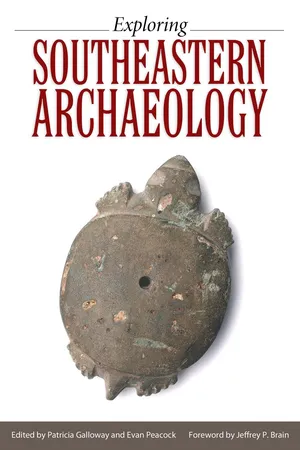
Contributions by Keith A. Baca, Jeffrey P. Brain, Samuel O. Brookes, Ian W. Brown, Philip J. Carr, Jessica Crawford, Patricia Galloway, Alison M. Hadley, Christopher T. Hays, Edward R. Henry, Cliff Jenkins, Jay K. Johnson, Evan Peacock, Janet Rafferty, Maria Schleidt, Mary Evelyn Starr, James B. Stoltman, Andrew M. Triplett, Melissa H. Twaroski, and Richard A. Weinstein This volume includes original scholarship on a wide array of archaeological research across the South. One essay explores the effects of climate on early cultures in Mississippi. Contributors reveal the production and distribution of stone effigy beads, which were centered in southwest Mississippi some 5, 000 years ago, and trace contact between different parts of the prehistoric Southeast as seen in the distribution of clay cooking balls. Researchers explore small, enigmatic sites in the hill country of northern Mississippi now marked by scatters of broken pottery and a large, seemingly isolated "platform" mound in Calhoun County. Pieces describe a mound group in Chickasaw County built by early agriculturalists who subsequently abandoned the area and a similar prehistoric abandonment event in Winston and Choctaw Counties. A large pottery collection from the famous Anna Mounds site in Adams County, excavations at a Chickasaw Indian site in Lee County, camps and works of the Civilian Conservation Corps in the pine hill country of southern Mississippi, and the history of logging in the Mississippi Delta all yield abundant, new understandings of the past. Overview papers include a retrospective on archaeology in the National Forests of north Mississippi, a look at a number of mound sites in the lower Mississippi Delta, and a study of how communities of learning in field archaeology are built, with prominent archaeologist Samuel O. Brookes's achievements as a focal point. History buffs, artifact enthusiasts, students, and professionals all will find something of interest in this book, which opens doors on the prehistory and history of Mississippi.
- 320 pages
- English
- ePUB (mobile friendly)
- Available on iOS & Android
eBook - ePub
Exploring Southeastern Archaeology
About this book
Information
Topic
Ciencias socialesSubtopic
Historia de NorteaméricaCHAPTER 1
Introductory Remarks
Public archaeology is many things: research, outreach, communication, negotiation, resource management, partnerships, stewardship, and service. A career spent working within these challenging arenas is a career that matters. Samuel O. Brookes’s career as a public archaeologist demonstrates why.
Sam received his B.A. in Anthropology at the University of Mississippi (Ole Miss) in 1970, where he twice served as assistant for archaeological field schools, followed by a stint doing salvage excavations related to land leveling for the University of Missouri in the summer of 1971. He obtained his Master of Arts from Ole Miss in 1980 with his thesis “The Peabody Phase: Coles Creek in the Upper Sunflower Region” (Brookes 1980a). In 1972, Sam went to work as an archaeologist for the Mississippi Department of Archives and History, a post he held for 12 years. Over this time, he conducted numerous field investigations ranging from salvage excavation at the Grand Gulf Mound (Brookes 1976a) to excavations at the Late Paleo-Indian/Early Archaic Hester site in Monroe County (Brookes 1978, 1979; Brookes and McGahey 1974) to site surveys in Claiborne, Clay, Lowndes, Monroe, and Wilkinson counties (Brookes and Inmon 1973). One result of such wide-ranging work was that Sam became a “go-to” person for anyone interested in the archaeology of the Magnolia State. Following a brief spell with the US Army Corps of Engineers in Vicksburg, Sam became Forest Archaeologist (later Heritage Program Manager) for the USDA Forest Service, National Forests in Mississippi. In this post he acted as mentor to a cadre of young archaeologists and helped fill many a blank space on the archaeological map of the state.
Festschrifts most often are compiled to honor retiring academicians for their scholarly achievements, for their role as educators, and for their service to the discipline. What is sometimes overlooked in our business is that most archaeology, a great deal of educating, and an incredible amount of service goes on outside the halls of academe. Practitioners of cultural resource management are the front line of the discipline when it comes to preserving the world’s cultural heritage, seeking balance among numerous parties with vastly different agendas, and educating a varied public while at the same time furthering our knowledge of the human condition over time. The best practitioners manage, somehow, to do all these things well.
Sam is just such a practitioner. His scholarly contributions include detailed descriptions of a number of important sites in Mississippi (Brookes 1969, 1974a, 1975a, 1975b, 1976a, 1979, 1980b, 1981; Brookes and Potts 1981; Connaway and Brookes 1983; Toth and Brookes 1977), illustration and description of notable artifacts and discussions of artifact typology (Brookes 1974b, 1974c, 1974d, 1975c, 1976a, 1976b, 1976c, 1985, 2007; Brookes and Connaway 1975; Brookes et al. 1974), and histories of archaeological projects (Brookes 1977, 2000, 2001). His topical research papers range from work on late prehistoric phases in the Mississippi Delta (Brookes 1980c; Brookes and Taylor 1986) to Archaic-period settlement patterns, raw material exchange, artifact production, and social complexity (Brookes 1997, 1999a, 1999b, 2004; Johnson and Brookes 1988, 1989). We are pleased to include another of his original contributions in this volume.
Sam’s service contributions are extraordinary, ranging from duties on behalf of the Mississippi Archaeological Association and the Mississippi Association of Professional Archaeologists (e.g., Briuer and Brookes 1991) to organizing annual meetings for the Mississippi Archaeological Association, the Mid-South Archaeological Conference (Peacock and Brookes 1999), and the Southeastern Archaeological Conference, to being a consultant for museums across the state. His series “Everyman’s Guide to Projectile Points” remains one of the most popular features ever to be run in Mississippi Archaeology (Brookes 1981, 1982a, 1982b, 1983a, 1983b, 1984). A look at how the “Everyman’s Guide” series developed from 1981–1984 demonstrates how he was able to bring avocational readers into the archaeological conversation: what Brookes provided in this popular series was not only the basics like projectile point features and temporal spans—he also showed how he was forming his own thinking and asked avocationals to join in by contacting him with examples and indeed arguments. Those who have attended the presentations he has given to hundreds of groups of all ages and backgrounds over a period of decades will know that this inclusiveness has been a key to his engagement of the public. His Delta mound tours are one of the most important public education events in Mississippi, and he has deservedly been honored by the Mississippi Archaeological Association, the Mississippi Humanities Council, and the USDA Forest Service for his outstanding contributions to heritage concerns in Mississippi and beyond. As for teaching, there are few Midsouth archaeologists who haven’t learned something valuable from Sam over the years, and he continues to share his knowledge with professionals, avocational archaeologists, and the public at large in a way that is, in itself, educational for us all.
The chapters in this volume reflect, directly or indirectly, the positive outcomes that can occur as the result of one individual’s dedication to his calling. Research reported here demonstrates the influence of Sam’s scholarship and the importance of his support for the scholarship of others by facilitating the gathering of data, the evaluation of different methods, and the practicing of archaeology in areas that had been little explored before. Far less visible are the battles that had to be waged to bring those positive outcomes about, battles fought while Sam worked as a professional archaeologist under three different state and federal bureaucracies. As a group, archaeologists are well versed at moving dirt. To shift bureaucracies, one must move mountains. To do so requires patience and persistence, tireless constituency building, and thoughtful value creation. Especially in his role as Heritage Program Manager for the National Forests in Mississippi, Sam made those mountains move, at least a little. Doing so required challenging the status quo, which never has been, is not, and never will be “good enough.” Doing so required courage, patience, and diplomatic skill. It also required a willingness to reach out to many communities that admired but did not directly participate in archaeology—at least not before they met him. Not all the battles were won, of course; they never are. But Sam’s perseverance in “fighting the good fight” won him the respect and admiration of far more of us than he probably even realizes. We hope that this volume serves as at least a small repayment for his ongoing service to the discipline of archaeology and to the many publics to whom we are beholden.
As a researcher, Sam has an intimate familiarity with Mississippi’s prehistoric material record, an accomplishment that allows him to “see” where many of us are in the dark. His connection to the historical past is equally intimate; it is a connection of the spirit as much as the mind. His scholarly work is eclectic, imaginative, and occasionally speculative. This, too, takes courage, and this, too, can be inspirational. Although one might disagree with any particular interpretation that Sam has offered us over the years, such disagreements are the stuff of science; without them we are simply cheerleaders for the latest fad. And more than one example in this volume shows how his ideas have ignited new questions in the testing of the questions he has raised. On offer here is everything from basic description of materials necessary for culture history (Brown), to fundamental investigations of poorly known spatial, temporal, and functional aspects of the material record (Jenkins; Crawford; Peacock Chapter 8; Baca; Johnson and Henry), to explanatory frameworks ranging from social organization at a landscape scale (Hadley and Carr; Hays, Stoltman, and Weinstein), to environmental (Brookes and Twaroski) and evolutionary (Triplett; Rafferty) approaches. With some history of Southeastern archaeology (Brain; Peacock Chapter 2) and cultural lifeways of different places and times in the Magnolia State (Schleidt; Starr), and with considerations of professional practice (Galloway, Peacock Chapter 2) thrown in for good measure, we have a fair representation of what Sam’s career has been all about: concern for all aspects of the archaeological and historical records of Mississippi and places beyond.
Sam’s many achievements are a testament to what can be accomplished if we do not give up the never-ending fight to make archaeology better. As a result of his vision, the archaeology of the public lands of interior Mississippi is now taken seriously and is of interest beyond the USDA Forest Service. As a result of his efforts, there are now more well-qualified archaeologists to work on the problems his teams opened up. And as a result of his work, members of the broad range of social worlds he assembled around forest archaeology are aware as they weren’t before of the possibilities of focusing on a common goal. For readers of this book, including current and future archaeologists, it may be sufficient just to know that such accomplishments are possible, but we hope that this volume also will demonstrate something of how.
We close this volume by including the nomination for the USDA Forest Service’s National Award for Excellence in the Heritage Program that was submitted by his USDA Forest Service colleagues on Sam’s behalf. Sam received this well-deserved award in 2011, the year of his retirement from the USDA Forest Service. The day when he “retires” from archaeology hopefully lies many, many years in the future.
Acknowledgments
Our thanks to all the participants in the Southeastern Archaeological Conference symposium that led to this volume, and many thanks to the external reviewers whose substantive and insightful comments led to considerable revision and a much-improved final product. We thank the USDA Forest Service for allowing us to reprint the Heritage Award citation as an Appendix, and our thanks go to Melissa Twaroski and Doug Stephens for their assistance in that regard. We also appreciate the assistance provided by Greg Johnson on the transcription of song lyrics in Starr’s chapter.
PART I
Public Archaeology and Professional Practice
CHAPTER 2
Archaeology on the National Forests of North Mississippi: A Brief Retrospective
Introduction
Cultural Resource Management (CRM) archaeologists in the United States face a major problem when projects involve narrow, linear corridors (e.g., highways) or relatively small impact areas (e.g., a housing complex, an industrial park, or a borrow pit) (Aldenderfer and Hale-Pierce 1984). Such projects usually entail the mitigation of significant but unavoidable archaeological sites through excavation. While mitigation is better than the alternative (site destruction with no information yield), it is typically affected by a number of biases that negatively impact what is left for future generations of archaeologists to study. Even the best contemporary research designs are just that—contemporary—so that what we recover, how we recover it, and how remains are analyzed and reported may be biased in ways that are not even recognized at present (Dancey 1988; Dunnell 1984; Lynott 1980; McGimsey and Davis 1977; Smith 1983; see Plog 1984:94 and Raab 1981 for rejoinders to this argument). More distressingly, operational biases in CRM, such as a favoring of large, artifact-rich sites and the noncritical use of essentialist site “types,” continue despite explicit recognition of the problems created by such practices (e.g., Anderson and Smith 2003; Dunnell 2008a:36–37; Camilli 1988; Fisher 1980; Tainter 1979; Peacock, Feathers, Alvey, and Baca 2008; Ebert 1988) and an impressive body of literature on how they might be addressed (e.g., Aldenderfer and Schieppati 1984; Anderson and Smith 2003; Austin et al. 2002; Barber 2001; Cain 2012; Creasman et al. 2000; Dunnell and Dancey 1978, 1983; Fisher 1980; Gates 2004; McManamon 1984; Means 1999; Mueller 1975; O’Brien et al. 1982; Osborn and Hassler 1987; Rieth 2008; Saatkamp et al. 2000; Schiffer et al. 1978; Sullivan 1998; Wait 1993; Wobst 1983). The fact that such biases continue to exist is clear from even a cursory review of reports on file at state historic preservation offices around the country (Peacock and Burnworth 2010).
As noted four decades ago by Lipe (1974; see also Tainter 1987), federal lands present a special opportunity for preservation, as sites can be avoided with relative ease; a relaxing of pressure that also allows room for more thoughtful consideration of sites not customarily deemed to be significant (Peacock 1996a). National Forests are just the type of federal lands where innovative “out of the box” archaeology can be practiced. For this pressingly important promise to be met, the most basic fieldwork—archaeological site survey—must be carried out at a high level of quality. Meeting this demand requires an adequate number of well-trained personnel and the commensurate dedication of other resources (vehicles, office and lab space, curation funds, etc.). While some agencies remain out of compliance with the core requirements of the National Historic Preservation Act and other legislation (Peacock and Rafferty 2007; see also Meiszner 1981), in relative terms the USDA Forest Service has done well in such regards (Dunnell 2008a:36; see also Meiszner 1981). This has not always been the case; the agency was, in fact, slow to rise to the challenges posed by the passage of historic preservation laws (DeBloois and Schneider 1989; Proper 1988:8), and regional differences were quite pronounced as the agency came into compliance (DeBlooies and Schneider 1989). With some exceptions (e.g., Barber 1981; Geier 1981:26), the Southeast lagged far behind western regions (e.g., the papers in Tainter and Hamre 1988) in broad-scale considerations of heritage management responsibilities, despite having a relatively high timber output (DeBlooies and Schneider 1989:230) and consequent responsibilities under federal law. This certainly was the case for Mississippi (Peacock 1994).
In 1987, Samuel O. Brookes became Forest Archaeologist (later Heritage Program Manager) for the state. Not content with the status quo, Brookes built a strong CRM program, spearheading the hiring of several District Archaeologists and initiating productive partnerships with state universities (Galloway, this volume). Brookes’s efforts at program building, his institution of new methods, and his leadership by example helped dispel a damaging myth that the archaeological record of Mississippi’s public lands was “impoverished” (Peacock 1994, 1996b). To the contrary, more intensive surveys and a small number of excavations have revealed a wealth of prehistoric and historic remains in the state’s National Forests. Because of this work, synthetic treatments of prehistoric settlement patterns and other archaeological phenomena have been made possible at a broad scale. In addition, a number of studies related to historical archaeology on the forests have been conducted, and a body of work related to the management of cultural resources has been developed that complements similar work on public lands in other states (e.g., Anderson and Smith 2003; Anzalone 1987; Barber 1981; Geier 1981:26; Plog et al. 1978; Tainter and Hamre 1988).
In this chapter, I briefly discuss what has been learned as a result of such work, focusing on the National Forests of north Mississippi where I worked for several years under Brookes’s guidance. Following the overall structure of this volume, I discuss findings under the categories of resource management and archaeological methods, Paleo-Indian and Archaic occupations, Woodland occupations, Mississippian occupations, and Historic-period archaeology. A brief discussion of public archaeology is also included.
Resource Management and Archaeological Methods
While it is all too easy to criticize past practitioners of any profession from a modern standpoint, the fact remains that archaeological survey methods practiced on the National Forests of Mississippi before the Brookes era could scarcely have been better designed to miss sites. To give an example, one common practice of the time was “kick tests,” via which a surveyor would place the tip of his or her shovel on the ground and kick the back of the blade to clear leaf litter from a small spot. If no artifacts were seen on the exposed ground surface, it was assumed that none was present, and the surveyor moved on. Given that artifact-free biomantles and layers of organic detritus form over sites after cultivation ceases (see Peacock and Fant 2002 and references therein), it is not surprising that this method rarely produced any positive results. Many sites could have been found simply by walking and visually surveying the partially denuded logging roads common in the forests, bu...
Table of contents
- Cover
- Half title
- Title
- Copyright
- Dedication
- Contents
- Foreword
- Chapter 1. Introductory Remarks
- Part I: Public Archaeology and Professional Practice
- Part II: The Archaic Period
- Part III: The Woodland and Mississippian Periods
- Part IV: The Contact and Historic Periods
- Part V: Reflections
- Appendix. Citation for USDA Forest Service National Heritage Award
- Bibliography
- Contributors
- Index
Trusted by 375,005 students
Access to over 1.5 million titles for a fair monthly price.
Study more efficiently using our study tools.
Frequently asked questions
Yes, you can cancel anytime from the Subscription tab in your account settings on the Perlego website. Your subscription will stay active until the end of your current billing period. Learn how to cancel your subscription
No, books cannot be downloaded as external files, such as PDFs, for use outside of Perlego. However, you can download books within the Perlego app for offline reading on mobile or tablet. Learn how to download books offline
Perlego offers two plans: Essential and Complete
- Essential is ideal for learners and professionals who enjoy exploring a wide range of subjects. Access the Essential Library with 800,000+ trusted titles and best-sellers across business, personal growth, and the humanities. Includes unlimited reading time and Standard Read Aloud voice.
- Complete: Perfect for advanced learners and researchers needing full, unrestricted access. Unlock 1.5M+ books across hundreds of subjects, including academic and specialized titles. The Complete Plan also includes advanced features like Premium Read Aloud and Research Assistant.
We are an online textbook subscription service, where you can get access to an entire online library for less than the price of a single book per month. With over 1.5 million books across 990+ topics, we’ve got you covered! Learn about our mission
Look out for the read-aloud symbol on your next book to see if you can listen to it. The read-aloud tool reads text aloud for you, highlighting the text as it is being read. You can pause it, speed it up and slow it down. Learn more about Read Aloud
Yes! You can use the Perlego app on both iOS and Android devices to read anytime, anywhere — even offline. Perfect for commutes or when you’re on the go.
Please note we cannot support devices running on iOS 13 and Android 7 or earlier. Learn more about using the app
Please note we cannot support devices running on iOS 13 and Android 7 or earlier. Learn more about using the app
Yes, you can access Exploring Southeastern Archaeology by Patricia K. Galloway,Evan Peacock in PDF and/or ePUB format, as well as other popular books in Ciencias sociales & Historia de Norteamérica. We have over 1.5 million books available in our catalogue for you to explore.