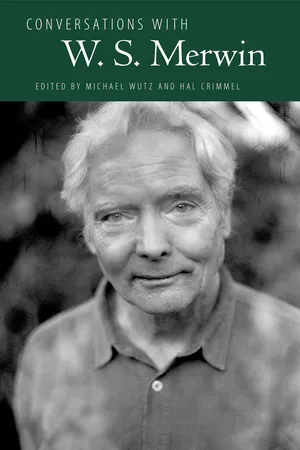
Conversations with W. S. Merwin is the first collection of interviews with former United States Poet Laureate W. S. Merwin (b. 1927). Spanning almost six decades of conversations, the collection touches on such topics as Merwin's early influences (Robert Graves and Ezra Pound), his location within the twin poles of Walt Whitman and Henry David Thoreau, and his extraordinary work as a translator, as well as his decades-long interest in environmental conservation. Anticipating the current sustainability movement and the debates surrounding major and minor literatures, Merwin was, and still is, a visionary.
He is among the most distinguished poets, translators, and thinkers in the United States. A major link between the period of literary modernism and its contemporary extensions, Merwin has been a force in American letters for many decades, and his translations from the Spanish, French, Italian, Japanese, and other languages have earned him unanimous praise and admiration. Merwin also wrote at the forefront of literature's environmental advocacy and early on articulated concerns about ecology and sustainability.
Conversations with W. S. Merwin offers insight into the various dimensions of Merwin's thought by treating his interviews as a self-standing category in his oeuvre. More than casual narratives that interpret the occasional poem or relay an occasional experience, they afford literary and cultural historians a view into the larger throughlines of Merwin's thinking.
- 242 pages
- English
- ePUB (mobile friendly)
- Available on iOS & Android
eBook - ePub
Conversations with W. S. Merwin
About this book
Information
Subtopic
Literary BiographiesIndex
Literature“Fact Has Two Faces”: An Interview with W. S. Merwin
Ed Folsom and Cary Nelson / 1981
From Iowa Review (University of Iowa) 13.1 (Winter 1982), 30–66. This interview took place on October 11, 1981, at Cary Nelson’s home in Champaign, Illinois. Reprinted by permission.
Ed Folsom: You have rarely done interviews. Why?
W. S. Merwin: I gave one in Los Angeles about six years ago, with a couple of students who wanted to do one, but they hadn’t prepared anything. I think that’s one of the reasons for distrusting it. If the interviewers are unprepared or the questions are remote, you have to give a monologue to save the occasion. Then the risk is self-indulgence. The interviews we know well, I suppose, started with those in Paris Review, about twenty-five years ago. Then it became a very popular form, and I think it’s been a happy hunting ground for all sorts of self-indulgence, both in the making and in the reading. It’s often a substitute for really thinking about a problem and trying to say something coherent. It can be spontaneous, but sometimes it’s just louder, given more seriousness and attention than it probably deserves.
Cary Nelson: I think the last detailed interviews I’ve seen with you are the 1961 interview published in The Sullen Art and the interview with Frank MacShane published in Shenandoah in 1970.
Merwin: Both were a long time ago—ten and twenty years, but I assume we’re doing something different.
Folsom: You were telling us recently that you have been reading Leaves of Grass again. I’m curious about what you find there now.
Merwin: I’ve always had mixed feelings about Whitman. They go back to reading him in my teens, having him thrust at me as the Great American Poet. At the time, coming from my own provincial and utterly unliterary background, I was overly impressed with Culture (with a capital C) so the barbaric yawp didn’t particularly appeal to me when I was eighteen, which is an age when it is supposed to, nor did I feel that this was the great book written by an American. I’ve tried over the years to come to terms with Whitman, but I don’t think I’ve ever really succeeded. I’ve had again and again the experience of starting to read him, reading for a page or two, then shutting the book. I find passages of incredible power and beauty…. Yet the positivism and the American optimism disturb me. I can respond to the romantic side of Whitman, when he presents himself as the voice of feeling, but even then it’s not a poetry that develops in a musical or intellectual sense. It doesn’t move on and take a growing form—it repeats and finds more and more detail. That bothers me, but in particular it’s his rhetorical insistence on an optimistic stance, which can be quite wonderful as a statement of momentary emotion, but as a world view and as a program for confronting existence it bothered me when I was eighteen and bothers me now. It makes me extremely uneasy when he talks about the American expansion and the feeling of manifest destiny in a voice of wonder. I keep thinking about the buffalo, about the Indians, and about the species that are being rendered extinct. Whitman’s momentary, rather sentimental view just wipes these things out as though they were of no importance. There’s a cultural and what you might call a specietal chauvinism involved. The Whitmanite enthusiasm troubles me for the same reasons; it seems to partake of the very things that bother me in Whitman. I don’t know how to say it better than this, which is one reason I didn’t write to you about it. I’m not sure I’m very clear about it.
Folsom: I think you’re very clear about it. We were talking this morning about the problems inherent in putting together a Collected Poems, especially for you, since you have developed individual books so clearly and with such integrity. People who follow your writing closely, I think, conceive of your career in terms of the various books, more so perhaps than in terms of individual poems. The books are each organic wholes, and each is a separate and clear step in your development, with growth and change in evidence. Each marks an important evolutionary shift. Whitman, on the other hand, is a poet who insisted on writing one book over a lifetime, and that’s part of the reason for the uncomfortable positivism that pervades his work, isn’t it? He starts out with this incredible positivism which is rampant in the mid-century, in the 1850s, which grows out of his sense of exhilaration about manifest destiny, about America as a ceaselessly growing field of unified contrarieties. As his career developed, though, the two major historical events of his adult life—the Civil War and the closing of the frontier—destroyed the persona that he had taken on with such burgeoning enthusiasm. Consequently the book—his one growing book—became a burden to him in a way. He could not contradict the book because he was not writing new ones; he was adding on to and readjusting the old one. I’m wondering if some of that positivism in Whitman is there because he refused ever to set his past aside and begin again?
Merwin: Several times Whitman sees something essential about the American situation. F. O. Matthiessen describes it too: in a democracy one of the danger points is rhetoric, public rhetoric. I think now, looking back, that he is also describing his own weakness. Both Whitman’s strength and his weakness is that he is basically a rhetorical poet. And he’s rhetorical not only in the obvious sense that all poetry is rhetorical, but in the sense of rhetoric as public speech: you decide on a stance and then you bring in material to flesh out that stance, to give details to your position. This is one of the things that makes me uneasy about Whitman. The stance is basically there; and much of the poetry simply adds detail to it. So many of the moments in Whitman that I really love are exceptions to this. Yet to my mind, these exceptions occur far too infrequently. Most of the time he’s making a speech. The whole Leaves of Grass in a sense is a speech. It’s a piece of emotional propaganda about an emotional approach to a historical moment. It’s almost set up in a way which makes it impossible for it to develop, to deepen, or to reflect on itself and come out with sudden new perspectives.
Folsom: What about some of the poems of the “Drum Taps” period like the “Wound Dresser”?
Merwin: They’re some of my favorite passages, you know, because his theory won’t support him there. He’s simply paying attention to what he sees in front of him. I find those poems both sharper and more moving than many other things in Whitman.
Folsom: But they tend to get lost in that vast programmed structure of Leaves of Grass …
Merwin: He allows himself to get lost in it, insisting on inciting the bird of freedom to soar …
Nelson: Even in those poems in which he is depressed by what he sees and admits his difficulty in dealing with it—rather than announcing it yet again as an appropriate occasion for his enthusiasm—some of the same role as the representative speaker for the country, the role of the speaker voicing the collective condition of America, continues to be foregrounded, though perhaps with less mere rhetoric, less oracular theatricality.
Merwin: I’m very anxious not to be unfair to him. I’m not altogether convinced, as you must guess, by the deliberate stance, but there’s obviously a wonderful and generous human being behind it, and a quite incredible and original gift, equally incredible power. But those misgivings have been quite consistent now for all these years, so I guess I’m going to have to live with them.
Folsom: Do you conceive of your own writing, your own career, as the creation of one large book?
Merwin: Well, your whole work is one large book, because there is a more or less audible voice running through everything. At least I would like to think that one’s work becomes a coherent project eventually, that poems are not merely disparate pieces with no place in the whole. But I don’t conceive of deliberately trying to construct a single book the way Whitman was trying to do with Leaves of Grass. I don’t think of that even in terms of the separate books. I never set out to write The Lice, or to write The Carrier of Ladders, but wrote until at a particular point something seemed to be complete. On what terms, or on the basis of what assumptions, I wouldn’t be able to say, any more than I would with a single poem be able to say, “Ah, that poem is finished.”
Folsom: You have said that when you go back to nineteenth-century American writers for a sustaining influence, it’s not Whitman you turn to, but Thoreau. I think a lot of people throw Whitman and Thoreau together as part of the American Transcendental and Romantic tradition. What draws you to Thoreau that doesn’t draw you to Whitman?
Merwin: I suppose the way in which he meant “In wildness is the preservation of the world” for one thing. Or the recognition that the human cannot exist independently in a natural void; whatever the alienation is that we feel from the natural world, we are not in fact alienated, so we cannot base our self-righteousness on that difference. We’re part of that whole thing. And the way Thoreau, very differently from Whitman, even in a paragraph takes his own perception and develops it into a deeper and deeper way of seeing something—the actual seeing in Thoreau is one of the things that draws me to him. I think that Thoreau saw in a way that nobody had quite seen before; it was American in that sense. I don’t know if Williams talks about Thoreau, but I would have liked to hear what Williams had to say about Thoreau’s capacity to see, even though Williams’s great sympathy is more toward Whitman. Indeed I’ve suspected for a long time that an American poet’s sympathy would tend to go either toward Whitman or toward Thoreau, not toward both. Gary Snyder at this point is rather snippy about Thoreau, says he’s very uptight, WASP, and so forth. That’s a way of describing Thoreau’s weaknesses all right—such as his lack of any automatic spontaneous sympathy for his fellow human beings. Thoreau is not all-embracing. The kind of hawky thing in Thoreau puts off the enthusiasts of enthusiasm itself, the great Whitmanite hugs of feeling, the lovers, “I love my fellow man.” Perhaps if you really are there you don’t have to say it so often and so loudly. Dana recently has been reading Henry James and Thoreau and getting very impatient with James and reading a passage of Thoreau and saying, “You know, for James the natural world is scenery outside the window.” There’s never anything alive out there. And for Thoreau, when he sees it, it’s alive, completely alive, not a detail in a piece of rhetoric. And he leaves open what its significance is. He realizes that the intensity with which he’s able to see it is its significance. This is an immense gesture of wisdom in Thoreau that I miss in Whitman. Whitman’s wonderful expansive enthusiasm isn’t there in Thoreau, though he has things of equal beauty and power. The last page of Walden is certainly one of the most beautiful things ever written, and of a kind of elevation that Whitman himself was trying to reach all the time.
Folsom: Yes, Whitman does tend to dwell a bit too long on “cameraderie,” as if it’s something he’s trying to invoke rather than to describe. I think in that sense there’s a real loneliness at the heart of Whitman.
Merwin: There is at the heart of both of those writers, but it’s quite obvious in Thoreau, he makes no bones about it. There’s that wonderful passage where he says, I don’t pay enough attention to my fellow human beings, I don’t feel strongly enough about them, I don’t take enough interest in them, and I’m going to do something about that: these people down here working on the bridge, I’m going to walk closer to them and see if I can’t think of them as though they were groundhogs.
Folsom: Do you read Thoreau often?
Merwin: Well, I keep him in the john. He’s been there for years. So I go back and read things over again. I think Walden is an incredible book. I feel grateful to Thoreau in a way. He’s been a companion. Yet I see Thoreau’s limitations, too, including whatever it is that makes him write by tacking one sentence onto another sentence out of notebooks, and putting them together. It’s a strange way of writing, though he’s not the first person in history to write that way, after all.
Folsom: Your myriad translations suggest all kinds of affinities for you from outside America, but are there other American writers besides Thoreau that you find yourself returning to, that you would call sustaining influences?
Merwin: Thoreau is really the main one that I go back to. There’s nobody really before Thoreau. There was a time when I used to read Mark Twain for fun, but apart from Huckleberry Finn, which I love, I find that he doesn’t last very well. I don’t even find him very funny anymore. And then I read an early book, his book about Hawaii. It’s amazing how much racism and John Wayne-ism there was in that generation.
Nelson: Has Thoreau been behind some of the prose that you’ve written recently? You’re writing about your family and your past, which are very different topics from his, but there’s a certain humility about phenomenal existence that I see both in Thoreau and in these pieces from your new prose book, Unframed Originals.
Merwin: I hadn’t thought of that, Cary; that’s interesting. Maybe so, who knows?
Folsom: Certainly that position you put yourself in when you buy the old abandoned house in France at the end of that one autobiographical essay, called “Hotel”—the position of moving into that house only so far, not wanting to clear the floor and put panes in the windows and paint the walls, but rather only lie there on a simple cot—is a very Thoreau-like position. It’s like his bean-field: half-cultivated and half-wild.
Merwin: Yes. I guess that’s part of what I was talking about a minute ago. That’s a wonderful way of putting it, too—his humility before the phenomenal world. If you don’t accept the genuine chairness of the chair, if it’s all just background, as it is for a great many people in the contemporary world—first the separation from the natural world, then from the phenomenal world—things tend to be seen only in terms of their uses, or in terms of what abstraction they can serve. If the reality of the unreal objects cannot be accepted as an infinite thing in them, you can’t see anything. You only see counters in a game that is of very doubtful value.
Nelson: I feel in your recent pieces a real wariness about rhetorical over-statement, a wish to write in a very delicate and lucid way and not to fall into what might be a Whitmanesque mode of thinking about your own past, but to speak in simple and direct terms about it if possible.
Merwin: Well, of course I don’t have to tell you that you’re always writing in a rhetoric of one kind or another, but I am working to avoid as much as possible a kind of rhetoric which is an emotional screen that keeps you from seeing what you’re trying to look at. That’s something I did want to do. And I also realized, part way through, since one of the main themes of the book is what I was not able to know, what I couldn’t ever find out, the people I couldn’t meet, that reticence was one of the main things I was writing about. Indeed it was a very reticent family. But I felt if I could take any detail, any moment, anything I could clearly see, and pay enough attention to it, it would act like a kind of hologram. I’d be able to see the whole story in that single detail—just the way, if you could really pay attention to a dream, the dream would probably tell you everything you needed to know for that time and place. But obviously any exaggerated rhetoric you were using at that point, in the...
Table of contents
- Cover
- Title Page
- Copyright
- Contents
- Introduction
- Chronology
- A Conversation with W. S. Merwin
- W. S. Merwin
- “Tireless Quest”: A Conversation with W. S. Merwin
- W. S. Merwin: An Interview
- “Fact Has Two Faces”: An Interview with W. S. Merwin
- A Conversation with W. S. Merwin
- An Interview with W. S. Merwin
- W. S. Merwin, The Art of Poetry, No. 38
- A Poet of Their Own
- An Interview with W. S. Merwin
- Interview with W. S. Merwin
- Poet W. S. Merwin
- The Progressive Interview
- Nature, Conservation, and the Unseen: A Conversation with W. S. Merwin
- Additional Interviews
- Index
Trusted by 375,005 students
Access to over 1.5 million titles for a fair monthly price.
Study more efficiently using our study tools.
Frequently asked questions
Yes, you can cancel anytime from the Subscription tab in your account settings on the Perlego website. Your subscription will stay active until the end of your current billing period. Learn how to cancel your subscription
No, books cannot be downloaded as external files, such as PDFs, for use outside of Perlego. However, you can download books within the Perlego app for offline reading on mobile or tablet. Learn how to download books offline
Perlego offers two plans: Essential and Complete
- Essential is ideal for learners and professionals who enjoy exploring a wide range of subjects. Access the Essential Library with 800,000+ trusted titles and best-sellers across business, personal growth, and the humanities. Includes unlimited reading time and Standard Read Aloud voice.
- Complete: Perfect for advanced learners and researchers needing full, unrestricted access. Unlock 1.5M+ books across hundreds of subjects, including academic and specialized titles. The Complete Plan also includes advanced features like Premium Read Aloud and Research Assistant.
We are an online textbook subscription service, where you can get access to an entire online library for less than the price of a single book per month. With over 1.5 million books across 990+ topics, we’ve got you covered! Learn about our mission
Look out for the read-aloud symbol on your next book to see if you can listen to it. The read-aloud tool reads text aloud for you, highlighting the text as it is being read. You can pause it, speed it up and slow it down. Learn more about Read Aloud
Yes! You can use the Perlego app on both iOS and Android devices to read anytime, anywhere — even offline. Perfect for commutes or when you’re on the go.
Please note we cannot support devices running on iOS 13 and Android 7 or earlier. Learn more about using the app
Please note we cannot support devices running on iOS 13 and Android 7 or earlier. Learn more about using the app
Yes, you can access Conversations with W. S. Merwin by Michael Wutz, Hal Crimmel, Michael Wutz,Hal Crimmel in PDF and/or ePUB format, as well as other popular books in Literature & Literary Biographies. We have over 1.5 million books available in our catalogue for you to explore.