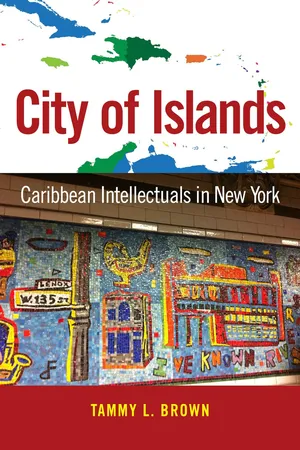
Tammy L. Brown uses the life stories of Caribbean intellectuals as "windows" into the dynamic history of immigration to New York and the long battle for racial equality in modern America. The majority of the 150,000 black immigrants who arrived in the United States during the first-wave of Caribbean immigration to New York hailed from the English-speaking Caribbean—mainly Jamaica, Barbados, and Trinidad. Arriving at the height of the Industrial Revolution and a new era in black culture and progress, these black immigrants dreamed of a more prosperous future. However, northern-style Jim Crow hindered their upward social mobility. In response, Caribbean intellectuals delivered speeches and sermons, wrote poetry and novels, and created performance art pieces challenging the racism that impeded their success.
Brown traces the influences of religion as revealed at Unitarian minister Ethelred Brown's Harlem Community Church and in Richard B. Moore's fiery speeches on Harlem street corners during the age of the "New Negro." She investigates the role of performance art and Pearl Primus's declaration that "dance is a weapon for social change" during the long civil rights movement. Shirley Chisholm's advocacy for women and all working-class Americans in the House of Representatives and as a presidential candidate during the peak of the Feminist Movement moves the book into more overt politics. Novelist Paule Marshall's insistence that black immigrant women be seen and heard in the realm of American Arts and Letters at the advent of "multiculturalism" reveals the power of literature. The wide-ranging styles of Caribbean campaigns for social justice reflect the expansive imaginations and individual life stories of each intellectual Brown studies. In addition to deepening our understanding of the long battle for racial equality in America, these life stories reveal the powerful interplay between personal and public politics.
- 192 pages
- English
- ePUB (mobile friendly)
- Available on iOS & Android
eBook - ePub
About this book
Information
CHAPTER 1

Caribbean New York
It is so stupid and idiotic—the jealousies, rivalries and
discords between West Indian and American Negro[s].1
discords between West Indian and American Negro[s].1
—CLAUDE MCKAY, 1932
On August 1, 1945, Café Society Uptown was abuzz. The offshoot of a successful Greenwich Village club run by Barney Josephson, and long a center of cross-cultural bohemia, the uptown location provided yet another venue for black and white intellectuals to mix and mingle. On that August day, a crowd of some three thousand well-wishers awaited the arrival of the beloved newlyweds Hazel Scott and Adam Clayton Powell, Jr.2 The bride, a twenty-five-year-old ingénue and jazz pianist, and the groom, a handsome thirty-six-year-old New York congressman, had wed earlier that day in a private ceremony officiated by the groom’s father, Reverend Adam Clayton Powell Sr., at the Bethel African Methodist Episcopal Church in Stamford, Connecticut. Always elegant, the bride wore a tea-length Chantilly lace gown and carried a bouquet of gardenias and white orchids. Powell wore pinstriped pants and a box-cut black suit jacket with a white gardenia on his lapel. In photographs, the couple appears happy, albeit a bit overwhelmed. By 1945, Scott’s celebrity had reached an international audience, and Powell’s political cache had expanded beyond black New York as he worked to establish a reputation as a national civil rights leader. By the mid-1940s, Scott also was known as a champion of civil rights in her own right.
In many ways, the marriage of the Trinidadian-born starlet Scott to the American-born politician Powell provides a glimpse into the close—and sometimes fractious—social and political relationships that Caribbean immigrants and American-born blacks formed during the early decades of the twentieth century. What made the “New Negro,” a term popularized by philosopher Alain Locke, so new was the synergy and diversity of cultural ideals and intellectual influences among Caribbean immigrants and American-born blacks mixing and mingling in the world’s premier black metropolis.3 Although many Caribbean immigrants held on to their island-specific cultural identities by way of neighborhood settlement patterns and mutual-aid societies, the strictures of American racism forged shifting political alliances, friendships, and even romantic partnerships among Caribbean immigrants and American-born blacks. And New York City was the epicenter of this African diasporic cultural exchange.
The sheer volume of black migrants from southern states intermingling with black immigrants, especially from the English-speaking Caribbean, fostered a climate ripe for black cultural reinvention. In 1910, the black population in New York totaled 91,709. By 1920 it had increased by two-thirds, to 152,367.4 Dramatic push and pull factors fueled the Great Migration of blacks from the South to states in the North, Midwest, and later the West. Racial violence, disenfranchisement, crop failure due to the boll weevil scourge, and economic underdevelopment and isolation pushed blacks out of the South toward industrializing cities such as Philadelphia, Pittsburgh, Indianapolis, Cincinnati, and Chicago. Between 1900 and 1930, more than five hundred thousand southern blacks moved from rural areas to cities, and to the North, Midwest, and West.5
The biblical Exodus narrative in which Moses led the children of Israel out of slavery in Pharaoh’s Egypt and into freedom in Canaan, which dominated the imaginations of enslaved Africans in antebellum America, continued to resonate for blacks during the Great Migration.6 Just as African slaves followed the North Star along the Underground Railroad to freedom in a “promised land,” the North maintained its allure as a place of tremendous opportunity for black migrants invested in individual and collective racial uplift in the aftermath of failed Reconstruction at the turn of the twentieth century. News of better-paying jobs and less stringent racial politics in the North reached black southerners via the black press and word of mouth. The Amsterdam News and the Chicago Defender, black-run newspapers, published testimonials by migrants who were thriving in northern cities; companies sent representatives to the South to aggressively recruit new employees; and migrants sent letters to family members full of details about job opportunities, housing arrangements, and social life. Some families, like that of Harlem Renaissance painter Jacob Lawrence, gradually moved northward along the Eastern Seaboard. Although Lawrence’s father was from South Carolina, his mother came from Virginia, and he was born in Atlantic City, New Jersey. Harlem brownstones, streets, and city folk were central images in Lawrence’s visual vocabulary, because he had moved to the black mecca with his family at age thirteen.7
Likewise, African Caribbean immigrants came in droves to New York City during the opening decades of the twentieth century. The forces driving the immigration were in some ways similar to those pushing American blacks northward. British colonial oppression, the declining price of sugar, and natural disasters—hurricanes, floods, droughts, and earthquakes—pushed immigrants out of the Caribbean toward better job opportunities in the United States.8 In New York, social networks established between families and through churches, fraternities, and mutual-aid societies informed immigrants’ family and friends in the Caribbean about city life and the jobs awaiting for them in the carpentry and garment industries. On arriving in New York, many black immigrants found skilled-labor hard to come by, and worked in white homes as domestic workers or in restaurants and buildings as bellhops, elevator operators, and waiters.9
Beyond the pragmatic pull of jobs, more intangible matters of the spirit and heart also attracted some to New York. One of those moved by the heart was Amy Ashwood, who would later become the wife of Jamaican-born black consciousness leader Marcus Garvey. Garvey and Ashwood would become the center of a racial uplift movement in both Jamaica and New York. The two had met in Jamaica and cofounded the Jamaican branch of the Universal Negro Improvement Association in 1914, and were secretly engaged in 1915. Two years later, frustrated by the long engagement, Ashwood wrote to Garvey from Panama, stating her plans to take the Royal Mail boat to New York to be reunited with him.10 She was a woman of her word. She arrived in 1918 and married Garvey in 1919. Although the marriage was short-lived, it began Amy Ashwood’s long love affair with the city of New York.11
By 1932, the total number of Caribbean immigrants living in the United States was eighty-eight thousand, of whom thirty-six thousand lived in New York City.12 Although many Caribbean immigrants were laborers, New York was the ideal place for members of the professional class.13 Caribbean intellectuals, like Ashwood, Garvey, Ethelred Brown, and jazz pianist Hazel Scott, found New York to be a wellspring of inspiration and opportunity. Brown deemed Harlem’s multi-ethnic, liberal, and cosmopolitan environment the best milieu in which to advance his racial uplift mission through his Unitarian ministry, which had floundered in Jamaica. Manhattan also was the ideal location in which Scott thrived artistically; young Hazel was admitted into the prestigious Juilliard School of music when she was only eight years old. Scott’s Trinidadian heritage combined with the cross-cultural newness of New York inspired her musical compositions—ranging from Harlem stride piano Jazz to Calypso. Ashwood, Garvey, Brown and Scott transformed the meanings of blackness through the very process of their intellectual endeavors. Historian Gilbert Osofsky captured this new “melting pot” in his book on Harlem:
There were ten times as many foreign-born Negroes in New York City as in any other American urban area. In 1930, 54,754 foreign Negroes lived in the city—39,833 of whom resided in Manhattan. Miami, the next largest American city in terms of immigrant Negroes, was settled by only 5,512 people; Boston ranked third with 3,287 Caribbeans. About 25 per cent of Harlem’s population in the twenties was foreign-born. Harlem was America’s largest Negro melting pot.14
Osofsky’s deliberate use of the term “melting pot” underscores the very important but underanalyzed phenomenon of “diversity within blackness.”15 As discussed in the following chapters, black New Yorkers were diverse in every way imaginable; birthplace, age at time of migration to New York, family background, gender, class, and individual personality were significant categories that marked the cultural and intellectual diversity among black New Yorkers. Osofsky recognized these factors that constitute diversity within blackness when he articulated his idea of Harlem as a “melting pot.” While the term “melting pot” usually applies to America as a whole, and particularly during the surge of European immigration at the turn of the twentieth century, Osofsky conjures the same metaphor to describe the intraracial cultural diversity of Harlem—a city within the city—teeming with multiethnic, black denizens from North Carolina, Georgia, Alabama, Jamaica, Trinidad, Barbados, Puerto Rico, and other locales throughout the African diaspora. And just as American-born whites tried to make sense of where immigrants from southern and eastern Europe fit in America’s racial hierarchy, American-born blacks and black immigrants also danced a dance of political alliances and betrayals as they grappled with the meanings of blackness in attempts to elevate their own social and economic status in modern America. This battle of cultures, black immigrant versus American-born black cultural ideals, was intensely felt in New York City.
New York, NY
New York has dominated modern reality and mythology as a center of American cultural capital and as the leading site of cultural production throughout the world for the greater part of the twentieth century. The city that poet Emma Lazarus, the daughter of Jewish immigrants from Portugal, wrote about in her famous sonnet “The New Colossus,” held different meanings for its diverse denizens. Written in 1883 and engraved on a bronze plaque at the foot of the Statue of Liberty in 1903, the poem calls Lady Liberty a “Mother of Exiles”: “From her beacon-hand/ Glows world-wide welcome.”16 For impoverished immigrants from southern and eastern Europe, Lazarus’s description of “huddled masses” and “wretched refuse” who “yearn to breathe free” was more apt. But for educated immigrants of a professional class, including Hazel Scott’s family and other Caribbean immigrants, New York was a voluntary “exile,” with promises of better opportunities in America’s industrializing, cultural capital compared to the largely agricultural economies of the Caribbean islands.
Members of the first-wave of Caribbean immigration to New York, from the 1880s through the 1920s, were by far more highly educated than European new immigrants who arrived in New York at the same time. According to historian Winston James, the “most remarkable feature of the social and economic profile of the early [West Indian] migrants is the high proportion who, in their country of origin, held professional, white collar, and skilled jobs.”17 More than a half century earlier, scholar Roi Ottley made a similar observation when he wrote, “many of them were skilled workers—carpenters, masons, bricklayers, tailors, printers—in trades which American Negroes lost when the race was excluded from the trade unions in the last century.”18 Indeed, the first wave of highly educated, predominantly upper-middle-class Caribbean immigrants cut a different figure upon arrival in New York.
Yet, while they moved to the United States with high hopes for good paying jobs that better fit their skills, Caribbean immigrants quickly learned first-hand about northern-style Jim Crow racism. Consider the life of Jamaican-born minister Ethelred Brown who wanted to put his theological training to good use in full-time ministry. Yet he was only able to pursue his ministry part-time because he also had to work as an elevator operator in order to pay the bills.19 Brown blamed the all-white leadership of the American Unitarian Association (AUA) for denying him funding to run his ministry fulltime. When he considered the AUA’s generous fiscal support of his white counterparts, Brown felt slighted. Stories like this appear so frequently in novels about the Caribbean immigrant experience that it is safe to assume that the frustrations of fictional characters reflect this reality of American dreams deferred.20 Black immigrants navigated a new, complex, terrain of racial politics, bringing prior knowledge of British colonial oppression into conversation with northern-style Jim Crow laws, challenging both and re-envisioning blackness through this process of self-definition and reinvention.
That reinvention of black cultural identity was taking place amid a city reinventing itself at the time. In the opening decades of the twentieth century, Caribbean New Yorkers became part of a city under construction, literally and figuratively. In the literal sense, new edifices sprang up throughout the city, ranging from overcrowded, predominantly European immigrant tenements on the Lower East Side to gargantuan skyscrapers in downtown proper. Historian Richard Plunz notes that, “By 1900 more than 80,000 tenements were built in greater New York City. These buildings housed a population of 2.3 million, out of a total city population of 3,369,898.”21 In 1931, the Empire State Building was completed, built at the intersection of Fifth Avenue and West 34th Street and towering 1,250 feet over the blooming cityscape. America’s own Eiffel Tower, the Empire State Building represented modernity, industrial capitalism, and newfound power in an age of steel, brawn, and intellectual might.
As the buildings were going up, families were sorting themselves in new ways. Whites were moving out of Harlem and into Brooklyn and Long Island, leaving real estate that black entrepreneurs such as Philip A. Payton Jr. could afford to purchase. Other cramped apartments were owned by whites but represented by black agents. Bridges, tunnels, and the new subway better linked the five boroughs of New York.
Although racism was less overt than in the South, northern-style Jim Crow and racially segregated neighborhoods still made Caribbean immigrants feel like they inhabited islands within the city. Many New Yorkers, especially during the early twentieth century, lived and worked in the same neighborhood and rarely ventured into other boroughs for work or play. For Caribbean immigrants, it was not uncommon to live in Harlem and commute to Manhattan to work as doormen in high-rise residential and office buildings or to Brooklyn to work as domestics in white homes. The divisions between the white worlds of Manhattan and Brooklyn and the black world of Harlem during the early twentieth...
Table of contents
- Cover
- Half title
- Title
- Copyright
- Dedication
- Contents
- Abbreviations
- Prologue: An Autobiography of the Biographer
- The Personal Is Political: An Introduction
- Chapter 1 Caribbean New York
- Chapter 2 Ethelred Brown and the Character of New Negro Leadership
- Chapter 3 Richard B. Moore and Pan-Caribbean Consciousness
- Chapter 4 Pearl Primus and the Performance of African Diasporic Identities
- Chapter 5 Shirley Chisholm and the Style of Multicultural Democracy
- Chapter 6 Paule Marshall and the Voice of Black Immigrant Women
- Coda “Garvey’s Ghost”: Life after Death
- Acknowledgments
- Notes
- Bibliography
- Index
Trusted by 375,005 students
Access to over 1.5 million titles for a fair monthly price.
Study more efficiently using our study tools.
Frequently asked questions
Yes, you can cancel anytime from the Subscription tab in your account settings on the Perlego website. Your subscription will stay active until the end of your current billing period. Learn how to cancel your subscription
No, books cannot be downloaded as external files, such as PDFs, for use outside of Perlego. However, you can download books within the Perlego app for offline reading on mobile or tablet. Learn how to download books offline
Perlego offers two plans: Essential and Complete
- Essential is ideal for learners and professionals who enjoy exploring a wide range of subjects. Access the Essential Library with 800,000+ trusted titles and best-sellers across business, personal growth, and the humanities. Includes unlimited reading time and Standard Read Aloud voice.
- Complete: Perfect for advanced learners and researchers needing full, unrestricted access. Unlock 1.5M+ books across hundreds of subjects, including academic and specialized titles. The Complete Plan also includes advanced features like Premium Read Aloud and Research Assistant.
We are an online textbook subscription service, where you can get access to an entire online library for less than the price of a single book per month. With over 1.5 million books across 990+ topics, we’ve got you covered! Learn about our mission
Look out for the read-aloud symbol on your next book to see if you can listen to it. The read-aloud tool reads text aloud for you, highlighting the text as it is being read. You can pause it, speed it up and slow it down. Learn more about Read Aloud
Yes! You can use the Perlego app on both iOS and Android devices to read anytime, anywhere — even offline. Perfect for commutes or when you’re on the go.
Please note we cannot support devices running on iOS 13 and Android 7 or earlier. Learn more about using the app
Please note we cannot support devices running on iOS 13 and Android 7 or earlier. Learn more about using the app
Yes, you can access City of Islands by Tammy L. Brown in PDF and/or ePUB format, as well as other popular books in Social Sciences & Latin American & Caribbean History. We have over 1.5 million books available in our catalogue for you to explore.