The extensive influence of the creative traditions derived from slave culture, particularly black folklore, in the work of nineteenth- and twentieth-century black authors, such as Ralph Ellison and Toni Morrison, has become a hallmark of African American scholarship. Yet similar inquiries regarding white authors adopting black aesthetic techniques have been largely overlooked. Gretchen Martin examines representative nineteenth-century works to explore the influence of black-authored (or narrated) works on well-known white-authored texts, particularly the impact of black oral culture evident by subversive trickster figures in John Pendleton Kennedy's Swallow Barn, Harriet Beecher Stowe's Uncle Tom's Cabin, Herman Melville's Benito Cereno, Joel Chandler Harris's short stories, as well as Mark Twain's Adventures of Huckleberry Finn and Pudd'nhead Wilson. As Martin indicates, such white authors show themselves to be savvy observers of the many trickster traditions and indeed a wide range of texts suggest stylistic and aesthetic influences representative of the artistry, subversive wisdom, and subtle humor in these black figures of ridicule, resistance, and repudiation. The black characters created by these white authors are often dismissed as little more than limited, demeaning stereotypes of the minstrel tradition, yet by teasing out important distinctions between the wisdom and humor signified by trickery rather than minstrelsy, Martin probes an overlooked aspect of the nineteenth-century American literary canon and reveals the extensive influence of black aesthetics on some of the most highly regarded work by white American authors.
eBook - ePub
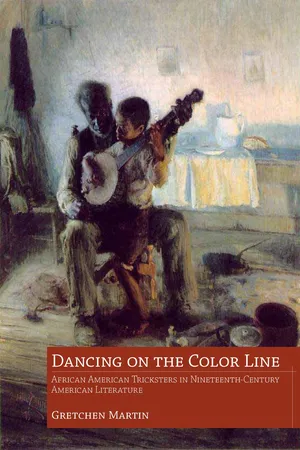
Dancing on the Color Line
African American Tricksters in Nineteenth-Century American Literature
- 224 pages
- English
- ePUB (mobile friendly)
- Available on iOS & Android
eBook - ePub
Dancing on the Color Line
African American Tricksters in Nineteenth-Century American Literature
About this book
Information
Chapter 1
Swallow Barn’s Signifying Son
Originally published in 1832 and revised and republished in 1851, John Pendleton Kennedy’s novel Swallow Barn; or, A Sojourn in the Old Dominion has become well known to scholars of Southern literature as a foundational text of the antebellum plantation school and model for postbellum plantation authors.1 The novel is also an early example of the frame narrative, which would become an important structural device in the genres of frontier humor and late nineteenth-century plantation fiction. Published only a year after the Nat Turner rebellion in 1831, Kennedy’s novel reflects the judicious balance he maintained in his personal and professional life in a period growing increasingly “embroiled in sectional rivalry,” and his depiction of slavery functions as a careful but complex negotiation of what was becoming the central issue of the nineteenth century (MacKethan, “Introduction” i).2 In her introduction to the novel, Lucinda MacKethan notes that Kennedy’s mother was “allied to a thriving planter clan of old Virginia, aristocratic gentleman and ladies whose plantations were spread throughout the Shenandoah Valley–Berkeley County regions of a state far more southern in its leanings than was Maryland. Through his father, John Kennedy, he belonged to the Baltimore merchant class” (xii). After the death of his first wife, Kennedy married Elizabeth Gray, daughter of Edward Gray, a wealthy textile manufacturer who “opposed slavery and distrusted southerners as idlers” (xiii). As MacKethan notes, Kennedy adopted the political and economic views of his father-in-law, “but his Virginia relatives and their plantations kept a strong hold on his sympathies” (xiii). Kennedy’s treatment of the issue of slavery in Swallow Barn is often viewed as cautiously endorsing the perspective of the novel’s planter patriarch, Frank Meriwether, who regards the institution as an inherited evil and social dilemma, a perception similar to the paradox Thomas Jefferson expressed in his claim: “‘We have the wolf by the ears and we can neither hold him, nor safely let him go. Justice is in one scale, and self-preservation in the other’” (qtd. in Kolchin 89). As MacKethan notes, “never a defender of slavery, Kennedy in his treatment of blacks in Swallow Barn shows how ever more deeply even he became entangled in the pastoral mystique of the world he set out to satirize” (xxv).
The novel is typically considered one of the earliest and most well-known representatives of the proslavery plantation tradition, and many consider Swallow Barn, as Frankie Y. Bailey notes, to be “a book offering an idyllic picture of plantation slavery” (3); other scholars have argued that this view overlooks the text’s subversive complexities. In Unwelcomed Voices, Paul Jones contends that the novel “ultimately refuses to commit itself to a single view of the South and, instead, struggles with several, including one that is sympathetic and romantic and one that is ironic and critical” (123). Scott Romine identifies a duality of discourses and contends that “mediating between the two master discourses of apologist rhetoric—slavery as ‘a necessary evil— versus ‘a positive good’–Kennedy refuses the teleology of the latter, which would involve a cultural narrative producing the pastoral icon of the plantation community” (86). Romine asserts that rather than endorsing slavery, Kennedy’s agenda is expressed through his character Meriwether’s view that slavery is “morally wrong” and will eventually be eradicated but that the responsibility to create a plan to abolish the institution is a Southern rather than Northern responsibility; consequently, “the authorial control of the emancipation plot must remain a southern prerogative” (87). In addition to the master discourses that dominate the narrative perspective throughout the novel, another distinct discourse is evident by the voices of the slaves, which often operate to undermine these master discourses. Kennedy thus grants the South the prerogative of writing “the emancipation plot,” but his depictions of black characters throughout the novel often function subversively to apply pressure to this expectation. Of the novel’s forty-nine chapters, two chapters deal directly with the issue of slavery, yet the racial theories employed in the debates regarding slavery are typically presented as a given by the white characters. Kennedy, however, also integrates black voices throughout the novel that operate subversively to destabilize the foundation of racial theories. The first chapter to focus directly on slavery, “The Quarter,” broadly addresses the issue during a visit to the plantation’s quarters while the following two-part chapter, “A Negro Mother, Abe,” provides the personal stories of two individual slaves, Lucy and her rebellious son Abe. The section featuring the character Abe has proven a particularly compelling and often perplexing critical aspect of the novel.3
Most scholars view the character Abe as representative of Kennedy’s conflicted view of slavery and as a type of chivalric hero who sacrifices himself in an ill-advised rescue mission. However, throughout the novel, Kennedy features two distinct cultures, the white master class and the black community held in bondage by the master class. While the members of these respective communities interact with each other, they also maintain important cultural features and social values that distinguish one from the other. Kennedy presents Frank Meriwether as a representative of the ideal Virginia gentleman as well as his nephew Ned Hazard, who is depicted as a younger version and thus in the social process of becoming this ideal, particularly because he is next in line to inherit Swallow Barn.4 The language of chivalry is utilized throughout the novel, typically by Ned during his courtship, and while often humorous, functions to delineate the Southern man of honor’s appropriate behavior, social responsibility, proper etiquette, dress, and indeed worldview. A very different type of language is depicted by the slaves in this plantation community and often suggests rather subversive elements, which indicates an independent community culture.
The language of the slaves is presented through dialogue, stories, and songs and demonstrates unifying elements of an autonomous community culture. Houston Baker claims that “the singing that wafted to John Pendleton Kennedy’s ears on his visit to ‘the quarters’ was not the gentle outpouring of a contented slave. When black Americans sang their spirituals, Pharaoh was a very real person: he was the white master who sat on the porch, whip in hand. The River Jordan was not a mystical boundary between earth and heaven: it was the very real Ohio that marked the line between slave and free states. And to ‘steal away’ was not to go docilely home to God but to escape from the southern land of bondage” (Long Black Song 12–13). For African Americans, as Baker points out, “the world is not composed of white supermen producing culture and nonwhite underdogs and colonial subjects attempting to rival white culture,” which is the perspective typically attributed to the assessment of Abe as a chivalric hero, but for the slave community, their stories, songs, and cultural wisdom demonstrate that they celebrated very different types of heroes (10).
Roger Abrahams notes that “the trickster figure has been the most identified hero in Negro lore” and is “one who triumphs or functions by means of his wits” (Deep Down in the Jungle 62). Jeanne Rosier Smith explains that “Br’er Rabbit’s tremendous wit highlights an important aspect on African American cultural identity. Because the American slave system involved living with whites in daily power-based relationships, African American trickster tales strongly reflect the necessity for the trickster’s subversive, masking, signifying skills. Maintaining any sort of cultural identity under slavery demanded an overt acceptance of, and covert resistance to, the dehumanizing racial myths of slavery” (113). Another hero celebrated in the slave community is the fugitive, who as numerous examples of the slave narratives demonstrate, also succeeds “by means of his wits.” Lawrence Levine notes that in the slave community, “for all their stress on the need for caution, they seemed to take delight and pride in telling stories of relatives and friends who challenged the system by escaping” (88). While Abe’s heroism is certainly evident by his actions, elements of African American folktale traditions, as well as the trickster wisdom of the slave narratives, suggest that this character operates on a still more deeply subversive level than has been previously suggested. I contend that the slave community’s elders pass their trickster wisdom on to Abe to enable him to emerge as a drastically different kind of hero, the type growing out of the slave narrative: the successfully escaped slave.
Kennedy uses the epistolary form and a variety of framing techniques in structuring his novel; thus, it is important to point out the distinction between story and plot. Story is defined as a specific narrative event, whereas plot is created by the way in which the stories are arranged in the narrative. The novel opens with an “Introductory Epistle” addressed to “Zachary Huddlestone, Esq., Preston Ridge, New York” from Mark Littleton, and chapters often contain embedded narratives that feature specific characters telling a story or a story Littleton records after hearing. Gerald Prince explains that stories function on “the content plane of narrative as opposed to its expression plane or discourse; the ‘what’ of a narrative as opposed to its ‘how’” (Dictionary of Narratology 91). While the content of the stories is provided by the narrator Mark Littleton, frequently as a result of his role as narratee, the discourse plane of the narratives often betrays his limitations. Prince notes that the “the portrait of the narratee emerges above all from the narrative addressed to him” (“Study of the Narratee” 219). The distinction regarding Littleton’s negotiation between narrator and narratee is important because he often functions as a listener to the narrative accounts of others, repeating these stories in his lengthy “letter.” The stories he recounts, however, often indicate that he lacks the ability or inclination to fully comprehend the discourse plane of many narratives, which often implicitly expose issues regarding race, slavery, and power functioning on a deeply subversive level.
The chapters are typically structured by Littleton’s description of the events that lead to a particular character telling a story or engaging in a discussion with Littleton. Ken Egan points out that the novel “is indeed a highly dialogized narrative” and speaks in “multiple voices” (63). These multiple voices are often evidenced by Littleton interacting with and telling stories of the novel’s black characters. For example, when Meriwether’s sister Prudence begins her morning uncharacteristically playing the piano and singing, “the domestics” regard her strange behavior as a sign of “some impending disaster” (155). Littleton notes that, according to the house slaves: “Such a change in the lady’s habits could import no good! They intimated that when people were going to give up the ghost, such marvels were the not unusual precursors of the event. ‘It was as bad,’ one of the servant maids remarked, ‘as to hear a hen crow at night from the roost, and she shouldn’t wonder if something was going to happen,—a burying, or a wedding, or some such dreadful thing’” (155). The dialogue Littleton engages in with black characters exposes him to elements of the discourse plane of black oral culture. It is important to point out, however, that when slaves are talking to whites or to each other in the presence of whites, the dynamic of power is a crucially important element in examining these scenes. In this exchange, Littleton overlooks the implicit critique of this white woman by the slaves regarding her cheery mood as so unusual, they characterize her behavior as a marvel.
Throughout the novel, the slaves demonstrate their keen awareness of audience, routinely utilizing the terms sir and master when addressing white men, even toward those who are not their owners. Their behavior with whites also demonstrates their savvy insight regarding the appropriate behavior whites expected, which could be manipulated to influence white opinion and exploited to blacks’ advantage. For example, when Scipio accompanies Littleton to Swallow Barn, according to Littleton, he conducted himself “with such a deferential courtesy and formal politeness, as greatly to enhance my opinion of his breeding” (22). Other characters Littleton records interaction with include Carey, Old Jupiter, and Uncle Jeff. Lewis P. Simpson regards Old Jupiter as “a parody of Meriwether,” while Romine asserts that Carey, Meriwether’s personal servant, also “intends to parody his master” (45; 71). Romine contends that Carey is “fundamentally different because his imitation is not, as it were, overtly slavish” and argues that “surely it is possible to read beneath Littleton’s ignorant slave to one who cagily acts the fool perfectly aware of the performative demands being made of him” (71–72). Read in this light, Carey emerges as “one who consciously and cagily accommodates himself to his audience’s expectations” (72). Furthermore, Simpson and MacKethan also detect performative strategies operating in the character Scipio as well; as MacKethan notes, “we can also see stirrings of the sentiment that produced Paul Laurence Dunbar’s poem ‘We Wear the Mask’ and Ellison’s devious grandfather figure in Invisible Man when Scipio, ‘laughing till the tears came into his eyes,’ says that ‘people think old Scipio a fool, because he’s got sense’” (xxv). The performative nature of these characters, which Egan describes as “active, energetic, even manipulative,” suggests that they operate by drawing on trickster wisdom (67).
Characters functioning subversively and their strategic manipulation of appearances provide evidence of the influence of black oral culture in the novel. Romine notes that “Kennedy had ample opportunity to observe slaves at The Bower, the Pendleton plantation that provided the model for Swallow Barn, and if we cast him in a sheerly mimetic role as the recorder of actual slave behavior, his portrayal of this imaginary slave might well register a level of resistance of which he may not and probably could not have been aware” (73). Several scenes depict the activities of the black community independent of the white community, which indicates a distinct cultural identity. For example, after Carey entertains Ned Hazard and his guests in the main house with his banjo and songs, he then heads to the quarters, and as Littleton notes, “after I had got to bed, I could hear the negroes dancing jigs to Carey’s banjo” (103). Similarly, during the Fourth of July celebration,5 Carey serves as the carriage driver to conduct Hazard’s guests to a party at “the Landing” and while “some thirty or forty [white] persons” entertain themselves dancing at the main house, Littleton observes that “a group of negroes, outside of the house were enjoying themselves in the same way, shuffling through the odd contortions of a jig, with two sticks lying crosswise upon the ground, over which they danced” (160). Another feature of black folklife is depicted after Carey is relieved of his duties, and he is free to spend time with his peers. Littleton observes that “Carey had collected about him a set of his old cronies, to whom he was delivering a kind of solemn harangue, of which we could only observe the energy of his gesticulations” (161). Carey’s association with slaves from other plantations demonstrates that the black community is not limited to members of a specific household but indicates a much more extensive social group.
Other significant elements of slave life include keeping themselves well informed of the activities and conversations of the master class. Charles Joyner notes that
at the center of the slave community was a communications network known as the “grapevine.” The grapevine was a crucial element of slave resistance. “We used to carry news from one plantation to the other I recon, ’cause mammy would tell about things going on some other plantation and I know she never been there,” recalled Phyllis Petite, a former slave. How did slaves learn what was going on in the larger world? According to Benjamin Russell, who had been a slave in South Carolina, “many plantations were strict about this, but the greater the precaution the alerter they became for outside information. Among the sources were girls that waited on the tables, the ladies’ maids, and the drivers; they would pick up everything they heard and pass it on to the other slaves.” (Shared Traditions 82)
During several social events, the slaves are depicted “gathered about the doorway, or peeped in at the window,” and during one rainy afternoon while Hazard and his guests put on a play for their entertainment, Littleton overhears the “sundry distinct giggles from a group of servants on the outside of the door” (97, 99). Walter Johnson points out that “as much as slaveholders liked to think that their affairs were their own business, they could not stop their property from listening in on their conversations or gossiping with their associates or neighbors” (31). Scenes of black interest in white activities indicate that Swallow Barn’s black community was keenly intent to keep themselves well informed of what was going on in the master’s house, which could be exploited to their advantage. For example, although Carey is Meriwether’s personal servant, he is constantly able to manipulate circumstances in order to accompany Hazard and Littleton on a variety of excursions, visits, and other activities, which benefits him by allowing him to gain information and relieves him of more arduous duties.
The language and behavior that slaves used with whites or between each other in the presence of whites, moreover, introduces a signifying system that Meriwether and Littleton are exposed to but unable to decipher because it is built on a network of communication designed to mask and protect the slaves’ opinions, intentions, emotions, sense of self, and the intricacies of black vernacular. The complexity inherent in this language is that it is a form of communication overtly spoken but covertly understood, communicating different messages for distinct audiences. Julia Sun-Joo Lee points out that in the black vernacular tradition, “the signifier is emptied out—or opened up—to include a multiplicity of rhetorical figures. Thus, standard English signifying is transmuted into black vernacular Signifyin(g), a multivalent and multivocal trope that is skillfully wielded by the folkloric trickster” (462). Several scenes regarding black characters are described by Littleton and often suggest activities and communication operating subversively.
It is during a visit to the slave quarters that Kennedy provides Meriwether’s explicit perspective regarding slavery and implicit view of race, which begins to indicate Meriwether’s hermeneutic limitations. Meriwether’s view of slavery reflects the notion of noblesse oblige built on a racially oriented hierarchy.6 In her book Race in North America, Audrey Smedley notes that by the eighteenth century, “the word ‘race’ was transformed in the English language from a mere classificatory term to a folk idea that expressed certain attitudes toward human differences and prejudgments about the nature and social value of these differences” (5). Furthermore, these theories functioned
as a way of imposing order and understanding on complex realities in which one group asserted dominance over others, “race” was the option that some Europeans chose. Those Europeans who came to dominate the colonial world of seventeenth- and eighteenth-century America created a world in which the status of “whiteness” achieved supremacy, while inferior or lower-status identities were imposed on those populations encountered and exploited. . . . Race conveyed a model of the world as being divided into exclusive groups that were naturally unequal and had to be ranked vis-à-vis one another. (6)
And, as Gates notes, “ideas about race were received from the Enlightenment, if not from the Renaissance. By midpoint in the nineteenth century, ideas of irresistible racial differences were commonly held” (“Editor’s Introduction: ‘Race’” 3). Although Meriwether and Littleton agree that slavery is “morally wrong” and that “the injustices of slavery must and will be removed by the southerner,” their racially oriented view of the great chain of being is presented as a given (Romine 87). Littleton, for example, characterizes race in generalizations, noting “their predominant love of sunshine, and their lazy, listless postures, and apparent content to be silently looking abroad” (451). Littleton claims that before arriving at Swallow Barn, he was inclined to disapprove of the institution of slavery and notes: “I came here a stranger, in great degree, to the negro character. Knowing but little of the domestic history of these people, their duties, habits or temper, and somewhat disposed, indeed, from prepossessions, to look upon them as severely dealt with, and expecting to have my sympathies excited towards them as objects of commiseration” (452). His observations and discussions with Meriwether lead him to a different understanding ...
Table of contents
- Cover
- Halftitle
- Title
- Copyright
- Frontmatter
- Contents
- Acknowledgment
- Introduction
- Chapter 1: Swallow Barn’s Signifying Son
- Chapter 2: Come Back to the Cabin Ag’in, Tom Honey!
- Chapter 3: Melville’s Signifying Monkey “Starts Some Shit”
- Chapter 4: Born in a Brier-Patch and Frontier Bred
- Chapter 5: Twain’s Tricksters
- Conclusion: the Tellers
- Notes
- Bibliography
- Index
Trusted by 375,005 students
Access to over 1.5 million titles for a fair monthly price.
Study more efficiently using our study tools.
Frequently asked questions
Yes, you can cancel anytime from the Subscription tab in your account settings on the Perlego website. Your subscription will stay active until the end of your current billing period. Learn how to cancel your subscription
No, books cannot be downloaded as external files, such as PDFs, for use outside of Perlego. However, you can download books within the Perlego app for offline reading on mobile or tablet. Learn how to download books offline
Perlego offers two plans: Essential and Complete
- Essential is ideal for learners and professionals who enjoy exploring a wide range of subjects. Access the Essential Library with 800,000+ trusted titles and best-sellers across business, personal growth, and the humanities. Includes unlimited reading time and Standard Read Aloud voice.
- Complete: Perfect for advanced learners and researchers needing full, unrestricted access. Unlock 1.5M+ books across hundreds of subjects, including academic and specialized titles. The Complete Plan also includes advanced features like Premium Read Aloud and Research Assistant.
We are an online textbook subscription service, where you can get access to an entire online library for less than the price of a single book per month. With over 1.5 million books across 990+ topics, we’ve got you covered! Learn about our mission
Look out for the read-aloud symbol on your next book to see if you can listen to it. The read-aloud tool reads text aloud for you, highlighting the text as it is being read. You can pause it, speed it up and slow it down. Learn more about Read Aloud
Yes! You can use the Perlego app on both iOS and Android devices to read anytime, anywhere — even offline. Perfect for commutes or when you’re on the go.
Please note we cannot support devices running on iOS 13 and Android 7 or earlier. Learn more about using the app
Please note we cannot support devices running on iOS 13 and Android 7 or earlier. Learn more about using the app
Yes, you can access Dancing on the Color Line by Gretchen Martin in PDF and/or ePUB format, as well as other popular books in Literature & Modern Literary Criticism. We have over 1.5 million books available in our catalogue for you to explore.