Krzysztof Kie?lowski's untimely death came at the height of his career, after his Three Colors trilogy of films garnered international acclaim (and an Oscar nomination), and he had been proclaimed Europe's most important filmmaker by many critics. Born in 1941, he was only fifty-four years old when he died.
Kie?lowski himself tried to tell the story of his life and career in the 1993 book Kie?lowski on Kie?lowski. This collection, by contrast, reveals the shifting voice of a filmmaker who was initially optimistic about his social and cultural role, then felt himself buffeted by the turbulent politics and events of the People's Republic of Poland. As described in the chronology in this book, he found himself subject to the "economic censorship" of post-Communist filmmaking.
How Kie?lowski responded at each moment of his life, what he tried to achieve with each of his films, is finely detailed in thirty-five selections. These pieces bring together his thesis from the famous Lodz film school, a manifesto written just before the dark days of martial law in Poland, diary entries from the first time he was working outside Poland, and numerous rare interviews from Polish-, French-, and English-language sources.
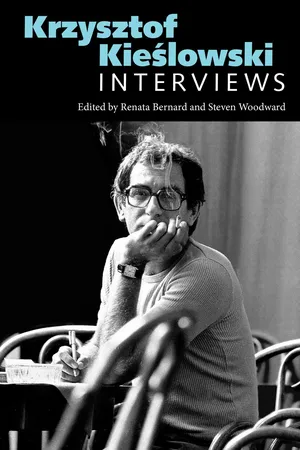
eBook - ePub
Krzysztof Kieślowski
Interviews
- 256 pages
- English
- ePUB (mobile friendly)
- Available on iOS & Android
eBook - ePub
About this book
Information
Subtopic
Film & VideoDiary: 1989–1990 (1)
Krzysztof Kieślowski / 1989–90
From Kino 12 (1991): 38–39. Reprinted by permission.
This and the following extracts from Krzysztof Kieślowski’s diaries were published first in German in the Zurich magazine Du and printed in the original Polish in Kino.
Krzysztof Kieślowski: These will be the simplest notes on Life this coming year. Please, don’t expect deep reflections. Something has crossed my path, or something has crossed my mind. That’s all.
Sunday: I’ve arranged a meeting with friends in front of a good hotel in Paris. I am waiting, [it is] morning. The biggest, newest black BMW with an Italian license plate arrives. Inside—an elegant, greyish man. He leans over smiling: are you Italian? I answer with a negative nod of the head and see that I’ve really upset him. I feel sorry, but at the same time, glad: he’s taken me for an Italian! French? He continues to ask and gets worried that I’m not even French. He switches to English, and because he speaks that language worse than me, I have a nice, and nasty, sense of advantage. A tourist? I confirm it. He tells me a story: he is a fashion designer and today he has just finished his show in Paris. He shows folders. Nice. During the closing, his wallet was stolen with money, credit cards; fortunately he kept his passport separately; he also shows his Italian passport. He thought I was a compatriot, and now.… And again a worried, doggy, congenial face. I ask what it’s about. About money; he has to have some money to get back to Rome, to stay overnight somewhere on the way, to eat something. How much? A lot. More or less as much as what I have. He apologizes that he’s intruded, and I feel so good! I am in a way proud that he’s addressed me for help, that he’s chosen me. I take my wallet out. He gives me his business card, he will pay me the money back and we’ll drink wine in Rome, whenever I come there! And he takes out a huge, plastic bag. This is a present for you. Inside: a few leather jackets, these are his designs, whatever is left from the show. I don’t want the jackets, I don’t look at them, but he definitely has to give me a present. If I don’t take [it], he will be offended and he already wants to give me the money back. This is worth a lot more, more than a thousand dollars, he says; it’s only a present for you being so good! I feel even better. He pushes the bag on me, and leaves. For the whole day I don’t have time, but in the evening I open the bag. The jackets are made of hideous, tawdry artificial leather. Still trustingly, I check his business card: the street in which he lives does not even exist in Rome! I hang the jacket up on a hanger, the seam comes apart.
Tuesday: Bad news this morning. A few months ago, my friend’s mother was murdered.1 He found her in [her] apartment tied up with a very crafty knot; she was dead. My friend is a lawyer. He acted in the trial of the priest Popiełuszko’s murderers, milicja officers [trans: “milicja” is the name for the police of the People’s Republic; in post-communist Poland “milicja” became “policja”].2 He was these officers’ private prosecutor. That’s precisely the knot they used to tie the priest before they drowned him. Yesterday, he had his car broken into. A few days ago, his apartment. Dangerous.
Monday: I’m buying a gas gun. A whole day of work. A purchase permit, fees, photographs, certificates. I’m coming back with a gun; it lies on the car seat next to me. At an empty crossroads, I want to let a motorbike through, even though I have the right of way. On the bike, two young boys in jean jackets. They think that I dawdle, that I dillydally. They go past me and the one on the backseat screams straight into my face through the open window: cunt! For a few seconds I have an unrestrained desire: to turn back, catch up with them and shoot the guy on the backseat straight in his face with the gun that lies next to me. How dangerous! I go back home and put the gun in a drawer. After a few hours I change the place: I put it where it would be handy.
Saturday: Today I’m coming back [home], tomorrow I’m leaving [again]. I don’t like travelling. I have a feeling that hours in hotels and on planes are time that stands still. Last week, I got on the plane eleven times. Before, I used to think that I was afraid of flying. Only recently I’ve understood that I’m afraid that I would be afraid. I return and it turns out, naturally, that time has passed by. Daughter has gotten good marks in math and English, and bad in Russian. Wife has had trouble at work. The dog has puked in the hallway. They will be developing the attic above our apartment. The washing machine has broken down. The grandmother of my daughter’s boyfriend has died. So many important things have happened.
Thursday: Morning, 6 am at the airport in America in Los Angeles. A taxi-driver already warns me, seeing numerous people in front of the airport building: a bomb. Indeed, there have been phone calls, they’ve planted a bomb. The police are throwing everyone out: travellers and staff, even chefs from the airport restaurant. Probably two thousand people. Hot. There is nowhere to go, there is only a building surrounded by the police, and the highway on which they’ve stopped traffic. We crowd up in bedlam; it’s getting hotter. Everything that should be happening is: children are crying, somebody is singing, someone is fainting in the squeeze, and so on. But after an hour, I notice that a strange movement persists among people, or more like a displacement, squeezing through with bundles, step by step. At first it’s difficult to understand it, and then it becomes clear. After an hour of that movement the crowd has divided itself: Whites separate, Blacks separate, Chinese, Japanese, and other Asians separate, Mexicans separate. Everyone is standing in harmony, crowded together, but now segregated. Nobody could have planned that, but that’s how it’s happened. I wonder if I have also moved. Yes. I’ve moved two meters, because next to me a Mexican child’s been screaming. I have moved towards people speaking French; they are probably from Europe.
Friday: At the airport in Warsaw, as usual, a half-an-hour wait for the luggage. The carousel keeps turning and with it go round: a cigarette butt, an umbrella, a Marriott Hotel badge, a suitcase strap buckle, and a white, clean handkerchief. Despite the non-smoking signs, I light up a cigarette. Next [to me], four guys who handle baggage continue sitting on the only four chairs: smoking is not allowed here, chief, one of them says. And sitting and doing nothing is? I ask. Doing nothing in Poland is always allowed, says the other. They roar with laughter. One has no top teeth, no central incisor, nor lateral incisor. The other has no canines. The third one has no teeth at all, but he is older; he might be already some fifty-years-old. The fourth one, about thirty, has all his teeth. I wait for the luggage another twenty minutes, altogether almost an hour. Because we now feel acquainted, the baggage guys say nothing more when I light up a second cigarette.
Thursday: Really, why did I think about censorship yesterday? It’s the two conversations I’ve had in the last few days with the most prominent Polish directors, those who also work domestically. Wajda heavily involved himself in politics for at least two years; he’s been a Senator for a year. I’ve never hidden that I consider it absurd wasting such talent as Wajda’s on politics. He says that he wants to do something for Poland, for the new Poland. I’ve told him that the only truly good thing that he can do is a good film, because he knows how. Recently, he’s announced that he won’t be running in the next election. I met him, he was sad. What will I be doing? he asked. Films, I answered. What about? He looked at me in such a way that I understood he really didn’t know. Two days ago, I met Zanussi. He’d finished shooting. When asked how it went, he shook his head in displeasure. I’ve shot something similar to what Wajda did a few days ago. Do you know what they want? Who? I asked. He pointed with his head there, outside. They, people.
Thursday: It has occurred to me that since I’ve mentioned censorship, it would be good to say how it used to work. I’ve had, just like my colleagues, a heap of adventures with censorship. Some of my films were not screened for years, others never. Frequently, I cut something out thinking that the change was not destroying the film; frequently, I refused. In 1976 I made the feature film The Calm for television. I liked that film, it had a few good scenes, and a thought—that a man couldn’t achieve peace even if it meant only home, wife, television—was near to me. The protagonist is a guy who comes out of prison. Once free, he works at a small building site. They bring prisoners there to help. Television objected to that scene. The [television] vice-president was a very intelligent and cunning man. He called me into his office. I knew why. When I approached the building, I noticed that prisoners were working on the railway tracks. They were dressed normally, in prison clothes, around them guards with rifles. I entered the vice-president’s office. He said he liked The Calm a lot and voiced a truly astute review of that film. Really, he understood everything. He truly liked the film. I was nicely tickled and waited for what was to follow; I knew I hadn’t been called in to listen to compliments. Of course. The vice-president with regret informed me that he had to demand the deletion of a few scenes from the film. He believed it would not hurt. On the contrary, the film would be more nimble. Among the scenes for deletion he included also the one with the building site with prisoners. I asked why there could be no scene in which prisoners work on a building site. Because in Poland, said the vice-president, prisoners don’t work outside prison. The convention forbids it.… He mentioned the name of an international convention. I asked him to come to the window. He did. I asked him what he saw. He said, tramway tracks. And on the tracks? Who is working there? He looked more closely. Prisoners, he said calmly, they’re here every day. So, prisoners in Poland work outside prison, I noted. Of course, he said, that’s why you have to delete that scene.
That’s more or less what those conversations looked like. That one was quite pleasant. I deleted the scene with prisoners and a few more, and the film still would not be shown for four years. When it was shown, it had already become a historical film. In Poland a lot changes fast.
Tuesday: Fourteen years have passed since the conversation with the vice-president. Yesterday I passed through a small town. I slowed down, because the road was being repaved. Like in a bad script, those who were repaving were dressed in prison clothes. Guards with rifles stood next to them. Today I can make a film about it. That’s it on censorship, which doesn’t exist anymore. And also on how much and how fast things change.
Notes
1. Krzysztof Piesiewicz’s mother was murdered on July 22, 1989.
2. Priest Jerzy Popiełuszko’s murder in October 1984 was one of the most politically and socially laden murder cases of that era.
Diary: 1989–1990 (2)
Krzysztof Kieślowski / 1989–90
From Kino 1 (1992): 29–30. Reprinted by permission.
This is the second extract from Krzysztof Kieślowski’s diaries printed in the Zurich magazine Du and reprinted in Polish in Kino.
Wednesday: For a few weeks now, or more precisely since the beginning of work on the script, we have been thinking about the film’s title. In Poland, it was much simpler: publicity around a film didn’t have much significance, so I would find the title when the film was already edited. At least I knew what it was about, which made it easier. Here you have to decide the title as early as possible and the producer is justifiably upset with me that I can’t make my mind up. The script is called Choir Girl. Admittedly, it doesn’t sound the best, although it describes quite aptly the profession of the protagonist; namely, she is a choir girl. It turns out that in France it has bad connotations; someone having read the title said, “oh, God, yet another Catholic film from Poland.” The implication is that no one is going to see the film. The protagonist’s name is Weronika and from the start I’ve thought her name to be a good title. However, it’s not possible. The ending of her name in French, “nique” (Veronique), describes in not a very elegant way actions that take place between a woman and a man. Obviously, we’ve abandoned it. The producer is a jazz lover, so he comes up with poetic titles from jazz pieces—“Unfinished Girl,” “Alone Together”—which seem to me somewhat pretentious, so we give up. I have about fifty titles in my notebook and really I don’t like any of them. The producer is pressing. We both agree that the word An Understudy [French: “Doublure”] sounds good and we almost decide, when suddenly someone remembers that men wear “doublure” under their trousers. Of course, An Understudy is out of the question. Everyone is involved in looking for the title. My wife and daughter propose all sorts of words; assistants read Shakespeare’s sonnets, believing that he had not too bad a mind. When I go through the city, I catch myself reading posters, advertisements and newspapers, looking incessantly for some intelligent title. I’ve announced to a group of colleagues a competition with a cash prize. In the end, we’ve adopted the title The Double Life of Véronique, which will probably not be final. It sounds not bad in Polish, in French, and in English, it’s quite commercially viable before you see the film, and after you see it, it describes quite precisely its content. It has one fault: neither I nor the producer are really convinced by it, and no doubt we will have to change it after we start shooting.
Sunday: Shooting continues for The Double Life of Véronique. Cinema is not the audience, festivals, reviews, and interviews. It’s getting up everyday at 6 am. It’s [a] cold [morning], rain, mud, and heavy lights. It’s nerve-wrecking activities, and at some stage everything has to be subordinated to it. Including family, emotions, private life. Of course, a train engineer, commercial agent, or banker will say the same about his work. He will certainly be right, but I do my work and I write about my [work]. I’m almost fifty. I probably should not be practicing this profession any more. I am running out of something necessary for making films: patience. I have no patience for actors, camera operators, weather, waiting, for nothing coming out the way I really want it. At the same time I can’t let it show. Especially me; I cannot. It’s hard work to hide my impatience from my crew. I think the more sensitive ones know that I’m not feeling well in my predicament. What would a reader of the Swiss monthly Du care? Not at all, with some exceptions. I quite regularly give classes in Switzerland for younger colleagues, screenwriters and directors. I am writing this to confirm once again what I have already told you. Even if you happen to get satisfaction out of making cinema, there is a high price for that. And satisfaction happens rarely.
Thursday: Fears that the French system of shooting will be completely different to the one I know, ours, have turned out to be unnecessary and premature. People from the crew want to work and they know their job. They are genial and surprised that I arrive on the location first with the cinematographer, and then after the shooting I don’t leave by car, but I try to help load up the truck. They don’t let me; they think there is a strict division of labor. I have a completely different view. I know that we all make the film, and of course everyone is responsible for their bit, but we are all responsible for the whole. There is another issue, somewhat embarrassing. On the location, everyone has something. The cinematographer has a camera and a photometer, the sound guy has a microphone, gaffers have lights and so on. I have nothing. Straightaway, I give the script to the script girl and I walk around the location empty-handed. That gives an impression, perhaps justifiably so, that I have nothing to do there. Of course, I’m directing. I chat with the cinematographer, I say something to actors, I give some commands, sometimes I change something in the dialogue, sometimes I come up with something. But I have nothing in my hands. Recently, I worked with Wiesiek [trans: diminutive of Wiesław] Zdort; I was making Decalogue I with him. He kept watching me; we were working together for the first time and we worked well together. He once said: “The director is a guy who helps everyone.” I liked that simple definition. I repeated it to the French assistants who protested when I was carrying boxes to their truck. They nodded their heads and let me do the boxes.
Sunday: I listen to the news from Poland on the radio. I turn it off after a minute. I don’t know if this is because I am all-consumed by the film, but I don’t care about it. Not at all.
Saturday: We’re shooting. We’ll be doing it on Sunday also, with a small crew, only a few people. They consent without problems, they don’t complain. It’s nice to meet people who like their job.
Thursday: A few Italian journalists arrive. They want to know what the difference is between making a film in the East [of Europe] and here, in the West. They shake their heads, displeased, when I say that there aren’t significant [differences]. So, I find a difference, to France’s disadvantage. I don’t like an hour-long lunch break, which distracts people in the middle of the day. They note this down, satisfied. Maybe in their Italy, there is no lunch break? Or, maybe after all they want something in the East to be better.
Friday: Editing is the only period of film production that I truly like. I think that a really good film is created in the editing room. Shooting is only gathering material, creating possibilities. I try to conduct it so I ensure the greatest freedom to maneuver for myself. Of course, editing is about gluing together two pieces of film and at that level there is a series of principles and ...
Table of contents
- Cover
- Title Page
- Copyright
- Contents
- Introduction
- Chronology
- Filmography
- The Dramaturgy of the Real
- 16 or 35?
- A Film about the Working Class
- Interview Not for Print
- Conversation with the Laureate
- Interview with Krzysztof Kieślowski
- First Meetings with Krzysztof Kieślowski
- In Depth Rather than Breadth
- About Me, about You, about Everyone
- Without Me
- On A Short Film about Killing
- The Key Thing Is to Make a Believable Film
- Weapon of Despair
- Interview with Krzysztof Kieślowski
- A Normal Moment
- Diary: 1989–1990 (1)
- Diary: 1989–1990 (2)
- Diary: 1989–1990 (3)
- Express Meeting with Kieślowski
- From Weronica to Véronique
- Tree That Is
- Beautiful Slogans and Mystery
- The Key to Sensitivity
- Behind the Curtain
- Blue Lollipop
- No End to the Enigma
- Glowing in the Dark
- Kieślowski: The End
- Colors of Life Interest Filmmaker
- Auteur of His Own Destruction
- Past, Present … Future?
- The Same Questions
- The Inner Life Is the Only Thing That Interests Me
- Fragments of the Meeting at the Ósmego Dnia Theatre
- Transcript of a Conversation for Polish Television
- We Slip from God’s Hand
- Key Resources
- Index
Trusted by 375,005 students
Access to over 1.5 million titles for a fair monthly price.
Study more efficiently using our study tools.
Frequently asked questions
Yes, you can cancel anytime from the Subscription tab in your account settings on the Perlego website. Your subscription will stay active until the end of your current billing period. Learn how to cancel your subscription
No, books cannot be downloaded as external files, such as PDFs, for use outside of Perlego. However, you can download books within the Perlego app for offline reading on mobile or tablet. Learn how to download books offline
Perlego offers two plans: Essential and Complete
- Essential is ideal for learners and professionals who enjoy exploring a wide range of subjects. Access the Essential Library with 800,000+ trusted titles and best-sellers across business, personal growth, and the humanities. Includes unlimited reading time and Standard Read Aloud voice.
- Complete: Perfect for advanced learners and researchers needing full, unrestricted access. Unlock 1.5M+ books across hundreds of subjects, including academic and specialized titles. The Complete Plan also includes advanced features like Premium Read Aloud and Research Assistant.
We are an online textbook subscription service, where you can get access to an entire online library for less than the price of a single book per month. With over 1.5 million books across 990+ topics, we’ve got you covered! Learn about our mission
Look out for the read-aloud symbol on your next book to see if you can listen to it. The read-aloud tool reads text aloud for you, highlighting the text as it is being read. You can pause it, speed it up and slow it down. Learn more about Read Aloud
Yes! You can use the Perlego app on both iOS and Android devices to read anytime, anywhere — even offline. Perfect for commutes or when you’re on the go.
Please note we cannot support devices running on iOS 13 and Android 7 or earlier. Learn more about using the app
Please note we cannot support devices running on iOS 13 and Android 7 or earlier. Learn more about using the app
Yes, you can access Krzysztof Kieślowski by Renata Bernard, Steven Woodward, Renata Bernard,Steven Woodward in PDF and/or ePUB format, as well as other popular books in Media & Performing Arts & Film & Video. We have over 1.5 million books available in our catalogue for you to explore.