In this stirring book, William H. Barnwell tells the stories of prison inmates and the Kairos Prison Ministry volunteers who work with them. Set mostly at the huge Louisiana State Penitentiary at Angola, Barnwell's narrative illustrates how offenders who have done the worst can and do change, becoming model inmates and, if released, productive citizens. The stories also reveal how Kairos volunteers have found healing for broken hearts.
Given that the United States incarcerates more people per capita than any country in the world, reformers are seeking radically new ways to reduce our prison populations. Kairos volunteers and inmates alike have much to contribute to the ongoing reform discussions. Now serving 300 state and federal prisons, 30,000 Kairos volunteers work with 20,000 inmates each year. They take part in long weekend retreats with the inmates and follow up with regular prison visits. Since its beginning in 1976, Kairos has served over 250,000 inmates. Broad-based, nondenominational, and nonjudgmental Christian, Kairos seeks to carry out its slogan—"listen, listen, love, love"—among inmates who have had few to listen to them, and fewer still to love them.
In Called to Heal the Brokenhearted are stories of undeniable redemption. They point the way to personal transformation for the inmates and the volunteers. One Kairos inmate speaks of the change this way: he makes guitars out of the good wood "hidden beneath the surface" of throwaway pianos. "I find my work incredibly fulfilling," he says. "I see myself in every piano, discarded by society but redeemed and put to use in a new way."
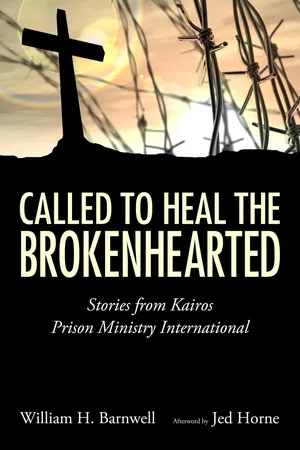
eBook - ePub
Called to Heal the Brokenhearted
Stories from Kairos Prison Ministry International
- 324 pages
- English
- ePUB (mobile friendly)
- Available on iOS & Android
eBook - ePub
Called to Heal the Brokenhearted
Stories from Kairos Prison Ministry International
About this book
Information
Topic
Theology & ReligionSubtopic
North American HistoryPART I
Before Kairos #53
During the 1970s, the Episcopal Church was experimenting with our new Baptism Covenant, which became official in 1979. At baptisms, everyone in the congregation is asked if they will “seek and serve Christ in all people.” Well there it is, I said, Christ in all people. Not just people of faith. Not just good people but all people. Mother’s language was different, but her point was the same, at least in my thinking. Years later, my friend Sister Helen Prejean, author of Dead Man Walking, would affirm that somehow Christ does live in all people, “however well disguised he may be.”
CHAPTER ONE
Beginning a Prison Ministry
I am pushing age seventy-six, but I still listen to my long-deceased genteel mother. “William,” she would say, “always look for the good in other people. It’s never too late to do the right thing. And if you can’t say something nice about someone else, don’t say anything at all.” She would often recite the jingle she had memorized as a little girl (from Edward Hoch): “There is so much bad in the best of us, and so much good in the worst of us that it hardly behooves any of us to talk about the rest of us.”
My mother was a person of her time and place: old, white, segregated Charleston, South Carolina. She could never have known that her optimism about people would direct me head-on to prison work when I was a young clergyman in New Orleans. In later decades, her views would inspire me to work with Kairos, whose former director, Ike Griffin, says will transform American prisons and how the voting public views those we incarcerate so easily—up these days to 2.3 million people, more per capita than anywhere else in the world.
I had to know if there was something “good” in prison inmates who had done the worst things. My seminary training from 1964 to 1967 confirmed what my mother had been drilling into me. If we are all created in the divine image, as we are told in Genesis (1:27), how can that divine image disappear entirely? Satan (read Evil) is not that strong! Can’t the divine image be brought forth no matter what we have done? And what about Jesus forgiving everyone, even those who carry out his cruel execution? There must have been hope even for them. “Forgive them Father for they know not what they do” (Luke 23:34). And what about the man crucified next to him? When he confesses to his crime, Jesus tells him that they will be together that day in Paradise (Luke 23:42–43).
During the 1970s, the Episcopal Church was experimenting with our new Baptism Covenant, which became official in 1979. At baptisms, everyone in the congregation is asked if they will “seek and serve Christ in all people.” Well there it is, I said, Christ in all people. Not just people of faith. Not just good people but all people. Mother’s language was different, but her point was the same, at least in my thinking. Years later, my friend Sister Helen Prejean, author of Dead Man Walking, would affirm that somehow Christ does live in all people “however well-disguised he may be.” I have long quoted Matthew 25:26, where Jesus says that a visit to someone in prison is a visit to him. “What a great example of the importance of prison ministry that is—when you visit someone who may be doing a life sentence for a violent crime, you are doing the work of Jesus,” I would say. Only recently, a Kairos friend gave another meaning to the passage: “Yeah, that’s right about the importance of prison ministry, but I take what Jesus said literally. When we go into prison, we don’t take Jesus with us. He is already there--right there in many of the inmates we serve.”
In the early 1970s, I was a chaplain at Tulane University and had law school friends who gave legal help to inmates in the huge Orleans Parish Prison. (In Louisiana, a “parish” is a county.) As part of an inmate-run program called Concept, the law school students knew that I led what we called “encounter groups” on the Tulane campus. We set up a so-called safe space with ten to fifteen people who met weekly sometimes for many months and got everyone to tell their stories as they could and to listen earnestly, without judgment, as others told their stories. The idea was that you learn a lot about yourself and you learn to somehow experience the stories of the people in the group. We used to say that encounter groups will help you understand where people in your life “are coming from”—ah, the psychobabble—so that you will appreciate them more and more. At least you can find common ground with them.
My law school friends told me that some of the inmates they had been working with in the Concept program were asking for something like an encounter group in “the Parish,” as the inmates called the prison. Could I help? Many inmates had been through Twelve Step Alcoholic Anonymous (AA) programs, but they wanted more.
Here was the opportunity I was waiting for—to prove that my mother was right. It is never too late for anyone to do the right thing. Never too late for people who may have done terrible things to be redeemed, I would say. Besides, working in the prison seemed a natural follow-up to my earlier work in the civil rights movement. Why were so many African Americans in prison? Had the civil rights movement completely failed them, as Michelle Alexander was to suggest many years later in The New Jim Crow: Mass Incarceration in the Age of Colorblindness?
So I took my law school friends up on their request. For the next four years I led weekly encounter groups in the Concept program. Most of the fifteen or so inmates in each group were multiple offenders, called “characters” by the authorities and themselves as well. Many were in Orleans Parish Prison instead of a state prison because they were awaiting long appeals. Most were black, but those in the groups didn’t think much about race. If blacks, Latinos, Asians, and whites don’t try to kill each other in prison, I realized early on, they often figure out a way to integrate about as well as in any institution, except maybe the military. With a “common enemy”—their jailers—it is not hard to see why. That and they can’t easily get away from one another in their crowded prisons.
The inmates in the encounter groups talked about whatever was on their minds and at times added—in nonencounter group style—what they called “tell-it-like-it-is,” which they had learned from Twelve Step programs in the prison. In ordinary criminal life, I quickly discovered, many offenders reverse what most of society calls good and evil. “Good” is simply not getting caught or being able to con yourself out of a dire situation if you are caught. “Evil” is all those who put you behind bars and try to keep you there: the police, the prosecuting attorneys, the judges, the prison authorities, family members oftentimes, almost everyone.
When the inmates were doing “tell-it-like-it-is,” one of them might say to one of the others: “You don’t con us like you do those dudes in Rehab. We know who you are—a junkie. Face it, you ain’t worth a damn and you never have been. You can’t change your life unless you know you need to change, and what you need to change!” Then there would be smiles and sometimes hugs, and the conversation would move on.
Since I am easily impressed—conned, some would say—I became an eager advocate for the inmates in the groups I led. “They really are doing the near impossible,” I announced to my congregation during those days at the Episcopal Chapel of the Holy Spirit that served Tulane and other colleges in the area. “These men are really changing their lives. You watch, when they get out of prison, they aren’t likely to come back.” I was never to know, as Concept kept no statistics.
The prison—too informally run for later administrations—let me take some of the Concept inmates on unescorted speaking engagements (thirty or more times) around the city and state so that they could testify on just how bad prison was and what young people, especially young black men, should do to stay out of prison. Though some of the men I took on these speaking engagements were serving long prison sentences, not one tried to escape. I surely could not have stopped them if any had tried. Their commitment to each other, to Concept, and to me kept them “honest,” as they liked to say.
I grew close to some of the men. I remember especially Ervin St. Julian. On one occasion he had tried to escape by climbing down a rope from the third floor. A guard spotted him and shot through the rope, causing Ervin to fall and break his leg badly. He still walked with a limp. The father of seven children, he was serving a thirty-year sentence. Like the other inmates, he did pretty well day by day. But at our group meeting following the news that he had lost an appeal, he could not help but look into the empty future. When it came Ervin’s turn to say what was on his mind, he did something prison inmates seldom do—he quietly wept. “Thirty years,” he said, “how can I ever survive thirty years? My children will have all forgotten about me, if I live that long.”
And then there was a very dark complected man with the jailhouse name of Buggie, “’cause he looks like the Buggie [Boogie] Man.” For his first three years in prison, Buggie helped lead a jailhouse clique that dealt drugs and terrorized the other inmates. But with the help of the law students and others, he eventually began to question his ways and later became a key leader in the Concept program and a helper to others in the groups I led. “The person you hurtin’ most,” he would tell the new inmates, “is your own self. I know ’cause I know what I done to my own self.”
One day after he’d been in prison for five years, Buggie was called into the sheriff’s office and unexpectedly released. He was overjoyed, for he was supposed to serve two more years. Right away he got himself a job learning a trade as an automobile mechanic; after his long incarceration, he reconciled with his mother and three sisters. It looked as if he would make it this time. Three weeks passed. He told me that he was trying to help other ex-inmates stay out of trouble in an outside Concept program.
But one evening about suppertime there was a loud knock at the front door of his mother’s home. Buggie answered it. “You’re under arrest,” a voice from the dark outside said. They had made a mistake and released him two years early. Once back in the “Parish,” Buggie wouldn’t say anything to anyone for weeks. One evening he showed up for the group I led and acted as though he had never left the prison. I asked him how he was dealing with such a grave disappointment. “Mr. Barnwell,” he said, “I don’t know nothin’ else.”
At one of our Concept Christmas parties, the inmates put on a skit for fifty or so free people, including two criminal judges, who had befriended us. The scene was an Orleans Parish courtroom. Inmates were the judge, the jury, the lawyers, and the defendants. An old-time “character” well known to the police department—a tall, slender, distinguished-looking black man with graying hair—played the part of the judge.
“I want you to know,” he said to the white “defendant” in his most solemn voice from behind “the bench,” “that you will get a fair trial in my court. Everyone here is impartial and objective, and you will be presumed innocent until proven guilty beyond any reasonable doubt. Now, if you expect me to believe that you really was with your mama the night that color television was stole, White Cracker, you’s crazier than I thought you was!” And so it went until the inmates had spoofed the entire system that kept them behind bars. All had what one of the men called “a lovely time.”
It was something of a stretch, but I used to tell this story when I was explaining Jesus’s “triumphant entry” into Jerusalem. Following Harvey Cox in his book Feast of Fools, I would say that Jesus entered Jerusalem not at all as a king, but quite the opposite. Mounted on a donkey with his ragtag bunch of followers shuffling along with him, he was having a grand time making fun of all earthly authority that took itself so seriously, so dangerously seriously. The Concept Christmas play was like that, I said. The inmates too were having a grand time making fun of all authority, and in the process making fun of themselves. But like Jesus and his ragtag band of followers, they were also dead serious about what they were saying in the play. (See Mark 11:1–11.)
My most transformative experience in the Concept encounter groups occurred one evening shortly after I joined the program. James Bullock, president of the Inmates’ Council and one of the founders of Concept, had spent more than twenty years behind bars, four of which were on Death Row at Angola. He had killed a policeman—he claimed, in self-defense. After an automobile chase, James said he got out of the car with his hands up, ready to be arrested by two police officers. “Die, Nigger,” one of them said, and took a shot at him from some distance that missed. James then grabbed his pistol from the front seat of his car and shot and killed the police officer who had shot at him, but James did not shoot the second police officer; instead he shouted at him to drop his weapon, which he did.
James surely would have been executed for killing a police officer, except for the fact that in the 1970s the US Supreme Court declared that there would be no more executions until the states rewrote their death penalty statutes. When I met him, James was doing mandatory life, in Orleans Parish Prison on an appeal. (Twenty years later a jury believed James’s story and reduced his sentence to manslaughter. I would see him again in 2003 not long before he died but as a free man.)
That evening in the encounter group, we had just started “sharing” when suddenly prison guards rushed into the dayroom, herded all the inmates except for James back to their cells for lockdown, and rushed me out of the prison. The next day I found out what had happened. One of the guards was being held at knifepoint by an inmate. When the guards rushed the Concept members back to their cells and me out of there, they asked James to come with them to help in a very tense situation. The inmate held a sharp knife, a “shank,” right at the windpipe of a young, terrified prison guard. It took James half an hour or so, but quietly and carefully he talked the inmate into handing over the knife. “We were just about to execute this man as worthless, an absolute evil being,” I would pronounce to all who would listen and to those who would not. “Yet it was he, James Bullock, who saved his jailer’s life.”
What my mother had taught me in my growing-up years made more and more sense: “Just remember, William, it is never too late to do the right thing.” “Never too late,” I would say from the pulpit, at public forums, in letters to the New Orleans Times-Picayune, testifying before state legislature committees, advocating for shorter sentences and for prison reform in general: “It’s never too late for men and women who have done terrible things to turn around—repent!—and begin a new and healthy life. Our prison system has it all wrong. We bring out the worst in the inmates instead of trying to bring out the best in them.
“Think of St. Paul,” I would say. “An accessory in the stoning murder of Stephen, the first Christian martyr, Paul would have gotten a long sentence, twenty years to life in Louisiana; yet Paul went on to become, along with Peter, the founder of our faith” (Acts 7:54–8:1). James Bullock in particular and my prison work in general convinced me more than ever that the growing dualism in this country—the Manichean Heresy I learned to call it at seminary, dividing people into “the Good” and “the Evil”—is absolutely wrong.
In the late 1970s my life took a turn when I began teaching English at the University of New Orleans. (Along the way, I had gotten a Master of Arts in Teaching at Tulane.) I did not have time to do extensive prison ministry. But I always longed to be back in my encounter groups both because they gave me a lot of satisfaction and also because I could say, as more and more I got to be friends with the men: “Yes, our Baptism Covenant is right. Christ, no matter how well disguised, does live in all people. We just have to have the eyes to see, know the right way to support, and the patience to wait.”
Was I ever conned by the inmates in Orleans Parish Prison by their claims at times that they were not guilty, that everything wrong that happened to them was not their fault? Sure, I was conned. Still Mother was right, and being conned did me no real harm.
Some fifteen years later I discovered Kairos, which at the time—the early 1990s—was serving 200 or so prisons. I took what I had learned from “the Parish” and eagerly got involved with Kairos first in a program in Texas, then one in Ohio. I helped start Kairos at the Louisiana State Penitentiary at Angola in 1993 and have been involved whenever possible ever since.
It was during this time, the early 1990s, that I had to wrestle with a question often hurled at me: “Okay Barnwell, we understand what you think about criminals, but what about their victims and the victims’ families? Don’t you care about them? What are you doing to support them?” From 1983 to 1996 I served as an associate pastor at Trinity Church in New Orleans, the largest Episcopal church in the state. The question about “the victims” came mostly from church members, some of whom were themselves victims or “survivors,” as they now like to be called. Who wants to be known as a victim?
Others could not understand why Kairos pays little or no attention to three of the four traditional reasons for incarceration: deterrence, incapacitation, and retribution. Kairos is all about the fourth reason for incarceration: rehabilitation. And Kairos’s way of rehabilitation with its “listen, listen, love, love” is unlike that of most corrections programs. While Kairos is a broad-based Christian program, it does not evangelize in the traditional way, but sets out to show love to those who have had so little love during their entire lifetimes.
As Checo Yancy, a longtime Angola inmate and now an active Kairos voluntee...
Table of contents
- Cover
- Title Page
- Copyright
- Dedication
- Contents
- Introduction
- Part I: Before Kairos #53
- Part II: Kairos #53, November 10–13, 2011
- Part III: After Kairos #53
- Afterword: A Secular Journalist Responds to Kairos, by Jed Horne
- Appendix A: The Resolution on Kairos Ecumenism
- Appendix B: A “Working Paper” from the Louisiana Sentencing Commission
- In Appreciation
- Index
Trusted by 375,005 students
Access to over 1.5 million titles for a fair monthly price.
Study more efficiently using our study tools.
Frequently asked questions
Yes, you can cancel anytime from the Subscription tab in your account settings on the Perlego website. Your subscription will stay active until the end of your current billing period. Learn how to cancel your subscription
No, books cannot be downloaded as external files, such as PDFs, for use outside of Perlego. However, you can download books within the Perlego app for offline reading on mobile or tablet. Learn how to download books offline
Perlego offers two plans: Essential and Complete
- Essential is ideal for learners and professionals who enjoy exploring a wide range of subjects. Access the Essential Library with 800,000+ trusted titles and best-sellers across business, personal growth, and the humanities. Includes unlimited reading time and Standard Read Aloud voice.
- Complete: Perfect for advanced learners and researchers needing full, unrestricted access. Unlock 1.5M+ books across hundreds of subjects, including academic and specialized titles. The Complete Plan also includes advanced features like Premium Read Aloud and Research Assistant.
We are an online textbook subscription service, where you can get access to an entire online library for less than the price of a single book per month. With over 1.5 million books across 990+ topics, we’ve got you covered! Learn about our mission
Look out for the read-aloud symbol on your next book to see if you can listen to it. The read-aloud tool reads text aloud for you, highlighting the text as it is being read. You can pause it, speed it up and slow it down. Learn more about Read Aloud
Yes! You can use the Perlego app on both iOS and Android devices to read anytime, anywhere — even offline. Perfect for commutes or when you’re on the go.
Please note we cannot support devices running on iOS 13 and Android 7 or earlier. Learn more about using the app
Please note we cannot support devices running on iOS 13 and Android 7 or earlier. Learn more about using the app
Yes, you can access Called to Heal the Brokenhearted by William H. Barnwell in PDF and/or ePUB format, as well as other popular books in Theology & Religion & North American History. We have over 1.5 million books available in our catalogue for you to explore.