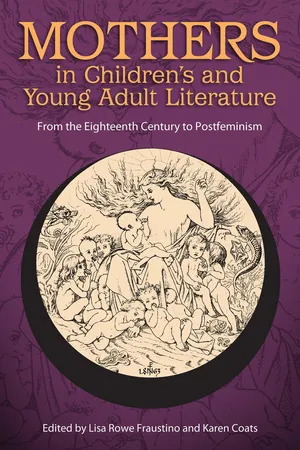
Winner of the Children's Literature Association's 2018 Edited Book Award Contributions by Robin Calland, Lauren Causey, Karen Coats, Sara K. Day, Lisa Rowe Fraustino, Dorina K. Lazo Gilmore, Anna Katrina Gutierrez, Adrienne Kertzer, Kouen Kim, Alexandra Kotanko, Jennifer Mitchell, Mary Jeanette Moran, Julie Pfeiffer, and Donelle RuweLiving or dead, present or absent, sadly dysfunctional or merrily adequate, the figure of the mother bears enormous freight across a child's emotional and intellectual life. Given the vital role literary mothers play in books for young readers, it is remarkable how little scholarly attention has been paid to the representation of mothers outside of fairy tales and beyond studies of gender stereotypes. This collection of thirteen essays begins to fill a critical gap by bringing together a range of theoretical perspectives by a rich mix of senior scholars and new voices.Following an introduction in which the coeditors describe key trends in interdisciplinary scholarship, the book's first section focuses on the pedagogical roots of maternal influence in early children's literature. The next section explores the shifting cultural perspectives and subjectivities of the twentieth century. The third section examines the interplay of fantasy, reality, and the ethical dimensions of literary mothers. The collection ends with readings of postfeminist motherhood, from contemporary realism to dystopian fantasy.The range of critical approaches in this volume will provide multiple inroads for scholars to investigate richer readings of mothers in children's and young adult literature.
eBook - ePub
Mothers in Children's and Young Adult Literature
From the Eighteenth Century to Postfeminism
- 240 pages
- English
- ePUB (mobile friendly)
- Available on iOS & Android
eBook - ePub
Mothers in Children's and Young Adult Literature
From the Eighteenth Century to Postfeminism
About this book
Information
PART I
Historical Legacies: Maternal Instruction and Delight
Chapter 1
Barbauld and the Body-Part Game: Maternal Pedagogy in the Long Eighteenth Century
In her landmark 1986 essay, “Impeccable Governesses, Rational Dames, and Moral Mothers: Mary Wollstonecraft and the Female Tradition in Georgian Children’s Books,” Mitzi Myers argues that a new type of protagonist had arisen at the end of the Enlightenment: the mother as an educating heroine. This moral mother was “a dream of strength and power,” and she represented “the heroic potential available in ordinary female life” (43, 50). These educating heroines are piercingly intelligent, benevolent, stern, and emotionally distant figures of authority, and they appear in a wide range of genres, from poetry and epistolary fiction to novels and didactic drama. A typical rational-dame text (such as Maria Edgeworth’s “The Purple Jar” from The Parent’s Assistant, 1796) depicts a mother and a daughter who take a walk together, and the mother uses the child’s interest in the world around her as an opportunity for teaching. These texts as a body of literature are united by the shared characteristics of their mother figures as well as by a certain mode of female authority. Indeed, Anne Mellor suggests that this speaking mode—the voice of the mature, didactic, benevolent, and confident maternal figure—that began in children’s books soon extended into a wider political arena, and rational dames such as Hannah More and Anna Letitia Barbauld adopted the powerful position of a moral mother who addresses the nation.1
The rise of the moral mother as a literary hero type was a reflection of the increasing visibility of parenting in the long eighteenth century. In Some Thoughts Concerning Education (1693), Locke explains that parents have the responsibility of establishing a child’s lifelong habits of behavior and attitudes by vigilantly structuring their child’s environment. Rousseau contends in Émile (1762) that “we begin to learn when we begin to live” (10) and that mothers have an essential role to play in early childhood. For example, a mother must breastfeed her children lest their link to their fathers, siblings, mothers, and, by extension, motherland be lost: when women “deign to nurse their own children, then will be a reform of morals, natural feeling will revive in every heart; there will be no lack of citizens for the state” (15). For Rousseau, writes Mary Trouille in Sexual Politics in the Enlightenment, “the refusal of motherhood was both a symptom and a primary source of the moral corruption and egoism of society in eighteenth-century France” (24). Madame de Genlis, in Adèle et Théodore, ou Lettres sur l’éducation (originally published in French in 1782), reminds her readers that “the fixing of our first principles and turn of mind depends greatly on the impressions we receive in infancy” (1.58), and Elizabeth Hamilton, in Letters on the Elementary Principles of Education (1801), excoriates mothers who have never assisted their children “in the acquirement of a single idea during infancy” and who assume that active teaching begins only after children are ready to learn to read (1.41). By contrast, writes Hamilton, as soon as a child is old enough to see, touch, taste, or smell, learning happens—and active teaching should begin.
These foundational figures of eighteenth-century rational pedagogy, despite having profound political, religious, and national differences, all share a basic assumption: children are physical creatures whose habits and sensibilities develop through interactions with their environment, and the best way to shape a child’s development is by manipulating and carefully structuring this environment. The importance of the mother as an inculcator of the child’s first sense impressions is undeniable. The sociopolitical power of rational education, as with all forms of education, is that it imprints the ideologies of society on an individual’s consciousness.2 Eighteenth-century mothers as the primary teachers of young children had authority over the child and his or her world, and their abilities to shape a child’s environment and manipulate his or her responses shaped the child’s “habitus,” a term that refers to an individual’s internalized set of responses and behaviors that allow an individual to function in the world and that reflect a personalized version of a society’s ideology.3
Despite a broadly shared understanding in the eighteenth century that early childhood experiences lay the foundation for the child’s development and that the mother has a vital role in the earliest stages of education, most pedagogical fiction from the Enlightenment depicts mother figures and female educators interacting with school-aged children, not infants and toddlers. At Mrs. Teachum’s school for girls in The Governess, or Little Female Academy (1749), pupils range in age from eight to fourteen. Mary Wollstonecraft’s Mrs. Mason from Original Stories from Real Life (1788) teaches a twelve- and a fourteen-year-old. The educating heroines in other rational dame texts—Charlotte Smith’s mothers and aunts from Rural Walks (1795), Rambles Further (1796), Minor Morals (1798), and Conversations, Introducing Poetry (1804); the schoolmistress in Maria Edgeworth’s “The Bracelets” (1787); the benevolent aunt in Adelaide O’Keeffe’s Dudley (1819); and the moral mother in Mary Belson Elliott’s Precept and Example, or a Midsummer’s Holiday (1812)—teach children who have already learned to read and are primed to receive more complex lessons. These children have settled habits, and often the role of the mother-teacher is to “cure those faults by reason, which ought never to have taken root in the infant mind” (Wollstonecraft iii).
Most scholarly attention has understandably focused on this particular strand of the educating heroine, the mother figure who well knows the faults of her school-age charges and takes steps to address them. However, a different mode of interaction is necessary when the mother and child dynamic involves a toddler. The mother-teacher cannot instruct a toddler through lectures and abstractions. Her tools are more tactile and direct: educational games, repetitive practice, and physical objects. Instead of teaching complex social behaviors like humility, conversational skills, benevolence, or a neat simplicity in dress, the mother-educator of a toddler has a rather different educational agenda. Toddlers are being taught to be ready to learn. They practice their letters, count to ten, mimic animal noises, grip a crayon, and identify body parts.
In Anna Letitia Barbauld’s groundbreaking Lessons for Children (1778–79), mothering is intimate and immediate. Barbauld captures the language of real-life mothers and their toddlers, and her simple, lucid prose in a natural idiom is compelling. As Sarah Trimmer would later write of Barbauld’s Lessons, before its publication everything for little children had been written in diminutive font and too often in miniature books. By contrast, Barbauld insisted that “the eye of a child cannot catch, as ours can, a small, obscure, ill-formed word, amidst a number of others all equally unknown to him” (Lessons 1: 4). Trimmer praised her “stile of familiar conversation... free from all formality” (Easy xii), and Frances Burney described Barbauld’s anecdotal dialogue between mother and child as “the new walk” of children’s books (5: 419).4
Unlike other primers and spelling books of the period, Lessons does not supply word or syllable lists. It simply depicts the intimate conversations between a mother and her child from their intermingled points of view. Lessons was inspired by actual parent-child interactions between Barbauld and her adopted son, Charles Aikin. Volume 1 of Lessons, which was titled Lessons for Children of Two to Three Years Old and published by the important radical publisher Joseph Johnson in 1778, recounts the events of a single day, from morning to evening as Barbauld and two-year-old Charles explore the small world of home, farm, and field. Barbauld as the mother in the text is nothing like earlier educating heroines such as Sarah Fielding’s Mrs. Teachum. Mrs. Teachum observes her charges from a distance lest her presence disrupt their group dynamic, and she requests regular reports about her pupils’ progress from her acolyte and stand-in, Jenny Peace. Barbauld, by contrast, plays baby games, word games, and body-part games. She teaches math through counting and eating raisins. She demonstrates the proper way to pet the family cat.
The toddler-appropriate approach to mothering in Lessons for Children of Two to Three Years Old anticipates modern pedagogical practices in its use of manipulatives, motherese, response priming, and, in particular, the co-opting of child’s play for pedagogical purposes. Play is an important teaching strategy when one is working with a toddler, and it was recognized as such in works of education throughout the long eighteenth century. In Thoughts Concerning Education, Locke famously advocated for the use of play as a pedagogical tool so as to make learning a “play and a recreation to children” (114). He offered several suggestions for using play as a teaching strategy, including the use of alphabet dice to teach letters and syllables (115). Over the course of the eighteenth century, his insight—that play can be used to enhance learning—is reiterated in children’s texts and in the writings of various rational education proponents. In The History of Little Goody Two-Shoes (1765), Margery Meanwell teaches reading to children by having them play a game in which they create words out of wooden alphabet blocks. Adam Smith, in The Theory of Moral Sentiments (1759), explains that childhood play is a profoundly important element in the growth of moral sensibility, for it is through our early interactions with others that we learn how our actions impact others and how to act altruistically in order to satisfy our own self-interests. One of the first fully developed books of original poems for children, Dorothy and Mary Ann Kilner’s Poems on Various Subjects, for the Amusement of Youth (circa 1783), opens with a long poem depicting children who amuse themselves by playing a word game.
In Barbauld’s Lessons for Children of Two to Three Years Old, we see how a particular mother maintains a level of tension between parent as play-companion and parent as adult-teacher so as to maximize learning. Barbauld takes play and directs it toward a productive, instrumental, and purposeful pedagogical goal. Some twenty-first-century game theorists, following the lead of Johan Huizinga, define play as an act of autotelicity, activity for its own sake, unproductive, noninstrumental, and purposeless.5 However, as Peter Hopsicker and Chad Carlson suggest, a parent’s participation in a child’s game fundamentally alters the nature of play. If parenting is the top priority, parents might use play to teach life skills or even how to better play the game, but they run the risk of taking away the fun. Even parents who attempt to play without obvious instrumental purposes still cannot merely play—for example, they must think beyond the game so as to see ways to sustain play or to keep the game at the child’s level. Hopsicker and Carlson argue that creative adults are the best parent-teachers: they maintain a stretched and tenuous point between the two poles of parent-play (parent as play-companion, and parent as adult-teacher) so as to keep a high quality of play and a high level of skill learning.
In Lessons for Children of Two to Three Years Old, Barbauld as mother keeps the tension between the two poles of parent play and, in doing so, maximizes play as fun as well as learning. Charles is demanding and egoistic, and the mother constantly engages in a subtle flanking action in which the child’s own self-centered desires are redirected into learning activities—both learning about the world as well as learning how to play effectively and keep a game going. For example, in the following passage, Barbauld initiates a body-part game:
Charles, what are eyes for?
To see with.
What are ears for?
To hear with.
What is tongue for?
To talk with.
What are teeth for?
To eat with.
What is nose for?
To smell with.
What are legs for?
To walk with.
Then do not make mamma
carry you. Walk yourself.
Here are two good legs.
Will you go abroad?
Fetch your hat.
Come, let us go into the fields,
and see the sheep, and the
lambs, and the cows, and
trees, and birds, and water. (1: 37–39)
Barbauld simplifies diction by omitting articles and speaks in short sentences that communicate in direct and uncomplicated ways. Little Charles answers each question with the same sentence phrase, changing only the verb: to see, to hear, to talk. Charles is learning not only body parts, but how to play interactive games that require give and take between two players. The sudden snap from the body-part game to parental exasperation is instantly recognizable by any parent of a toddler, and it functions as both closure and transition. One element of creative play is the ability to have self-perpetuating script writing and the improvisation of good lines that perpetuate the game—as Barbauld does by asking a repetitive question that Charles can successfully answer. However, Barbauld destroys the game’s pattern by inserting a “bad line” (a line that ends the game). Her bad line is both an ending and a beginning. The shift to the mother’s perspective, “Then do not make mamma carry you,” ends the game, but it also readies the child for a new activity, the walk.
The linguistic simplicity of this passage has multiple functions: it helps Charles learn body parts, develop cognitive and linguistic patterns, and develop affectively and socially. These intimate scenes of learning show how Barbauld as mother adapts her teaching approach to a child’s earliest level of language use: drawing attention to the self (as when Charles thinks about his own body), identifying objects, offering objects, and requesting objects.
This passage is also an ingenious display of parenting techniques. The question-and-answer format coaxes the little boy into appropriate behavior (standing on his own instead of clinging to his mother) by getting the child to participate in playful interactions that culminate in a desired behavior. Behavioral psychologist Alan Kazden calls this parenting technique “response priming.” Children are more likely to engage in a desired behavior if they participate in an activity that is an initial step in a chain of activities leading to a desired outcome. Charles willingly plays the body-part game, and it leads to his own acknowledgment of what legs are for—standing up and walking. A second response priming in this passage is the mother’s command to Charles, “Fetch your hat,” which is the first step in the chain of actions that lead to taking a walk. Rather than tell a toddler to “go and get ready,” a vague command to give a two-year-old and one that is fraught with potential false starts, Barbauld gives a specific command, that of fetching a hat, and links following the command to...
Table of contents
- Cover
- Half title
- Title
- Copyright
- Contents
- Acknowledgments
- Introduction: Mothers Wanted
- Part I—Historical Legacies: Maternal Instruction and Delight
- Part II—Mothering in Modernity: Shifting Cultures and Subjectivities
- Part III—The Mother-Child Bond: Fantasy and Desire for the Real
- Part IV—Performing Postfeminist Motherhood
- Contributors
- Index
Trusted by 375,005 students
Access to over 1.5 million titles for a fair monthly price.
Study more efficiently using our study tools.
Frequently asked questions
Yes, you can cancel anytime from the Subscription tab in your account settings on the Perlego website. Your subscription will stay active until the end of your current billing period. Learn how to cancel your subscription
No, books cannot be downloaded as external files, such as PDFs, for use outside of Perlego. However, you can download books within the Perlego app for offline reading on mobile or tablet. Learn how to download books offline
Perlego offers two plans: Essential and Complete
- Essential is ideal for learners and professionals who enjoy exploring a wide range of subjects. Access the Essential Library with 800,000+ trusted titles and best-sellers across business, personal growth, and the humanities. Includes unlimited reading time and Standard Read Aloud voice.
- Complete: Perfect for advanced learners and researchers needing full, unrestricted access. Unlock 1.5M+ books across hundreds of subjects, including academic and specialized titles. The Complete Plan also includes advanced features like Premium Read Aloud and Research Assistant.
We are an online textbook subscription service, where you can get access to an entire online library for less than the price of a single book per month. With over 1.5 million books across 990+ topics, we’ve got you covered! Learn about our mission
Look out for the read-aloud symbol on your next book to see if you can listen to it. The read-aloud tool reads text aloud for you, highlighting the text as it is being read. You can pause it, speed it up and slow it down. Learn more about Read Aloud
Yes! You can use the Perlego app on both iOS and Android devices to read anytime, anywhere — even offline. Perfect for commutes or when you’re on the go.
Please note we cannot support devices running on iOS 13 and Android 7 or earlier. Learn more about using the app
Please note we cannot support devices running on iOS 13 and Android 7 or earlier. Learn more about using the app
Yes, you can access Mothers in Children's and Young Adult Literature by Lisa Rowe Fraustino,Karen Coats in PDF and/or ePUB format, as well as other popular books in Literature & Literary Criticism. We have over 1.5 million books available in our catalogue for you to explore.