Contributions by Leah Aldridge, Karen M. Bowdre, Aymar Jean Christian, Keith Corson, Rachel Jessica Daniel, Artel Great, Brandeise Monk-Payton, Miriam J. Petty, Eric Pierson, Paul N. Reinsch, TreaAndrea M. Russworm, Rashida Z. Shaw, Samantha N. Sheppard, Ben Raphael Sher, and Khadijah Costley White
For over a decade, Tyler Perry has been a lightning rod for both criticism and praise. To some he is most widely known for his drag performances as Madea, a self-proclaimed "mad black woman," not afraid to brandish a gun or a scalding pot of grits. But to others who watch the film industry, he is the businessman who by age thirty-six had sold more than $100 million in tickets, $30 million in videos, $20 million in merchandise, and was producing 300 projects each year viewed by 35,000 every week.
Is the commercially successful African American actor, director, screenwriter, playwright, and producer "malt liquor for the masses," an "embarrassment to the race!," or is he a genius who has directed the most culturally significant American melodramas since Douglas Sirk? Are his films and television shows even melodramas, or are they conservative Christian diatribes, cheeky camp, or social satires? Do Perry's flattened narratives and character tropes irresponsibly collapse important social discourses into one-dimensional tales that affirm the notion of a "post-racial" society?
In light of these debates, From Madea to Media Mogul makes the argument that Tyler Perry must be understood as a figure at the nexus of converging factors, cultural events, and historical traditions. Contributors demonstrate how a critical engagement with Perry's work and media practices highlights a need for studies to grapple with developing theories and methods on disreputable media. These essays challenge value-judgment criticisms and offer new insights on the industrial and formal qualities of Perry's work.
eBook - ePub
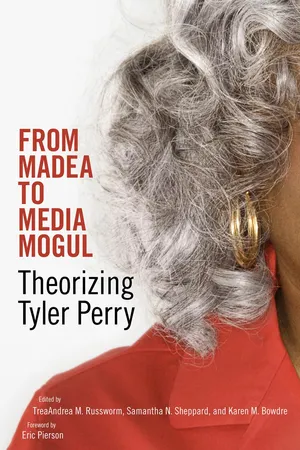
From Madea to Media Mogul
Theorizing Tyler Perry
- 240 pages
- English
- ePUB (mobile friendly)
- Available on iOS & Android
eBook - ePub
From Madea to Media Mogul
Theorizing Tyler Perry
About this book
Information
Subtopic
Film History & CriticismIndex
Social SciencesCHAPTER ONE
“Tyler Perry Presents . . .”: The Cultural Projects, Partnerships, and Politics of Perry’s Media Platforms
Tyler Perry is a cultural figure entrenched in the commodification of self. Perry distinguishes his vast media empire through his ability to mold himself into a marketable persona and product, most famously the drag personality Mabel “Madea” Simmons and the theatre, film, and print work based on her character. As Madea, he successfully markets his comedic melodramas to Black women and Christian audiences. In a USA Today profile on Perry, one woman explained: “We trust him . . . It’s not about being black—though it’s nice to see yourself in a Hollywood movie once in a while. I know I can take my kids. I know there will be a good message. Critics can say whatever they want; he’s the only one making movies about people trying to live right.”1 As this explanation demonstrates, Perry provides for his viewers both on-screen and on-stage what critic Hilton Als describes as “a lens through which to see themselves refracted, and a forum in which their religious and political beliefs would be neither challenged nor ignored.”2
A reliable brand, Perry’s success registers in two particular ways. First, as Los Angeles Times movie columnist Patrick Goldstein suggests, Perry’s substantial box-office results have garnered him (and less so his work) critical attention, transforming him from the realm of movie mogul to that of a “movie king.”3 Second, his studio, Tyler Perry Studios, production companies, 34th Street Films and My.Te.Pe. Productions, and distribution outlet, the Tyler Perry Company, provide him with an unprecedented infrastructure to control his means of production. For these reasons alone, Perry operates as a central, albeit controversial, figure in the visibility, circulation, and exhibition of Black media in American public and popular culture.
In Cultural Moves: African Americans and the Politics of Representation, Herman Gray explains that “Black American cultural representations involve complex texts, discourses, and narratives that are typically expressed in multiple and overlapping sites and media.”4 As such, I consider the role of Perry’s media platforms in the proliferation of Black media content and cultural production. To be clear, I am less concerned with textually analyzing Perry’s specific work, meaning his films, television shows, and plays. Instead, I am interested in the projects and partnerships that use Perry and his established media convergence economy to market themselves to wider Black audiences. These projects and partnerships include his co-presentation/executive producing of Lee Daniel’s Precious: Based on the Novel “Push” by Sapphire (2009) and the exclusive deal he struck in 2012 with the Oprah Winfrey Network (OWN) to create scripted content for the cable channel. In this regard, I analyze the ways in which Perry operates not only across multiple media platforms (e.g., theatre, film, and television) but also functions as a media platform (i.e., operates as cultural and industrial leverage for others via partnerships and co-productions). Using Gray’s method of examining the politics of representation through a focus on tactics, strategies, and maneuvers, I scrutinize the cultural politics of these projects and partnerships as examples of contemporary Black cultural producers’ “struggles for cultural visibility, recognition, and inclusion in the national media.”5
With a focus on the tensions and complexities of these struggles within contemporary culture, I turn my attention to Tina Gordon Chism’s 2013 comedy Tyler Perry Presents Peeples, which was co-produced by Perry’s 34th Street Films and is a “Tyler Perry-adjacent” project. I define Chism’s Peeples as “Tyler Perry-adjacent” in that it is related and attached to Perry’s media empire but was not written or directed by him. I deliberately use the orienting term “adjacent” to highlight the diffusion of Perry’s influence on contemporary media and Black representation whereby the term operates as both a site, a location in which to map the branching of Perry’s ancillary media universe, of his media platforms and a citation, an alignment with the character, features, and aesthetic imagination of Perry’s media content, of his cultural production. In my discussion of Peeples, I examine how Perry’s industrial practices and presentational aesthetic resulted in a paradoxical illumination and occlusion of Chism’s directorial debut. I consider how Perry as a media platform engenders semiotic and social forces that structure “the conditions of possibility within which black cultural politics are enacted, constrained, and mediated.”6 In this regard, I address how Chism uses Perry’s media platforms and Perry as a media platform to provide Peeples with visibility, framing, and potential commercial success, (mis)shaping her work in terms of legibility for Black audiences and, consequently, (re)shaping the creative and cultural boundaries of Perry’s own work. Thus, in evaluating how he functions as a structuring agent for other Black cultural productions, I focus on the mutually constitutive relationship between Perry and his brand at work in media culture and media politics. Finally, I cast Perry, his partnerships, and his numerous “Tyler Perry-adjacent” projects within a larger social and cultural arena, examining how Perry as a Black cultural producer operates within a broader context of a contested Black cultural formation within American national and public culture.
Perry’s Media Platforms
A multi-hyphenate media juggernaut, Perry operates across various media sites. Renewing, reusing, and recycling content, Perry’s media conservation relies on the circulation of media across platforms and the convergence of old and new media forms. Convergence, Henry Jenkins explains, describes “the flow of content across multiple media platforms, the cooperation between multiple media industries, and the migratory behavior of media audiences who will go almost anywhere in the search of the kinds of entertainment experiences they want.”7 Perry’s flow of content occurs across multiple mediums including stage, film, episodic television, and literature. This media convergence operates in conjuncture with many media industries and relies on Perry’s marketability to Black audiences. In outlining Perry’s media platforms, I underscore how Perry functions as a media platform. Significantly, this shift from Perry’s media platforms to Perry as a media platform denotes the means by which other Black cultural producers use Perry and his brand as a way to develop, package, and elevate their media texts and themselves as media-makers. Both Perry’s media platforms and Perry as a media platform widen and diversify his reach and appeal in popular media and US public culture.
Deftly commoditizing his creative texts, Perry reworks his stage plays for various mediums, including film (video and theatrical releases) and television. Most of his plays get the on-screen treatment, such as the staged version of I Can Do Bad All by Myself (2000) that was theatrically released on film in 2009 and starred then-recent Academy Award-nominated actress Taraji P. Henson. Additionally, some stage narratives are repurposed for the big and small screen. For example, Why Did I Get Married first premiered on stage in 2004 and was adapted for the silver screen in 2009. The film’s commercial success made way for a sequel in 2010 that later produced a spin-off television series, Tyler Perry’s For Better or Worse (TBS, 2011–12; OWN, 2013–present).
Moreover, before the release of his first film, Tyler Perry’s Diary of a Mad Black Woman (Darren Grant, 2005), Perry staged six plays and released the videos on DVD. Adapting his stage catalogue for the screen with a quick-paced production style (he is known for only doing one to two takes per scene while filming), Perry released nearly two films a year from 2007 to 2013. Additionally, Perry concurrently writes and stages new gospel plays that are turned into films within a matter of months. For example, in 2010, Madea’s Big Happy Family premiered on stage and toured the US with Perry in the title role. Perry filmed the staged play and distributed the video the same year. A year later, Lionsgate released the film adaptation Tyler Perry’s Madea’s Big Happy Family (Tyler Perry, 2011) in theatres.
There are a host of other stage-to-film-to-television combinations of his work. A skilled progenitor, Perry employs not only repetitive storylines and titles but also recognizable actors and characters. For example, gospel singers Tamela and David Mann starred in the stage play Meet the Browns (2004), the film adaptation Tyler Perry’s Meet the Browns (Tyler Perry, 2009), and the television series Tyler Perry’s Meet the Browns (TBS, 2007–2012). However, Madea stands at the center of Perry’s multimedia empire as the most important of these reoccurring characters. Her character stars in nine films including an animated feature, appears in ten stage plays, guest stars on two of Perry’s shows, and is the subject of his 2006 New York Times bestseller Don’t Make a Black Woman Take Off Her Earrings: Madea’s Uninhibited Commentaries on Love and Life.8 A cadre of supporting characters join in her various adventures, including Mr. Brown (David Mann), Brian (Tyler Perry), and Joe (Tyler Perry). In this regard, Perry traffics in familiar storylines and characters, providing a level of content consistency across platforms for audiences conversant in his oeuvre.
The flow of Perry’s content across multiple media underscores how Perry recognizes both the affordance and limitations of each platform in relationship to his core Black audience. For instance, Perry’s shift from the “Chitlin Circuit” to film and television demonstrated what Hilton Als calls Perry’s pragmatism. “He understood,” Als explains, “the intimacy of film and television, and the access they offer to those who are less inclined to join in the community aspect of theatre. Communities may crumble and fracture, but everybody goes to the movies.”9 Perry’s flexibility and platform shifts indicate not only social forces but also the circumstances that structure reception conditions for specific Black communities. For example, in 1992, his first play, I Know I’ve Been Changed (1992), flopped, largely because of his venue choice. In 1998, Perry staged the production at a local church-turned-theatre.10 In this case, Perry shifted his appeal to target Black, Christian, working-class people. “The audience he wanted to attract,” Als explains, “thought theatergoing as a luxury. Churchgoing, on the other hand was a necessity. Perry resolved to turn his performances into an extension of their faith. He did the rounds of Atlanta’s black churches, becoming a spokesman for his plays and the values it stood for.”11
In this vein, Tyler Perry’s If Loving...
Table of contents
- Cover
- Half title
- Title
- Copyright
- Contents
- Foreword—Centrality
- Acknowledgments
- Introduction—Respectability
- Chapter 1—Platforms
- Chapter 2—Chitlin
- Chapter 3—Gospel
- Chapter 4—Affect
- Chapter 5—Cinephilia
- Chapter 6—Disguise
- Chapter 7—Niche
- Chapter 8—Thirst
- Chapter 9—Exceptionalism
- Chapter 10—Mogul
- Chapter 11—Rebrand
- Epilogue—Madea
- Contributors
- Index
Trusted by 375,005 students
Access to over 1.5 million titles for a fair monthly price.
Study more efficiently using our study tools.
Frequently asked questions
Yes, you can cancel anytime from the Subscription tab in your account settings on the Perlego website. Your subscription will stay active until the end of your current billing period. Learn how to cancel your subscription
No, books cannot be downloaded as external files, such as PDFs, for use outside of Perlego. However, you can download books within the Perlego app for offline reading on mobile or tablet. Learn how to download books offline
Perlego offers two plans: Essential and Complete
- Essential is ideal for learners and professionals who enjoy exploring a wide range of subjects. Access the Essential Library with 800,000+ trusted titles and best-sellers across business, personal growth, and the humanities. Includes unlimited reading time and Standard Read Aloud voice.
- Complete: Perfect for advanced learners and researchers needing full, unrestricted access. Unlock 1.5M+ books across hundreds of subjects, including academic and specialized titles. The Complete Plan also includes advanced features like Premium Read Aloud and Research Assistant.
We are an online textbook subscription service, where you can get access to an entire online library for less than the price of a single book per month. With over 1.5 million books across 990+ topics, we’ve got you covered! Learn about our mission
Look out for the read-aloud symbol on your next book to see if you can listen to it. The read-aloud tool reads text aloud for you, highlighting the text as it is being read. You can pause it, speed it up and slow it down. Learn more about Read Aloud
Yes! You can use the Perlego app on both iOS and Android devices to read anytime, anywhere — even offline. Perfect for commutes or when you’re on the go.
Please note we cannot support devices running on iOS 13 and Android 7 or earlier. Learn more about using the app
Please note we cannot support devices running on iOS 13 and Android 7 or earlier. Learn more about using the app
Yes, you can access From Madea to Media Mogul by TreaAndrea M. Russworm,Samantha N. Sheppard,Karen M. Bowdre in PDF and/or ePUB format, as well as other popular books in Social Sciences & Film History & Criticism. We have over 1.5 million books available in our catalogue for you to explore.