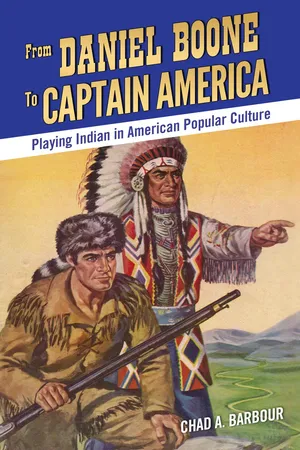
From nineteenth-century American art and literature to comic books of the twentieth century and afterwards, Chad A. Barbour examines in From Daniel Boone to Captain America the transmission of the ideals and myths of the frontier and playing Indian in American culture. In the nineteenth century, American art and literature developed images of the Indian and the frontiersman that exemplified ideals of heroism, bravery, and manhood, as well as embodying fears of betrayal, loss of civilization, and weakness.In the twentieth century, comic books, among other popular forms of media, would inherit these images. The Western genre of comic books participated fully in the common conventions, replicating and perpetuating the myths and ideals long associated with the frontier in the United States. A fascination with Native Americans also emerged in comic books devoted to depicting the Indian past of the US In such stories, the Indian remains a figure of the past, romanticized as a lost segment of US history, ignoring contemporary and actual Native peoples.Playing Indian occupies a definite subgenre of Western comics, especially during the postwar period when a host of comics featuring a "white Indian" as the hero were being published. Playing Indian migrates into superhero comics, a phenomenon that heightens and amplifies the notions of heroism, bravery, and manhood already attached to the white Indian trope. Instances of superheroes like Batman and Superman playing Indian correspond with depictions found in the strictly Western comics. The superhero as Indian returned in the twenty-first century via Captain America, attesting to the continuing power of this ideal and image.
eBook - ePub
From Daniel Boone to Captain America
Playing Indian in American Popular Culture
- 208 pages
- English
- ePUB (mobile friendly)
- Available on iOS & Android
eBook - ePub
About this book
Information
Subtopic
Popular CultureIndex
Social SciencesCHAPTER ONE
THE INDIAN MALE BODY AND THE HEROIC IDEAL
Tecumseh and the Indians of Parkman and Cooper
IN VARIOUS INSTANCES IN EARLY-NINETEENTH-CENTURY US CULTURE, the Indian male is cast as a heroic, yet tragic, figure: John Galt’s anecdote of Benjamin West and the Apollo Belvedere, the figure of Tecumseh (especially in Ferdinand Pettrich’s sculpture The Dying Tecumseh), Uncas in The Last of the Mohicans, and Francis Parkman’s depictions of Oglala warriors. The Indian male body functions in four ways: 1) as an ideal of admiration, especially by white viewers; 2) as dangerous, with the attendant menace of the body; 3) as a figure of dying, specifically in the trope of the vanishing Indian; and 4) as stasis, the artistic freezing of the body in print, sculpture, or art. The Indian male body represents an attractive physical ideal often hollowed of historical particularity yet also maintaining a degree of menace or violent potential. In other words, the Indian male body is a contradictory blend that inspires admiration and fear.1 By examining these examples from the nineteenth century, one will see many of the precedents for later incarnations in American culture of playing Indian, as well as some of the rationale behind the attraction to being like an “Indian,” especially in terms of masculine rhetoric and ideology. This chapter describes a rhetorical and ideological dynamic of depicting idealized Indian male bodies in American literature and art that gains purchase in the nineteenth century and will carry on into the twentieth century.
The anecdote of Benjamin West and the Apollo Belvedere provides an early significant example within an American context of the valorization of the male Indian body. In 1760 Benjamin West visited the Vatican in Rome on his grand tour of Europe. While there, his Italian hosts took him to see the Apollo Belvedere, the sculpture that resides in art history’s pantheon as one of the pinnacles of art and of human beauty. As the story goes, upon seeing the statue, West proclaims, “My God, how like it is to a young Mohawk warrior!” This anecdote would find circulation in antebellum US culture via the biography by John Galt (1816–1820). Galt’s anecdote, coming as it does in the early nineteenth century, depicts an Anglo white identity that identifies with the physical vigor of American “savages.” Galt recodifies West’s “Mohawk” as a model of Anglo white manhood, a “Mohawk Apollo” that obfuscates Indian racial features while maintaining the admirable physical strengths and masculine virtues of courage and strength. The West anecdote brings into focus the somewhat convoluted racialized negotiation of ideological qualities drawing on imagined Indians and white manhood. The conflation of the Apollo Belvedere with a Mohawk warrior performs a kind of pentimento of the Native “savage” in order to preserve from him those admirable, mythic qualities that can fortify an Anglo white manhood.
In considering the Indian male body as found in the neoclassical style of sculpture and art of the nineteenth century, an ideological negotiation emerges between admiration and objectification. The audience may admire the physical prowess and athleticism of the Indian male but must maintain an objective distance to maintain an appropriate racialized distinction. One way to understand this negotiation is through viewing the depiction of the Indian male body as simultaneously embodiment and disembodiment. This symbolics of male Indians performs two primary functions: 1) disembodied Indians are “safe” Indians in white male imaginations, and 2) disembodied Indians are a blank slate onto which white males can inscribe their symbolics of manhood.2 Yet, while this disembodiment takes place, there is still the need for those bodies, for the embodied part of the equation. This figurative process strips the Indian of any historical particularity while simultaneously preserving the figure of his body, a figure that takes on a metonymic function in which the Indian male is both disembodied (emptied of actual agency and presence) and embodied (his figure made a symbol or vessel of desired qualities). This metonymic physicality maintains an Indianized ideal of manhood for a white audience without that Indian ideal’s potential for encroachment upon white male authority through competition or conflict. Metonymic Indian male bodies provide an ideal object of male physicality that white males can identify with and admire. Indian male bodies are such objects of identification because of their perceived “untouched” masculinity; Indian male bodies represent a manly physicality that has not been tempered or softened by the luxury of “civilized” living. For this reason, male Indian bodies present admirable models of physicality, while also representing that “savagery” to which whites must not succumb.
Imagined Indians like Cooper’s Uncas or Pettrich’s version of Tecumseh provide ideal Indian bodies with which white males identify, yet the classical aesthetic form empties them of political and historical specificity. White males idealize an Indian (for his impressive physical strength and build) but identify with a de-Indianized male body (to avoid the potential of cross-racial sympathy). The power of this strategy lies in white males’ affective detachment from the Indian body in its objectness, which receives emphasis through its marginalized status in white imaginations structured upon the “vanishing Indian” trope. These figurative Indians, then, prop up white manhood through erasing racial difference by classicist reproduction of Indian bodies. Instead of seeing Indian bodies as already passed away, the visualizing and imagining of Indians as examined in this chapter seek to reveal the physical presence of those bodies, although emptied of sociopolitical force.
The problem of Native bodies becomes apparent in Nancy Shoemaker’s analysis of Indian and white metaphors of the body in treaty language. She argues that the body worked to help Indians and Europeans “circumnavigate a larger sphere of obscure and cultural differences” (212). What began as a way to communicate from a common ground became a troublesome contact zone. The image of one flesh and one blood shared by whites and Indians, which formerly allowed different cultures to communicate with each other, becomes a troubling thought for whites who would see themselves as racially separate from Indians. As Daniel Richter shows, the “parallel lives” of Indians and Europeans, held together by an “Empire of Goods,” would ultimately collide, especially in the 1760s with the “parallel campaigns of ethnic cleansing” led by Pontiac and the Paxton Boys (190–91). The common ground gives way to increasing perceptions of both whites and Indians of their racial opposition. As Richter articulates this point, the growing perception of “ethnic diversity” in the eighteenth century “wrought an increasingly pervasive view that ‘Indians’ and ‘Whites’ were utterly different, and utterly incompatible, kinds of people who could never peacefully share the continent” (180).
In terms of this chapter’s analysis, this oppositional diversity creates a contradiction in that white males seek to extirpate Indians yet find that their male bodies can provide a symbolics of white manhood. This conflict drives an iconology of Indians into that realm between the corporeal and the spectral, not fully ghosts and not fully flesh and blood.3 It is this flux of corporeality that allows whites to imagine Indians as either embodied or disembodied, according to whatever cultural or racial imperative needs to be fulfilled. For example, a white model of virile masculinity might evoke the image of a muscular Indian male body, such as Uncas with his classical features. On the other hand, a white model of expansion might evoke a decorporealized Indian that aligns more closely with the spectral Indian; another example from Cooper is Chingachgook as the lone surviving Mohican after his son’s death and his appearance as a “spectral-looking figure.” A rhetorically powerful device of embodiment/disembodiment exists in the Indian as statue. Literally and figuratively, a host of examples illustrate the presence of the Indian body as a physical entity while being removed from historical presence via a figuration as statue.
A striking figurative example of the Indian as statue appears in an obscure epic poem by George Hooker Colton, Tecumseh (1842). Colton relates Tecumseh’s initial appearance in this way: “He yet revealed a symmetry / Had charmed the Grecian sculptor’s eye, / A massive brow, a kindled face, / Limbs chiseled to a faultless grace” (37). On one level this statue imagery communicates the manly stoicism of Tecumseh, his physical perfection. These lines are meant to convey praise and admiration for the Indian leader. Colton’s choice of the epic poem speaks to the classicizing of Tecumseh as epic hero. Colton transforms the Indian leader into an American hero, suitable for epic treatment. On the other hand, this rhetoric of classical sculpture and epic poetry makes Tecumseh a static figure, a statue or artifact of some ancient past, not a sentient near contemporary. Folded into the archaic potential of this description is the distancing of the audience from the object of description. Through likening Tecumseh’s features to sculpture, Colton marginalizes or preempts any potential intimacy that might arise through the male gaze fixed upon a male subject. Colton’s description of Tecumseh as statue makes the person an artifact, and such objectification channels any potential subjective identification into a safer rhetorical alignment with the Indian disembodied of physical particularity and agency and embodied with symbolic or figurative meaning.
When Tecumseh is rendered as statue, he is a dead Indian frozen in the past, and his incorporeal status marginalizes him from flesh-and-blood existence, displacing him as a political entity and rendering him as a static body, a statue. Nowhere is this more vivid than in Ferdinand Pettrich’s The Dying Tecumseh (1856).4 Sculpted in white marble, Tecumseh lies supine, upper body exposed, muscular though submissive in his dying position (Fig. 1.1). He grasps his tomahawk in his death as he exhales his last breath. The most literal reading of this statue is as the Vanishing American. Julie Schimmel argues that “Pettrich’s marble, which creates for Tecumseh the role of a dying Roman general, passes judgment on all Indian ‘heroes’ who die in battle against whites. Their courage and skill, Pettrich maintains, were devoted to the wrong cause. Their deaths argued not for Indian rights but for the triumph of expansionism” (169–70). Within the popular Vanishing American tradition of this time, this interpretation is accurate. The Dying Tecumseh’s contemporary and stylistic peer, Thomas Crawford’s The Indian: Dying Chief Contemplating the Progress of Civilization (1856), extends this particular reading of the Vanishing American theme (Fig. 1.2). As Vivien Fryd describes, Dying Chief “is frozen in melancholic thoughts” (116). Like Dying Tecumseh, Dying Chief represents the impotence and lack of force of an Indian race in its inevitable decline. This interpretation gains resonance in this statue’s inclusion in Crawford’s Progress of Civilization (1855–1863), the Senate pediment in which the chief appears on the right beside a grave and a grieving Indian woman. As the eye travels from the chief to the left, one sees the “progress of civilization,” culminating in the figures of the white businessman and mechanic. Crawford’s statue complements Pettrich’s in the representation of the Vanishing American. Yet their compositions are striking differently: Dying Chief sits, bending forward with head propped in right hand,5 while Dying Tecumseh lies supine and visibly dying. This particular pose occurs in other instances of classical and neoclassical sculpture. Dying Tecumseh follows in this tradition and demonstrates a concern or fascination with such aesthetic representations of the dead or dying male.

Figure 1.1. Ferdinand Pettrich. The Dying Tecumseh. 1856. Marble with painted copper alloy tomahawk. 36 5/8 x 77 5/8 x 53 3/4 in. Smithsonian American Art Museum. Transfer from the US Capitol.

Figure 1.2. Thomas Crawford. The Indian: Dying Chief Contemplating the Progress of Civilization. 1856. Marble. Height 55 in. New York Historical Society, New York City.
A number of sculptures featuring the dying-male pose provide another possible reading of Dying Tecumseh that is more attuned to the white male’s stake in viewing this statue. From antiquity, such sculptures as the Dying Gladiator (Dying Gaul), the Son of Niobe (of the Niobe Group), and the Pasquino depict the dying male. Preceding and contemporary to Pettrich are Jean-Baptiste Giraud’s Achilles (1789), Antonia Canova’s Endymion (1819–1822), and Paul Akers’s Dead Pearl Diver (1857).6 Samuel F. B. Morse’s The Dying Hercules (1812) offers one instance of this pose in US painting.7 The frequency of the dying-male pose might owe to an early-nineteenth-century sentimental fascination and preoccupation with death and mortality.8 Yet, while this may be more the case in images of women and children, the image of a dying male in antebellum US culture raises a set of issues concerning white male authority and power. On this point Abigail Solomon-Godeau’s argument is useful: “It may well be the case that the manifest preoccupation with perfect male bodies that are at the same time threatened, symbolically castrated, or dead speaks both to (and of) a defensive aggrandizement of masculinity and the concomitant acknowledgement of its vulnerability—the threats that assail it both materially and psychically” (97). In the case of Dying Tecumseh, and its stylistic and cultural peers, the white male fear of vulnerability would find origin in the forces of market change, democratization, and domestic realignments especially prevalent in the early nineteenth century. Kasson argues that the power of such images of vulnerability “spoke to the concerns of both an older economic elite and a rising business class on the brink of a period of social and economic transformation” (18). The image of the dying male, then, not only conveys a fascination or confrontation with mortality but captures a potent symbol of masculine vulnerability. With an Indian male as the subject, such vulnerability might be displaced onto the other, insulating the white male audience from anxieties of disempowerment or weakness. The dying Indian functions as a projection of white male anxieties, as well as effecting the abstraction of a concrete threat into the realm of aesthetics and the imagination.
While such ideological functions of the dying Indian make this figure an attractive symbol for white males, the physical presence of that Indian male body raises a troubling relationship between it and the male spectator. The statue’s three-dimensional concreteness as a physical entity supplies a physical presence that is not as available in painting. The physical presence emphasized by the sculpture’s own presence implies the actuality of the Indian’s physical self, that ever-looming threat constantly depicted and imagined in American culture, a physical threat of violence or of disruption of a national mythology of “progress” and “manifest destiny.” Such implications of the sculpture’s physicality become muted, though, via the form and operation of the gaze upon the sculpture. The form of marble or stone freezes the Indian body, creates a stasis that hollows the Indian subject of agency. The operation of the gaze further removes agency of the subject, because the sculpture makes the Indian male’s body accessible and available to the white male viewer’s gaze. In this aspect the male is “nude” in the sense that John Berger describes it: “To be nude is to be seen naked by others and yet not recognized for oneself. A naked body has to be seen as an object in order to become a nude. . . . Nudity is placed on display” (54). The Indian male body is nude in this sense: it is on display as an object, not as a subject. In this way the Indian male is available to white males’ gaze and possession. Thus, The Dying Tecumseh erases the physical threat and particularity of an Indian male body (his potential aggression and/or attractiveness) while making that same body available as a symbolic object of white manhood and its own sense of entitlement. This simultaneous erasure and objectness of the Indian male body demonstrates the dynamic of embodiment and disembodiment discussed above.
This artistic dis/embodiment found in sculptures by Pettrich and others detaches and obfuscates white male attraction to an Indian male body. Russ Castronovo’s model of “necro citizenship” is especially relevant in this regard. Castronovo argues that “necro citizenship” is “a logic of incorporation and discorporation hostile to some historical bodies, but also erotically bound to the rigidity and corporeality of others” (17). As incorporeal historical bodies, Native persons possess no political weight and thus become available as symbolic figures. But as symbolic models for white manhood, these Indian male bodies become bound, erotically or sympathetically, to white males in a connection that alleviates the troubling exigencies of an Indian’s, like Tecumseh’s, corporeal existence while maintaining enough of his reality to form a stable and comprehensible symbol for white manhood. Similarly, one could look to Judith Butler’s “derealization of the ‘Other,’” in which “it is neither alive nor dead, but interminably spectral” (qtd. in Byrd xviii). In her examination of the function of indigeneity in American colonialism, Jodi Byrd modifies Butler’s “derealization” (originally conceived in regard to post-9/11 conditions) to argue that “this process of derealization . . . has been functioning in Atlantic and Pacific ‘New Worlds’ since 1492” (xviii). This dis/embodiment paradigm is not isolated to any one period of US history. The representations of Indianness existent in the nineteenth century persist in their power and their reach into the wide array of fictions of Indians and the frontier that populate American culture into the twentieth century and beyond. These examples from sculpture vividly illustrate the dynamic of Indian symbolism that erases and preserves, disembodies and embodies. This symbolic dynamic finds potent life in literature, too, especially in the work of James Fenimore Cooper and Francis Parkman.
The examples of Indians depicted as sculpture in the neoclassical style in the early nineteenth century demonstrate the power of such depiction to simultaneously embody and disembody the subject. This same dynamic is also present in the literature of the period. Two prominent works, among many, that focus on the Indian during this time are Cooper’s The Last of the Mohicans (1826) and Parkman’s The Oregon Trail (1849). In one vivid example, Cooper implements the rhetoric of classical sculpture to describe Uncas. When the travelers have settled in the Glenn’s Falls hideout, they are able, for the first time, “to view the marked lineaments of either of their Indian attendants” (61). Uncas receives an extended portrait in this section that accentuates his aesthetic appeal with “the bold outline of his high, haughty features, pure in their native red; or the dignified elevation of hi...
Table of contents
- Cover
- Half title
- Title
- Copyright
- Dedication
- Contents
- Acknowledgments
- Introduction
- Chapter 1 The Indian Male Body and the Heroic Ideal Tecumseh and the Indians of Parkman and Cooper
- Chapter 2 The White Frontiersman, Manhood, Domesticity, and Loyalty
- Chapter 3 From the Nineteenth to the Twentieth Century The Frontier Mythos in Comics Adaptations
- Chapter 4 “White Blood Turns Red” Playing Indian in US Comics
- Chapter 5 When Superheroes Play Indian Heroic Masculinity, National Identity, and Appropriation
- Conclusion
- Notes
- Works Cited
- Index
Trusted by 375,005 students
Access to over 1.5 million titles for a fair monthly price.
Study more efficiently using our study tools.
Frequently asked questions
Yes, you can cancel anytime from the Subscription tab in your account settings on the Perlego website. Your subscription will stay active until the end of your current billing period. Learn how to cancel your subscription
No, books cannot be downloaded as external files, such as PDFs, for use outside of Perlego. However, you can download books within the Perlego app for offline reading on mobile or tablet. Learn how to download books offline
Perlego offers two plans: Essential and Complete
- Essential is ideal for learners and professionals who enjoy exploring a wide range of subjects. Access the Essential Library with 800,000+ trusted titles and best-sellers across business, personal growth, and the humanities. Includes unlimited reading time and Standard Read Aloud voice.
- Complete: Perfect for advanced learners and researchers needing full, unrestricted access. Unlock 1.5M+ books across hundreds of subjects, including academic and specialized titles. The Complete Plan also includes advanced features like Premium Read Aloud and Research Assistant.
We are an online textbook subscription service, where you can get access to an entire online library for less than the price of a single book per month. With over 1.5 million books across 990+ topics, we’ve got you covered! Learn about our mission
Look out for the read-aloud symbol on your next book to see if you can listen to it. The read-aloud tool reads text aloud for you, highlighting the text as it is being read. You can pause it, speed it up and slow it down. Learn more about Read Aloud
Yes! You can use the Perlego app on both iOS and Android devices to read anytime, anywhere — even offline. Perfect for commutes or when you’re on the go.
Please note we cannot support devices running on iOS 13 and Android 7 or earlier. Learn more about using the app
Please note we cannot support devices running on iOS 13 and Android 7 or earlier. Learn more about using the app
Yes, you can access From Daniel Boone to Captain America by Chad A. Barbour in PDF and/or ePUB format, as well as other popular books in Social Sciences & Popular Culture. We have over 1.5 million books available in our catalogue for you to explore.