On Saturday, September 5, 1964, the family of Albert W. "Red" Heffner Jr., a successful insurance agent, left their house at 202 Shannon Drive in McComb, Mississippi, where they had lived for ten years. They never returned. In the eyes of neighbors, their unforgiveable sin was to have spoken on several occasions with civil rights workers and to have invited two into their home. Consequently, the Heffners were subjected to a campaign of harassment, ostracism, and economic retaliation shocking to a white family who believed that they were respected community members.
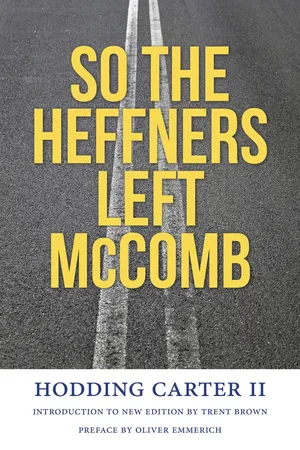
So the Heffners Left McComb, originally published in 1965 and reprinted now for the first time, is Greenville journalist Hodding Carter's account of the events that led to the Heffners' downfall. Historian Trent Brown, a McComb native, supplies a substantial introduction evaluating the book's significance. The Heffners' story demonstrates the forces of fear, conformity, communal pressure, and threats of retaliation that silenced so many white Mississippians during the 1950s and 1960s. Carter's book provides a valuable portrait of a family who was not choosing to make a stand, but merely extending humane hospitality. Yet the Heffners were systematically punished and driven into exile for what was perceived as treason against white apartheid.
- 176 pages
- English
- ePUB (mobile friendly)
- Available on iOS & Android
eBook - ePub
So the Heffners Left McComb
About this book
Information
Subtopic
African American HistoryCHAPTER I
Six dozen frozen hot tamales can scarcely be thought of as a collective instrument of personal disaster. For Albert W. Heffner, Jr., whose friends in McComb, Mississippi, and elsewhere call Red, and his wife, Mary Alva, better known as Malva, they were. On the night of July 17, 1964, they served the hot tamales to the wrong people, to wit, two young white civil rights workers, one an ordained minister.
Red and Malva purchased the tamales at Doe’s in Greenville, Mississippi, at the end of a glorious 4th of July weekend complete with a Delta wedding and three days of fun. On the way home they bought them there because Doe’s regionally famous tamales lean strongly to garlic and Red and Malva like garlic.
This story is principally that of forty-two-year-old Red and Malva who is forty but doesn’t look it. They had lived in McComb for ten years before the sharing of these tamales made them refugees from McComb and the state of Mississippi. It concerns, too, their seventeen-year-old daughter Carla and Malva’s nineteen-year-old daughter, Jan Nave, who was Miss Mississippi for 1963–64 and whose GI father was killed in the Battle of the Bulge a month before Jan was born.
The tale also has to do with the overwhelming majority of the 8000 white residents of McComb, all bound together in a unity spawned of fear. McComb is a community of 13,000 souls in Southwest Mississippi’s Pike County.
There are others who can be seen against a near and far background of bombed-out and burned Negro churches and houses, the partially wrecked dwelling with the hopeful name of Freedom House, the beleaguered home in which the Heffners lived; some clergymen, mostly Episcopalian; some public officials; a newspaper editor and some newspapermen; an office-building owner; an apartment-house manager; and some young adult and student members of a group that called itself COFO, the Council of Federated Organizations, consisting mostly of college undergraduates who made an idealistic if foolhardy attempt to educate Mississippi Negroes for citizenship and to help them register in the summer of 1964, the long, hot summer. Nor can some once-friendly neighbors be overlooked. A shadowy contrapuntal chorus might be recruited from McComb’s 5000 Negroes whose presence has not often been taken into serious account by the whites.
Until that summer, Red Heffner was just another youngish businessman who made a decent living, drove a 1963 Impala and a 1962 Chevy II, which were not bought for cash, and had the usual house and other notes to meet. If he was slow to pay, he was no slower than most of his contemporaries and he always paid. Because he wanted his town to prosper and grow, he took part in a variety of civic activities.
On their first day in McComb the Heffners had moved into their then uncompleted flat-top, three-bedroom home as first settlers in the rolling Carroll Oaks subdivision. They lived in the $16,000 dwelling until Labor Day weekend, 1964. By that time there were few lots remaining to be sold in Carroll Oaks. It had become the second most desirable residential area in McComb. Its homeowners were mostly junior industrial executives and younger business and professional men, some of whose homes cost as much as $40,000.
In the intervening years the Heffners had converted the carport at the front of the house into an informal den, glass-walled on two sides and with an open counter, for easy service, on the kitchen side. To keep the television set from dominating a gathering of friends, it was mounted on a shelf behind paneled doors which could be opened when there was a program those in the room wanted to see. Wall-to-wall carpeting covered the more formal living- and dining-rooms and the next project would have been a second bathroom. A tree near the front entrance, around which the house had been built, had long since died but Malva had planted a wisteria vine whose green leaves in summer and lavender blooms in the spring were supported by the dead trunk. The garden, like most of those in McComb, had its share of camellias, and Red himself had planted the camellia sasanqua hedge across the back of the property.
Red, in the last two years, had made an increasingly good living as an independent insurance agent after eight years with Blue Cross. His special field was pensions. He was proud of the three beautiful women of his household and of the recognition which he and the girls had won in the past year. Red and Malva delighted in showing visiting friends the billboards on the outskirts of their little city which proclaimed that it was the home of Jan Nave, Miss Mississippi. They liked to reminisce about their trip to Atlantic City the previous September for the Miss America contest and a holiday in Miami that spring, given as an award to Red by the Lincoln National Life Insurance Company of Fort Wayne, Indiana, for selling in excess of $2,000,000 worth of life insurance in 1963. Carla, a high school junior, who had been selected best high school actress at the Mississippi State University Drama Festival in November, had been rewarded in May with a summer scholarship to the Herbert Berghof Drama Studio in New York City. She and Jan had each been chosen in their early teens as “Future Miss Pike County.” Jan’s Miss Mississippi title had cost Red some $5000 in such added expenses as clothing for the womenfolk and the family’s trip to Atlantic City for the Miss America Pageant. But no one minded in July 1964. The Heffners were happier and riding higher than ever before in their lives.
Two months later, none of the Heffners was a resident of McComb and only Jan, as a student at Mississippi State College for Women, remained in Mississippi.
Red Heffner had no other idea than to spend the rest of his life in McComb and the way his premium volume was rising every month he couldn’t see any obstacle. He believed that he was liked, not only by the crowd at the Country Club and the Little Theatre group but by the community at large. Six years earlier the Chamber of Commerce had given him a coveted Community Service Award for his part in McComb’s effort to gain new industries. He had been president of the Pike County Little Theatre Association and state president of the Mississippi Multiple Sclerosis Association. He had helped set up the Pike County chapter of the organization working for exceptional children.
Malva had found her place, too. She had been a member of the Junior Auxiliary, a South-wide social and charitable organization modeled upon the Junior League of the larger cities, and when her five years of active service were up had become an associate. For five years she had served as president of McComb Youth Center, Incorporated, and had led the drive to raise $30,000 to build the center. In the years of fund raising she had supervised magazine sales and automobile raffles, served innumerable cookies and cokes to the young people who met in her home to organize student fund-raising projects during the building campaign, hired the director after the brick veneered concrete block building was completed, and even waxed its floors herself. Her hula at Dixie Springs Lake north of town provided the most attractive sequence in the civic movie with which McComb sought to lure new industries. She and Sid Hodges had also danced a memorable calypso at the Lions Club Annual Minstrel, and Red, who somehow has managed to keep his sense of humor, says that if they had to be run out of town, it should have been because of that performance. Like the rest of the family, Malva had acted in the Little Theatre plays and had been costume director ever since she and Red moved to McComb. She was in demand throughout the state as a beauty-pageant director and everybody gave her much of the credit when Jan was selected Miss Mississippi.
Malva and Red liked to relax with their friends, of whom they believed they had many, in the Country Club swimming pool, dining-room, and bar on Saturdays. And they usually kept their own counsel when members disclosed authoritatively that the Supreme Court and every President since Herbert Hoover were or had been Communist tools and that civil rights decisions and legislation were part of a Communist masterplot to mongrelize the race.
The more strait-laced folk of the largely Baptist town may have thought that the Heffners, along with the rest of the interwoven Country Club and Little Theatre sets, drank too much. But they were not singled out for any particular community disapproval.
They were and are extraordinarily devoted to the two girls. They cannot talk for five minutes without introducing them into the conversation.
Except for being lovely and gifted and popular, Jan and Carla are dissimilar. Jan, slim of body and of average height, is an olive-skinned brunette and much more studious than Carla. She finished McComb High School in three years. She was proficient as a swimmer and specialty dancer and paid for her own dancing lessons by assisting her teacher. She turned more to art at Mississippi State College for Women, where she stretched her Miss Mississippi and GI scholarship money by serving as a student assistant to the Dean of Women. She sews beautifully and makes many of her own clothes.
It should be remembered that in July 1964 Jan had been living in a dream world for almost a year. No other girl in Mississippi enjoys the wardrobe of a Miss Mississippi or the use of a handsome automobile presented for her year as beauty queen. She had participated in Governor Paul Johnson, Jr.’s inaugural parade in Jackson and, as part of the courtesies to the governor’s lady, she had presented her with a bouquet of red roses. In the spring she had represented the state of Mississippi at the inauguration of Governor John McKeithen of Louisiana, dressed in a long emerald silk satin gown with a train-type panel down the back.
In her year as Miss Mississippi Jan had gone to Atlantic City as a Miss America contestant and there danced between life-size charcoal portraits of herself which she had sketched. She had been feted in Mississippi some fifty times. It is no wonder that the harsh realities created by her parents’ involvement were distasteful to her, especially since she does not have the temperament of a crusader. She was not happy over what was happening and she wanted no part of it. Neither did Harry “Brother” Wilson, member of an estimable arch-conservative planter family in the Yazoo-Mississippi Delta, the boy she would pick from a good many suitors for a husband. In his social concepts Brother was poles apart from her parents; except that Jan, like the rest of the family, had always considered segregation morally wrong, she and Brother are also poles apart from Carla in their thinking.
Carla, who is almost a blonde, with light, wavy hair and gray-blue eyes, was no scholar at McComb High. Her grades in the studies she liked were good, but she preferred to read controversial books, to write for the McComb Enterprise-Journal and the McComb High School paper, The Tiger Rag, and to scribble poetry that is astoundingly mature. She also liked the stage and acted in the Little Theatre and school plays from the time she was twelve.
What sets Carla further apart from her sister is her preoccupation with civil rights. The young girl had been speaking her mind about human freedom long before she went to school in New York. A letter she wrote from there to her parents was as thought-revealing as any letter ever written home by a teenager.
The Heffners had other interests besides their family life and civic work and enjoying themselves. Among their closer friends were the Reverend Colton Smith, vicar of the Episcopal mission Church of the Mediator, and his wife, Angela. The Reverend Mr. Smith is a twenty-eight-year-old native of Vicksburg, Mississippi, who, after his graduation from the University of the South at Sewanee, Tennessee, took his degree in theology from the General Theological Seminary in New York City. Angela Smith is the British-born daughter of a former member of the staff of the British delegation to the United Nations, and the Smiths met in New York City. The young minister’s abiding hope was to raise the mission, which could count some 150 communicants, to the status of a parish. His concern in the summer of 1964 was to keep down racial conflict by building understanding. It was simply because Colton and Angela were interesting young people that Red and Malva were attracted to them.
The Heffners took their church at least as seriously as do most Episcopalians. Red, who had been a Methodist, and Malva, who had been a Baptist, had been confirmed in 1956 in McComb. Red had served on the Mission Committee, the equivalent of a parish vestry, and had become a lay reader early in 1963. When Jan, then a freshman at M.S.C.W., was selected in May of that year to represent the college in the Miss Mississippi Pageant, Red and Malva returned home early from the festivities so he could be on hand to read morning prayer at McComb and at the tiny county seat of Magnolia, seven miles to the south.
In all fairness it must be admitted that on several occasions the Heffners had not behaved in the accepted McComb tradition.
It was in 1956 that Red declined to join the formidable state-wide Citizens Council, organized in Indianola, Mississippi, a year earlier with the purpose of holding the racial line through economic, political, and social sanctions. In 1960 Red and Malva not only voted for John F. Kennedy but admitted their heresy. And in 1962 at the Ole Miss-Kentucky football game played in Memorial Stadium in Jackson, the night before the bloody Ole Miss riots, they remained in their seats in stunned horror as nearly all other Mississippians in the stadium rose to their feet and cheered in near hysteria as Governor Ross Barnett made an incendiary half-time speech. It was then that Malva wrote to the Jackson Clarion-Ledger a letter which that newspaper did not publish. This is the first time it has appeared in print:
202 Shannon Drive
McComb, Mississippi
McComb, Mississippi
October 3, 1962
Mr. T. M. Hederman, Editor
The Clarion-Ledger
Jackson, Mississippi
Dear Mr. Hederman:
Your paper and our governor, Ross Barnett, have done the worst possible disservice to our state of Mississippi by not guiding the people and helping them get ready for this change that is taking place in America and the South. Search your souls and ask your God if you have done the right thing by not trying to awaken your fellow Mississippians to the facts of change. We cannot separate ourselves from the past. The past cannot be carried into the future.
I quote a well-loved southern author, Lillian Smith:
“Segregation is a symbol of all we lack; a symbol of hollow men, of emptiness, a symbol of brokenness. We cannot limit this word to race relations. Our entire lives are fragmented; we are split off from the source of wholeness; we are not deeply related even to ourselves.”
Some weeks ago, in our capitol city, there was an international football game. Mexican youths playing our white youths. In parts of this country, these Mexicans would not have been allowed to play with our pure white, yet in Jackson the game was widely publicized and received tremendous popular support. Take our Negroes to the same part of the country that would not accept the Mexicans and they would have been accepted in the same manner that Mississippi accepted the Mexicans. Why is this?
Don’t call me names. My grandfather served with the Confederate Army during the War Between the States. My first husband died in combat in the Battle of the Bulge. He and I both attended ‘Ole Miss.’ I feel that the American flag should fly high.
I cannot understand why so many people in my home state feel as they do. Their leadership, the politicians, clergy, and newsmen have, for a hundred years, lived in the past. They have not tried to guide people in the problems of the present. They have taken the easy way by catering to our natural pride in the achievements of our forefathers. Our forefathers were faced with problems of a hundred years ago. Our problems are with us now. If we are to survive as a great state and a great people, we must be educated to handle current problems.
We in Mississippi, along with others throughout the country, can find ourselves through love and understanding. We are created in His image—the red and yellow, the black and white.
Sincerely yours,
Malva Cooper Heffner
In November 1963 Carla burst into tears and walked out of a school student-body pep rally when Principal Percy Reeves’ announcement that the President of the United States had been assassinated was greeted with the kind of mass cheering usually reserved only for a winning football team. Three days later the Heffners asked that Carla be excused from school ten minutes before the noon recess to attend a memorial service for the late President at the Church of the Mediator. Although Principal Reeves had soundly reprimanded his students for their joyous approval of murder, in which they were obviously echoing their parents’ sentiments, Carla was told that she must remain until the noon bell rang. Red and Malva were astounded the request was denied and Red went over the head of the principal and demanded of the superintendent of schools, Robert Simpson, that his daughter be let out. She was. Nobody else in high school was.
But on the night of July 17, most people in McComb were not much concerned with the Heffners’ respect for John F. Kennedy. They had more important matters on their minds. Namely the COFO invasion and how to meet it.
The Council of Federated Organizations, COFO, was the title under which several of the principal national organizations dedicated to obtaining civil rights for Negroes joined t...
Table of contents
- Cover
- Half title
- Title
- Copyright
- Introduction
- Preface: The Way It Was
- Chapter I
- Chapter II
- Chapter III
- Chapter IV
- Chapter V
- Chapter VI
- Chapter VII
- Chapter VIII
- Chapter IX
- Chapter X
Trusted by 375,005 students
Access to over 1.5 million titles for a fair monthly price.
Study more efficiently using our study tools.
Frequently asked questions
Yes, you can cancel anytime from the Subscription tab in your account settings on the Perlego website. Your subscription will stay active until the end of your current billing period. Learn how to cancel your subscription
No, books cannot be downloaded as external files, such as PDFs, for use outside of Perlego. However, you can download books within the Perlego app for offline reading on mobile or tablet. Learn how to download books offline
Perlego offers two plans: Essential and Complete
- Essential is ideal for learners and professionals who enjoy exploring a wide range of subjects. Access the Essential Library with 800,000+ trusted titles and best-sellers across business, personal growth, and the humanities. Includes unlimited reading time and Standard Read Aloud voice.
- Complete: Perfect for advanced learners and researchers needing full, unrestricted access. Unlock 1.5M+ books across hundreds of subjects, including academic and specialized titles. The Complete Plan also includes advanced features like Premium Read Aloud and Research Assistant.
We are an online textbook subscription service, where you can get access to an entire online library for less than the price of a single book per month. With over 1.5 million books across 990+ topics, we’ve got you covered! Learn about our mission
Look out for the read-aloud symbol on your next book to see if you can listen to it. The read-aloud tool reads text aloud for you, highlighting the text as it is being read. You can pause it, speed it up and slow it down. Learn more about Read Aloud
Yes! You can use the Perlego app on both iOS and Android devices to read anytime, anywhere — even offline. Perfect for commutes or when you’re on the go.
Please note we cannot support devices running on iOS 13 and Android 7 or earlier. Learn more about using the app
Please note we cannot support devices running on iOS 13 and Android 7 or earlier. Learn more about using the app
Yes, you can access So the Heffners Left McComb by Hodding Carter II in PDF and/or ePUB format. We have over 1.5 million books available in our catalogue for you to explore.