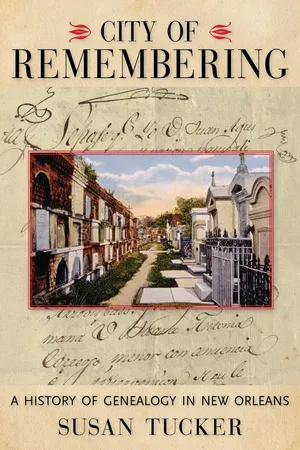
City of Remembering represents a rich testament to the persistence of a passionate form of public history. In exploring one particular community of family historians in New Orleans, Susan Tucker reveals how genealogists elevate a sort of subterranean foundation of the city—sepia photographs of the Vieux Carré, sturdy pages of birth registrations from St. Louis Cathedral, small scraps of the earliest French Superior Council records, elegant and weighty leaves of papers used by notaries, and ledgers from the judicial deliberations of the Illustrious Spanish Cabildo. They also explore coded letters left by mistake, accounts carried over oceans, and gentle prods of dying children to be counted and thus to be remembered. Most of all, the family historians speak of continual beginnings, both in the genesis of their own research processes, but also of American dreams that value the worth of every individual life. The author, an archivist who has worked for over thirty years asking questions about how records figure in the lives of individuals and cultures, also presents a national picture of genealogy's origins, uses, changing forms, and purposes. Tucker examines both the past and the present and draws from oral history interviews, ethnographic fieldwork, and archival research. Illustrations come from individuals, archives, and libraries in New Orleans; Richmond; Washington, DC; and Salt Lake City, as well as Massachusetts and Wisconsin, demonstrating the contrasts between regions and how those practitioners approach their work in each setting. Ultimately, Tucker shows that genealogy is more than simply tracing lineage—the pursuit becomes a fascinating window into people, neighborhoods, and the daily life of those individuals who came before us.
Trusted by 375,005 students
Access to over 1.5 million titles for a fair monthly price.
This is a book about practices and histories of genealogy and its more informal version, family history. It is not a traditional history but rather a personal and professional journey. Genealogy is defined most simply as the study of lineages, or more accurately in regard to today’s endeavors, as “the study of an entire family unit, including collateral as well as direct line descendants.”1 I think of family history as encompassing more than biological descent, as involving the neighborhoods in which people lived, or some sense of a few key elements that made up daily lives. Overall, family history becomes a gift of remarkable generosity, not just to one’s immediate kin but also to a wider world, to cousins across time and space.
I learned to think like this from genealogists I’ve interviewed and worked among during the past ten years.2 What they reminded me about often was that very little is left to us from past lives, from our kin or anyone really. So, this is also a book about what does remain behind: records, stories, and artifacts. Of course, there are other “remainders.” We have the great histories of nations, cities, and organizations. But usually they are not what we use as touchstones of our living. Asked to choose what items they would take when leaving a home in an emergency, most people tell of items from family life: photographs, needlework, a child’s artwork, a letter, a book with an inscription. These material objects remind us that life is a continuing process, that something can be passed on that is unique and is at once private and universal in love. The practice of family history does that in daily doses.
I begin in New Orleans since it is the place where I have learned about such means and matters, humble and grandiose. I often think about what it means to live among records, to live too in a particular climate, since I am an archivist. The city’s hot, humid weather is notoriously unkind to paper. Yet the foundation of much of the majesty and the less visible but unassuming, ordinary local life is formed from sepia photographs of the city’s immigrant families, the sturdy pages of birth registrations from Saint Louis Cathedral, the small scraps of the earliest French Superior Council records, the elegant and weighty leaves of papers used by notaries, and ledgers from the judicial deliberations of the Illustrious Spanish Cabildo. This book is about these local distinctions as seen within the context of a larger national history of genealogy.
Begin with the self. That is one of the first dictates of genealogy.3 I have never traced my own family’s history, but it figures in my interest in the paths that others have taken to know their ancestors. I started to think of my own life as going by (unrecorded, more or less) when I inherited two nineteenth-century portraits that now hang in my New Orleans home. Their story begins when John Houston Mifflin, a Philadelphia portrait painter, journeyed to the South in the 1830s.4 One of the places where he stopped was at the Marengo County, Alabama, home of my fifth greatgrandmother and grandfather. Mifflin painted their likenesses in oil on large canvases, twenty-four by thirty inches. They were named Emily Hare Croom Norris (1817–1866?) and Calvin Norris (1806–1853).5
FIGURE 1.1
Emily Croom Norris, John Houston Mifflin, ca. 1835. Oil on canvas. Photograph by Yuka Petz.
FIGURE 1.2
Calvin Norris, John Houston Mifflin, ca. 1835. Oil on canvas. Photograph by Yuka Petz.
I know something about the portraits since I have always been the guardian of documentation on our family. My mother passed me a folder on Mifflin, at some point, with her notes that he had been a student of Thomas Sully (1783–1872). As genealogists say, “Every family has someone appointed as recordkeeper.”
My possession of the portraits suggests another story too that is common to many families. I was the one to get the portraits after our mother’s death because of another legacy, this time of circumstance and behavior. I had the smallest house; I could not accommodate the larger legacies of furniture that my sisters could.
Genealogists often talk about gifts of generosity within families and within the reading rooms of libraries where they work. Like the acts of sharing they told me about, my sisters’ gift of thoughtfulness itself derives from a sort of birthright: our mother’s mother and her extensive family had been Quakers, a group that countless histories have described as quiet and meditative people. This family also carried, and still carries, a gene for a disease that restricts breath. Even those not affected by the disease are socialized by people whose voices can often be faint. As one of my cousins once said to me, the adjective “soft-spoken” is written in many descriptions of family members.
This family, my mother’s maternal grandmother and grandfather, came to the United States in the 1870s. My great-grandfather and his brother were known in their Scottish village as enterprising people, and so they were hired by an English lord who gave them money to buy up timberland and start a lumber business in the American South. In the classrooms of my childhood, such people were called carpetbaggers, who, after the Yankees had done their damage, further destroyed the plantation way of life. This education was another kind of inheritance.
FIGURE 1.3 Helen and Billy Hunter, with their mother, May Prince Hunter, ca. 1910. Studio print. Collection of the author.
Helen was one family member who had a more pronounced form of myotonic dystrophy. That said, she did not display symptoms until her late teens, and here one sees something of the normalcy, and hence likely the thought of the future involved with having a studio print made of her, her mother, and brother.
One of these great-grandparents brought the genetic disease to this side of the Atlantic. People with this disease are often lethargic, although in our family we say “complacent,” and people with this disease sleep more than others do. These symptoms fated us for parenting and family life that, for at least two generations and likely more, had been understated; had been marked by gratitude for good health; and, as far as I could ever tell from my grandmother and her sisters, had been accepting of ill health, the placement of it under the category of “everyone is different.” This meant that we, the lucky ones who thrived, were also given a lot of freedom and—I have come to believe—the chance to be reflective enough to be considerate. All this boiled down to my current custody of the portraits.
My step-grandmother called the genetic illness “the horrible disease.” Although we always knew that it was a form of muscular dystrophy, only when I was in my forties did I learn its name: myotonic dystrophy.
As genealogists often told me, one’s mother’s family often holds the most crucial place in one’s knowledge of the past. This was true for my sisters and me, and also for our mother: we thought of ourselves as primarily descended from her maternal side of the family rather than from the side of my father or even from my maternal grandfather, whose great-grandmother and grandfather were Emily and Calvin Norris of the portraits.
My mother’s mother, our granny, had divorced our grandfather in the mid-1920s. They had had their first child in 1916, and they knew from the very beginning that she was a sickly child. Today we would know that she had the juvenile onset of myotonic dystrophy, but then there was not enough medical information to tell them so. They chose to think or were told to think that she had some other, unnamed condition. Even when others in the family were diagnosed with muscular dystrophy, they thought of this disease as passed on the male line only and did not know about the other manifestations, such as heart problems that this child had, as associated with a genetically linked problem. Not knowing then what we know now, my grandparents decided to stay together long enough to have another child, a healthy one. Both my mother and my grandfather’s second wife—again, our step-grandmother—would even boast about this gamble they took. Their passion for life, their confidence, their entrepreneurial daring seemed to be epitomized by this decision to have a second child, who would, as they never doubted, be healthy, even though, or perhaps especially since, they also planned to divorce once this child was born.
FIGURE 1.4 Helen Hunter (right) and friend, ca. 1930. Family snapshot. Collection of the author.
Helen needed a wheelchair by the time she reached her late twenties. In their albums, families often leave out images that show evidence of disabilities.
We know today that myotonic dystrophy is transmitted with a predictable and pitiless statistical frequency to both male and female descendants: if you have the disease, you have a fifty-fifty chance of passing it to any child you might have. You can also possess varying degrees of the disease. Some people might have only mild symptoms: the sleepiness and softness of voice I have described, or early cataracts, or, in men, early balding. Still, a mildly affected parent may have a severely affected child.6
My grandmother and my grandfather did not know these chances. They dared to have another child. In 1920, they had my mother.
She did not have the disease. My grandmother and her friends did not say the word “healthy.” They said, about our mother, that she was fun and lively; an early talker; a popular child who smiled easily, was good at art and math, and was easy to take on a trip around town. Much later, in 1998, a genetic test would show she did not have even a mild form of the disease. They knew they were lucky but not as lucky as we know that they were.
In addition to this healthy child who became my mother, my grandparents had a friendly divorce. My sisters and I moved easily between them. The grandmothers (my real grandmother and my step-grandmother) talked to each other almost every day. This civility was another legacy passed on to us.
I was named Susan for the child who had the disease—Sue Norris, who would live into her twenties but who was never healthy, never normal. There is evidence that she lived a fairly good life. She went to school, she made trips, she read books and kept scrapbooks. My mother became an artist, she said, because her sister would not or could not play with other children, could not run and jump, and would not or could not easily communicate; painting pictures on their front porch, my mother could console her sister.
Sue Norris signed her name in books, wrote about the movies she saw as she pasted magazine clippings in scrapbooks, and collected dolls. These ephemeral items attest to the story she could weave on daily life, reasons to get up in the morning, and delight in living itself. Genealogists made me see all these little items differently, made me place them as products of both family and worldly habits as well as family and worldly diseases.
My grandmother clearly always valued the belongings from her daughter’s life. We know that because our own house burned to the ground in 1955, and anything that survived is rimmed with black edges and the smell of smoke. So when my grandmother died in 1959, my mother could not part with the things her mother had saved, and she took them to our new house. One box that I am sure had not been opened in decades contained a list Sue Norris made of ten collected dolls. I found this list in 2009 and read over its description of chosen names, outfits worn and outfits that could be created, and visions about the world (here a Scandinavian doll, here an American Indian), but also information on who gave her each doll, and, in microcosm, a picture again of family and neighborhood.
That sort of dating of memories too is something many genealogists told about. In describing the artifacts of their families, they took on the responsibility of knowing who saved what and when.
When I look up at Emily and Calvin, I sweep through these memories told to me. They hold other accounts of individual acts that made my mother who she was, and thus made me, my sisters, and our children. The portraits say to me, we are part of your gran...
Table of contents
Cover
Half title
Title
Copyright
Dedication
Contents
Acknowledgments
Chapter One Introduction
Chapter Two Foundations of One City in a Nation of Genealogy
Chapter Three The Journey to a Populist Culture of Searching
Chapter Four Public Genealogies around Creole and Other Ethnic Identities
Chapter Five Treasures: Memory Objects, Private Records, Science, and Art
Chapter Six The “Most Wonderful Collections”: New Orleans Recordkeeping
Chapter Seven One Account: Many Branches in Family Trees
Chapter Eight Complexities of Gender in Family History
Chapter Nine A Continuum of Family History
Notes
Sources
Index
Frequently asked questions
Yes, you can cancel anytime from the Subscription tab in your account settings on the Perlego website. Your subscription will stay active until the end of your current billing period. Learn how to cancel your subscription
No, books cannot be downloaded as external files, such as PDFs, for use outside of Perlego. However, you can download books within the Perlego app for offline reading on mobile or tablet. Learn how to download books offline
Perlego offers two plans: Essential and Complete
Essential is ideal for learners and professionals who enjoy exploring a wide range of subjects. Access the Essential Library with 800,000+ trusted titles and best-sellers across business, personal growth, and the humanities. Includes unlimited reading time and Standard Read Aloud voice.
Complete: Perfect for advanced learners and researchers needing full, unrestricted access. Unlock 1.5M+ books across hundreds of subjects, including academic and specialized titles. The Complete Plan also includes advanced features like Premium Read Aloud and Research Assistant.
Both plans are available with monthly, semester, or annual billing cycles.
We are an online textbook subscription service, where you can get access to an entire online library for less than the price of a single book per month. With over 1.5 million books across 990+ topics, we’ve got you covered! Learn about our mission
Look out for the read-aloud symbol on your next book to see if you can listen to it. The read-aloud tool reads text aloud for you, highlighting the text as it is being read. You can pause it, speed it up and slow it down. Learn more about Read Aloud
Yes! You can use the Perlego app on both iOS and Android devices to read anytime, anywhere — even offline. Perfect for commutes or when you’re on the go. Please note we cannot support devices running on iOS 13 and Android 7 or earlier. Learn more about using the app
Yes, you can access City of Remembering by Susan Tucker in PDF and/or ePUB format, as well as other popular books in History & North American History. We have over 1.5 million books available in our catalogue for you to explore.